The History of the Frisbee
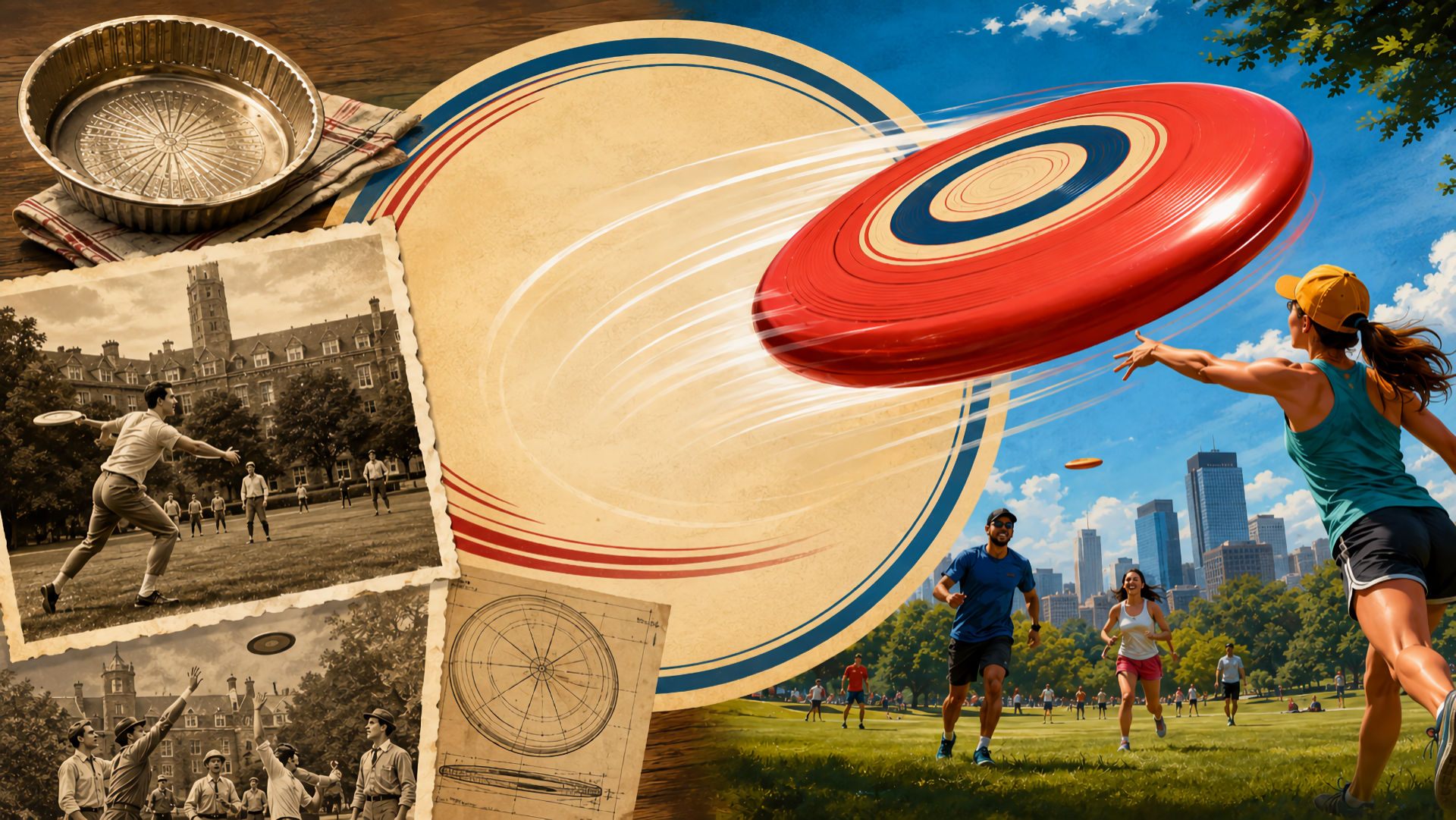
The story of the Frisbee begins not with a toy designer, a sports league, or a glossy advertising campaign, but with pies. In 1871, William Russell Frisbie bought and renamed a bakery in Bridgeport, Connecticut, creating the Frisbie Pie Company. The business sold pies in metal tins, and those tins would become unexpectedly important long after the pastry itself had disappeared. This is one of those rare moments in history where dessert genuinely contributes to human progress, which is exactly the sort of evidence pudding has been waiting for.
The Frisbie Pie Company supplied pies across parts of New England, including areas with strong college links. Students, particularly around Yale and other north-eastern campuses, discovered that the empty tins could be flipped upside down and thrown. They were not especially elegant objects, and they were certainly not precision-engineered sporting equipment, but they had one magical property: they flew. A curved metal plate, a casual toss, and an open patch of grass were enough to turn lunch leftovers into recreation.
There are several versions of the early Frisbie tin legend, and not every detail can be nailed down with the neatness of a factory production record. Some accounts emphasise Yale students; others point to wider college culture in Connecticut and beyond. The important point is not that one student invented the game in a single heroic throw, but that a habit formed. People began associating the name “Frisbie” with a flying disc long before Wham-O turned the spelling into a trademarked toy.
That informal origin matters because the Frisbee did not begin as something people were told to play with. It began as something people chose to play with. No instruction manual was needed, no referee had to be summoned, and no one had to explain the deep strategic implications of hurling a pie tin at your friend. The idea was simple, social, and slightly ridiculous, which meant it had excellent survival prospects. From there, the next stage was not invention in the formal sense, but repetition: more campuses, more throws, more people realising that an object designed for apple pie could also produce a surprisingly graceful arc.
Campus Tossing and the Birth of a Flying Craze
By the early twentieth century, the flying tin had become part of a broader campus tradition rather than just a Bridgeport curiosity. Students did not need much encouragement to turn almost anything into a game, as centuries of university furniture can sadly confirm. The pie tin was portable, cheap, and just unpredictable enough to be fun. It wobbled, curved, dipped, and occasionally betrayed its thrower, but that was part of the charm.
What made the flying disc different from many other informal games was its openness. A ball game usually needed goals, bats, nets, teams, or at least a commonly agreed-upon idea of what counted as success. A disc could simply be thrown and caught. The satisfaction came from the flight itself, especially when a throw seemed to hang in the air for longer than expected. It was a small miracle of physics disguised as mucking about.
College culture helped the idea spread because it rewarded repeatable rituals. Students returned each term, taught the game to others, and carried habits with them after graduation. The shouted warning “Frisbie” is often linked to the need to alert people when a tin was flying towards them, which feels sensible given that metal pie plates are not famous for their gentle bedside manner. Whether every detail of that tradition is exact or embroidered, the association between the word and the flying object became powerful enough to survive the move from bakery tin to plastic toy.
The timing also mattered. By the mid-twentieth century, America was changing rapidly. Leisure time, youth culture, beach life, suburban lawns, and mass-produced consumer goods were all becoming part of everyday life. A flying disc fitted neatly into that world because it felt modern without being complicated. It needed no batteries, no rules lecture, and no specialist clothing, although some regrettable shorts were probably involved.
This campus tradition created the market before the product officially existed. People already understood the basic pleasure of throwing a disc. What was missing was a version that could be manufactured consistently, fly better than a tin, and survive more than a few enthusiastic collisions with pavements, trees, or human foreheads. That step would come from a very different direction: a Californian inventor, a beachside game, and the post-war fascination with flying saucers.
Plastic Takes Flight: Walter Morrison and the Flying Disc
The key figure in turning the idea into a modern toy was Walter Frederick Morrison, often known as Fred Morrison. In 1937, Morrison and his future wife, Lucile Nay, were reportedly tossing lids and pans on a California beach when they realised there might be commercial potential in a better flying object. The story has the pleasing simplicity of many great inventions: somebody plays with a thing, notices people like it, and then wonders whether a slightly improved thing might sell. It is not quite Archimedes in the bath, but it does have better beachwear.
Morrison’s life was shaped by more than toys. During the Second World War, he served as a fighter pilot, and after the war, he returned to civilian life with inventive ambitions. His early flying disc designs appeared under names such as the Flyin-Saucer, reflecting the late 1940s and 1950s fascination with UFOs, rockets, and mysterious things apparently refusing to obey gravity. The space-age theme was not accidental. It gave a simple toy the glamour of the skies at a time when the public imagination was already looking upwards.
The major advance was material. A metal pie tin could fly, but it was not ideal. It bent, clattered, and carried a faint suggestion of minor injury. Plastic allowed Morrison to shape a disc deliberately rather than borrow the shape of a food container. By curving the outer edge and refining the form, he created something easier to throw, easier to catch, and much better suited to mass production.
In the mid-1950s, Morrison developed the Pluto Platter, a name that neatly captured America’s flying saucer mood. Wham-O, the California toy company that would later become famous for products like the Hula Hoop, acquired the rights. On 23 January 1957, Wham-O began producing the plastic flying disc that would become known worldwide as the Frisbee. It was still a toy, but now it had industrial backing, moulded plastic reliability, and a company with a gift for turning simple objects into national crazes.
Wham-O, the Frisbee Name, and the Making of a Pop Culture Icon
Wham-O understood something very important about toys: a good product needs a good story. The Pluto Platter had a fashionable space-age name, but the word already circulating among students had deeper cultural roots. College players had been using a version of “Frisbie” for years, linking the flying object back to the pie tins of Connecticut. Wham-O adopted the sound but changed the spelling to “Frisbee”, creating a brand name that felt familiar, playful, and just unusual enough to stick.
The name was formally protected as a trademark in 1959, which helped turn a casual nickname into a commercial identity. That distinction still matters because “Frisbee” is technically a brand name, although many people use it casually to describe almost any flying disc. This is one of those linguistic victories that companies both love and fear. When your product name becomes the everyday word, you have conquered culture, but your trademark lawyer starts twitching in the corner.
Wham-O also benefited from the post-war boom in inexpensive leisure products. The Frisbee could be sold to children, students, beachgoers, families, and anyone with enough arm movement to attempt a throw. It was cheap, colourful, portable, and endlessly reusable, unless a dog claimed legal ownership. Unlike many toys, it did not dictate a single way to play. It could be used for catch, trick throws, informal competitions, or simply as an excuse to stand outdoors pretending to be athletic.
A crucial later figure was Ed “Steady Ed” Headrick, who joined Wham-O in the 1960s and helped refine the Frisbee into a better flying object. Headrick added important aerodynamic improvements, including the familiar raised rings that improved stability and flight. His professional model helped shift the disc from novelty toy to performance object. In other words, he gave the Frisbee the dignity of engineering while allowing it to remain, at heart, a plastic circle people throw at picnics.
That change opened the door to something bigger. Once the disc flew more reliably, people could do more than casually toss it back and forth. They could create rules, skills, contests, and eventually entire sports. The Frisbee had become a pop culture object, but it was about to become an athletic one, too.
From Beach Game to Serious Sport: Ultimate, Disc Golf, and Freestyle
The Frisbee’s transformation into organised sport began when players realised that throwing and catching could be structured without losing the freedom that made the disc appealing in the first place. One of the most important developments was Ultimate, which emerged in the late 1960s at Columbia High School in Maplewood, New Jersey. Joel Silver introduced the idea in 1968, and the first games followed soon after. The sport combined elements of football, basketball, and end-zone games, but with a disc at the centre and a distinctive emphasis on self-officiating.
Ultimate mattered because it gave the Frisbee a new identity. It was no longer just a toy thrown on beaches and lawns. It became the central object in a fast, tactical team sport that demanded stamina, timing, spatial awareness, and calm decision-making under pressure. The best players could bend the disc through the air with astonishing control. The worst players could still launch it into a hedge, preserving the democratic spirit of the original invention.
Disc golf followed a different but equally important path. Instead of passing and catching, players threw discs towards targets across a course, adapting the logic of golf to a flying disc. Ed Headrick was again central to this story, helping to formalise the sport and promote standardised targets. The Professional Disc Golf Association was founded in 1976, giving the sport an organisational structure that supported rules, competition, and growth.
Freestyle Frisbee also developed as a performance discipline, focusing on spins, catches, delays, and choreographed routines. This was the Frisbee at its most theatrical, where the throw was only the beginning, and the catch might involve a leap, a roll, or a level of coordination most people only experience briefly before falling over. Freestyle showed that the disc could be expressive as well as competitive. It belonged as much to performance culture as to organised sport.
By the late twentieth century, flying disc activities had diversified far beyond casual catch. Ultimate, disc golf, freestyle, guts, double disc court, and other variations all revealed different qualities hidden inside the same simple object. The Frisbee could be a team sport, a precision sport, an artistic prop, or a backyard game. That flexibility explains why it endured. It was not one invention with one use, but a platform for play.
The Frisbee’s Lasting Spin: Design, Culture, and a Very Simple Joy
The Frisbee’s endurance comes from the fact that it balances simplicity with skill. Anyone can pick one up and throw it badly within seconds, which is an underrated design achievement. With practice, the same object can be made to curve, float, skip, rise, stall, or slice through the air with impressive control. That range makes it welcoming to beginners and endlessly interesting to experts, which is more than can be said for many objects found at the back of a garage.
Its design also gives it a special emotional quality. A ball follows a familiar arc, but a disc seems to negotiate with the air. It hovers just long enough to create hope, then either lands beautifully in someone’s hands or drifts away with the quiet confidence of an object that has other plans. The Frisbee invites movement without making play feel formal. It is exercise disguised as idling, socialising disguised as sport, and physics disguised as fun.
Culturally, the Frisbee belongs to several worlds at once. It is part of beach culture, university life, children’s play, dog training, public parks, counterculture recreation, and serious international sport. It can be bought cheaply, carried easily, and shared instantly. There is no elaborate barrier to entry. One person throws, another catches, and suddenly there is a game.
That accessibility explains why the Frisbee survived long after many novelty toys faded. Wham-O’s branding made it famous, Morrison’s design made it practical, Headrick’s refinements made it perform, and organised sports gave it depth. But the original appeal remained the same as it had been with the pie tins: the pleasure of watching a flat object do something surprisingly graceful. The Frisbee never really needed to become complicated. Its genius was that it made the air visible for a moment, turning an ordinary throw into a small shared spectacle.
So the history of the Frisbee is not just the story of a toy. It is the story of how play often begins by accident, how ordinary objects can gather meaning, and how a bakery tin became a global symbol of relaxed, democratic fun. From Bridgeport pies to Californian plastic, from college greens to Ultimate pitches and disc golf courses, the Frisbee has travelled a long way. Not bad for something whose ancestor once had cherry filling in it.
The History of the Frisbee FAQ
The modern flying disc is most closely associated with Walter Frederick Morrison, who developed early plastic flying disc designs before the idea was later bought and marketed by Wham-O. The name Frisbee, however, was inspired by earlier student games involving tins from the Frisbie Pie Company.
The name is linked to the Frisbie Pie Company of Bridgeport, Connecticut. Students reportedly threw empty pie tins for fun, calling the activity by a version of the company’s name before Wham-O later adopted the spelling “Frisbee” for its flying disc.
The Frisbee became especially popular after Wham-O began marketing it in the late 1950s. Its popularity grew rapidly during the 1960s and 1970s as it became associated with beaches, parks, campuses, and organised flying disc sports.
Two of the best-known sports linked to the Frisbee are Ultimate and disc golf. Ultimate combines passing, movement, tactics, and end zones, while disc golf uses flying discs thrown towards targets across outdoor courses.
A Frisbee flies because of its spinning motion and aerodynamic shape. The spin gives it stability, while the curved upper surface and angled throw help generate lift, allowing it to glide through the air rather than simply dropping like a very disappointing dinner plate.