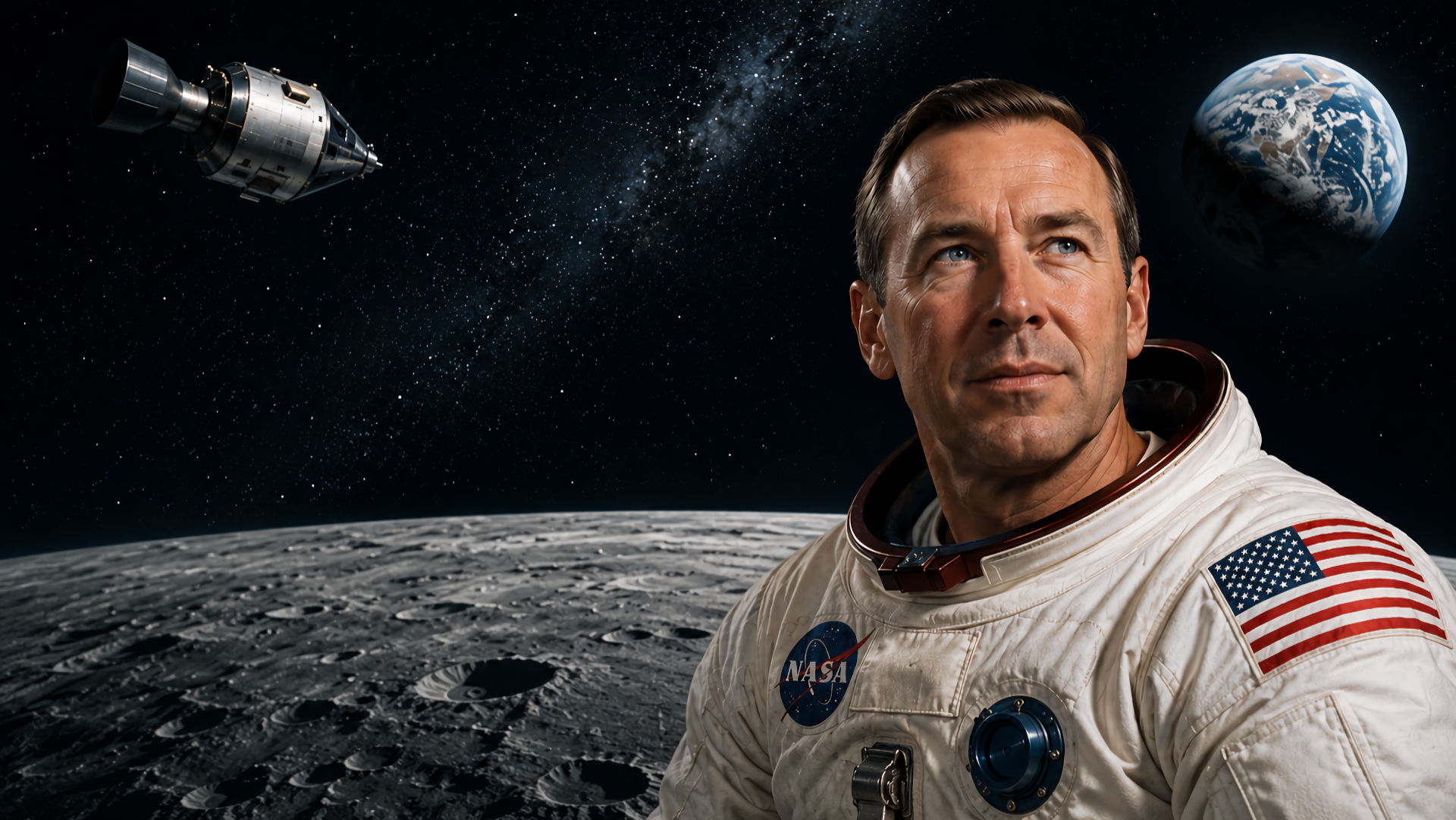
Jim Lovell
James Arthur Lovell Jr. was born in Cleveland, Ohio, on 25 March 1928, but much of his childhood was shaped by Milwaukee, Wisconsin, where he grew up with a fascination for machines, movement, and the sky. He was still a boy when aviation seemed to be transforming from a daring novelty into a serious profession, and he watched that transformation with the sort of attention most children reserve for sweets, comics, or avoiding homework. For Lovell, flight was not just exciting. It was a puzzle, a discipline, and a promise.
His early life was not cushioned by certainty. His father died when Lovell was young, and his mother, Blanche, raised him through the difficult years of the Great Depression and the Second World War era. Those years helped form a character that would later seem almost tailor-made for spaceflight: calm, methodical, resilient, and not especially prone to theatrical panic, which is always handy when your spacecraft starts misbehaving with national television watching.
As a teenager, Lovell became involved in scouting and developed an interest in rocketry long before rockets were the glamorous symbols of the Space Age. He reportedly built small model rockets and followed the work of early spaceflight thinkers, imagining journeys that still sounded more like science fiction than career planning. This was the age before NASA, before Sputnik, before astronauts became household names. To dream of space then required a particular combination of imagination and stubbornness.
Lovell first attended the University of Wisconsin, but his ambitions soon took him towards the United States Naval Academy at Annapolis. There, he entered a world built on discipline, hierarchy, mathematics, engineering, and the sea. He also married Marilyn Gerlach in 1952, beginning a partnership that would endure through long absences, dangerous flights, national fame, and the peculiar domestic challenge of having a husband who occasionally left the planet.
By the time Lovell graduated from the Naval Academy in 1952, he had already begun shaping himself into the kind of man the early American space programme would need. He was not a celebrity in waiting. He was a naval officer, a student of machines, and a young man who understood that courage without preparation was simply asking for trouble.
From Naval Aviator to Test Pilot
After graduation, Lovell entered the United States Navy and trained as a pilot, a path that demanded precision long before it offered glory. Naval aviation was one of the most demanding branches of flying, especially for those who operated from aircraft carriers. Landing a fast jet on a moving ship at sea is not so much a skill as a controlled argument with physics, weather, machinery, and one’s own nerves.
Lovell became a naval aviator in the 1950s, serving during a period when aircraft technology was changing rapidly. Jet engines were reshaping military aviation, and pilots had to adapt to machines that were faster, less forgiving, and more complex than the propeller aircraft of the previous generation. He logged thousands of hours in the air, including extensive time in high-performance jets, building the practical experience that would later make him valuable to NASA. Spaceflight may look romantic from the outside, but inside the cockpit, it is very much a matter of switches, procedures, numbers, and not touching the wrong thing.
His abilities eventually took him to the United States Naval Test Pilot School at Patuxent River, Maryland, where some of the Navy’s most capable pilots were trained to evaluate aircraft at the edge of their performance. Test pilots had to combine courage with caution, which sounds contradictory until you realise that reckless test pilots tend not to have very long careers. Lovell worked with advanced aircraft and became familiar with the disciplined reporting, engineering awareness, and cool judgment required when machines behaved unpredictably.
This background mattered because America’s first astronauts were not chosen simply because they looked good in silver suits. They were selected because they could understand systems, survive stress, communicate clearly, and make decisions in situations where the margin for error was laughably thin. Lovell first applied for NASA’s original Mercury astronaut group but was not selected. It was a disappointment, but not the end of the road.
In September 1962, NASA selected him as part of its second group of astronauts, the so-called New Nine. This group would help carry the United States beyond short solo Mercury flights and into the far more ambitious Gemini and Apollo programmes. Lovell had arrived at NASA at exactly the right moment. The question was no longer whether Americans could briefly survive in space. The question was whether they could learn to work there, navigate there, rendezvous there, and eventually reach the Moon.
Gemini: Learning Space the Hard Way
Lovell’s first spaceflight came with Gemini VII in December 1965, alongside Frank Borman. The mission was not glamorous in the simple, flag-waving sense, because its main purpose was endurance. NASA needed to know whether astronauts could live and function in space for roughly the length of time required for a future lunar mission. Lovell and Borman, therefore, spent nearly two weeks inside a spacecraft that was about as spacious as a small cupboard with ambition.
Gemini VII proved that long-duration spaceflight was possible, but it also proved that possible and comfortable are not the same thing. Lovell and Borman endured cramped conditions, limited movement, and the relentless demands of life in orbit. The mission also became part of a major spaceflight milestone when Gemini VI-A, crewed by Wally Schirra and Tom Stafford, performed the first successful rendezvous between two crewed manoeuvrable spacecraft. It was a crucial rehearsal for Apollo, where spacecraft would have to meet and dock in lunar orbit.
Lovell returned to space less than a year later, commanding Gemini XII with Buzz Aldrin as pilot. By this point, NASA was working through some of the stubborn practical problems that stood between Earth orbit and a Moon landing. One of the biggest was extravehicular activity, or spacewalking, which had proved far more difficult than expected. Astronauts had discovered that moving outside a spacecraft in weightlessness was exhausting, awkward, and not remotely like gracefully floating through the heavens. Space, as usual, was not being cooperative.
Gemini XII helped solve that problem. Aldrin’s carefully planned spacewalks, supported by Lovell from inside the spacecraft, demonstrated that astronauts could work effectively outside the capsule when given proper restraints, handholds, and procedures. The mission brought the Gemini programme to a successful close and gave NASA confidence that the techniques needed for Apollo were falling into place. Rendezvous, endurance, docking practice, navigation, and spacewalking were no longer theories. They were operational skills.
For Lovell, Gemini established him as one of NASA’s most experienced astronauts. He had endured a long mission, commanded another, and played a role in solving problems that could have derailed the lunar programme. He was not the loudest figure in the astronaut corps, nor the most mythologised. He was something more useful: dependable, tested, and trusted when the mission demanded quiet competence.
Apollo 8: First Around the Moon
In December 1968, Lovell joined Frank Borman and William Anders on Apollo 8, one of the boldest missions in human history. Originally, Apollo’s schedule had been more cautious, but delays with the lunar module and concerns about Soviet progress helped push NASA towards a dramatic decision. Apollo 8 would not merely test the command and service module in Earth orbit. It would ride the massive Saturn V rocket to the Moon, enter lunar orbit, and bring its crew home.
Lovell served as command module pilot and navigator, a role of immense responsibility. Navigation mattered because Apollo 8 was doing something no human beings had ever done before. The crew would leave Earth’s immediate neighbourhood, cross the vast distance to the Moon, and rely on mathematics, instruments, ground control, and their own discipline to return. For all the poetry later attached to the mission, it was also a very serious exercise in not missing the planet on the way back.
Apollo 8 launched on 21 December 1968 and reached lunar orbit on Christmas Eve. The crew became the first humans to see the far side of the Moon directly and the first to witness Earth rising above the lunar horizon, a sight captured in the famous Earthrise photograph. Although Anders took the photograph, all three men were part of the moment it represented. Earth suddenly appeared fragile, distant, and startlingly beautiful, like a blue marble floating in a vast void.
That Christmas Eve, the Apollo 8 crew read from the Book of Genesis during a broadcast watched by millions around the world. The moment gave the mission a cultural and emotional weight that went far beyond engineering. At the end of a turbulent year marked by war, protest, assassination, and unrest, Apollo 8 offered a rare shared experience of wonder. It did not solve Earth’s problems, but it briefly changed the view.
For Lovell, Apollo 8 was a triumph of navigation, trust, and nerve. He had now travelled farther than almost any human being in history and helped prove that the Moon was within reach. Yet, strangely, his most famous mission still lay ahead. Apollo 8 made him one of the first men to orbit the Moon. Apollo 13 would make him a symbol of survival.
Apollo 13: When the Moon Landing Became a Rescue Mission
Apollo 13 launched on 11 April 1970, with Lovell as commander, Fred Haise as lunar module pilot, and Jack Swigert as command module pilot. The mission was intended to land in the Fra Mauro region of the Moon, giving Lovell the chance to do what Apollo 8 had not allowed him to do: walk on the lunar surface. He had already been to the Moon once without landing. Apollo 13 was supposed to be the moment he finally stepped onto it.
Two days into the mission, everything changed. An oxygen tank exploded in the service module, crippling the spacecraft and forcing the crew to abandon the planned lunar landing. The command module, Odyssey, lost vital power and support systems, and the lunar module, Aquarius, had to be turned into a lifeboat. This was not what its designers had primarily intended, but spacecraft, like people, sometimes discover their true purpose during emergencies.
Lovell, Haise, and Swigert worked with Mission Control in Houston to conserve power, manage carbon dioxide levels, ration water, and keep the spacecraft on a return trajectory. The crisis required countless small decisions rather than one grand heroic gesture. The crew had to move carefully, follow improvised procedures, and trust engineers on the ground who were solving problems in real time. It was a rescue mission conducted across hundreds of thousands of miles, with no roadside assistance and absolutely no option to pull over.
Lovell’s leadership during Apollo 13 became central to his public image. He remained calm under extraordinary pressure, helping his crew focus on survival rather than disappointment. That disappointment must not be underestimated. Apollo 13 came close enough to the Moon for Lovell to see what he would not reach. He became one of the few people to travel to the Moon twice, but he never walked on its surface.
The crew returned safely to Earth on 17 April 1970, splashing down in the Pacific Ocean after a mission that NASA later called a “successful failure.” The phrase sounds odd, but it fits. Apollo 13 failed to land on the Moon, yet succeeded in bringing its crew home alive through ingenuity, discipline, and teamwork. Lovell lost his Moonwalk, but gained a legacy that arguably became even larger.
The Astronaut Who Never Walked on the Moon, But Became a Legend
After Apollo 13, Lovell remained one of the most respected figures in the American space programme. He had flown four missions: Gemini VII, Gemini XII, Apollo 8, and Apollo 13. He had helped prove that astronauts could endure long-duration flight, work effectively in space, travel around the Moon, and survive one of the most dangerous emergencies in spaceflight history. By the time he retired from NASA and the Navy in 1973, he had logged 715 hours in space.
Lovell then moved into business, taking senior roles outside government service. Like many astronauts of his generation, he had to build a second life after the extraordinary intensity of NASA’s lunar years. That transition cannot have been simple. Once your old job involves going round the Moon and returning from a damaged spacecraft, ordinary office meetings sometimes require a heroic amount of patience and politeness.
His story reached a new generation through the 1994 book Lost Moon, which he co-wrote with Jeffrey Kluger. The book became the basis for the 1995 film Apollo 13, with Tom Hanks portraying Lovell. The film helped fix the mission in popular memory as a story not simply of danger, but of problem-solving, professionalism, and teamwork. It also gave the world the famous line “Houston, we have a problem,” although the real wording used during the mission was slightly different, because history often gets a Hollywood polish whether it asked for one or not.
Lovell’s personal life was also central to his public story. His marriage to Marilyn Lovell lasted more than seventy years, and she became widely recognised as part of the human side of the space programme. Astronaut families carried a heavy burden during the early years of spaceflight. They watched launches, endured uncertainty, handled press attention, and waited through silences that no training manual could make easy. Jim Lovell died on 7 August 2025 at the age of 97, leaving behind a legacy unlike that of any other astronaut. He never walked on the Moon, yet his name remains inseparable from humanity’s journey there. His life reminds us that exploration is not only about reaching the destination. Sometimes it is about discipline under pressure, grace in disappointment, and getting everyone home when the plan has gone spectacularly, expensively sideways.
Jim Lovell FAQ
Jim Lovell was an American astronaut, naval aviator, and test pilot. He flew on four space missions, Gemini 7, Gemini 12, Apollo 8, and Apollo 13, becoming one of NASA’s most experienced astronauts.
No, Jim Lovell never walked on the Moon. He orbited the Moon during Apollo 8 and was meant to land during Apollo 13, but that mission was cancelled after an oxygen tank explosion.
Jim Lovell was the commander of Apollo 13. After the spacecraft was damaged, he helped lead the crew through the emergency and worked with Mission Control to bring them safely back to Earth.
Apollo 13 is often called a successful failure because it failed to complete its planned Moon landing, but succeeded in bringing all three astronauts home alive after a major in-flight emergency.
Jim Lovell is important because he played a major role in both Apollo 8, the first crewed mission to orbit the Moon, and Apollo 13, one of the most famous survival missions in spaceflight history.