
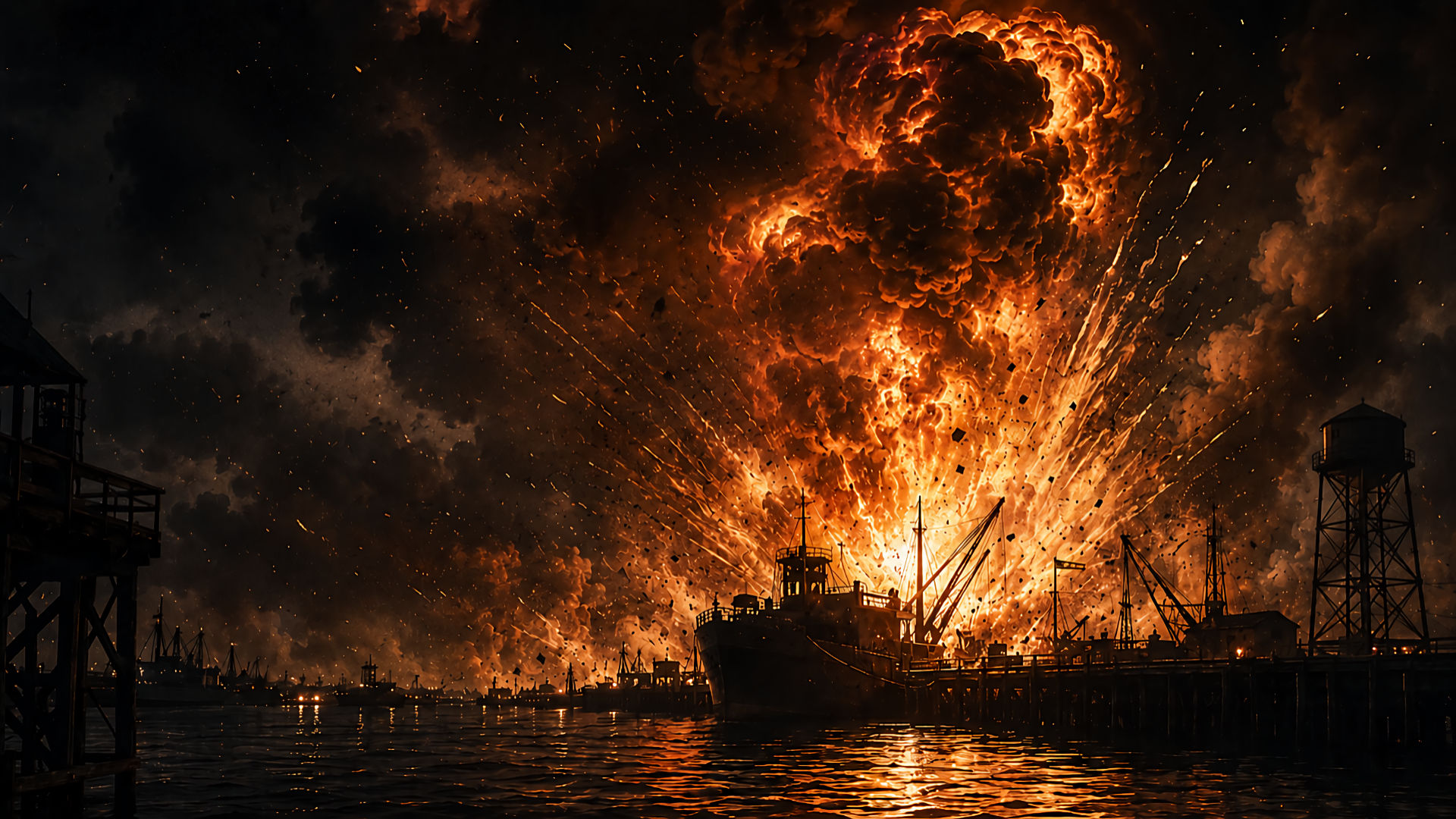
The Port Chicago Explosion
By the summer of 1944, the United States was deep into the Second World War, and the demand for ammunition on the Pacific front was immense. At Port Chicago, on Suisun Bay in California, the Navy operated a huge ammunition loading base where bombs, shells, depth charges and other munitions were moved from railcars onto cargo ships bound for war. The work was essential, urgent and dangerous. It was also shaped by the racial segregation that still defined much of American military life. African American sailors were overwhelmingly assigned to the brutal labour of loading explosives, while white officers supervised them and generally did not perform the same hazardous work themselves.
Most of the Black sailors at Port Chicago had enlisted in a Navy that, at that point, restricted many opportunities by race. Instead of being trained broadly for technical or combat roles, many were funnelled into support duties. At Port Chicago, that meant long shifts on the docks, heaving ammunition by hand and with machinery, under pressure to keep ships moving. The job was not a side issue to the war effort. It was the war effort, at least for the men ordered to do it, and it carried risks that everyone on the pier could see. Yet the system around them treated those risks as routine.
The naval magazine was not a calm industrial workplace where caution ruled the day. It was a place of pace, noise and strict hierarchy. Ships arrived, railcars rolled in loaded with high explosives, and the men on the loading crews were expected to work fast. Competition between divisions reportedly became part of the culture, with speed treated almost like proof of discipline and toughness. Safety training, by contrast, was dangerously limited. Men were handling some of the most destructive materials in the world while receiving far too little preparation for what could go wrong.
To many of the sailors, the inequity was obvious. The people doing the lifting, hauling and stacking were Black enlisted men. The officers giving the orders were white. The men closest to the bombs had the least power to question the system built around them. They were expected to obey, to keep moving and to trust that the people in charge knew what they were doing. That trust was thin. Some sailors later described a climate in which fear and frustration were already present before the disaster ever happened.
All of this formed the backdrop to what would become the deadliest home-front disaster of the Second World War for the U.S. Navy. The explosion that made Port Chicago famous did not emerge from nowhere, like a random thunderbolt out of a clear sky. It took place inside a system already straining under wartime pressure, one in which danger, discrimination and urgency had been packed together far too tightly. Before the blast itself came the conditions that made such a catastrophe possible, and on the docks, those conditions were visible every single day.
Danger on the Docks, Pressure in the Loading Crews
The routine at Port Chicago was built around relentless movement. Freight cars arrived carrying munitions, and the loading crews transferred that cargo onto ships as quickly as possible. It was not tidy warehouse work. Bombs and shells were being shifted in volume, often under heavy time pressure, in a wartime climate that prized output. The Navy needed ammunition in the Pacific, and Port Chicago existed to help supply it. The result was a working environment where speed could seem more important than caution, a terrible imbalance when the material being handled could obliterate a pier in seconds.
The men doing that work were not given the level of specialist training the task demanded. National Park Service material and Navy accounts alike point to inadequate preparation and unsafe conditions as central parts of the story. Sailors were taught enough to function, but not enough to truly understand the full risk surrounding the different kinds of ammunition they handled. Some munitions were sensitive, some were massive, and all required disciplined procedures. Yet the atmosphere on the docks did not consistently reflect the seriousness of that reality.
There were also cultural problems that made a dangerous job worse. Officers pushed for fast loading times, and accounts of competition between crews suggest that speed was not merely encouraged but celebrated. In such an environment, caution could easily look like hesitation, and hesitation could look like weakness. That is a rotten formula in any workplace, but in an ammunition depot it borders on the absurd.
The racial structure of the base sharpened every tension. Black enlisted sailors lived with the knowledge that they were doing the most dangerous work while having little authority to challenge procedures. White officers oversaw the operation but did not share the same exposure in the same way. That imbalance was obvious, but at Port Chicago, the chain of command demanded obedience. However, it did not build confidence.
By July 1944, two ships would become central to the disaster: the cargo ship E. A. Bryan and the Quinault Victory. The E. A. Bryan had already been loading for more than three days, while ammunition and bombs were also positioned on the pier for the Quinault Victory. Two ships, a busy pier and huge quantities of explosives created a setting in which any serious mistake, spark or mishap could become catastrophic. Nobody could say exactly how that catastrophe would begin. But the conditions for it were there, stacked as plainly as the bombs themselves.
So when the night of 17 July arrived, Port Chicago was not a place at ease. It was a tense, overworked wartime depot where undertrained men were handling dangerous materials in a segregated system that prized speed. The blast that followed would shock the nation, but to understand its force, you first have to understand the pier before it vanished, busy, pressured, and already far too close to disaster.
The Night of 17 July 1944
On the evening of 17 July 1944, work continued at the Port Chicago Naval Magazine as it had on many other nights. Munitions were being loaded onto ships at Pier No. 1. The E. A. Bryan was heavily laden with ammunition, and the Quinault Victory was also at the pier with additional explosives nearby in railcars. At 10:22 p.m., according to Navy records, witnesses reported two explosions in quick succession. What had been an active loading operation became an apocalyptic scene almost instantly.
The force of the combined blast was staggering. The pier was obliterated. The explosion effectively vaporised the E. A. Bryan, and the Quinault Victory was catastrophically damaged. The shock wave tore through the surrounding area, heavily damaging nearby buildings and the town of Port Chicago itself. Windows shattered far from the blast site, structures were wrecked, and residents were thrown into confusion and terror. For many people nearby, there was no gradual understanding of what had happened. There was simply a colossal concussion, fire, debris and a night sky torn open by war-grade destruction on American soil.
The human cost was awful. The explosion killed 320 men and injured around 390 others. Most of those killed were African American sailors assigned to ammunition loading duties. Navy and National Park Service sources both emphasise how heavily the casualties fell on those Black enlisted men who had been placed at the centre of the most dangerous work. Entire divisions were shattered. Families would receive telegrams, and communities would struggle to make sense of a disaster that many Americans had never imagined could happen in a home-front military installation.
Investigators would later conclude that the precise cause of the explosion was never definitively established. The Navy war diary noted that the cause was unknown, even though witnesses believed two explosions had occurred. That uncertainty has remained part of the story ever since. What is known is that a vast quantity of ammunition was present, that loading was underway, and that unsafe conditions had long existed. The technical spark may remain unidentified, but the broader conditions were plain enough. Port Chicago was not destroyed by mystery alone. It was destroyed in an atmosphere where risk had been normalised.
The blast was so violent that recovery itself became difficult. Bodies were torn apart, thrown into the water, buried in wreckage or simply never fully recovered. The physical landscape of the pier was erased. Men who had been working moments earlier disappeared into smoke, flame and fragments of twisted steel. If there is a point in this story where the ordinary language of history starts to fail, this is probably it. The event was not merely an industrial accident. It was a sudden act of annihilation.
And yet the story did not end with the blast. In some ways, the explosion was only the beginning of Port Chicago’s place in American history. What followed involved grief, investigation, fear and a growing refusal among survivors to return to the same work under the same conditions. The pier was gone, but the questions it raised were just beginning to gather force.
Devastation, Rescue, and the Search for Answers
In the immediate aftermath, Port Chicago was a scene of chaos. Rescue workers, surviving personnel and local responders faced darkness, fire, wreckage and the grim task of finding the dead and wounded. Buildings had been smashed, the pier had disappeared, and the two ships at the centre of the blast were wrecked beyond recognition. The nearby town suffered extensive damage, with homes and businesses hit by the force of the explosion. This was not a contained military accident hidden behind a fence. Its impact rippled across the surrounding community in the most physical way possible.
The effort to identify victims was agonising. So many bodies had been mutilated or destroyed that full identification was often impossible. Families were left with partial information, delayed certainty or, in some cases, almost none at all. Lists of the dead and missing became part of the tragedy. The Navy’s own records and later memorial work preserved the names, but names on a list can only hint at the scale of the loss. Behind each one was a young man who had enlisted during wartime and ended up killed on an American dock while loading explosives under racially unequal conditions.
There was, naturally, pressure to understand what had happened. Yet the search for answers ran into a hard wall. The precise initiating cause of the blast was never conclusively determined. Official records acknowledged uncertainty. That lack of a single, neat answer has sometimes allowed the event to be discussed as if it were simply one of history’s terrible accidents, beyond explanation. But even without pinpointing the first fatal trigger, officials and historians have been able to identify the wider failures surrounding the disaster: poor training, unsafe loading practices and a command culture that placed impossible pressure on the men doing the work.
For the surviving Black sailors, the emotional impact was immediate and obvious. They had seen friends and shipmates die in extraordinary numbers. They had lived through an explosion so violent it could hardly be processed in ordinary terms. And then, after that trauma, they faced the prospect of being ordered back into ammunition loading service. National Park Service accounts make clear that the disaster was not followed by a full transformation of safety procedures that might have reassured the men. Instead, many survivors saw the same danger waiting for them again.
That was the pivot on which the story turned. Up to this point, Port Chicago could be told as a wartime disaster, appalling but self-contained. What came next made it something larger. The men who had survived the explosion were not simply grieving. They were being asked to resume the same kind of work in a system they no longer trusted, if they had ever trusted it at all. Their fear was not abstract, not hypothetical and not cowardice dressed up in hindsight. It was rooted in the smoking evidence of what had just happened on the pier.
So the aftermath of Port Chicago became more than an investigation into a blast. It became a test of authority, race and memory. The Navy wanted discipline restored. The survivors wanted safety, dignity and some recognition that what had happened to them was not normal. Those competing demands would soon collide in one of the most controversial military trials of the Second World War.
Fear, Refusal, and the Port Chicago Mutiny Trial
In the weeks after the explosion, surviving sailors were transferred to Mare Island and then ordered to resume loading ammunition. For many of them, that order was intolerable. They had just witnessed a catastrophe that killed hundreds of their fellow sailors, and they did not believe the underlying problems had been fixed. Their refusal was not a political gesture. It was the reaction of traumatised men who believed that returning to the job might mean being the next to be blown apart.
At first, 258 enlisted men refused to load munitions. Most returned to work after being confronted by authority, but 50 African American sailors continued to refuse. Those 50 became the defendants in what is now known as the Port Chicago mutiny trial. The Navy charged them not with a lesser disciplinary offence but with mutiny, an exceptionally serious accusation implying a concerted challenge to lawful authority. That decision immediately transformed the case from a labour and safety dispute into a national controversy over race, justice and military power.
The trial began in September 1944 and attracted considerable public attention. Civil rights organisations and journalists followed it closely. Among those who became involved was Thurgood Marshall, then serving as special counsel for the NAACP, who attended the proceedings and sharply criticised the way the case was handled. Marshall and others argued that the men were not mutineers in any meaningful sense. They were scared survivors objecting to conditions that had already killed hundreds. The prosecution, however, insisted on discipline and collective disobedience as the defining issue.
The court found all 50 men guilty and sentenced them to prison terms ranging from 8 to 15 years of hard labour, along with dishonourable discharges, though later wartime needs and public pressure affected what followed. The verdict stunned many observers and deepened the sense that Port Chicago exposed not only a disaster of explosives but a disaster of policy and prejudice. The men most endangered by the system had now also been criminalised by it.
The trial forced Americans to look at a contradiction inside the wartime nation. The United States was fighting fascism abroad while maintaining racial segregation and unequal treatment within its own armed forces. Port Chicago made that contradiction harder to ignore. The case of the 50 sailors became a rallying point in the broader struggle for civil rights, highlighting the injustice faced by Black service members who were expected to risk their lives without equal status, equal protection or equal trust.
By the end of the war, the legal punishments would not stand in quite the dramatic, permanent way the verdict had suggested. But the moral questions raised by the trial did not go away. They lingered, and over time, they grew more powerful. Port Chicago had started as a wartime loading base and had become the site of a catastrophic explosion. Now it had become something else as well, a landmark in the story of American civil rights and the long challenge to segregation in the military.
Legacy of the Explosion, From Civil Rights to Historical Memory
The legacy of Port Chicago reaches far beyond the blast itself. In the years that followed, the disaster and the mutiny trial increasingly came to be understood as connected events, not separate chapters. The unsafe loading operation, the disproportionate burden placed on Black sailors, the refusal to return to the same dangerous work and the harsh criminal response all formed part of one larger story. It was a story about wartime urgency, yes, but also about how race shaped who carried danger and who held authority in mid-twentieth-century America.
Historians and public memory have since recognised Port Chicago as an important milestone on the road toward desegregation in the U.S. armed forces. The sailors’ stand, and the public debate surrounding their prosecution, helped expose the injustice of segregated military structures. While the disaster did not alone transform the armed forces overnight, it contributed to growing pressure for change. In that sense, Port Chicago belongs not only in the history of disasters, but in the history of civil rights.
The site itself has been preserved in national memory. The Port Chicago Naval Magazine National Memorial, administered through the National Park Service, stands as a place of remembrance for the men killed on 17 July 1944 and for the wider significance of what occurred there. Memorialisation matters here because, for many years, the event did not occupy the place in popular history that its scale deserved. Hundreds died in the deadliest home-front disaster of the war for the U.S. Navy, and yet Port Chicago has often been less widely known than other wartime tragedies. The memorial helps correct that silence.
There have also been later efforts to revisit the treatment of the Port Chicago 50 and to honour those affected more fully. Even where legal and political processes moved slowly, public understanding changed. The men once branded mutineers came to be seen by many as survivors who had been forced into an impossible position. That shift in memory is important. It does not undo the suffering, but it does restore some moral clarity to the story.
What makes Port Chicago endure is that it operates on several levels at once. It is the story of a single horrific night when explosives tore apart ships, men and a California dockside town. It is also the story of the system that made that night possible, a segregated and pressured wartime workplace where safety came second to speed. And beyond that, it is the story of what happened when traumatised survivors refused to accept that their lives were expendable. So the Port Chicago Explosion deserves to be remembered not only for its violence, but for what it revealed. It exposed the cost of reckless practices. It exposed the cruelty of racial inequality inside the military. And it exposed how institutions can fail twice, first in the disaster itself and then in the way they answer those who survive it. That is why Port Chicago still matters. It was a wartime catastrophe, certainly. But it was also a warning, and warnings like that should never be filed away quietly and forgotten.
The Port Chicago Explosion FAQ
The Port Chicago Explosion was a catastrophic ammunition blast at the Port Chicago Naval Magazine in California on 17 July 1944, during the Second World War. It killed 320 men and injured hundreds more.
The exact trigger was never definitively identified, but investigators and later historians linked the disaster to unsafe loading conditions, inadequate training, and intense pressure on sailors handling large quantities of explosives.
The Port Chicago 50 were the fifty African American sailors convicted of mutiny after refusing to resume ammunition loading duties following the explosion. Their case became an important civil rights issue.
The disaster is significant not only because of the scale of the explosion, but because it exposed racial inequality in the US Navy and became part of the wider story of civil rights and military desegregation.
It took place at the Port Chicago Naval Magazine on Suisun Bay in California, northeast of San Francisco. The site is now commemorated by the Port Chicago Naval Magazine National Memorial.


