
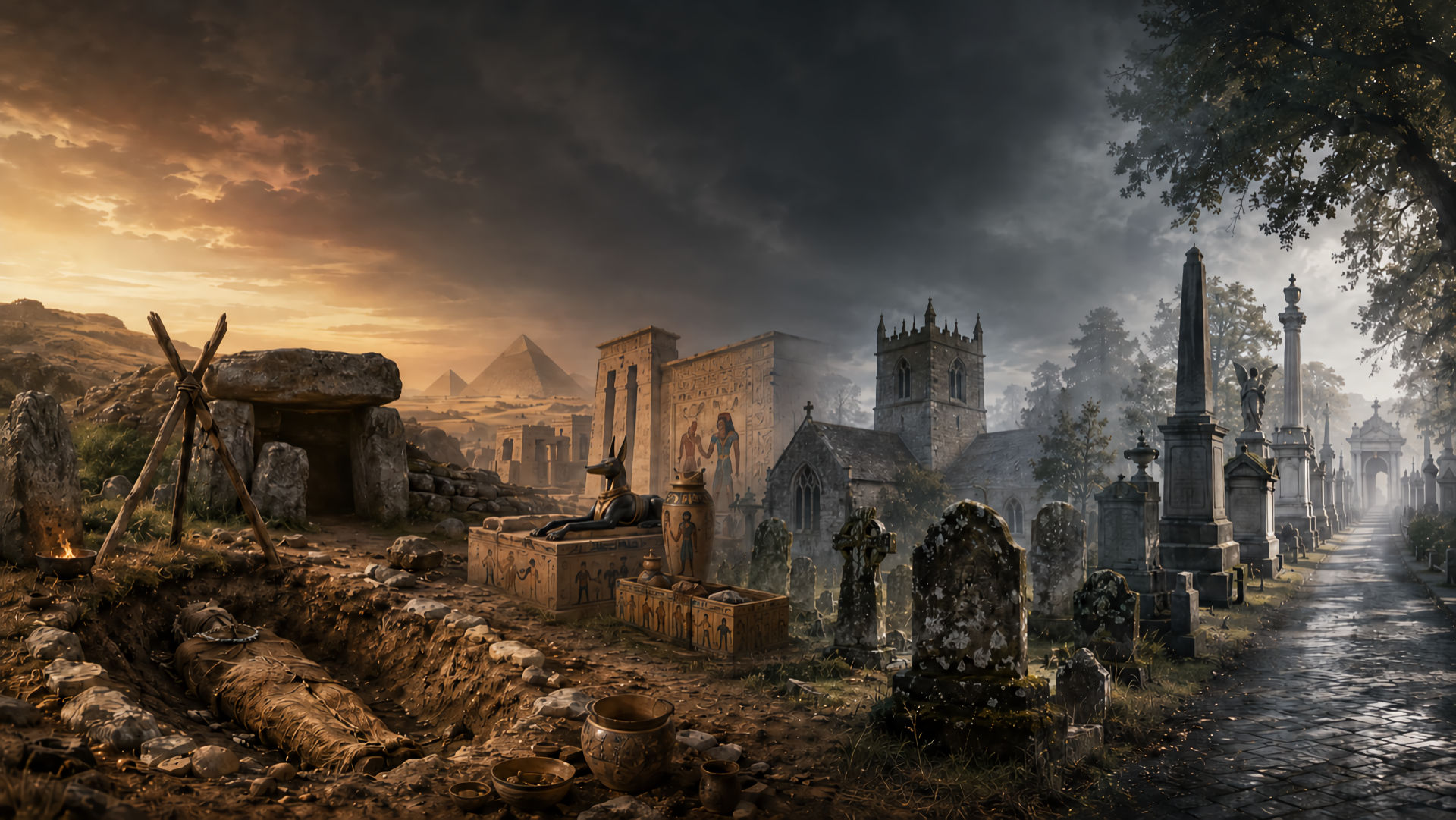
The History of Burial Customs
Before temples, churches, cemeteries, undertakers, mourning cards, and carefully chosen funeral music, there was the simple and deeply human problem of what to do when someone died. Death is biological, but burial is cultural. It turns loss into action, and action into meaning. The earliest evidence of deliberate burial is difficult to interpret with absolute certainty, because archaeology often deals in fragments, shadows, and the occasional bone that refuses to explain itself politely. Yet across prehistoric sites, we find signs that some ancient humans did more than abandon their dead. Bodies were placed in particular positions, sometimes in pits, sometimes with tools, animal bones, pigment, flowers, or personal items nearby.
The burial ritual suggests memory. It tells us that the dead were not always treated simply as remains, but as people who still had a place in the minds of the living. Some Neanderthal and early Homo sapiens burials appear to show care, though scholars still debate exactly how much ritual meaning we can safely read into them. Even so, the pattern is powerful. A body placed deliberately into the earth is not the same as a body left where it fell. It implies choice, effort, and possibly grief. In a world where survival was hard, food was uncertain, and predators were not merely a bad metaphor, spending time and energy on the dead meant something.
Early burial customs may also have helped communities cope with fear. A corpse changes quickly, and for early humans, that transformation must have been unsettling. Burial could protect the living from disease, smell, scavengers, and the distress of seeing a loved one decay. But it may also have protected the dead from being disturbed. Covering the body, placing it in a sheltering hollow, or marking the spot could have been a way of saying, in the earliest human language of all, this person mattered.
As human groups became more socially complex, burial became more varied. Some bodies were curled into foetal positions, perhaps symbolising return to the earth or rebirth, although we must be cautious about assuming too much. Others were laid out with objects that might have belonged to them in life. Red ochre appears in several prehistoric burials, possibly because its colour suggested blood, life, transformation, or simply because prehistoric people liked a dramatic visual touch as much as anyone. What we can say is that burial began as more than disposal. It became one of the first ways humans turned death into a story.
Earth, Stone, and Ancestors: Burial in the Ancient World
As humans settled into farming communities, burial customs became more closely linked to place. For mobile groups, the dead may have been remembered through stories, objects, or temporary graves, but settled communities could attach memory to land in a new way. The dead became part of the landscape. They were buried beneath houses, beside settlements, in family plots, or under mounds that could be seen for generations. Death was no longer just a private event. It became tied to ancestry, territory, inheritance, and belonging.
In Neolithic and Bronze Age societies, stone and earth were used to create lasting monuments for the dead. Chambered tombs, long barrows, passage graves, cairns, and burial mounds appeared across different parts of Europe and beyond. These structures were not merely graves; they were statements. They took labour to build, and labour meant cooperation, leadership, and shared belief. Some tombs held many bodies over long periods, suggesting that burial was not always about the individual alone. It could be about the community, the ancestors, and the living group’s claim to continuity. The dead helped anchor the living to the land.
Burial customs also began to reflect status more visibly. Some graves contained weapons, jewellery, pottery, beads, tools, or ornaments, while others were far plainer. This does not always mean simple wealth in the modern sense, but it does suggest that social roles mattered in death as they did in life. A person might be buried as a warrior, craft worker, leader, parent, elder, or ritual figure. Grave goods could show identity, honour, affection, or a belief that the dead would need certain objects beyond the grave. They could also show what the living wanted others to remember.
Across the ancient world, different civilisations developed distinctive burial landscapes. In Mesopotamia, family burials often connected the dead to household and ancestry. In ancient Egypt, tombs became increasingly elaborate, especially for elites, as preservation and afterlife beliefs became central. In parts of ancient Britain and Ireland, monumental tombs aligned with seasons and celestial events, suggesting a connection between death, time, and cosmic order. In China, tombs could include goods, servants in symbolic or actual form, and later vast armies of figures intended to accompany rulers after death.
The key change in this period was permanence. Burial sites were no longer just places where bodies were placed. They became monuments, memory banks, and claims about who belonged where. The grave was becoming a public language. It spoke of family, land, rank, and the growing human conviction that death was not the end of social identity.
Death and the Divine: Religion Transforms the Grave
Once organised religion developed, burial customs became even more closely shaped by beliefs about the soul, the body, and the world beyond death. The grave was no longer only a place of memory or ancestry. It became a threshold. Different cultures imagined that the dead might travel, sleep, wait, be judged, be reborn, join ancestors, enter another realm, or require help from the living. This gave funerary rituals enormous importance. A badly performed burial was not merely socially awkward; although that would be bad enough, it could be spiritually dangerous.
Ancient Egypt offers one of history’s most famous examples of religion shaping burial. Egyptians believed that survival after death depended partly on preserving the body and properly equipping the deceased for the next world. Mummification, tomb paintings, funerary texts, amulets, food offerings, and grave goods all served a purpose. The tomb was not just a resting place, but a prepared environment for eternity. Of course, eternity was rather more comfortable if one happened to be royal, wealthy, or able to afford a decent burial package. The pyramids and royal tombs were extreme examples, but the underlying belief reached far beyond kings.
Other traditions took different approaches. In ancient Greece, burial or cremation was accompanied by rites intended to honour the dead and secure their proper passage. The unburied dead were often imagined as restless or dishonoured, which shows how strongly ritual mattered. In Rome, funerals combined family memory, public display, and religious duty. Ancestor masks, funeral processions, inscriptions, and tombs along roads all helped connect the dead to the living world. In Hindu traditions, cremation became especially important because the body was seen as temporary, while the soul moved onward through cycles of rebirth. Fire transformed the body and released the soul from its earthly form.
Judaism, Christianity, and Islam all developed burial customs rooted in theological ideas about the body, dignity, resurrection, and divine judgement. Jewish burial traditionally emphasised simplicity, speed, and equality before God. Christianity, especially after its spread through the Roman Empire, placed increasing importance on burial in consecrated ground, often near churches, saints, or holy places. Islam also stressed prompt burial, bodily dignity, and orientation of the grave toward Mecca. Across these faiths, the body was not treated as rubbish left behind by the soul. It retained sacred significance.
Religion also created rituals around mourning. Prayers, wakes, offerings, chants, washing, shrouding, incense, candles, and processions all helped structure grief. These practices gave mourners something to do at the very moment when helplessness can be overwhelming. They also connected private sorrow to a larger cosmic order. Death remained painful, but it was given a place in a wider story, and that story shaped the grave.
Kings, Saints, and Commoners: Burial as a Mirror of Society
As burial customs became more elaborate, they also became clearer reflections of social hierarchy. In theory, death comes to everyone equally. In practice, history has rarely allowed anything to remain equal for long. The way people were buried often revealed their rank, wealth, occupation, gender, religion, and relationship to power. Some graves were built to impress the living as much as to honour the dead. A grand tomb could say, this person mattered, this family matters, and please continue to be impressed by us for several centuries.
Royal and elite burials often turned death into political theatre. Kings, queens, emperors, nobles, and military leaders were buried with ceremony, monuments, inscriptions, weapons, treasure, heraldry, or sacred symbols. Their funerals reinforced succession and authority. The burial of a ruler was not just a farewell, but a carefully managed statement that power had not died with the body. Medieval kings might be buried in abbeys or cathedrals, close to saints and sacred relics, while aristocrats commissioned tomb effigies showing themselves in armour, prayer, or noble repose. Even in stone, they knew how to pose.
At the other end of society, burial could be far more modest. The poor might be buried in simple graves, parish grounds, communal plots, or pauper sections with little or no marker. In times of famine, plague, war, or disaster, mass graves became grim necessities. These burials tell us as much about social systems as they do about death. Who received a named grave? Who was remembered publicly? Who disappeared into the earth almost anonymously? The answers reveal uncomfortable truths about class, labour, slavery, empire, and exclusion.
Saints and religious figures occupied a special place in burial history. Their tombs could become pilgrimage sites, drawing worshippers, donations, and prestige. Churches competed, quite literally, for proximity to holiness. Being buried near a saint or within church walls was believed by many Christians to offer spiritual benefit. This created a geography of sacred status, with the most desirable burial places closest to altars, relics, or holy ground. The dead were arranged not randomly, but according to spiritual and social value.
Burial also reflected gender and identity. Grave goods, clothing, inscriptions, and body placement could signal how communities understood a person’s role. Yet archaeology sometimes complicates old assumptions, especially when graves containing weapons, tools, or ornaments do not fit neat categories.
By looking at burial, we see society in cross-section. The grave could express love, faith, fear, pride, inequality, and control. It preserved not only bodies, but also social order. Sometimes it also preserved the evidence needed to question that order.
Cities of the Dead: Cemeteries, Public Health, and Changing Attitudes
By the early modern and modern periods, burial customs faced a growing problem, especially in towns and cities. There were simply too many dead and too little space. For centuries in much of Europe, Christian burial was centred on churchyards. This made sense when communities were smaller, but urban growth changed everything. Churchyards became crowded, graves were reused, bones were disturbed, and burial grounds could become unpleasant, unhealthy, and deeply unpopular with anyone possessing a nose. The dead, who had once anchored communities, were now causing a planning crisis.
Public health concerns became especially urgent during the eighteenth and nineteenth centuries. Urban populations expanded rapidly, and old burial spaces could not cope. Reformers worried about foul smells, contaminated water, overcrowded graves, and the general horror of trying to squeeze generations of bodies into tiny churchyards. In Paris, the problem led to the movement of bones from overflowing cemeteries into the catacombs. In Britain, similar anxieties helped drive the creation of large landscaped cemeteries outside crowded city centres. Burial was moving away from the parish churchyard and into planned spaces designed for sanitation, order, and reflection.
The nineteenth century transformed the cemetery into a new kind of public landscape. Places such as Père Lachaise in Paris and the great Victorian cemeteries of London turned burial grounds into spaces of architecture, mourning, status, and even leisure. Families visited graves, walked among monuments, and used cemetery space as a form of public memory. Tombs, angels, urns, broken columns, weeping figures, and elaborate inscriptions became part of a rich visual language of grief. Victorian mourning culture could be intensely formal, with black clothing, mourning jewellery, memorial cards, and strict etiquette. Frankly, the Victorians did not so much mourn as construct a fully operational grief industry.
This period also saw the rise of more professional funeral services. Undertakers, coffin makers, carriage providers, grave diggers, florists, and monument masons became part of a growing funerary economy. Funerals became more standardised, especially among the middle classes, who sought respectable rituals that reflected both sorrow and social position. The way one buried a relative could say a great deal about family dignity. Even grief had to look properly furnished.
At the same time, attitudes toward death were slowly changing. In earlier periods, death had often been a visible part of daily life, especially when people died at home and were buried locally. Modern urban life has gradually separated the living from the dead. Cemeteries moved outward. Funerals became more specialised. Professionals handled bodies. Death did not disappear, obviously, but it became more managed, more regulated, and less physically present.
The modern cemetery, therefore, represents a major turning point. It combined public health reform, urban planning, religious tradition, family memory, and social display. It turned burial into a system, one designed to manage both the dead and the living who had to carry on without them.
From Tradition to Choice: Burial Customs in the Modern World
In the modern world, burial customs have become more varied than ever. Traditional religious funerals remain deeply important for many people, but they now exist alongside secular ceremonies, cremations, woodland burials, humanist services, sea burials, donated bodies, digital memorials, and highly personalised celebrations of life. The old question remains the same: What do we do when someone dies? Yet the range of answers has expanded dramatically. Modern burial customs are shaped by faith, family history, cost, environmental concern, personal identity, migration, law, and sometimes the deceased’s very firm instructions about not wanting everyone to sing something gloomy.
Cremation has been one of the biggest changes. Although cremation is ancient in many cultures, it became increasingly common in parts of the modern West from the late nineteenth and early twentieth centuries onward. It appealed for practical reasons, especially where burial space was limited, but also because it fitted changing attitudes toward religion, the body, and memorialisation. Ashes could be kept, buried, scattered, divided, or placed in memorial gardens. This gave families flexibility, although it also created new emotional questions about where remembrance should physically belong.
Environmental concerns have also reshaped burial customs. Natural or woodland burial avoids some of the materials and processes associated with conventional funerals, such as embalming chemicals, metal fittings, concrete vaults, and polished stone memorials. Bodies may be buried in biodegradable coffins, shrouds, or simple graves marked by trees or modest plaques. For some, this feels like a return to older ideas of the body rejoining the earth. For others, it reflects modern ecological values. Either way, it shows that burial customs continue to adapt to the concerns of the living.
Migration and cultural diversity have made modern funerary practice more complex and more interesting. Cities now contain communities with very different traditions around washing the body, viewing the dead, mourning periods, music, food, prayers, cremation, burial direction, grave visitation, and anniversary rituals. Funeral providers increasingly need to understand cultural details rather than offer one standard model. This is a major change from older systems, where burial customs were often defined by a dominant local religion or community.
Technology has added another layer. Online memorial pages, livestreamed funerals, digital condolence books, QR codes on gravestones, and social media tributes have changed how people remember the dead. A grave may still be a physical place, but memory now also lives in digital spaces. This can be comforting, strange, permanent, fragile, or all of those at once.
Across history, burial customs have never been only about the dead. They are about what the living believe, fear, value, and hope. From prehistoric graves to modern memorial forests, humans have used burial to say that a life mattered. The forms change, but the impulse remains ancient. We place the dead somewhere, physically or symbolically, because memory needs a home.
The History of Burial Customs FAQ
Burial customs are the rituals, traditions, and practical methods used by societies to care for the dead. They can include burial, cremation, mourning practices, grave goods, tomb building, religious ceremonies, and memorials.
Some of the earliest evidence for deliberate burial dates back tens of thousands of years. Archaeologists have found prehistoric graves where bodies appear to have been carefully placed, sometimes with tools, pigments, ornaments, or other objects.
Grave goods often reflected beliefs about the afterlife, social status, personal identity, or affection from the living. Objects such as weapons, jewellery, pottery, food, and tools could symbolise what the person had been in life or what they might need after death.
Large cemeteries became more common as towns and cities grew, especially when churchyards became overcrowded. Public health concerns, urban planning, and changing attitudes towards mourning all helped create the modern cemetery system.
Modern burial customs are more varied than ever. Alongside traditional religious funerals, many people now choose cremation, secular ceremonies, woodland burials, personalised memorials, livestreamed funerals, and digital remembrance pages.


