The Battle of Gettysburg
By the summer of 1863, the American Civil War had become a test of endurance as much as strategy. The conflict had begun in 1861 with confident expectations on both sides that victory might come quickly, but two years of fighting had shattered that illusion. The Union still possessed greater manpower, industry, transport links, and naval strength. Yet, the Confederacy had repeatedly shown that it could survive, strike back, and make the cost of conquest painfully high.
In the Eastern Theatre, the Confederate Army of Northern Virginia had become the South’s sharpest military instrument. Under General Robert E. Lee, it had won a series of dramatic victories, most recently at Chancellorsville in May 1863. That victory had come at a terrible price, however, because Stonewall Jackson, one of Lee’s most aggressive and trusted commanders, had been accidentally wounded by his own men and later died. The Confederacy could celebrate success, but it could not easily replace the people who made success possible.
For the Union, the situation was frustrating and politically dangerous. President Abraham Lincoln had changed commanders several times in search of someone who could defeat Lee rather than merely survive him. The Army of the Potomac was brave and experienced, but it had often been poorly led at critical moments. The men had fought hard at places such as Antietam, Fredericksburg, and Chancellorsville, yet Lee remained undefeated in the minds of many observers. In Washington, patience was wearing thin, which in political terms is usually when everyone becomes an expert, and nobody becomes calmer.
The wider war also mattered. In the west, Union forces under Ulysses S. Grant were closing in on Vicksburg, the Confederate stronghold on the Mississippi River. If Vicksburg fell, the Confederacy would be split in two, and Union control of the river would become a strategic fact rather than an ambition. Lee understood that the South needed more than battlefield survival. It needed a shock, a victory that might influence Northern public opinion, threaten major cities, and perhaps encourage foreign powers to look again at the Confederate cause.
That was the background to Gettysburg. It was not planned as a neat set-piece battle in a picturesque Pennsylvania town. It emerged from a campaign of pressure, movement, uncertainty, and ambition. By June 1863, both armies were exhausted, both governments needed results, and both sides understood that one major engagement could change the direction of the war. The stage was not yet Gettysburg itself, but the war was clearly searching for a turning point.
Lee Marches North
Robert E. Lee’s decision to invade the North in 1863 was bold, risky, and rooted in both military logic and political hope. Virginia had suffered badly from repeated campaigning, and moving the war into Pennsylvania would give Confederate troops access to fresh supplies while relieving pressure on Southern farms. Lee also believed that a victory on Northern soil could damage Union morale, strengthen peace sentiment, and perhaps force Lincoln’s government into a more difficult political position. It was not simply a raid for food and shoes, although shoes would soon become part of the Gettysburg legend. Armies may march on strategy, but they also march on leather, and preferably leather without holes in it.
Lee’s Army of Northern Virginia moved north through the Shenandoah Valley, screened by cavalry and protected by the mountains. The movement was initially successful, with Confederate units crossing into Maryland and then Pennsylvania. Towns that had previously read about the war in newspapers now found Confederate soldiers on their roads, taking supplies, demanding goods, and alarming civilians who had never expected the conflict to arrive quite so personally. The invasion created exactly the sort of anxiety Lee wanted, but it also stretched his army across unfamiliar territory.
One major problem was information. Lee’s cavalry commander, J. E. B. Stuart, was away on a wide ride around the Union army, which left Lee without his usual flow of reconnaissance. Stuart’s absence did not single-handedly cause Confederate defeat, but it did mean Lee was less well-informed than he wanted to be. For a commander operating deep in enemy territory, that was dangerous. He knew the Union army was somewhere to the south and east, but he did not know enough about its precise movements. The fog of war, sadly, does not clear just because a general would find it convenient.
Meanwhile, the Union Army of the Potomac was also on the move. Its commander, Joseph Hooker, had lost Lincoln’s confidence, and on 28 June 1863, he was replaced by Major General George Gordon Meade. Meade had only a few days to take command before the campaign reached its crisis point. He did not have the luxury of long preparation, but he did understand the basic requirement. He had to keep his army between Lee and Washington, and he had to stop the Confederate invasion before it produced the political earthquake Lee hoped for.
The roads of southern Pennsylvania now began to pull both armies towards each other. Confederate units were searching for supplies, Union cavalry was probing ahead, and commanders on both sides were reacting to incomplete reports. Gettysburg was important because roads met there, not because either Lee or Meade had chosen it in advance as the grand arena of decision. Like many great battles, it began less as a master plan and more as a collision between hungry armies, tired men, and bad information.
The First Shots at Gettysburg
On 1 July 1863, Confederate infantry approached Gettysburg from the west and north. Union cavalry under Brigadier General John Buford had already entered the town and recognised the importance of the surrounding ground. Buford understood that the ridges south of Gettysburg offered strong defensive positions, and he decided to delay the Confederate advance until Union infantry could arrive. It was a crucial decision. He could not win a major battle with cavalry alone, but he could buy time, which in warfare is sometimes the most valuable thing on the field.
The first fighting began west of the town, near McPherson Ridge. Confederate troops from A. P. Hill’s corps pressed forward, expecting opposition but not necessarily the beginning of a three-day battle. Buford’s dismounted cavalry fought skilfully, using their carbines to slow the advance and create the impression of a larger force. Soon, Union infantry from the I Corps, commanded by Major General John Reynolds, began to arrive. Reynolds was one of the Union army’s most respected officers, and his presence gave the defence urgency and confidence. That confidence was badly shaken when he was killed early in the fighting.
As the morning turned into afternoon, the battle expanded rapidly. More Confederate forces arrived, including troops from Richard Ewell’s corps coming from the north. Union reinforcements also reached the field, but the pressure against them grew heavier. Fighting spread across ridges, farms, fields, and the outskirts of Gettysburg itself. The Union line was eventually forced back through the town, with many soldiers captured in the confusion. Street fighting and retreating infantry turned Gettysburg from a quiet community into a battlefield with civilians trapped in cellars and homes.
The Union defeat on the first day could have become a disaster, but the retreat did not become a rout. Surviving Union troops fell back to Cemetery Hill, just south of the town. From there, the line extended towards Culp’s Hill and, eventually, Cemetery Ridge. This high ground formed a powerful defensive position shaped somewhat like a fishhook, with curved lines that allowed Meade to shift troops more easily than Lee could attack them. That mattered enormously, because the battle was no longer a meeting engagement. It had become a fight over ground.
Lee saw an opportunity to press the advantage, but the moment slipped away. Ewell was instructed to take Cemetery Hill “if practicable”, a phrase that has kept historians busy ever since. He did not attack, partly because his men were tired and the situation unclear. By nightfall, Union forces had held the heights. The Confederates had won the day tactically, but the Union had secured the position that would define the rest of the battle.
Holding the High Ground
The second day at Gettysburg, 2 July 1863, was shaped by one central reality. The Union army held strong ground, and the Confederate army had to decide whether to attack it. Meade arrived on the field and chose to remain on the defensive, anchoring his line on Culp’s Hill and Cemetery Hill, then stretching south along Cemetery Ridge towards the rocky slopes of Little Round Top. It was not a perfect line, and parts of it were thinly held, but it gave the Union a major advantage. Soldiers defending high ground could see more, move reserves more efficiently, and force attackers to cross dangerous open spaces.
Lee believed the Union flanks could be struck and broken. His plan called for James Longstreet’s corps to attack the Union left while Ewell demonstrated or attacked on the Union right. Longstreet had doubts, preferring a manoeuvre that might force Meade to attack instead, but Lee wanted offensive action. The Confederate army had won many of its greatest victories by striking boldly, and Lee trusted the fighting quality of his men. Gettysburg would test whether courage could overcome terrain, timing, and increasingly powerful defensive fire.
The Confederate assault on the Union left became one of the most intense phases of the battle. Fighting erupted around the Peach Orchard, the Wheatfield, Devil’s Den, and Little Round Top. These names sound almost gentle until one remembers what happened there. The Peach Orchard was not a charming agricultural diversion, and the Wheatfield became less a field than a revolving door of regiments being sent in, battered, and replaced. Union General Daniel Sickles had moved his III Corps forward from the main line, creating a vulnerable salient that Confederate troops attacked fiercely.
Little Round Top became especially important. If Confederate forces had taken it, they might have threatened the Union left and fired along Cemetery Ridge. Colonel Joshua Lawrence Chamberlain and the 20th Maine famously helped hold the far left of the Union line, eventually launching a bayonet charge when ammunition ran low. Their stand became one of the most celebrated episodes of the battle, although it was only one part of a much larger fight. Across the field, thousands of soldiers on both sides fought with grim determination, often with little sense of the wider picture.
On the Union right, Culp’s Hill and Cemetery Hill also came under attack. Confederate troops made gains in some areas, particularly around lower Culp’s Hill, but they could not break the Union position. By the end of the second day, Lee’s army had inflicted severe damage but had not achieved the decisive breakthrough he needed. Meade’s line had bent, stretched, and suffered, but it had held. The high ground remained in Union hands, and the battle moved towards its final and most famous gamble.
Pickett’s Charge and the Breaking Point
On 3 July 1863, Lee chose to strike the centre of the Union line. He believed that Meade had reinforced his flanks after the heavy fighting of the previous day, leaving the centre on Cemetery Ridge vulnerable. The plan was for a massive artillery bombardment to weaken the Union position, followed by an infantry assault across open ground. The attacking force would include divisions under George Pickett, James Pettigrew, and Isaac Trimble, although history has remembered the assault mainly as Pickett’s Charge. Pickett’s name got the headline, which is unfortunate for the thousands of other men who had the same terrifying walk.
Before the assault began, Confederate artillery opened fire in one of the largest bombardments of the war. The sound was immense, and the smoke thickened across the battlefield. Union guns replied, creating a thunderous duel that seemed to promise destruction. Yet the bombardment was less effective than Lee needed it to be. Many Confederate shells overshot the Union line, and while the Union artillery suffered, it was not destroyed. Union artillery commander Henry Hunt also ordered some guns to cease firing to conserve ammunition, which may have encouraged Confederate commanders to believe they had done more damage than they had.
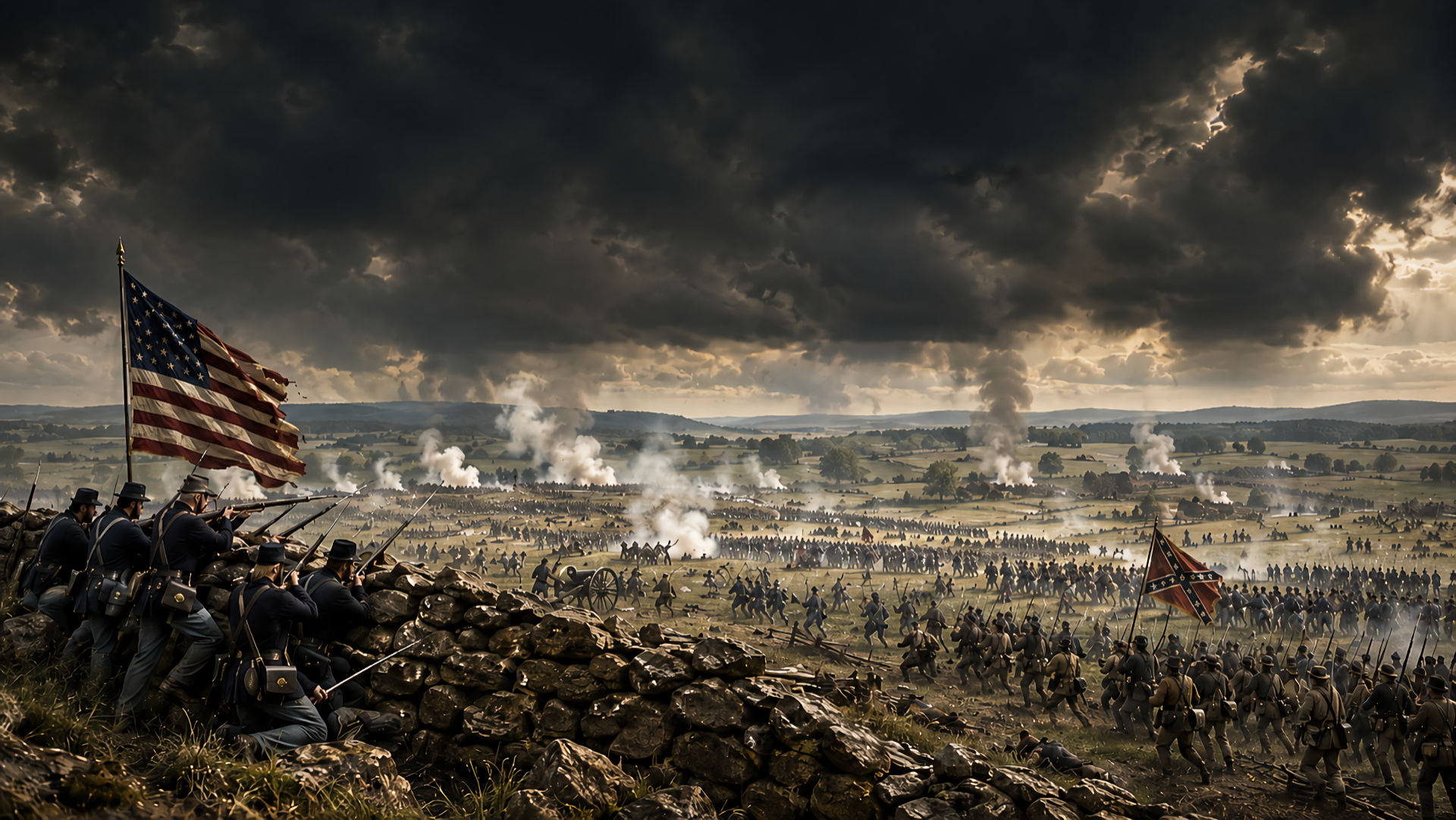
Then the infantry advanced. Around 12,000 Confederate soldiers stepped out from the tree line and moved towards Cemetery Ridge. They had to cross roughly three-quarters of a mile of open ground under artillery and rifle fire. The advance required discipline of the highest order, and the men showed extraordinary courage. But courage could not stop canister shot, musket volleys, and the brutal mathematics of attacking a prepared position in daylight. The closer they came, the worse the fire became.
At a low stone wall near a small clump of trees, some Confederate troops briefly reached the Union line. This moment later became known as the High Water Mark of the Confederacy, the furthest symbolic point of Southern advance. For a few desperate minutes, the result seemed to hang in the smoke. Then Union reinforcements closed in, the attackers lost momentum, and the Confederate assault collapsed. Men who had marched forward in formation now fell back in fragments, leaving the field covered with dead and wounded.
Lee accepted responsibility, reportedly telling survivors that the failure was his fault. The defeat was devastating. The Army of Northern Virginia remained dangerous, but Gettysburg had broken its offensive power in the campaign. Lee had gambled on one more crushing blow, and Meade’s army had absorbed it. The Confederacy’s hopes of a decisive victory on Northern soil had reached their breaking point at Cemetery Ridge.
After Gettysburg: Victory, Loss, and Memory
The Battle of Gettysburg ended on 3 July 1863, but its consequences continued long after the firing stopped. The scale of the losses was staggering. Across three days, the two armies suffered around 51,000 casualties in total, including killed, wounded, captured, and missing. The town and surrounding farms were left overwhelmed by bodies, shattered equipment, dead horses, and wounded men who needed care. Gettysburg had been a community before it was a battlefield, and afterwards it became a place where ordinary life had to resume amid the physical evidence of extraordinary violence.
On 4 July, Lee began withdrawing his army towards Virginia. Heavy rain slowed the retreat, and the Confederates had to move wounded men, wagons, and surviving units back across hostile territory. Meade pursued, but cautiously, and Lee was able to escape across the Potomac River. Lincoln was disappointed that the Army of Northern Virginia had not been destroyed, but the strategic result was still enormous. Lee’s invasion had failed. The North had not been forced into panic or negotiation, and the Army of the Potomac had proved that it could stand against Lee and win.
The timing made the Union victory even more powerful. On 4 July 1863, Vicksburg surrendered to Grant in the west, giving the Union control of the Mississippi River. Within two days, the Confederacy had suffered two major blows, one in Pennsylvania and one in Mississippi. Gettysburg did not end the war, and the fighting would continue for nearly two more years. But it changed the war’s direction. After Gettysburg, Lee would never again mount a major invasion of the North on the same scale.
The battle also became central to the memory of the Civil War. In November 1863, Lincoln visited Gettysburg for the dedication of the Soldiers’ National Cemetery. His Gettysburg Address was brief, especially by nineteenth-century standards. In a few carefully chosen words, he connected the battle to the founding ideals of the United States, the survival of democracy, and the meaning of sacrifice. The speech helped transform Gettysburg from a military event into a national symbol.
Gettysburg matters because it was both a battle and a turning point in interpretation. Militarily, it ended Lee’s northern campaign and gave the Union a crucial victory. Politically, it strengthened Lincoln’s cause at a moment when the war still demanded immense sacrifice. Morally and historically, it became tied to the idea that the Civil War was not only a struggle over territory or union, but over the future meaning of liberty in the United States. That is why Gettysburg still holds such power. It was three days of combat, but it became one of the defining memories of a nation.
The Battle of Gettysburg FAQ
The Battle of Gettysburg was fought from 1 to 3 July 1863 during the American Civil War. It took place in and around the town of Gettysburg, Pennsylvania.
The Confederate Army of Northern Virginia was commanded by General Robert E. Lee, while the Union Army of the Potomac was commanded by Major General George Gordon Meade.
Gettysburg was important because it ended Lee’s major invasion of the North and gave the Union a crucial victory. Alongside the fall of Vicksburg, it helped shift momentum in favour of the Union in July 1863.
Pickett’s Charge was the large Confederate infantry assault on the Union centre on 3 July 1863. It failed after Confederate troops crossed open ground under heavy fire and were repulsed at Cemetery Ridge.
No, Gettysburg did not end the Civil War. Fighting continued until 1865, but the battle marked a major turning point because Lee’s army never again launched an invasion of the North on the same scale.