
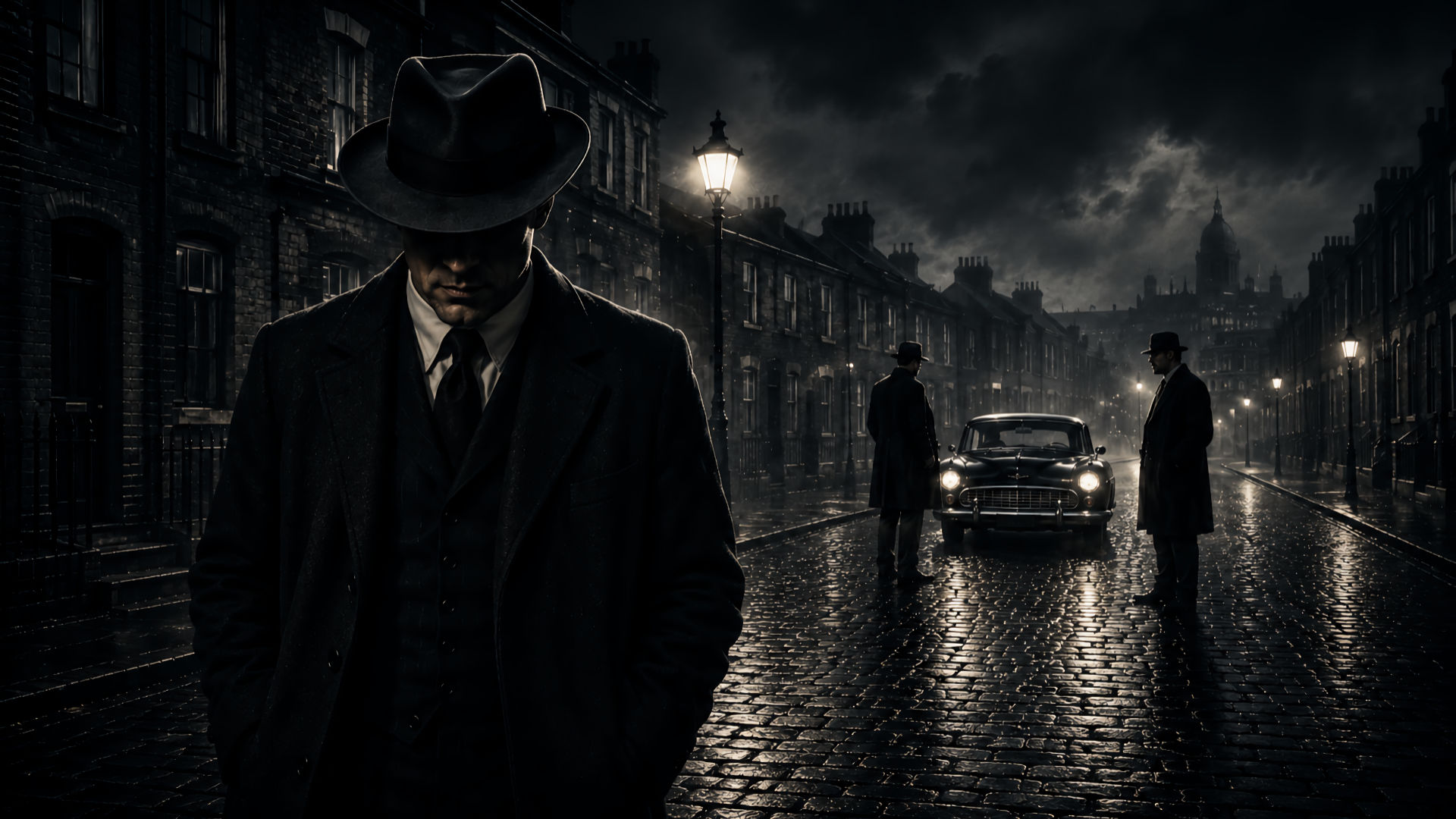
The Murder of Jack ‘The Hat’ McVitie
Jack McVitie belonged to the dangerous half-lit world of post-war London crime, where reputation could be currency, protection could be business, and a man’s nickname sometimes travelled further than his real name. Born Jack Dennis McVitie in 1932, he became better known as “Jack the Hat”, a name generally linked to his habit of wearing a trilby. It sounded almost jaunty, as if he were a character from a pub anecdote rather than a man moving through a violent criminal underworld, but the story behind him was anything but cheerful.
McVitie was not one of the grand architects of London organised crime. He was not a mastermind with an empire, a fleet of clubs, and photographers queuing for the privilege of turning menace into monochrome glamour. He was closer to the rougher machinery of that world, a man useful for intimidation, muscle, errands, threats, and jobs that respectable criminals preferred not to perform in person. In the mythology of the 1960s London underworld, men like McVitie often appear as supporting characters, but in reality they carried many of the risks.
The London he moved through was changing quickly. The old bomb-damaged city was giving way to the bright, noisy confidence of the 1960s, but not everyone was living in the brochure version of Swinging London. Beneath the nightclubs, celebrity parties, and sharp suits was a city of protection rackets, gambling clubs, unpaid debts, corrupt relationships, and private violence. The Kray twins, Ronnie and Reggie, became the most famous faces of that world, but their power depended on many lesser-known men who did the chasing, collecting, frightening, and occasionally worse.
McVitie’s reputation was complicated. He could be sociable, familiar, even amusing in the setting of a pub or club, but he was also volatile, increasingly unreliable, and drawn to danger in a way that made him useful until it made him intolerable. In organised crime, loyalty is often advertised loudly and practised badly. Once fear begins to slip, the whole arrangement starts to look fragile.
That was the world Jack McVitie inhabited. It was a world where a bad joke could become an insult, an insult could become a threat, and a threat could become a death sentence. By the late 1960s, McVitie was connected to the Krays closely enough to matter, but not securely enough to be safe. That was a particularly poor place to stand, rather like loitering between two closing lift doors and hoping both have manners.
The Krays, The Firm, and a Dangerous Arrangement
Ronnie and Reggie Kray had built their criminal reputation on a mixture of violence, discipline, intimidation, and performance. They were not simply gangsters hiding in back rooms. They cultivated a public image, appearing in clubs, mixing with entertainers, posing for photographers, and turning their East End notoriety into something strangely fashionable. For some people, they seemed to embody a kind of hard-edged glamour. For others, especially those who owed them money or crossed them, the glamour was noticeably thinner.
Their organisation, often referred to as The Firm, operated through fear as much as formal structure. It relied on men who could be summoned, paid, pressured, or flattered into carrying out unpleasant work. Jack McVitie was one of those men. He was not at the centre of the Kray empire, but he orbited it closely enough to be drawn into its business and its grudges. That made him valuable, but also expendable.
The Krays liked control. Ronnie in particular could be unpredictable, paranoid, and explosive, while Reggie was often seen as the more controlled of the two, though that distinction should not be mistaken for gentleness. Their strength as a pair lay partly in the fact that each made the other harder to challenge. To insult one was to provoke both. To disappoint one could be treated as betrayal by the family, the business, and the myth all at once.
McVitie’s relationship with them deteriorated in stages. He had done work for them, moved among their associates, and understood the codes of their circle, but his behaviour became increasingly erratic. Drink, drugs, loose talk, and unpaid obligations made him a liability. In any criminal organisation, a liability is not just inconvenient. It is dangerous, because weakness attracts attention and attention brings police, rivals, and gossip.
The Krays were already under pressure. Their violence had become harder to conceal, their enemies had multiplied, and their celebrity had made them more visible than was sensible for men trying to avoid long conversations with Scotland Yard. Yet their image still mattered deeply. If a man like Jack McVitie could take their money, fail to deliver, and then speak carelessly about them in public, what did that say about their authority?
This was the dangerous arrangement at the centre of the story. McVitie needed the Kray connection because it gave him status and work. The Krays needed men like McVitie because empires of intimidation require hands as well as heads. But once the relationship soured, both sides knew too much about the other. In that world, knowledge was not power. It was evidence with legs.
The Failed Hit on Leslie Payne
The immediate road to Jack McVitie’s murder ran through another intended killing, one that did not happen. Leslie Payne had once been close to the Krays, involved in parts of their business world, but he had fallen out of favour. Ronnie Kray, fearful that Payne might become a threat or informant, wanted him removed. In the logic of The Firm, this meant arranging a killing with the same grim practicality that other people might use to book a plumber.
McVitie was reportedly given money to carry out the murder of Payne. This created a debt that was not merely financial. In the underworld, taking payment for a violent job and failing to complete it was not the same as being late with an invoice. It looked like weakness, disrespect, and theft combined, a particularly unhealthy cocktail when mixed with Ronnie Kray’s temper.
The attempt itself was almost absurd in its failure, though not funny for anyone involved. McVitie and an associate went to Payne’s home, but Payne’s wife told them he wasn’t there. Instead of waiting, McVitie left. No assassination took place, and more importantly, McVitie kept the money he had been paid, and the whole affair became one more reason for the Krays to believe that Jack the Hat was no longer merely unreliable, but openly contemptuous of them.
That failure damaged McVitie’s standing at the worst possible time. He was already seen as loose, boastful, and increasingly out of control. He was said to have made threats against the twins, or at least talked in ways that suggested he was no longer afraid enough. In the Krays’ world, being feared was not decorative. It was operational. If fear failed, money stopped moving, people stopped obeying, and enemies started testing boundaries.
There was also the question of Ronnie’s pride. Ronnie Kray’s violence was often theatrical, but the consequences were brutally real. He could not easily tolerate being mocked, deceived, or made to look foolish, and McVitie had managed to brush up against all three. Reggie, meanwhile, was pulled into the same spiral, bound by loyalty to his brother and by his own need to preserve the Kray name.
By 1967, the situation had moved beyond ordinary criminal resentment. McVitie had become a symbol of something the Krays could not allow. He was a reminder that their control was imperfect, their authority contested, and their circle contaminated by loose ends. The failed Payne job did not by itself kill Jack McVitie, but it narrowed the route ahead. It made reconciliation less likely, violence more likely, and escape almost impossible.
The Party at Evering Road
On the night of 29 October 1967, Jack McVitie was drawn to a gathering at 97 Evering Road in Stoke Newington. The setting was domestic, almost ordinary, which makes the events that followed feel even more chilling. It was not a battlefield or a deserted warehouse, not the sort of place crime dramas generously dress in fog and menace. It was a home, with people, rooms, furniture, and all the normal things that become sinister only after something terrible happens there.
McVitie arrived unaware, or at least not fully aware, of the danger waiting for him. The Krays were already there. According to later accounts, the atmosphere had been shaped deliberately, with people moved or cleared so that McVitie could be confronted. Whatever uncertainty remains around some details, the essential truth is plain enough. This was not a spontaneous pub brawl that got out of hand. It was a meeting that turned into an execution.
Reggie Kray was the man who killed him. The most repeated account says that Reggie first tried to shoot McVitie, but the gun failed. That mechanical failure changed the manner of death, but not the intention behind it. What followed was more intimate and more savage. Reggie stabbed McVitie repeatedly during a struggle, while Ronnie’s presence and encouragement helped seal the fatal nature of the attack.
McVitie tried to escape, but this was not a duel between equal underworld warriors, staged according to some twisted code of honour. It was a trapped man trying to get away from men who had decided he should not leave alive.
After the killing, panic and practicality took over. A dead body is not just evidence. It is accusation made flesh. The men involved had to move quickly, relying on associates to help remove McVitie’s body and conceal the crime. The body was reportedly wrapped and transported, then moved again when its first location was judged too risky. In the end, McVitie’s body was never recovered.
That absence gave the case a grim afterlife. A murder without a body can become a rumour, a legend, a thing retold in pubs and books with details polished or distorted over time. But Jack McVitie was not a rumour. He was a man killed in a room because he had become inconvenient to men who believed violence was the final form of management.
The Killing That Could Not Be Hidden
For a time, the disappearance of Jack McVitie might have seemed manageable to those involved. His body had not been found, and the Krays still had a reputation powerful enough to silence many people before they even opened their mouths. Fear had always been one of their most reliable tools. Witnesses could be intimidated, associates could be reminded of consequences, and rumours could be allowed to drift through London’s criminal world without becoming formal evidence.
But McVitie’s murder was different from the Krays’ earlier acts of violence because it came from within their own circle. It unsettled people who had once depended on the twins, worked with them, or accepted their protection. If the Krays could murder Jack the Hat, a familiar associate, then no one near them was truly secure. That kind of fear can hold an organisation together for a while, but it can also rot it from the inside.
The police had long been interested in the Krays, but interest was not enough. The twins operated in a world where witnesses were frightened, and evidence was difficult to secure. Their public reputation, oddly, helped them as well as hurt them. People knew who they were, but the aura surrounding them made the legal task harder. It is one thing for a community to gossip about gangsters. It is another for frightened witnesses to stand in court and help put them away.
McVitie’s killing helped shift that balance. It created a trail of participants and accessories, people who had seen too much, done too much, or heard too much. The more people needed to conceal a crime, the more fragile the concealment becomes. Every helper is a possible witness. Every witness is a possible crack. Every crack is a detective’s invitation to insert a crowbar and start levering.
By 1968, the pressure on the Krays had increased dramatically. The investigation led by senior police figures began to gather momentum, helped by the willingness of some former associates to speak. The mythology of the twins as untouchable East End kings began to collide with the machinery of evidence, statements, surveillance, and prosecution. The Krays had spent years cultivating fear, but fear is a poor long-term filing system. Eventually, someone misplaces something.
McVitie’s murder could not be hidden because it exposed the weakness beneath the legend. The Krays were not invincible. They were dependent on frightened people continuing to be frightened. Once that fear weakened, the entire structure became vulnerable. Jack the Hat’s death did not instantly destroy the Krays, but it gave the authorities the case, the leverage, and the moral clarity needed to bring their reign towards an end.
The Trial, the Sentences, and the End of the Kray Myth
The trial of Ronnie and Reggie Kray in 1969 became one of the defining criminal proceedings of modern British history. It brought together the glamour, violence, fear, and grotesque celebrity that had surrounded the twins for years, then placed it all beneath the cold light of a courtroom. Away from the nightclubs and newspaper fascination, the story became less about style and more about murder, evidence, intimidation, and the cost of allowing criminals to become folk heroes.
The case involved not only Jack McVitie’s murder, but also the murder of George Cornell, whom Ronnie Kray had shot at the Blind Beggar pub in 1966. The prosecution presented a picture of criminal power enforced by violence, with the twins at the centre of a network of associates, threats, and cover-ups. The trial lasted weeks and attracted enormous public attention. The Krays had become famous, but fame is not much use when the jury is considering murder.
On 4 March 1969, the verdicts came. Reggie Kray was convicted of murdering Jack McVitie. Ronnie Kray was convicted over the murders of both George Cornell and Jack McVitie. Other associates were also convicted for roles connected to the crimes, including helping after McVitie’s murder. The following day, the twins were sentenced to life imprisonment, with a recommendation that they serve at least thirty years. The Kray empire, which had seemed so theatrical and untouchable, had ended in the most unglamorous way possible: guilty verdicts, prison vans, and very long sentences.
The murder of Jack McVitie became central to the collapse of the Kray myth because it revealed what that myth had always tried to disguise. The tailored suits, celebrity contacts, clubland photographs, and East End folklore could not soften the reality. The Krays were violent criminals who used fear to control people and murder to settle problems. McVitie was not their only victim, but his death exposed their world from the inside.
In later decades, the Krays continued to attract fascination. Films, books, interviews, documentaries, and pub stories helped keep their names alive. The danger is that style can crowd out substance. The murder of Jack the Hat McVitie is a useful corrective, because it strips the story back to its essentials. A man was lured to a house, trapped, stabbed to death, and disposed of like an inconvenience. That is where the legend should end. Not with glamour, not with celebrity, and not with sentimental nonsense about old-school villains. Jack McVitie’s murder was a brutal act that helped bring down two of Britain’s most notorious gangsters. The Krays built their kingdom on fear, but in the end, one killing too many brought the walls in around them.
The Murder of Jack ‘The Hat’ McVitie FAQ
Jack “the Hat” McVitie was a London criminal associated with the Kray twins and their wider criminal circle. He was not one of the major leaders of organised crime, but he became important because of his connection to Ronnie and Reggie Kray and the events that led to his murder.
McVitie was murdered after his relationship with the Krays deteriorated badly. A key factor was his reported failure to carry out a paid killing of Leslie Payne, which made him appear unreliable, disrespectful, and dangerous to the Krays’ authority.
Jack McVitie was killed at 97 Evering Road in Stoke Newington, London, on 29 October 1967. He had been brought to a gathering there before being confronted and murdered.
The murder of Jack McVitie became one of the key cases that helped bring down the Kray twins. In 1969, Reggie Kray was convicted of murdering McVitie, while Ronnie Kray was convicted in connection with both the McVitie murder and the earlier murder of George Cornell.
No, Jack McVitie’s body was never recovered. After the murder, associates of the Krays helped remove and conceal the body, which added to the grim mystery surrounding the case.


