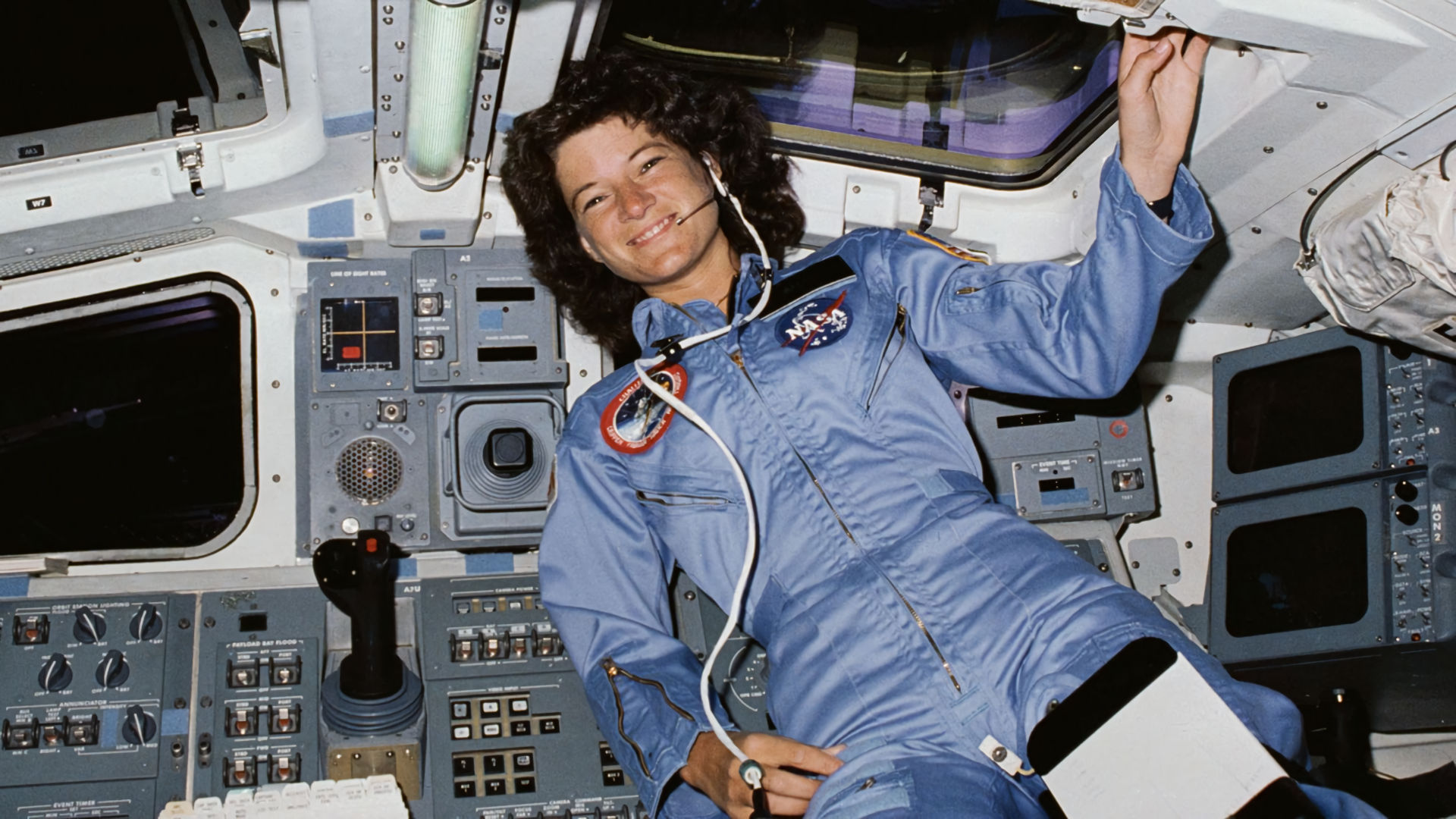
Sally Ride
Sally Ride’s journey into space was historic, but her deeper impact was felt on Earth. She did not simply become the first American woman to travel beyond the planet. She reshaped who felt entitled to imagine themselves among the stars. At a time when men dominated science, engineering, and space exploration, Ride emerged as a figure of quiet authority, intellectual precision, and unwavering focus. She never sought to be a symbol, yet she became one.
Her life tells a story not of spectacle but of substance. She was a physicist before she was an astronaut, an educator before she was a celebrity, and a reformer long before the world fully recognised the barriers she was helping dismantle. Ride’s legacy lies not only in what she achieved but in how she insisted on being taken seriously in a world that often underestimated her.
Early Years and a Curious Mind
Sally Kristen Ride was born on 26 May 1951 in Los Angeles, California. She grew up in a household that valued curiosity, discipline, and learning. Her father was a political science professor, and her mother worked as a volunteer counsellor. Together, they fostered an environment in which questioning and independent thinking were encouraged rather than constrained.
As a child, Sally showed a wide range of interests. She was athletic, competitive, and intellectually restless. Tennis became a significant part of her early life, and she demonstrated such promise that she briefly considered pursuing it professionally. The sport helped instil resilience and focus, qualities that would later prove essential in the demanding world of science and spaceflight.
Yet even as she trained rigorously on the tennis court, Sally’s curiosity extended far beyond sport. She was drawn to mathematics and science, subjects that challenged her to think abstractly and systematically. Unlike many girls of her generation, she was encouraged rather than discouraged from excelling in these fields. That encouragement mattered. It allowed her to see scientific ambition as natural rather than transgressive.
Education and the Path to Physics
Sally Ride attended Stanford University, where she pursued a degree in physics. Stanford was an environment that rewarded intellectual rigour and independence, and Ride thrived there. She completed her undergraduate degree before continuing on to earn a master’s degree and a doctorate in physics. Her academic focus was astrophysics, a field concerned with the fundamental workings of the universe.
During her time at Stanford, Ride distinguished herself not through flamboyance but through precision. She was known for her analytical clarity and her ability to approach complex problems methodically. She did not dominate conversations, but when she spoke, her contributions carried weight.
This approach would become a defining feature of her career. Ride was not interested in spectacle or self-promotion. She wanted to do the work well, to understand systems deeply, and to contribute meaningfully to scientific progress.
Entering NASA
In 1977, Sally Ride noticed a newspaper advertisement that would change her life. NASA was recruiting a new class of astronauts, and for the first time, women were encouraged to apply. Ride submitted her application without knowing whether the institution truly meant what it said.
The selection process was intense. Thousands applied. Only a handful were chosen. Ride was selected as one of thirty-five astronaut candidates, and one of six women in the group. Her acceptance marked a significant moment in the history of American spaceflight.
NASA in the late 1970s, was still shaped by its earlier culture. The astronaut corps had been built around test pilots, nearly all of them white men with military backgrounds. Ride did not fit that mould. She was a scientist, a civilian, and a woman. Her presence challenged long-standing assumptions about who belonged in space.
Training and Resistance
Astronaut training was physically and mentally demanding. Candidates underwent rigorous preparation, including flight training, survival exercises, technical instruction, and simulations designed to test their responses under pressure. Ride excelled. Her background in physics gave her an advantage in understanding spacecraft systems, and her calm demeanour proved valuable in high-stress situations.
Yet training was not free from bias. Ride faced intrusive questions from the media and, at times, from colleagues who seemed unsure how to treat a woman entering what they still viewed as a masculine domain. She was asked whether she would cry in space, whether menstruation would be a problem, and whether she could handle the emotional strain of the mission.
Ride did not engage publicly with these questions. She dismissed them through competence rather than confrontation. Her strategy was simple and effective. She focused on the work. Over time, her ability made the questions irrelevant.
Becoming an Astronaut
In 1983, Sally Ride was selected as a mission specialist for the Space Shuttle Challenger on mission STS-7. On 18 June of that year, she became the first American woman to travel into space. She was thirty-two years old.
The mission was a success. Ride operated the robotic arm used to deploy and retrieve satellites, demonstrating both technical skill and composure. Her performance was widely praised within NASA, but to her colleagues, she was not a symbol or a headline; she was a professional doing her job well.
The public reaction was immense. Ride became a household name almost overnight. She appeared on magazine covers and was interviewed extensively. For many women and girls, her presence in space was transformative. It made the abstract idea of equality tangible.
Ride, however, resisted being reduced to a single identity. She emphasised that she was an astronaut, not a woman astronaut. Her insistence on being recognised for her competence rather than her novelty reflected her broader philosophy. Representation mattered, but it should not eclipse substance.
Second Mission and Continued Work
Ride returned to space in 1984 on another Shuttle mission, again aboard Challenger for mission STS-41G. Once again, she performed her duties with precision. These flights were not experimental in the sense of early space exploration; they were operationally complex, and each mission required coordination, discipline, and trust.
After her second mission, Ride continued working at NASA in various capacities. She served as a liaison between engineers and astronauts, helping translate technical challenges into practical solutions. Her scientific background made her particularly effective in these roles.
She also contributed to the development of future space programmes, offering insight into training, safety, and mission design. Her influence within NASA extended beyond her flights. She helped shape the institution’s evolving identity.
On 28 January 1986, the Space Shuttle Challenger broke apart shortly after launch, killing all seven crew members aboard. The disaster shocked the nation and devastated NASA.
Sally Ride was appointed to the Rogers Commission, which investigated the causes of the accident. She played a crucial role in uncovering the technical failures that led to the tragedy. Working alongside other scientists, she helped identify flaws in the shuttle’s solid rocket boosters that had been known but insufficiently addressed.
Ride’s involvement in the investigation demonstrated her commitment to accountability. She was willing to confront uncomfortable truths, even when they reflected poorly on the institution she had served. Her work contributed to significant changes in NASA’s safety culture.
Leaving NASA and Turning to Education
Ride left NASA in 1987 and accepted a position as a professor of physics at the University of California, San Diego. Teaching became a central focus of her life. She believed deeply in the importance of education, particularly in science and mathematics.
Ride was concerned by the declining interest in science among young people, especially girls. She recognised that representation alone was not enough. Structural barriers remained. Educational materials often failed to engage students or reflect diverse experiences.
In response, Ride co-founded an organisation dedicated to science education called Sally Ride Science. Through this work, she helped develop curricula, programmes, and outreach initiatives designed to make science accessible and exciting. She focused on inquiry-based learning, encouraging students to ask questions and explore ideas rather than memorise facts.
A Quiet Advocate
Sally Ride was not a loud activist. She did not seek confrontation or publicity. Yet her advocacy was persistent and effective. She challenged institutions through example and evidence.
She spoke openly about the need to support women and minorities in science, emphasising mentorship and opportunity rather than rhetoric. She believed that talent was widely distributed, but opportunity was not. Her work aimed to narrow that gap.
Ride also served on various national committees addressing science policy and education. Her insights were valued because they were grounded in experience. She understood both the demands of high-level research and the realities of classroom teaching.
Private Life and Public Reserve
Throughout her career, Sally Ride maintained a strong sense of privacy. She rarely spoke about her personal life, preferring to keep the focus on her work. Only after her death did it become widely known that she had shared a long-term relationship with her partner, Tam O’Shaughnessy.
This posthumous revelation added another layer to her legacy. Ride had lived during a time when being openly gay could jeopardise professional standing, particularly in institutions like NASA. Her choice to keep her personal life private reflected caution rather than shame.
In death, her story resonated with yet another community. She became recognised as a trailblazer not only for women in science but also for LGBTQ+ representation in fields where visibility had been limited.
Illness and Death
Sally Ride died on 23 July 2012 at the age of sixty-one after a battle with pancreatic cancer. Her death was met with widespread tributes from across the scientific and educational communities.
Colleagues remembered her as rigorous, thoughtful, and deeply committed to her values. Students remembered her as an inspiring teacher who took their curiosity seriously. For many, her passing marked the loss of a guiding presence.
A Lasting Legacy
Sally Ride’s legacy is not defined solely by her time in space. It lives on in classrooms, laboratories, and institutions reshaped by her influence. She demonstrated that excellence does not require spectacle and that progress can be achieved through persistence rather than noise.
Her life reminds us that representation matters most when it is paired with opportunity. She opened doors not by demanding entry but by proving that she belonged.
Ride once said that science is fun and that everyone should have the chance to experience it. That belief guided her work and continues to inspire those who follow in her path.
Final Word
Sally Ride changed the story of space not by rewriting its rules but by expanding its possibilities. She showed that curiosity, discipline, and integrity could take a person beyond the limits imposed by tradition.
She was a scientist who became an astronaut, an educator who became a reformer, and a private individual whose life carried public significance. Her journey reminds us that progress often comes not from grand gestures but from steady commitment to doing work well and opening doors quietly behind you.
In reaching space, Sally Ride helped countless others imagine themselves there, too. Her legacy endures in every young mind that looks up and believes that the universe is not reserved for a few but open to all who are prepared to learn, work, and persist.
Sally Ride FAQ
Sally Ride was an American astronaut, physicist, and educator who became the first American woman to travel into space in 1983.
She flew aboard Space Shuttle Challenger on 18 June 1983 during the STS-7 mission.
After leaving NASA, she focused on science education, co-founding Sally Ride Science to encourage young people, especially girls, to pursue STEM careers.
Yes. She served on the Rogers Commission investigating the Challenger disaster in 1986, and later on the Columbia Accident Investigation Board in 2003.
Sally Ride remains a key figure in science and education because she expanded representation in spaceflight and dedicated her later life to improving scientific literacy.