The Collapse of the Tacoma Narrows Bridge
On the morning of 7 November 1940, a slender suspension bridge stretching across the Tacoma Narrows in Washington State tore itself apart in front of stunned onlookers. Less than five months after opening to traffic, the Tacoma Narrows Bridge collapsed in dramatic fashion, its roadway twisting, rising, and falling like a living thing before breaking away and plunging into the waters below. Film footage of the disaster would later become some of the most famous ever recorded in engineering history. The collapse was spectacular, but it was also deeply instructive. It exposed dangerous gaps in scientific understanding, reshaped bridge design worldwide, and turned a regional embarrassment into a global lesson about the power of wind, resonance, and unintended consequences.
The Setting and Ambition
The Tacoma Narrows is a narrow strait of water connecting Puget Sound with the larger Pacific system beyond. For decades, local leaders dreamed of a direct road connection between Tacoma and the Kitsap Peninsula. Ferries were slow and unreliable, limiting economic development and daily travel. By the 1930s, advances in suspension bridge engineering appeared to offer a solution. Long span bridges had become symbols of modernity and national confidence, particularly in the United States. Projects like the Golden Gate Bridge suggested that engineering had finally mastered scale, elegance, and efficiency.
The Tacoma Narrows Bridge was designed to be bold but economical. The Great Depression placed enormous pressure on budgets, and cost-cutting was not merely encouraged but demanded. Engineers proposed a streamlined structure that would use less steel than traditional designs. The result was a bridge that looked strikingly modern, with narrow stiffening girders and a sleek roadway suspended high above the water. On paper, it met all known safety requirements. In reality, it was dangerously vulnerable.
Design Choices and Hidden Risks
The bridge was designed under the direction of engineer Leon Moisseiff, a respected figure in suspension bridge theory. Moisseiff advocated for flexible structures, believing that lighter bridges could respond safely to wind rather than resisting it rigidly. This philosophy worked well in certain contexts, but it relied on assumptions that were not thoroughly tested at the time.
Unlike earlier suspension bridges, the Tacoma Narrows Bridge used solid plate girders instead of open trusses along the sides of the roadway. This reduced material costs and created a clean, modern appearance. However, it also changed how wind flowed around the structure. The solid girders trapped air and encouraged aerodynamic effects that designers did not yet fully understand. Wind tunnel testing was not standard practice for bridge design in 1940, and the interaction between airflow and flexible structures was still poorly explored.
Almost immediately after construction began, workers noticed something unsettling. The bridge deck moved visibly in even light winds. During construction, the partially completed roadway rose and fell in smooth waves, earning the structure a nickname that would soon become famous: Galloping Gertie. Engineers reassured observers that the motion was normal and harmless. Minor adjustments were made, including the installation of tie-down cables and hydraulic buffers, but none addressed the underlying aerodynamic instability.
Opening to Traffic
The Tacoma Narrows Bridge opened on 1 July 1940. At the time, it was the third-longest suspension bridge span in the world. Local newspapers celebrated the achievement, and motorists eagerly embraced the new crossing. Yet the bridge continued to behave strangely. Drivers reported seasick sensations as the roadway rolled beneath their tyres. Photographs showed the deck forming gentle but unmistakable waves, sometimes rising several feet above its resting position.
Engineers monitored the motion but remained confident. The oscillations appeared regular and predictable, and no structural damage was immediately apparent. The prevailing belief was that the bridge was simply flexible, not dangerous. In hindsight, this confidence would prove misplaced.
The Morning of the Collapse
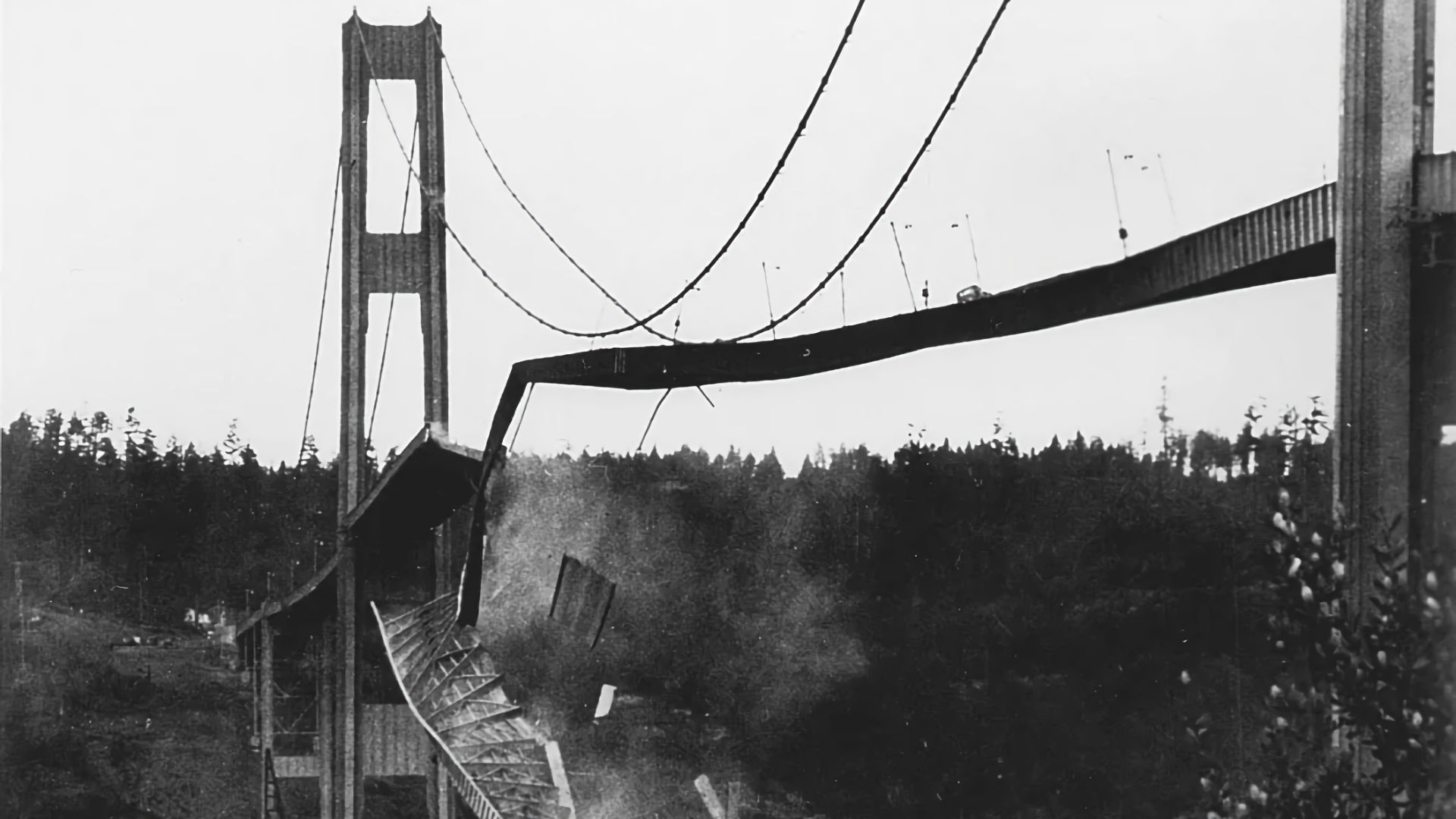
On 7 November 1940, winds blew steadily through the Tacoma Narrows at around 40 miles per hour. Such conditions were not unusual for the area. Early that morning, the bridge began to exhibit its familiar vertical undulations. By mid-morning, the motion had intensified. Instead of rising and falling smoothly, the roadway began twisting along its length. One side of the deck rose while the other fell, creating a violent torsional oscillation.
Motorists abandoned their vehicles and fled on foot as the bridge bucked beneath them. One man, Leonard Coatsworth, barely escaped with his life. He and his car were stranded on the bridge along with his dog, Tubby. Coatsworth crawled to safety, but Tubby remained trapped and was lost when the bridge collapsed. The image of the abandoned car and the doomed dog would become one of the most haunting symbols of the disaster.
Within minutes, the oscillations grew uncontrollable. Sections of the roadway tore loose and fell into the water. Steel cables snapped under the strain. At approximately 11 am, the central span broke apart entirely and collapsed into Puget Sound. Miraculously, no human lives were lost.
Understanding What Went Wrong
In the immediate aftermath, engineers struggled to explain the collapse. Early theories focused on resonance, the idea that wind matched the bridge’s natural frequency and amplified its motion. While resonance played a role, it was not the full explanation. Later analysis revealed a more complex phenomenon known as aeroelastic flutter.
Aeroelastic flutter occurs when aerodynamic forces interact with a structure’s natural modes of vibration in a way that feeds energy into the system. In the case of the Tacoma Narrows Bridge, the wind did not merely push against the bridge; it caused twisting motions that altered airflow, which in turn increased the twisting, creating a self-reinforcing cycle. Once this process began, it could not stop on its own.
The bridge’s narrow deck, solid girders, and extreme flexibility made it especially vulnerable to this effect. There was no significant damping mechanism to absorb the energy being fed into the structure. The result was catastrophic failure.
The Role of Scientific Limitations
It is important to understand that the collapse was not the result of negligence or incompetence in the modern sense. At the time, the science of aerodynamics as applied to large structures was still in its infancy. Engineers relied heavily on mathematical models and past experience, but they lacked experimental data for situations like this.
Wind tunnel testing of bridges was rare and rudimentary. Computational modelling did not exist. Engineers simply did not have the tools needed to predict complex aeroelastic behaviour. The Tacoma Narrows Bridge failed because it crossed a boundary of scale and design that science had not yet mapped.
The Aftermath and Investigation
In the months following the collapse, extensive investigations were carried out. Engineers, physicists, and mathematicians examined film footage, structural remnants, and eyewitness accounts. The disaster became a turning point in engineering education and practice.
One immediate consequence was the widespread adoption of wind tunnel testing for bridge designs. Engineers began building scale models and subjecting them to controlled airflow to observe potential instabilities. Bridge decks were redesigned to allow wind to pass through more freely, often using open trusses or aerodynamic fairings to reduce dangerous effects.
The collapse also prompted a re-evaluation of design philosophy. Flexibility alone was no longer considered sufficient. Engineers recognised the need to balance lightness with stiffness and damping. Structures had to resist and control motion, not merely accommodate it.
Rebuilding the Crossing
The loss of the Tacoma Narrows Bridge was a blow to the region, but it did not end the dream of a permanent crossing. During the Second World War, the need for reliable infrastructure became even more pressing. A replacement bridge was designed with lessons from the collapse firmly in mind.
The new Tacoma Narrows Bridge opened in 1950. It featured a more expansive deck, deeper stiffening trusses, and a design shaped to reduce aerodynamic instability. This time, extensive wind studies were conducted before construction. The replacement bridge has stood safely for decades, joined by a parallel span in 2007 to accommodate increased traffic.
Cultural Impact and Public Memory
The collapse of the Tacoma Narrows Bridge captured the public imagination like few engineering failures before or since. Film footage of the twisting roadway became iconic, shown in classrooms, documentaries, and television programmes around the world. Galloping Gertie entered popular culture as both a cautionary tale and a symbol of hubris.
For engineers, the disaster became a foundational case study. Students learned not just what failed, but why it failed, and how assumptions can prove dangerous when pushed beyond tested limits. The bridge’s collapse reminded designers that nature does not negotiate and that elegance must never come at the expense of understanding.
The incident also influenced public perceptions of engineering. It showed that even advanced technology can fail spectacularly when science lags behind ambition. At the same time, it demonstrated the value of learning from failure. Rather than retreating from bold projects, engineers used the lessons of Tacoma Narrows to build safer, more reliable structures.
Broader Lessons for Engineering
The collapse of the Tacoma Narrows Bridge had implications far beyond bridge design. It highlighted the importance of interdisciplinary thinking, bringing together structural engineering, physics, and aerodynamics. It showed that systems do not exist in isolation. Wind, structure, and motion form a complex whole that must be understood as such.
The disaster also reinforced the idea that testing and experimentation are essential, especially when exploring new design territory. Assumptions based on previous successes can fail when conditions change. The bridge was not inherently flawed because it was new or innovative. It failed because its innovation was not fully understood.
Modern engineers continue to draw lessons from Tacoma Narrows. Skyscrapers, aircraft wings, and even spacecraft components are now designed with careful attention to aeroelastic effects. In many ways, the bridge’s failure helped prevent countless future disasters.
Why the Story Endures
More than eighty years later, the Tacoma Narrows Bridge collapse remains one of the most studied engineering failures in history. Its endurance is due in part to the dramatic footage, but also to the clarity of its lesson. The bridge did not collapse because of a single mistake. It collapsed because of a gap between theory and reality.
That gap is something every generation of engineers must confront. As technology advances, new possibilities emerge, often faster than understanding can keep up. The story of Galloping Gertie serves as a reminder that progress must be paired with humility and rigorous testing.
Final Word
The collapse of the Tacoma Narrows Bridge was a moment of spectacular failure, but also of profound learning. In losing one bridge, the engineering world gained a deeper understanding of how structures interact with the forces of nature. The lessons drawn from that twisting roadway continue to shape design standards and safety practices around the globe.
Today, traffic flows smoothly across the Tacoma Narrows on bridges built with knowledge forged in failure. Beneath their steady spans lies the memory of a structure that danced itself to destruction and, in doing so, taught the world how not to repeat its mistake.
The Collapse of the Tacoma Narrows Bridge FAQ
The bridge collapsed due to aeroelastic flutter, where wind-induced twisting fed energy back into the structure until it failed.
It is a self-reinforcing interaction between wind forces and structural motion that can cause violent oscillations and collapse.
No human lives were lost, although a dog trapped in a stranded car was killed.
Because it visibly moved and undulated in the wind even before its collapse.
It led to mandatory wind tunnel testing, improved aerodynamic design, and a deeper understanding of how structures interact with airflow.