The History of Aviation Accidents
When powered flight first captured the imagination of the world in the early twentieth century, it carried with it a mixture of wonder, excitement, and very real danger. The first aeroplanes were fragile machines made of wood, wire, and canvas, powered by engines that were often unreliable and flown by pilots who were still learning the basic principles of aviation. In those early years, every flight was an experiment. The pioneers of aviation were pushing into completely unknown territory, and accidents were almost inevitable as they discovered what worked and what did not.
The story of aviation accidents begins almost as soon as aircraft themselves appeared. In 1903, the Wright brothers achieved the first controlled, powered flight in North Carolina, but it was clear from the beginning that flying was risky. Aircraft designs were still evolving rapidly, and many early machines lacked stability or control. Pilots had limited training, instruments were almost non-existent, and weather forecasting was extremely basic. These factors combined to make early aviation a hazardous pursuit.
One of the earliest fatal aviation accidents occurred in September 1908 during a demonstration flight at Fort Myer, Virginia. The aircraft was piloted by Orville Wright, who was demonstrating the Wright Flyer to the United States Army as part of a potential military contract. During the flight, a propeller failed, causing the aircraft to lose control and crash. Orville Wright survived with serious injuries, but his passenger, Lieutenant Thomas Selfridge of the US Army Signal Corps, was killed. Selfridge became the first person in history to die in a powered aeroplane crash, marking a grim milestone in the history of aviation.
Throughout the years that followed, accidents remained common as aircraft designers experimented with new ideas and technologies. Aviation pioneers such as Louis Blériot, Glenn Curtiss, and others, built aircraft that were often delicate and difficult to fly. Many early aircraft had open cockpits and minimal structural strength, meaning that even minor mechanical problems could quickly lead to disaster. Pilots were frequently injured or killed while testing new aircraft or attempting record-breaking flights.
Despite the risks, enthusiasm for aviation continued to grow. Public demonstrations and air shows became popular across Europe and North America, drawing large crowds eager to see these new flying machines in action. However, these events also highlighted the dangers of early flight. Pilots often performed risky manoeuvres to entertain spectators, and accidents during demonstrations were not uncommon.
These early tragedies played an important role in shaping the future of aviation. Each accident revealed weaknesses in aircraft design, pilot training, or safety procedures. Engineers and aviation pioneers gradually began to understand the importance of stronger structures, better engines, and improved flight controls. Although frequent accidents marked the early years of aviation, they also laid the foundation for the safety improvements that would eventually make air travel far more reliable.
Learning Through Tragedy: Early Investigations and the Birth of Air Safety
As aviation developed during the early decades of the twentieth century, accidents remained a frequent and sobering reality. Aircraft were improving, but they were still experimental machines operating in an environment that was only partly understood. Each crash, however, brought with it new questions. Why had the aircraft failed? Was the pilot responsible, or had something gone wrong with the machine itself? These questions gradually led to the beginnings of formal accident investigation and the first serious attempts to improve aviation safety.
During the 1910s and 1920s, aviation expanded rapidly, particularly during and after the First World War. Military aviation accelerated the development of aircraft technology, but it also exposed pilots to extreme risks. Training accidents were common, and the pressures of wartime operations often pushed aircraft beyond their limits. Engineers began to recognise that accidents were not simply unfortunate events but valuable sources of information. Each crash could reveal weaknesses in aircraft design or operational procedures that needed to be addressed.
In the early years, accident investigations were often informal. Military units or aircraft manufacturers would examine the wreckage and question witnesses, but there were few standardised procedures. Nevertheless, these early investigations helped identify recurring problems such as structural failures, unreliable engines, and aerodynamic instability. Pilots sometimes lost control of aircraft during certain manoeuvres because the behaviour of wings and control surfaces was not yet fully understood. Discoveries like these gradually shaped improvements in aircraft design.
The rapid growth of commercial aviation during the 1920s and 1930s made safety an even more urgent concern. Airlines were beginning to carry paying passengers, and public confidence depended on reducing the number of accidents. Governments in several countries started to establish regulatory bodies responsible for overseeing aviation safety. In the United States, the Air Commerce Act of 1926 marked an important milestone. It created federal oversight of civil aviation, including aircraft certification, pilot licensing, and the investigation of accidents.
As investigative techniques improved, engineers began to look more carefully at the chain of events that led to crashes. They realised that a single factor rarely caused accidents. Instead, they usually involved a combination of mechanical failure, weather conditions, pilot decisions, and sometimes poor communication. Understanding this complexity was a major step forward in aviation safety thinking.
Investigators also began to preserve and analyse wreckage more carefully, studying damaged components to determine exactly how a failure occurred. This approach helped engineers design stronger aircraft structures and more reliable engines. Improvements in pilot training also emerged from these investigations, with greater emphasis placed on understanding weather, navigation, and aircraft handling.
By the mid-twentieth century, the foundations of modern aviation safety were beginning to take shape. Accident investigation had become a systematic process aimed not at assigning blame, but at preventing future tragedies. The lessons learned from early crashes would gradually transform aviation into one of the safest forms of transportation in the world.
Disasters That Changed Aviation Forever
As aviation expanded during the mid twentieth century, aircraft became larger, faster, and capable of travelling much greater distances. Commercial airlines were carrying growing numbers of passengers across continents and oceans, turning air travel into a vital part of modern life. Yet as aviation became more widespread, the scale and impact of accidents also grew. Some disasters were so significant that they forced the industry to rethink its approach to safety, leading to major changes in aircraft design, regulations, and operating procedures.
One of the most influential accidents occurred in 1954 with the de Havilland Comet, the world’s first commercial jet airliner. The Comet represented a huge leap forward in speed and comfort, but within a year of entering service, several aircraft suffered catastrophic mid-air breakups. One of the most notable crashes occurred near the island of Elba in January 1954, when a Comet operated by BOAC disintegrated while climbing after takeoff from Rome. All 35 people on board were killed. Investigators eventually discovered that the aircraft’s metal fuselage had failed due to metal fatigue around its square-shaped windows. The repeated pressurisation and depressurisation of the cabin had caused tiny cracks to grow until the structure failed. This discovery led to major changes in aircraft design, including the adoption of rounded windows and stronger fuselage construction.
Another disaster that transformed aviation safety occurred on 27 March 1977 at Los Rodeos Airport on the island of Tenerife in the Canary Islands. In poor visibility, two fully loaded Boeing 747 aircraft, one operated by KLM and the other by Pan Am, collided on the runway during takeoff. The crash killed 583 people, making it the deadliest accident in aviation history. Investigators concluded that a combination of miscommunication, poor visibility, and human factors had contributed to the disaster. The accident prompted sweeping changes in pilot training, communication protocols, and cockpit procedures. One of the most important developments was the introduction of Crew Resource Management, a system designed to encourage better communication and teamwork among flight crews.
Some disasters exposed weaknesses in airport safety. In 1985, Japan Airlines Flight 123 crashed into Mount Takamagahara after suffering a catastrophic structural failure caused by an improperly repaired pressure bulkhead. The aircraft lost control and eventually crashed into mountainous terrain, killing 520 people. The accident remains the deadliest single aircraft disaster in history. Investigators found that the failure originated from a flawed repair carried out years earlier, highlighting the importance of strict maintenance standards and inspection procedures.
Each of these tragedies shocked the public and deeply affected the aviation industry. However, they also triggered major improvements in aircraft engineering, pilot training, air traffic control, and maintenance procedures. The lessons learned from these accidents helped transform aviation safety. Although crashes still occurred, each major disaster pushed the industry to develop new safeguards designed to prevent the same mistakes from happening again.
Human Error, Mechanical Failure, and the Complexity of Modern Flight
By the second half of the twentieth century, aviation had entered a new era. Aircraft were faster, more powerful, and capable of carrying hundreds of passengers across the globe. Jet engines had replaced propellers on most long-distance routes, navigation systems were becoming more sophisticated, and airports were growing into complex hubs of international travel. Yet despite these technological advances, aviation accidents still occurred, often revealing that flying safely involved far more than simply building better aircraft.
Investigators studying crashes increasingly realised that accidents rarely had a single cause. Instead, they often resulted from a chain of events in which several small problems combined to create a disaster. Mechanical failures, weather conditions, human decisions, and communication breakdowns could all interact in ways that were difficult to predict. This understanding marked a turning point in aviation safety thinking. Rather than focusing on individual mistakes, investigators began examining how entire systems could fail.
Human error proved to be one of the most significant factors in many accidents. Pilots operate in an environment that demands constant attention, rapid decision-making, and the ability to manage enormous amounts of information. Fatigue, stress, or miscommunication can sometimes lead to critical errors. In some cases, pilots misinterpreted instrument readings or failed to recognise dangerous situations developing around them. These mistakes were rarely the result of incompetence. More often, they occurred because the workload inside the cockpit had become overwhelming.
Mechanical failures also continued to play a role in aviation accidents. Aircraft are highly complex machines containing thousands of components that must operate perfectly together. Engines, hydraulic systems, flight controls, and electronic equipment all need to function reliably at high altitudes and extreme speeds. Even a small defect can have serious consequences if it occurs at a critical moment. Investigators, therefore, began to examine not only how components failed, but also how those failures could be prevented through better design and maintenance.
Weather has always been another major challenge in aviation. Storms, icing conditions, strong winds, and sudden changes in visibility can create dangerous situations even for experienced pilots. Although meteorological forecasting improved dramatically during the twentieth century, weather-related accidents still occurred when crews encountered conditions that were more severe than expected.
The increasing complexity of modern aircraft and air traffic systems meant that safety depended on many interconnected factors working together correctly. Airlines, manufacturers, regulators, and air traffic controllers all played a role in maintaining safe operations. When accidents did occur, investigators began examining the entire system surrounding the flight rather than focusing solely on the final moments before the crash.
This broader understanding helped shape modern aviation safety practices. By recognising that accidents often arise from a combination of human, mechanical, and environmental factors, the industry began developing systems designed to detect and correct problems before they could escalate into disasters.
Black Boxes, Safety Protocols, and the Science of Crash Investigation
As aviation accidents became more complex, investigators needed better tools to understand exactly what had gone wrong. Early crash investigations relied heavily on witness statements and the examination of wreckage, but these methods often left crucial questions unanswered. In many cases, the cause of the crash could be puzzling, with no clear indication of structural failure and no useful information from eyewitnesses. This challenge led to one of the most important innovations in aviation safety, the development of the flight recorder, more commonly known as the black box.
The concept of recording flight data began to take shape during the 1950s. One of the key figures behind this idea was Australian scientist Dr David Warren, who believed that investigators needed access to information from the cockpit in order to understand accidents properly. Warren proposed a device that could record both the technical performance of the aircraft and the conversations between pilots during a flight. His idea eventually led to the creation of two essential devices now found on virtually every commercial aircraft: the Flight Data Recorder and the Cockpit Voice Recorder.
The Flight Data Recorder captures information about how the aircraft is operating during a flight. It records details such as altitude, airspeed, heading, engine performance, and the movement of flight controls. Modern systems record hundreds of parameters, providing investigators with a detailed picture of what the aircraft was doing in the moments leading up to an accident. The Cockpit Voice Recorder, meanwhile, records conversations between pilots as well as other sounds within the cockpit, including alarms, switch clicks, and radio communications with air traffic control.
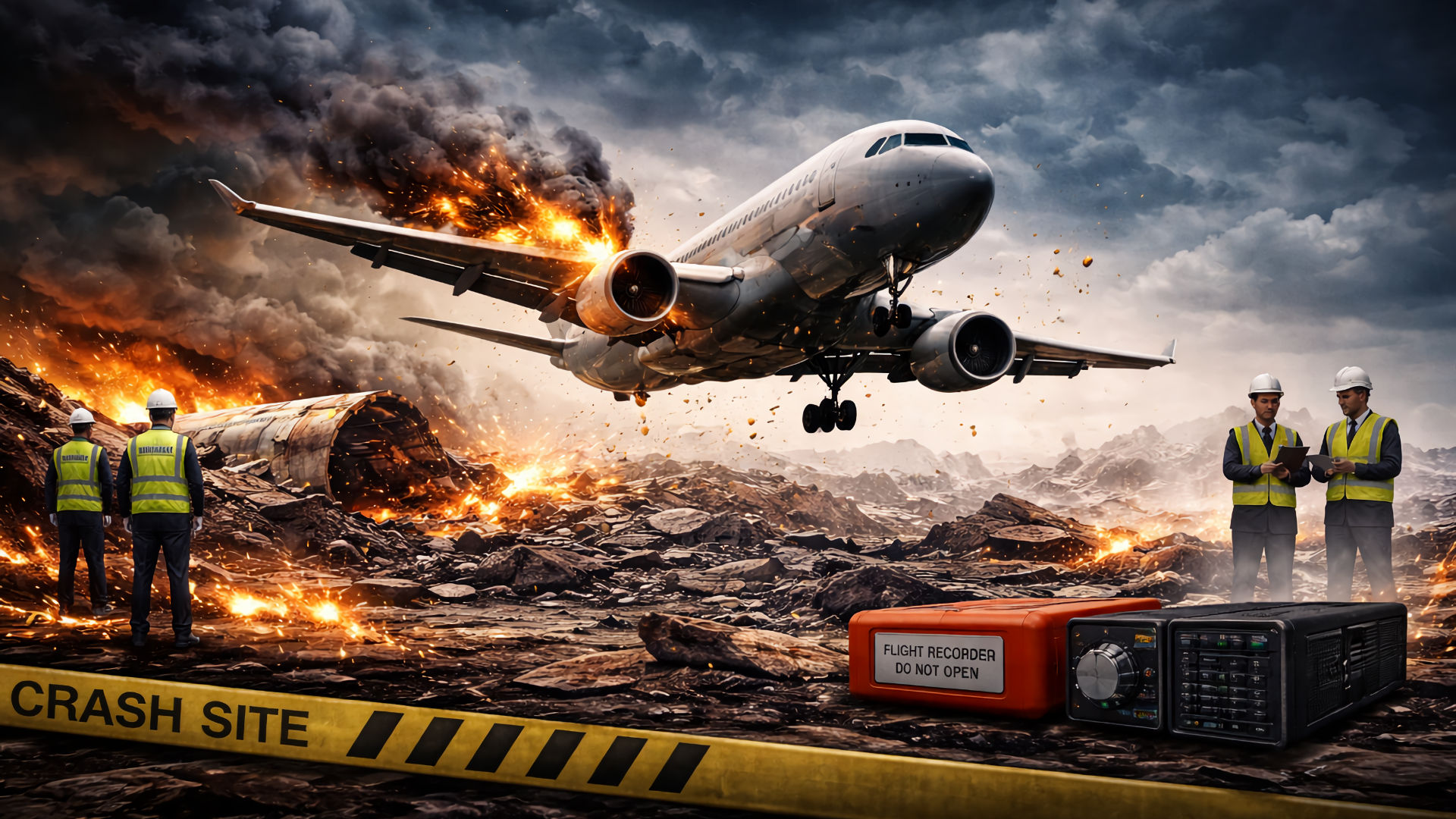
Both recorders are designed to survive extreme conditions. They are housed in bright orange crash-protected containers built to withstand high impact forces, intense heat, and deep water pressure. This durability allows investigators to recover vital information even when an aircraft has been destroyed in a severe crash. Once recovered, the recordings can reveal critical details about the sequence of events that led to an accident.
Alongside these technological advances, crash investigation itself became a specialised scientific discipline. Dedicated investigation agencies were established in many countries, including organisations such as the National Transportation Safety Board in the United States and the Air Accidents Investigation Branch in the United Kingdom. These agencies bring together teams of engineers, pilots, meteorologists, and other experts who analyse accidents in meticulous detail.
Investigators examine every aspect of a crash, from aircraft maintenance records and weather reports to air traffic control communications and pilot training histories. Their goal is not to assign blame but to identify the underlying causes of the accident. Once the investigation is complete, the findings often lead to new safety recommendations for airlines, manufacturers, and regulators.
These advances in investigation techniques have dramatically improved aviation safety. By carefully studying accidents and learning from them, the aviation industry has been able to develop better aircraft designs, stronger safety procedures, and more effective training programmes. Each investigation adds another piece to the ongoing effort to make flying safer for everyone.
From Catastrophe to Safer Skies: How Aviation Became the Safest Way to Travel
Despite the many tragedies that have shaped its history, aviation has gradually become one of the safest forms of transportation ever developed. The transformation did not happen quickly, nor was it the result of a single technological breakthrough. Instead, it emerged from decades of learning, investigation, and constant improvement. Each accident added new knowledge, and the lessons learned were used to strengthen the systems that keep aircraft, crews, and passengers safe.
One of the most important developments in modern aviation safety has been the introduction of multiple layers of protection. Aircraft systems are designed with redundancy, meaning that if one component fails, another can take over. For example, commercial aircraft often have multiple hydraulic systems, several electrical power sources, and backup flight control mechanisms. This approach ensures that a single failure is unlikely to lead to a catastrophe. Engineers also design aircraft structures to withstand extreme stress, ensuring that minor damage does not immediately compromise the safety of the aircraft.
Technology has also played a major role in reducing accidents. Modern aircraft are equipped with sophisticated navigation systems, weather radar, and automated safety warnings that help pilots detect and avoid dangerous situations. One of the most important innovations has been the development of the Ground Proximity Warning System, which alerts pilots if an aircraft is in danger of flying into terrain. Another key system is the Traffic Collision Avoidance System, which warns pilots when another aircraft is approaching too closely and provides instructions to prevent mid-air collisions.
Pilot training has evolved dramatically as well. Airlines now use advanced flight simulators that allow pilots to practise dealing with emergencies in a safe environment. These simulators can recreate engine failures, severe weather conditions, and other challenging scenarios that pilots might rarely encounter during real flights. This training helps ensure that pilots are prepared to respond quickly and effectively if something goes wrong.
Air traffic control systems have also improved significantly. Modern radar, satellite navigation, and digital communication allow controllers to monitor aircraft movements with remarkable precision. This helps maintain safe distances between aircraft and allows for better coordination across busy airspace. International cooperation has also become essential, with organisations such as the International Civil Aviation Organization, a United Nations agency, helping to establish global standards for aviation safety.
Today, commercial aviation operates within a vast network of safety procedures, regulations, and monitoring systems designed to detect problems before they can lead to accidents. Airlines analyse enormous amounts of flight data to identify potential risks, while maintenance teams carry out regular inspections to ensure that aircraft remain in excellent condition. The result of all these efforts is a remarkable achievement. Although aviation accidents still occur, they are now far rarer than in the past. The history of aviation accidents, while tragic at times, has ultimately helped create an industry where safety is the highest priority and where millions of people travel through the skies every day with confidence.
The History of Aviation Accidents FAQ
The earliest fatal powered aircraft accident occurred in 1908 when Lieutenant Thomas Selfridge died after a crash during a demonstration flight piloted by Orville Wright.
Early accidents were often caused by fragile aircraft structures, unreliable engines, limited pilot training, and a lack of understanding of aerodynamics.
A black box refers to the flight data recorder and cockpit voice recorder installed on aircraft. These devices record flight performance and cockpit conversations to help investigators understand accidents.
Several disasters led to major improvements, including the 1954 de Havilland Comet crashes and the 1977 Tenerife runway collision, which transformed aircraft design and pilot communication procedures.
Despite historical accidents, modern aviation is considered one of the safest forms of transportation thanks to strict regulations, improved technology, and detailed accident investigations.