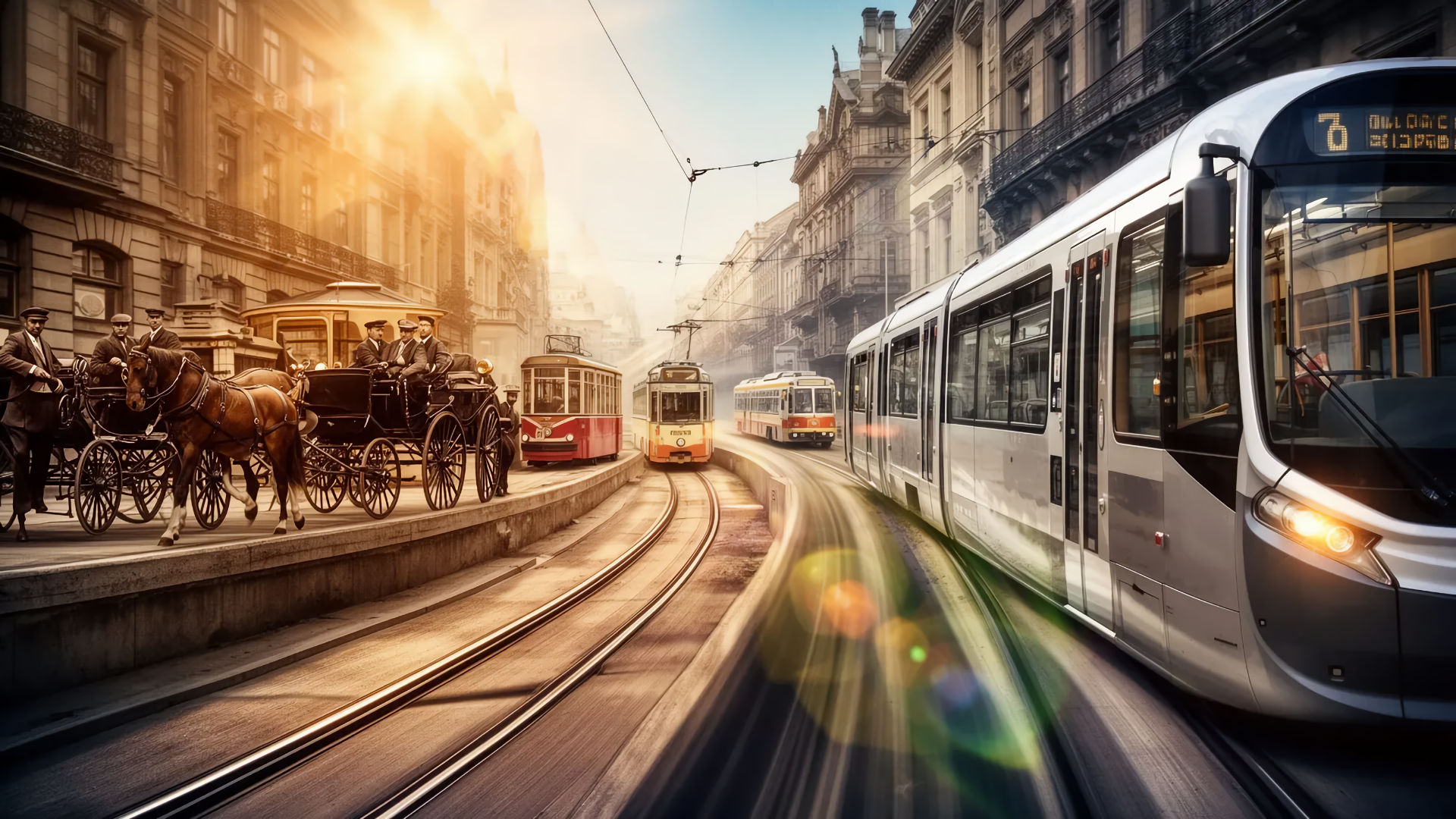
The History of Public Transport
For centuries, public transport has served as a vital artery of urban life, shaping the physical, social, and economic landscapes of cities and nations. From horse-drawn carriages to high-speed trains and autonomous buses, the evolution of public transport mirrors human ingenuity and the constant pursuit of mobility solutions that are efficient, affordable, and inclusive. This is the sweeping history of public transport.
Early Beginnings: Horse-Drawn Carriages and Stagecoaches
Public transport traces its roots back to antiquity, with rudimentary shared transport existing in ancient civilisations such as Rome and Egypt. Wealthy Romans often used litters or carriages, but these were private and did not serve the general population. The concept of shared urban transport truly began to take shape in the 17th century. In Paris in the 1660s, Blaise Pascal helped launch the “carrosses à cinq sols” (five-penny coaches), an early form of horse-drawn bus. Though they were short-lived due to social resistance to mixing classes, they laid the groundwork for future systems.
Stagecoaches in the 18th century offered intercity travel, connecting towns and cities along scheduled routes. They ran on relatively fixed timetables and picked up paying passengers along the way. While slow and uncomfortable, they marked an important evolution in long-distance public transport.
The Omnibus and Urban Expansion
The 19th century witnessed the rise of the omnibus. First introduced in Nantes, France, in 1826 and in London by 1829, the horse-drawn omnibus was a large, enclosed vehicle that followed a regular route. Unlike stagecoaches, omnibuses operated within cities and catered to a growing urban population. Their affordability and frequency made them the first true form of mass urban transit.
The omnibus’s popularity led to overcrowded and congested streets. This problem spurred innovations like the horse-drawn tram, which ran on rails and was smoother, faster, and capable of carrying more passengers. Tram systems emerged in major cities such as New York, Berlin, and Melbourne.
The Railway Revolution
While omnibuses and trams transformed city transport, the advent of railways in the 19th century revolutionised regional and national mobility. The Stockton and Darlington Railway (1825) and the Liverpool and Manchester Railway (1830) heralded the age of the steam-powered train.
Trains enabled faster, more reliable travel over long distances, breaking down geographic barriers and catalysing industrialisation. Railways not only transported people but also goods, reshaping economies and settlements. Suburban rail services emerged, enabling workers to live outside city centres and commute daily.
Urban underground railways soon followed. The London Underground opened in 1863, becoming the world’s first subway system. It used steam locomotives in its early days but soon transitioned to electric trains. Other cities, such as Budapest, Glasgow, and Boston, followed suit.
The Tram and Trolleybus Era
As electric power became more widely available in the late 19th century, tram networks expanded rapidly. Electrified trams replaced their horse-drawn predecessors, offering faster and cleaner service. By the early 20th century, nearly every major city boasted an electric tram system.
Meanwhile, trolleybuses emerged as a flexible alternative. These rubber-tyred vehicles ran on electricity drawn from overhead wires, providing some of the advantages of trams without the need for tracks. They became especially popular in cities where laying tram lines was too expensive or impractical.
The Rise of the Motor Bus
The internal combustion engine gave rise to the motor bus in the early 20th century. Free from fixed infrastructure like tracks or overhead wires, buses offered unmatched flexibility. Municipalities embraced motor buses for their ease of deployment and lower infrastructure costs.
By the 1930s, many cities began to phase out trams in favour of buses. The shift was driven by rising automobile traffic, perceived modernity, and rising maintenance costs for tram systems. Despite this, some cities, such as San Francisco and Melbourne, retained parts of their tram networks.
The bus revolution continued after World War II. Cities expanded their bus fleets to serve growing suburbs, and double-decker buses became iconic symbols in places like London. Innovations in engine technology improved fuel efficiency and comfort.
Metro Systems and Urban Congestion
By the mid-20th century, growing urban congestion reignited interest in high-capacity underground systems. Subway and metro systems proliferated in cities around the world. The Moscow Metro, noted for its grand architecture, opened in 1935. Systems in Tokyo, Paris, and New York expanded dramatically.
Metro systems offered speed, reliability, and efficiency in densely populated areas. Their ability to transport thousands of passengers per hour made them indispensable to urban planning. With dedicated rights-of-way and frequent service, they became a backbone of metropolitan mobility.
Innovations in the Late 20th Century
The latter half of the 20th century saw renewed interest in public transport amid rising concerns about pollution, oil dependency, and urban sprawl. Light rail transit (LRT) systems emerged as a middle ground between buses and heavy rail. Offering higher speeds and capacity than buses but at lower cost than subways, LRTs gained popularity in cities like Portland, Calgary, and Manchester.
Bus Rapid Transit (BRT) systems also began to appear. Pioneered in Curitiba, Brazil, in the 1970s, BRT uses dedicated lanes, rapid boarding stations, and high-capacity buses to provide metro-like service at a fraction of the cost. Cities like Bogotá and Istanbul later adopted BRT on a large scale.
Technological advances also enhanced the passenger experience. Real-time tracking, automated fare collection, and electronic ticketing made public transport more user-friendly. Accessibility improvements, such as low-floor buses and elevators in stations, expanded service to people with disabilities.
Public transport in the 21st century
The 21st century has seen both challenges and transformations in public transport. Rapid urbanisation, climate change, and the COVID-19 pandemic have all influenced how people move.
Environmental concerns have pushed many cities to electrify their fleets. Electric buses and hybrid vehicles are increasingly common. Some cities are exploring hydrogen-powered buses as a cleaner alternative.
Autonomous vehicles are also on the horizon. Pilot programs for driverless shuttles and automated trains are underway in cities like Singapore and Paris. While fully autonomous public transit remains in development, it represents a significant shift in how services might operate in the future.
Sustainability and integration are now central goals. Public transport is increasingly designed to work seamlessly with cycling, walking, and shared mobility options. Transport hubs are becoming multimodal, offering bike parking, scooter rentals, and seamless transfers between buses, trains, and ride-hailing services.
The Social Role of Public Transport
Public transport has never just been about moving people. It shapes the very fabric of society. It provides mobility for those who cannot afford private vehicles, reduces isolation for the elderly and disabled, and contributes to economic equity.
Investments in public transit also boost local economies, reduce traffic congestion, and improve air quality. From bustling metros to rural bus services, public transport is a social equaliser, connecting people to jobs, education, healthcare, and opportunity.
Looking Ahead
As cities face mounting pressure to become greener, more livable, and more inclusive, public transport remains at the heart of the solution. High-speed rail links, smart city integration, and zero-emission fleets are no longer futuristic ideas but present-day goals.
From humble horse-drawn carriages to intelligent, interconnected transit networks, the journey of public transport reflects humanity’s enduring quest for movement, access, and connection. Its future will be shaped by our collective values, sustainability, equity, and innovation, as much as by our engineering prowess.
The History of Public Transport
Horse-drawn carriages known as “omnibuses” in 17th-century France are widely considered the first organised form of public transport.
It led to the development of steam-powered trains and trams, making long-distance and affordable travel possible for larger populations.
Public transport is crucial for reducing congestion, supporting economic activity, and providing accessible mobility in densely populated areas.
Electric buses, driverless trains, high-speed rail, and integrated smart ticketing systems have all modernised public transport networks worldwide.