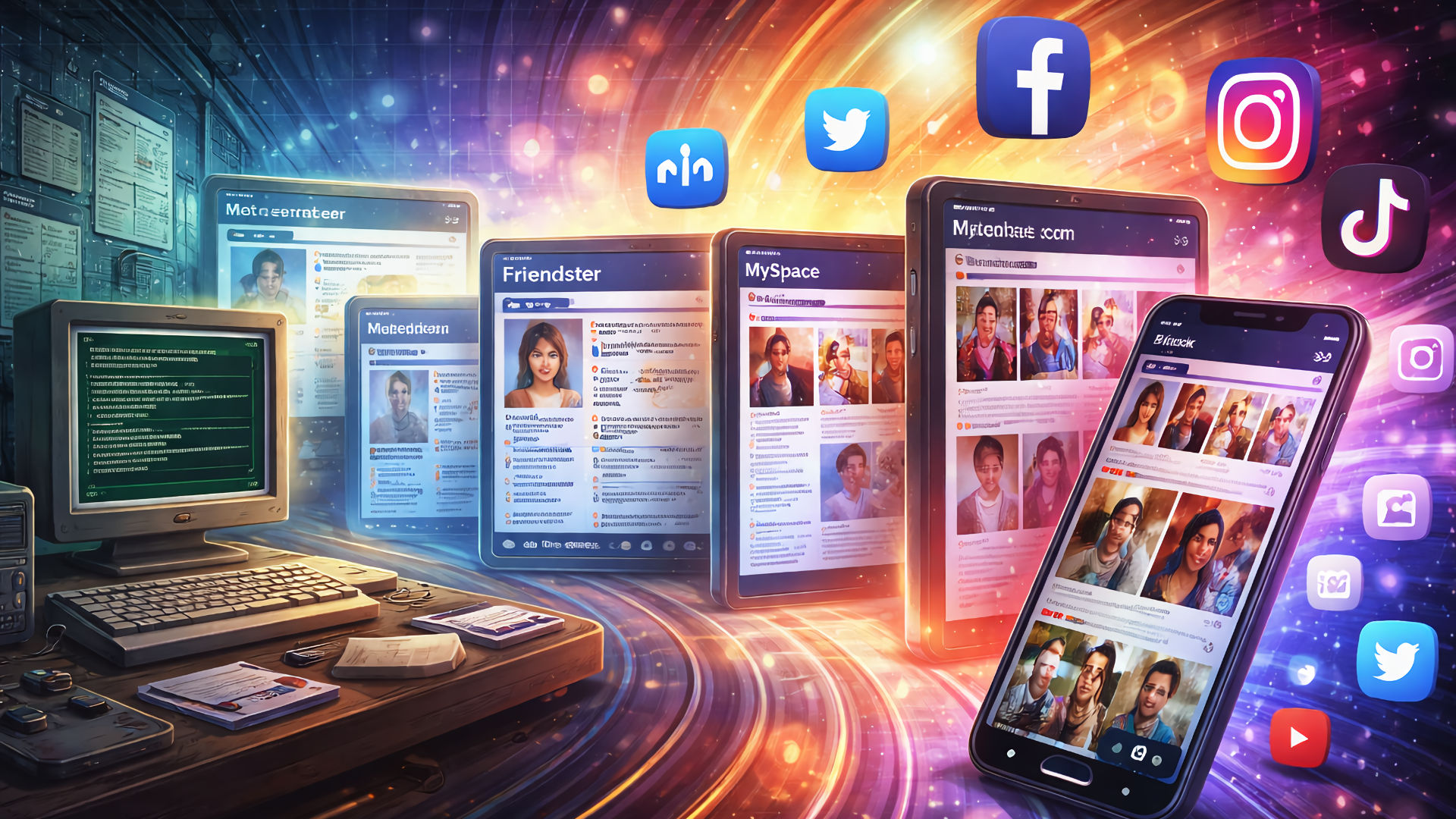
The History of Social Media
Social media did not begin with profiles, photos, or algorithms. Its roots lie in far earlier networked systems created for communication between engineers, academics, and hobbyists, long before the public internet existed.
The first recognisable form of online social interaction appeared in 1978 with the invention of the Bulletin Board System, or BBS. The first BBS was created in Chicago by Ward Christensen and Randy Suess during a snowstorm that prevented in-person computer club meetings. Users connected via telephone modems, one at a time, to post messages, share software, and leave notes for other users. Throughout the 1980s, thousands of independent BBSs emerged globally, each with its own community, rules, and culture. While small in scale, they established core social media behaviours such as usernames, threaded discussions, moderation, and online reputation.
In 1979, a more decentralised system appeared with the creation of Usenet. Developed by Tom Truscott and Jim Ellis at Duke University, Usenet allowed users to post messages to topical discussion groups known as newsgroups. Unlike BBSs, Usenet did not rely on a single host machine. Messages propagated across networks, creating global discussion spaces such as comp.lang.c and rec.sport.baseball. By the mid 1980s, Usenet had become one of the largest public discussion systems in the world, hosting debates, arguments, jokes, and early internet culture. Many conventions still used today, including FAQs, flame wars, and moderation policies, originated there.
Email also played a crucial social role. In 1971, Ray Tomlinson sent the first networked email and introduced the “@” symbol to separate the user from the host. Mailing lists soon followed, allowing groups to communicate collectively. Lists such as SF Lovers, created in the early 1970s, demonstrate that online communities formed almost as soon as networked communication became possible.
In 1988, real-time conversation arrived with Internet Relay Chat, or IRC, created by Jarkko Oikarinen. IRC enabled live group chats organised into channels, with operators, nicknames, and moderation tools. It was widely adopted by developers, gamers, journalists, and activists, and became a major communication tool during events such as the 1991 Soviet coup attempt.
By the early 1990s, these systems had already established the foundations of social media. Users formed identities, joined communities, argued, collaborated, and built relationships entirely online. What they lacked was scale and visual polish, not social behaviour. When the web arrived, it did not invent online social life. It inherited it.
The First Social Networks (1997–2004): SixDegrees, Friendster, and MySpace
The transition from scattered online communities to recognisable social networks began in the late 1990s, driven by the growth of the World Wide Web and the falling cost of internet access. For the first time, platforms were built specifically around personal profiles and explicit social connections, rather than shared topics or messages.
The first service to resemble modern social media was SixDegrees, launched in 1997 by Andrew Weinreich. Named after the “six degrees of separation” concept, SixDegrees allowed users to create personal profiles, list friends, and see connections between people. These features, now taken for granted, were genuinely novel at the time. By 1999, SixDegrees had attracted around one million users. However, the internet audience was still relatively small, and many users struggled to find enough real-world contacts online to make the service compelling. Still, it was sold in December 1999 to YouthStream Media Networks for $125m, just before the dot-com bubble burst. It closed in December 2000, but it established the core architecture of social networking.
The next major step came with Friendster, launched in 2002 by Jonathan Abrams. Friendster expanded on SixDegrees’ ideas and grew rapidly, reaching over three million users within months. It was particularly popular in the United States and later in Southeast Asia. Friendster introduced social networking to a mainstream audience and demonstrated that large-scale online social graphs were possible. However, rapid growth exposed technical weaknesses. Slow performance, server failures, and strict limitations on how users could interact frustrated the community. By the mid 2000s, user engagement declined sharply as competitors emerged.
In 2003, MySpace launched and quickly filled the gap Friendster left behind. Founded by Tom Anderson and Chris DeWolfe, MySpace prioritised user freedom over structure. Users could heavily customise their profile pages with HTML, music, images, and animations. This made profiles chaotic but expressive, and the platform became especially popular with musicians, artists, and teenagers. By 2005, when it was sold to News Corp for $580m, MySpace was the largest social networking site in the world, with over 100 million accounts.
These early platforms shared important characteristics. They introduced persistent personal profiles, public friend lists, and the idea that online identity should mirror real-world social networks. At the same time, they revealed critical weaknesses. Scaling infrastructure was difficult, moderation was inconsistent, and monetisation strategies were unclear.
By 2004, social networking had proven both viable and valuable, but it had not yet stabilised. The basic model existed. What was missing was refinement, reliability, and a platform capable of supporting billions rather than millions. That next phase was about to begin.
Facebook, Twitter, and the Mainstream Breakthrough (2004–2009)
The period between 2004 and 2009 marked the point at which social media moved from niche internet activity into everyday life. This shift was driven by a small number of platforms that combined real-world identity, technical reliability, and rapid network growth, creating services that could scale globally rather than collapse under their own popularity.
The most significant of these was Facebook, launched in February 2004 by Mark Zuckerberg with fellow Harvard students Eduardo Saverin, Dustin Moskovitz, and Chris Hughes. Initially called “TheFacebook”, the site was restricted to Harvard students before expanding to other universities, then high schools, and finally the general public in 2006. Unlike MySpace, Facebook enforced a clean, standardised profile layout and required real names. This reduced anonymity and positioned the platform as an extension of offline social life rather than an escape from it.
Facebook’s introduction of the News Feed in 2006 was a critical turning point. Instead of users visiting individual profiles, content was algorithmically aggregated into a central feed. This fundamentally changed how information circulated online and established the model that would dominate social media thereafter. By 2009, Facebook had more than 300 million users and had become the dominant social networking platform in much of the world.
At the same time, a different approach to social interaction emerged with Twitter. Launched in 2006 by Jack Dorsey, Noah Glass, Biz Stone, and Evan Williams, Twitter was originally designed as a short message service allowing users to post updates of up to 140 characters. Unlike Facebook, Twitter was public by default. Users could follow others without mutual approval, enabling asymmetric networks where journalists, politicians, and celebrities could broadcast directly to large audiences.
Twitter gained wider attention during events such as the 2007 South by Southwest conference, where usage spiked dramatically. It quickly became a platform for real-time commentary on news, politics, and popular culture. Features such as hashtags, replies, and retweets were initially user inventions rather than planned design elements, and were later formalised by the company.
This period also saw the decline of earlier platforms. MySpace struggled after its 2005 acquisition by News Corporation, failing to modernise its infrastructure or user experience. Facebook’s stability, speed, and clearer social purpose made it increasingly dominant.
By the end of the decade, social media had become embedded in daily routines. Real name identities, centralised feeds, and constant updates were now normal. The foundations of modern social media were firmly in place, setting the stage for mobile devices, visual platforms, and far greater cultural influence in the years that followed.
Smartphones and the Visual Turn (2010–2014): Instagram, Snapchat, and WhatsApp
Between 2010 and 2014, social media underwent a decisive shift driven by one piece of hardware: the smartphone. As devices like the iPhone and Android phones became widespread, social media stopped being something people checked at a desk and became something they carried constantly. This changed not just how often platforms were used, but what they were used for.
The most influential platform of this period was Instagram. Launched in October 2010 by Kevin Systrom and Mike Krieger, Instagram was built specifically for smartphones. It allowed users to take photos, apply filters, and share them instantly. The focus on images over text lowered barriers to participation and made content faster to consume. Instagram reached one million users within two months and was acquired by Facebook in 2012 for approximately $1 billion, a clear signal that visual social media was the future.
While Instagram focused on polished images, Snapchat took the opposite approach. Created in 2011 by Evan Spiegel, Bobby Murphy, and Reggie Brown, Snapchat introduced disappearing messages that deleted themselves after being viewed. This challenged the assumption that social media content should be permanent. Snapchat became especially popular with younger users, offering a sense of privacy and informality that Facebook lacked. Features such as Stories, introduced in 2013, would later be copied by multiple platforms.
Messaging also became social. WhatsApp, founded in 2009 by Jan Koum and Brian Acton, expanded rapidly during this period as smartphones and mobile data plans spread globally. WhatsApp offered free or low-cost messaging across borders, replacing SMS in many countries. Group chats, voice messages, and read receipts turned private messaging into a core social experience rather than a simple utility. Facebook acquired WhatsApp in 2014 for $21.8 billion, underlining the strategic importance of private networks.
This period also marked the decline of desktop-first social media habits. Check-ins, live photo uploads, and instant sharing tied online identity to physical location and daily activity. Social media became visual, immediate, and continuous.
By 2014, the direction was clear. Text-heavy platforms were no longer dominant. The future of social media would be mobile-first, image-led, and integrated into everyday life. The next phase would focus not just on connection, but on influence, monetisation, and algorithmic control.
Algorithms, Influencers, and Platform Power (2015–2019): YouTube, TikTok, and Monetisation
By the mid 2010s, social media platforms were no longer simply places to communicate. They had become powerful distribution systems controlled by algorithms, shaping what billions of people saw, shared, and believed. Between 2015 and 2019, the defining change was not the launch of entirely new platforms, but the consolidation of platform power and the rise of monetised influence.
Although YouTube launched earlier in 2005, its transformation into a central social media force accelerated during this period. Acquired by Google in 2006, YouTube increasingly relied on recommendation algorithms rather than subscriptions. By prioritising watch time and engagement, the platform incentivised longer videos, frequent uploads, and emotionally charged content. Creators became professionalised, with full-time careers built around advertising revenue, sponsorships, and brand deals. YouTube personalities reached audiences comparable to traditional broadcasters, often with far less oversight.
Influencer culture expanded rapidly across platforms. On Instagram, users with large followings began to monetise attention through sponsored posts, affiliate links, and partnerships. This blurred the line between personal expression and advertising. Influencers were no longer just popular users; they were marketing channels. Platforms adjusted their tools accordingly, introducing business accounts, analytics dashboards, and paid promotion features.
A major new entrant arrived from China. TikTok, launched internationally in 2018 by the company ByteDance, was built on the earlier app Musical.ly, which it acquired and merged. Unlike previous platforms, TikTok did not rely primarily on social connections. Its “For You” feed was almost entirely algorithm-driven, promoting content based on user behaviour rather than who they followed. This allowed unknown creators to reach millions of viewers overnight. TikTok’s short video format and powerful recommendation system rapidly attracted younger users and reshaped content creation norms.
Algorithmic control also brought scrutiny. Platforms were increasingly accused of amplifying misinformation, extremism, and polarising content because such material generated engagement. Revelations about data misuse, particularly following the Cambridge Analytica scandal involving Facebook in 2018, intensified public and political concern. Governments began holding hearings, demanding explanations of how platforms curated content and handled user data.
By the end of the decade, social media companies had become some of the most powerful corporations in the world. Their algorithms influenced elections, consumer behaviour, and cultural trends. Individual creators could gain unprecedented visibility, but only within systems they did not control.
This period marked a clear shift. Social media was no longer defined primarily by connection. It was defined by attention, monetisation, and algorithmic power, setting the stage for regulatory battles and cultural pushback in the years that followed.
Regulation, Fragmentation, and the Post-Peak Era (2020–Present)
From 2020 onward, social media entered a phase defined less by rapid expansion and more by regulation, political pressure, and structural fragmentation. Growth continued, but the mood shifted. Platforms that had once positioned themselves as neutral technologies were increasingly treated as powerful public actors.
Regulation accelerated first in Europe. The European Union’s General Data Protection Regulation, which came into force in 2018, began to have visible downstream effects in the early 2020s, forcing platforms to alter data handling, advertising practices, and consent mechanisms. This was followed by the Digital Services Act and Digital Markets Act, which targeted content moderation, platform accountability, and market dominance. For the first time, major social media companies faced coordinated legal frameworks rather than isolated fines.
The COVID-19 pandemic intensified scrutiny. During 2020 and 2021, platforms such as Facebook, YouTube, and Twitter became central channels for public health information, but also for misinformation. Governments pressured companies to remove false claims, while critics warned of censorship. This period exposed the difficulty of moderating speech on a global scale, particularly when political trust was already low.
Platform ownership also became a flashpoint. In 2022, Elon Musk acquired Twitter and rebranded it as X in 2023. The takeover led to rapid changes in moderation policy, verification systems, and staffing. Advertisers withdrew, alternative platforms gained attention, and debates over free speech versus platform responsibility intensified. The episode highlighted how concentrated control over a major platform could reshape global discourse almost overnight.
At the same time, user behaviour began to fragment. Instead of one dominant public square, audiences spread across multiple services. TikTok continued to grow, particularly among younger users, while platforms such as Discord, Telegram, and private WhatsApp groups drew users away from public feeds toward smaller, semi-closed communities. The “everything app” model struggled to coexist with rising demand for privacy and control.
Governments outside Europe also moved more aggressively. The United States held repeated congressional hearings involving platform executives. India imposed content and data localisation requirements. Several countries restricted or threatened bans on TikTok over national security concerns, reflecting growing anxiety about foreign-owned platforms.
By the mid 2020s, it was clear that social media had passed its early peak of cultural novelty. It had become infrastructure, embedded in politics, commerce, and daily life, but no longer universally trusted or admired. Growth slowed in mature markets, user sentiment hardened, and regulation became permanent rather than exceptional. Social media did not collapse. It stabilised. The era of unchecked expansion ended, replaced by one of negotiation between platforms, governments, and users. What emerged was not a single shared networked world, but a patchwork of platforms, rules, and communities, shaped as much by law and politics as by technology.
The History of Social Media FAQ
Early forms include bulletin board systems in the late 1970s and Usenet discussion groups created in 1979.
SixDegrees, launched in 1997, is widely considered the first true social networking site with profiles and friend lists.
Social media entered the mainstream between 2004 and 2009 with the rise of Facebook and Twitter.
Smartphones enabled constant access, visual content, and location based sharing, leading to platforms like Instagram and Snapchat.
Concerns over data privacy, misinformation, political influence, and platform power have led governments to introduce regulation.