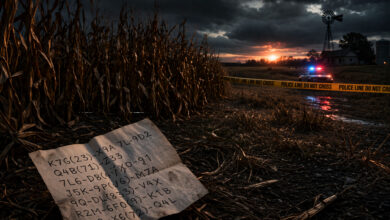
Gary Ridgway – The Green River Killer
In the early 1980s, a thick cloud of fear settled over Seattle and its neighbouring communities. Young women, many vulnerable, living on the streets, or working in the city’s brothel districts, began vanishing at a frightening pace. Families searched desperately, while police puzzled over bodies found discarded in remote wooded areas or dumped into the churning Green River. Whoever was behind these murders showed no mercy, no hesitation, and no desire to stop.
It would take nearly twenty years before investigators discovered that the man responsible was not a shadowy drifter or a figure lurking in the darkness. Instead, he was a married father. A commercial truck painter. A churchgoer who read the Bible. A quiet neighbour who kept his lawn perfectly trimmed.
Gary Leon Ridgway, the man eventually known as the Green River Killer, became one of the most prolific serial murderers in American history. His crimes reveal a chilling truth: evil does not always look like a monster. Sometimes, it looks like the man next door.
Growing Up in Turmoil
Gary Ridgway was born on 18 February 1949 in Salt Lake City, Utah. By many accounts, his early home environment was turbulent. His mother was controlling and domineering. His father, a bus driver, often complained about sex workers, unknowingly planting in young Gary a twisted connection between anger and those he would later hunt.
By his teens, Ridgway was already demonstrating deeply alarming behaviour. At age sixteen, he stabbed a six-year-old boy, leaving him bleeding yet still alive. The attack showed no apparent motive, just a young man inflicting pain to see how it felt.
Ridgway struggled academically, leaving high school near the bottom of his class. He enlisted in the Navy, where he reportedly visited sex workers regularly due to loneliness and insecurity. Later, he would develop a violent obsession with them that fuelled his crimes.
He married multiple times, but those relationships were fraught with jealousy, control, and emotional cruelty. His outward life seemed ordinary. His internal world simmered with hatred and fantasy.
The First Victims
The nightmare began in 1982, when the body of a sixteen-year-old girl was found in the Green River south of Seattle. Soon after, more young women disappeared, many last seen along Pacific Highway South, an area frequented by sex workers and runaway teenagers trying to survive.
When five bodies were discovered in the river within a short span, the media attached a name to the threat: “The Green River Killer.”
Police formed a massive task force to investigate. They interviewed hundreds of potential suspects, including Ridgway, who lived and worked in nearby suburbs. During a 1984 interview, he admitted to picking up sex workers but said he only wanted to help them by offering work cleaning his house. Detectives were uneasy, but they lacked evidence. He passed a polygraph.
And as long as he remained free, he kept killing.
Methodical Hunting
Ridgway targeted young women who were isolated, desperate, or struggling, people that society often ignores. He used this vulnerability to gain their trust, offering lifts or money. Once they were in his vehicle, he would strike suddenly, often strangling them with his bare hands or with ligatures he kept ready.
He murdered quickly. Efficiently. Then discarded the bodies in secluded clusters so he could visit them later. He took jewellery and clothing as trophies. When animals disturbed the remains, he sometimes repositioned the bones.
The horror was not just in how he killed, but how unemotional and routine the acts became for him.
Taunting the Search for Him
The Green River Task Force became one of the most extensive manhunts in US history. At one point, they even brought in serial killer Ted Bundy to provide insight into the killer’s psychology. Bundy suggested that the killer returned to the bodies, a theory that proved chillingly accurate.
Despite the resources in use and the urgency of the case, the investigation stalled. The killer was blending back into everyday life with terrifying ease.
Ridgway watched news of the hunt with interest, proud that he was outsmarting the police. He later admitted that when officers were searching rivers and forests, he continued working overtime, attending church, and raising his son.
The mask of normalcy was airtight.
Forensic Science Catches Up
By the late 1990s, DNA technology had begun to evolve rapidly. Evidence collected from victims in the early years, tiny traces left behind, suddenly offered investigators a new opportunity.
In 2001, detectives confronted Ridgway again, this time with science on their side. DNA linked him to multiple victims. Fibres from his truck and carpets matched remains found at dumping sites.
Gary Ridgway was finally arrested outside his workplace on 30 November 2001. He appeared more annoyed than frightened, calmly insisting he was innocent. But faced with mounting evidence, he soon broke.
A Chilling Confession
To avoid the death penalty, Ridgway agreed to a deal: in exchange for life imprisonment, he would confess to his crimes and help locate additional victims. Over months of interviews, detectives sat across from a man who murdered more than any serial killer in US history.
Ridgway spoke coldly, describing killing as casually as grocery shopping. He said murdering women gave him power. He admitted that he selected victims society looked down upon, believing their disappearances would not be noticed. It was calculated dehumanisation.
He eventually confessed to forty-nine murders. Investigators believe the actual number is likely seventy or even higher. Many victims remain unidentified, known only by physical markers and the places they were found.
Inside His Mind
Ridgway’s motivations were a disturbing mixture of rage, sexual compulsion, and a warped sense of judgment. He justified his violence by claiming he wanted to “rid the world of prostitutes.” Yet he continued to hire them, using their vulnerability as cover for his fantasies.
He was not driven by a desire to be infamous. He was not chaotic or impulsive. He was chillingly ordinary. A predator who learned how to manipulate, charm, and camouflage himself in plain sight.
That may be the most frightening thing about him.
Voices of the Lost
During Ridgway’s sentencing in December 2003, the families of the victims finally confronted him. Some shouted in rage. Others read heartbreaking tributes. One father expressed his grief by telling Ridgway he hoped he rotted in hell.
Then came a moment no one expected: a victim’s relative forgave him. Ridgway, who had remained emotionless throughout dozens of impact statements, began to cry, evidence that even someone who murdered without conscience could still be shaken by compassion he did not deserve.
But closure remained incomplete. Too many victims still lay unnamed. Too many lives ended without being counted in the public memory.
Justice Behind Bars
Gary Ridgway received forty-eight life sentences without the possibility of parole, one for each confirmed murder at the time. For safety reasons, he was transferred to a high-security facility outside Washington State.
He will spend the rest of his life under constant surveillance, stripped of the freedom he once wielded to prey on the vulnerable.
He remains unrepentant for most of his crimes, offering only occasional, hollow apologies. He is a living reminder of a terrifying truth: some predators do not stand out. They hide within the patterns of everyday life.
Investigative Breakthroughs and Lessons
Ridgway’s case forced significant changes in policing, which led to better tracking of missing persons, Increased services for vulnerable young women, modern DNA collection, forensic prioritisation, and collaborative task force models for serial cases.
While these improvements came too late for many victims, they have since saved countless lives.
The Green River killings revealed how society’s neglect of vulnerable populations creates blind spots that predators can exploit. Stronger protections and community awareness have since become crucial components in preventing similar crimes.
Final Word
The story of Gary Ridgway is not one of terror for terror’s sake; it is a stark indictment of how cruelty can flourish unnoticed. He preyed on those who had little or no support, believing they would never be missed. He was wrong; they were missed by families, by friends, and now by history.
Ridgway’s capture was a triumph of perseverance over evil. Yet it remains a reminder that the monsters we fear are not always strangers in the night. They may sit behind us at church. They may wave to their neighbours on the way to work. They may wear the mask of stability so well that even those closest to them never suspect the truth.
The Green River Killer will die behind bars. But the memory of his victims, named and unnamed, must never be buried with him. Their stories matter. Their lives mattered. And their loss continues to shape how we protect the vulnerable from predators who hope no one is watching.
Gary Ridgway – The Green River Killer FAQ
Gary Ridgway was an American serial killer known as the Green River Killer, responsible for at least 49 murders in Washington State.
He earned the nickname because several of his early victims were found near the Green River in Washington.
Investigative limitations, overlooked victims, and Ridgway’s ability to appear ordinary allowed him to evade police for years.
Advances in DNA technology linked Ridgway to the murders decades after they were committed.
He received multiple life sentences without the possibility of parole after pleading guilty in 2003.