The Mystery of the Copper Scroll Treasure
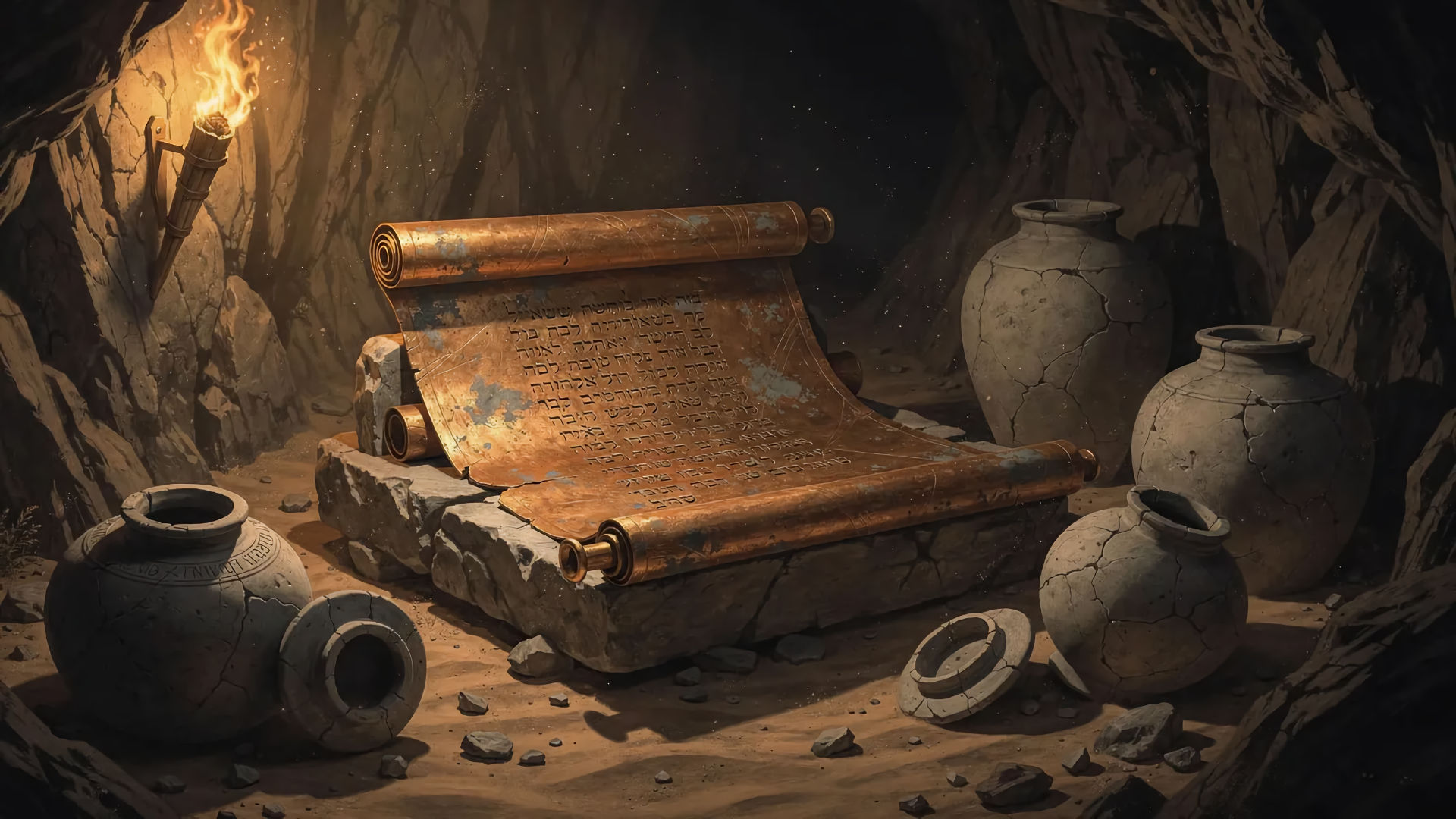
In the spring of 1952, archaeologists working in the caves near Qumran made a discovery that immediately set one artefact apart from the rest. Among the fragile parchment and leather manuscripts known collectively as the Dead Sea Scrolls, one item refused to behave. It was not written on skin or papyrus, but on thin sheets of copper mixed with tin, rolled tightly and already corroding. This was the Copper Scroll, and from the moment it emerged, it was clear that it was something altogether different.
The material alone was unsettling. Copper was heavy, expensive, and awkward to work with. It was not a medium chosen for poetry, law, or theology, which dominated the other scrolls. It suggested permanence, an intention that the text should survive fire, water, and time itself. Whoever created it expected the message to matter long after they were gone.
Then there was the content. When conservators finally cut the scroll into sections to read it, they found no prayers, no scripture, no moral instruction. Instead, the text listed locations, dozens of them, each followed by precise quantities of gold, silver, and sacred objects. Not symbolic riches or allegorical rewards, but exact weights and measurements. It read less like a religious manuscript and more like an inventory, or a set of directions left behind in a hurry.
This immediately posed a problem. The Copper Scroll did not fit neatly into any existing historical category. If it was genuine, it described an immense treasure, possibly connected to the Temple in Jerusalem. If it was symbolic, it was unlike anything else from the period. And if it was a hoax, it was an extraordinarily elaborate one, created using materials and techniques that made no sense for deception.
Scholars were divided from the start. Some argued that the scroll had nothing to do with the other Dead Sea manuscripts and had been hidden separately at a later date. Others believed it was the most important of them all, a literal record of sacred wealth concealed during times of invasion and upheaval. The list of locations was tantalisingly specific yet frustratingly vague, referring to landmarks that no longer exist or whose names have changed beyond recognition.
What made the Copper Scroll truly mysterious was its intent. It was not meant to be read casually. It was meant to be found by someone who knew what it described. That someone, whoever they were, never came back.
From its very first reading, the Copper Scroll posed an uncomfortable question that still hangs over it today. Was this a map to a real treasure, or a message never intended for modern eyes?
An Inventory of Gold, or an Elaborate Riddle?
Once scholars accepted that the Copper Scroll was fundamentally different from the other Dead Sea Scrolls, a more unsettling debate began. What exactly was this text trying to be? At first glance, it reads like an accountant’s nightmare, a relentless list of locations followed by quantities of gold, silver, and sacred objects. There is no narrative, no explanation, no justification. Just instructions. Dig here. Look there. Take this much.
The sheer scale of the treasure described is staggering. If taken literally, the scroll points to tens of tonnes of precious metal, far beyond the wealth of any private individual. Such quantities suggest an institutional source, most commonly linked to the riches of the Jerusalem Temple. According to this interpretation, the scroll is a last desperate record, created as Jewish authorities hurriedly concealed sacred wealth during periods of invasion, possibly in the lead up to the Roman destruction of Jerusalem in 70 CE.
But literal readings raise immediate problems. None of the listed treasures has ever been conclusively recovered. Many of the place names are obscure or entirely unknown, referring to cisterns, tombs, courtyards, and ruins that no longer exist, or perhaps never did in recognisable form. Measurements are precise, yet landmarks are maddeningly vague. To modern eyes, it feels less like a usable map and more like a set of clues missing their key.
This has led some scholars to argue that the Copper Scroll is not an inventory at all, but a riddle. In this view, the treasure descriptions are symbolic, encoding religious or theological ideas rather than physical riches. The gold and silver may represent purity, wisdom, or divine authority. The locations may point to texts, traditions, or rituals rather than buried chests. If so, the scroll was never meant to guide treasure hunters. It was meant to be understood by initiates.
Others reject symbolism entirely and focus on practicality. They argue that the scroll was created for a very small audience, people already familiar with the locations and terminology. To outsiders, it seems cryptic. To insiders, it may have been perfectly clear. The problem is that those insiders are long gone.
What makes the debate so persistent is that both interpretations fail in equal measure. If it is literal, the treasure has vanished without a trace. If it is symbolic, the symbolism is unlike anything else from the period. The Copper Scroll sits uncomfortably between genres, refusing to declare itself either a map or a metaphor.
And that ambiguity is precisely what keeps the mystery alive.
Decoded Words, Impossible Locations
As researchers worked their way through the text of the Copper Scroll, another problem quickly became apparent. Even once the ancient Hebrew was translated, the meaning of the instructions remained frustratingly elusive. The scroll listed more than sixty locations where treasure was supposedly hidden, but many of the place names made little sense, even to experts deeply familiar with the geography of ancient Judea.
Some locations referred to landmarks that no longer exist, such as long vanished cisterns, collapsed tombs, or ruined courtyards whose names appear nowhere else in surviving records. Others seemed to describe places that were never formally named at all, instead relying on local knowledge. A phrase like “in the ruin of the valley of Achor, under the steps” may have been perfectly clear to those who created the scroll, but two thousand years later, it reads like a dead end.
Attempts to match the listed locations with known archaeological sites have produced mixed results at best. In some cases, scholars can identify a general area, a valley, a settlement, or a temple complex. In others, the trail goes cold almost immediately. There are also troubling inconsistencies. Distances are rarely given. Directions are implied rather than stated. Measurements are precise for the treasure, but not for the journey to reach it.
Adding to the confusion is the language itself. The Hebrew used in the scroll differs slightly from that found in other Dead Sea Scrolls. Some words appear nowhere else in ancient texts, leading to disputes over their meaning. Are they technical terms, local slang, or coded references? A single mistranslated word could send a searcher miles in the wrong direction, or centuries away from the intended context.
This has not stopped people from trying. Over the decades, amateur treasure hunters, archaeologists, and even conspiracy theorists have attempted to follow the scroll’s instructions. Some digs have uncovered ancient tunnels or hidden chambers, but none have produced the vast riches the scroll describes. Each failure only deepens the mystery. Either the treasure was removed long ago, or the instructions were never meant to be followed by outsiders.
What makes the locations feel truly impossible is that the scroll seems to assume a shared understanding that no longer exists. It was written for a world with a mental map we no longer possess. Roads have shifted, cities have fallen, names have changed, and memory itself has eroded.
In trying to decode the Copper Scroll, scholars are not just translating words. They are attempting to reconstruct a lost way of seeing the landscape. And so far, that landscape refuses to come back into focus.
Who Hid the Treasure, and Why?
If the Copper Scroll does describe a real hoard, then the question of authorship becomes unavoidable. Who had access to such enormous wealth, and what circumstances would drive them to bury it in dozens of separate locations? The scale alone rules out private individuals. This was institutional money, carefully catalogued and deliberately concealed.
The most widely accepted theory points toward the authorities of the Second Temple in Jerusalem. In the decades leading up to the Roman destruction of the city in 70 CE, Jerusalem was a place of mounting tension. Rebellion simmered, invasions loomed, and sacred wealth faced the very real threat of seizure. Temple treasures were not merely financial assets. They were religious symbols, offerings dedicated to God, and losing them would have been both a spiritual and political catastrophe.
Under this interpretation, the Copper Scroll becomes an emergency document, a last inventory created as priests or officials hastily dispersed sacred objects across the countryside. The use of copper makes sense in this context. Unlike parchment, it could survive burial, damp, and time. The list was not meant to inspire future discovery by strangers. It was meant to preserve knowledge for those who might one day return, once the danger had passed.
But this theory raises uncomfortable doubts. If the treasure belonged to the Temple, why was the scroll hidden near Qumran, a site often associated with a separatist religious community? Some scholars argue that the scroll was not created by the Qumran group at all, but stored there for safekeeping. Others suggest a more complex relationship, involving internal disputes, rival factions, or a deliberate attempt to keep the treasure out of official hands.
Alternative theories widen the circle further. Some propose that the treasure belonged to a dissident sect, perhaps even a radical group opposed to Temple leadership. Others speculate about political motives, suggesting the hoard was hidden to fund future resistance or to preserve wealth for a messianic age that never arrived.
What unites these theories is a sense of urgency. The Copper Scroll does not read like a leisurely record. It feels rushed, practical, and incomplete. There is no introduction, no explanation, no conclusion. It assumes the reader already understands the situation.
Whoever hid the treasure believed there would be a future in which it could be recovered. That future never came, and the reason why may be the greatest mystery of all.
Searches, Claims, and False Discoveries
Once the contents of the Copper Scroll became widely known, it was inevitable that people would start looking. Scholars may have debated symbolism and context, but treasure has a habit of attracting more literal-minded attention. From the mid-twentieth century onward, the scroll inspired a steady stream of expeditions, theories, and confident announcements that the mystery was finally about to be solved.
Early searches were often driven by enthusiasm rather than evidence. Individuals and small groups attempted to match the scroll’s cryptic locations with known archaeological sites, sometimes stretching interpretations to fit a favoured theory. A ruined cistern here, a collapsed tunnel there, each discovery briefly celebrated as a breakthrough before quietly fading into obscurity when nothing of value emerged. Official archaeological teams were more cautious, constrained by permits and preservation rules, but even they found the scroll frustratingly resistant to practical use.
The problem was not a lack of digging, but a lack of certainty. Many of the places named in the scroll are described relative to features that no longer exist. Others may lie beneath modern towns, protected sites, or areas politically impossible to excavate. Even when a location seems plausible, the instructions often end ambiguously, leaving open the question of how deep to dig or what exactly to expect.
Over time, claims of discovery began to appear. Stories circulated of gold bars unearthed in secret, of ancient silver hidden away in private collections, of treasures quietly recovered and never reported. None of these claims has ever been verified. They persist largely because the Copper Scroll itself encourages belief. If the treasure exists, then secrecy would be expected. The lack of proof becomes, paradoxically, part of the argument.
This has also drawn less reputable actors into the story. Pseudo-archaeological ventures, sensational books, and dramatic documentaries have promised revelations that never quite arrive. Each new claim resets public attention, only for disappointment to follow. The Copper Scroll has become a magnet for overinterpretation, its ambiguity exploited by those eager for answers or notoriety.
What remains striking is that despite decades of searching, no discovery has definitively matched the scale or detail of the scroll’s descriptions. Either the treasure was removed long ago, scattered beyond recognition, or it was never there in the first place.
The scroll endures as a record of effort without reward, a map that leads nowhere, and a mystery that grows larger the more people claim to have solved it.
Is the Copper Scroll Treasure Still Waiting to Be Found?
After decades of study, debate, and determined digging, the question remains stubbornly open. Is the treasure described in the Copper Scroll still out there, buried beneath stone and soil, waiting for the proper set of eyes to recognise the clues? Or has the mystery survived simply because there was never anything to find in the first place?
Those who believe the treasure was real argue that the absence of evidence is not evidence of absence. The scroll was written for a specific audience, people who already understood the landscape, the terminology, and the urgency of the moment. Once that community was destroyed or dispersed, the knowledge required to recover the treasure vanished with them. In this view, the scroll has outlived its instructions. The map survives, but the legend explaining how to read it is gone.
There is also the uncomfortable possibility that the treasure was recovered long ago, quietly and without record. In times of upheaval, wealth often changes hands without paperwork or ceremony. If the hoard were retrieved centuries later, its dispersal would leave no clear archaeological footprint. Gold melts. Silver is reused. Sacred objects lose their context. What once had meaning dissolves into the broader economy of history.
Sceptics take a different stance. They argue that the Copper Scroll represents an idea rather than a location, a symbolic text created during a period of crisis to preserve hope, identity, or authority. Under this interpretation, the treasure was never meant to be dug up by future generations. It was a statement, not a set of directions. The fact that it continues to frustrate searchers is not a failure of archaeology, but a misunderstanding of intent.
What gives the mystery its staying power is that neither side can fully close the case. The scroll is too precise to dismiss as pure metaphor, yet too impractical to function as a usable map. It occupies an awkward middle ground, where belief and doubt coexist uncomfortably.
For the Compact Mysteries listener, that tension is the real treasure. The Copper Scroll reminds us that history does not always resolve itself neatly. Some records survive without their context. Some messages outlast their audience. And some questions endure because they were never meant to be answered by us at all. Whether the treasure still lies hidden or never existed beyond the copper itself, the mystery remains buried, not in the desert, but in the space between evidence and imagination.
The Mystery of the Copper Scroll Treasure FAQ
It is an ancient text engraved on copper that lists dozens of locations where large quantities of gold and silver were supposedly hidden.
Unlike other scrolls written on parchment or papyrus, it was made of metal and contains an inventory rather than religious or legal texts.
No confirmed treasure matching the scroll’s descriptions has ever been discovered.
Many scholars believe it was compiled by Temple authorities or a related group before the Roman destruction of Jerusalem in 70 CE.
Some researchers argue the list may be metaphorical or refer to ritual items rather than literal gold and silver.