The Battle of Bannockburn
In June 1314, a weary kingdom braced for a reckoning. For nearly two decades, Scotland had struggled through war and political fracture as English kings sought to dominate their northern neighbour. Robert Bruce, crowned King of Scots in 1306, had spent the intervening years fighting a mobile, often ruthless campaign to break garrisons, win over magnates, and rebuild a national army that could meet England in the field. The siege of Stirling Castle became the hinge. Its English commander had agreed to surrender by midsummer unless relieved. Edward II could not ignore the challenge. He led a large host north to break the siege and crush Bruce’s position. The place where the two forces met, at Bannockburn near Stirling, yielded one of the most studied victories in medieval warfare.]
Opposing Forces and Commanders
Edward II’s army was formidable on paper. Estimates vary, but the English fielded several thousand heavy cavalry and a larger infantry force that included contingents of longbowmen and spearmen, with many of the realm’s greatest lords riding with the king. English strength traditionally lay in shock action by armoured horsemen, supported by archers and foot.
Bruce’s army was smaller and lighter. He relied on schiltrons, dense formations of spearmen drilled to receive cavalry and to push in close combat. Scottish cavalry was limited in number, better suited to scouting and harassing than to a decisive charge. Bruce’s command team included experienced captains, such as his brother, Edward Bruce, Thomas Randolph, Earl of Moray, and Sir James Douglas. Their approach emphasised choosing ground, constricting movement, and forcing the enemy to fight on Scottish terms.
The Ground at Bannockburn
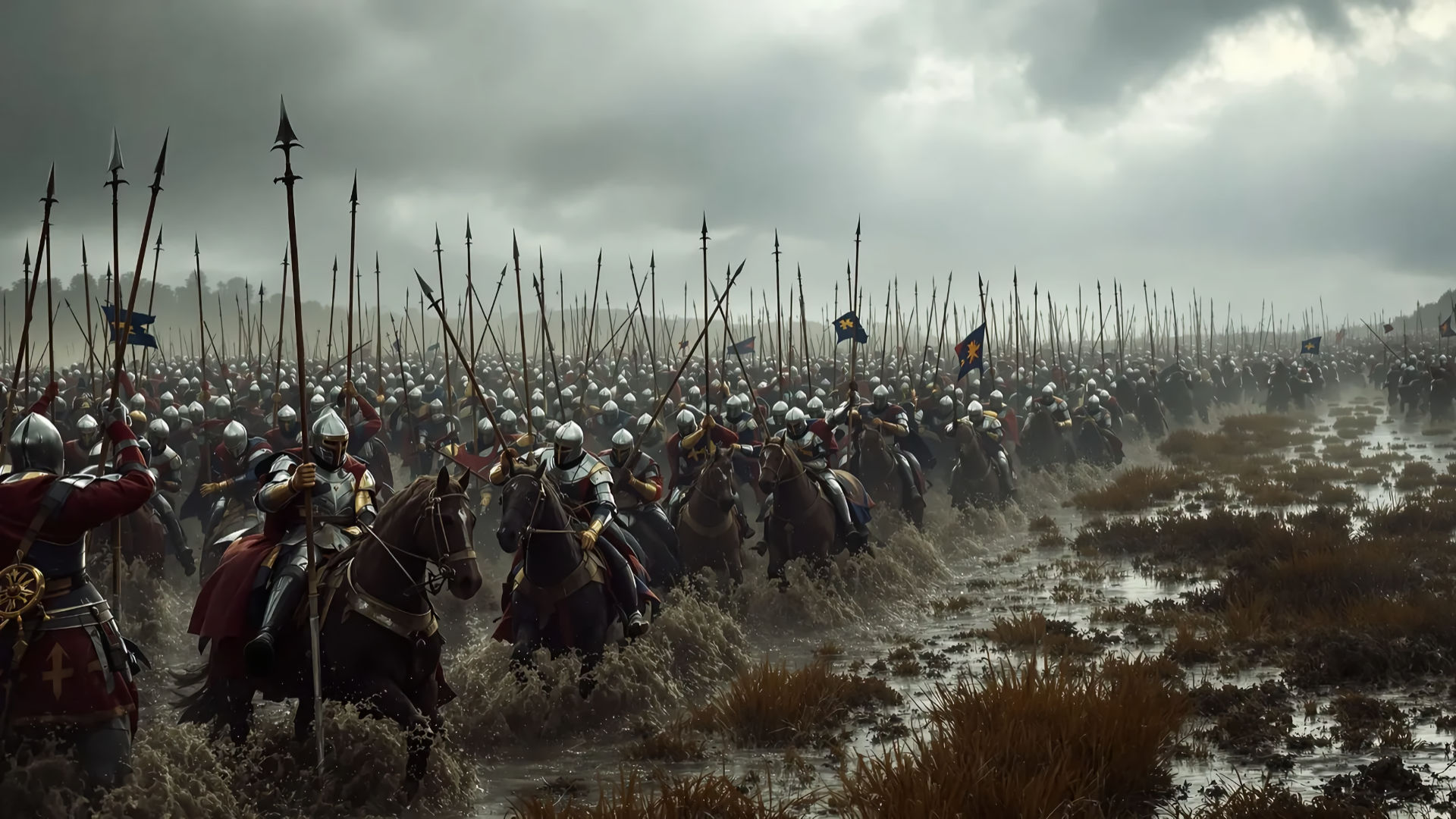
The landscape south of Stirling channelled armies into a few viable approaches. Between the high ground of the Bannock Burn and the steep banks of the Forth lay a patchwork of woods, marshy hollows, and narrow tracks. The carse could turn soft underfoot after rain. Where firm lanes did exist, they were often hemmed in by ditches and scrub. This mattered more than any single weapon. Knights needed space to build speed and keep formation. Archers needed clear arcs. The side that controlled the approaches would decide how and where the enemy could deploy.
Bruce’s Dispositions
Bruce placed his army to block the road to Stirling and to make the English advance a series of narrow tests rather than a broad, open engagement. Randolph held the approach from the east to prevent an outflanking move towards the castle. Edward Bruce covered the direct road south of the town. Robert reserved a small mounted body to strike at archers and to chase opportunities. In the days before the battle, Scottish soldiers prepared the ground. They dug pits and filled them with stakes and brush. They marked the best footing and learned the lie of the channels. Preparation would magnify courage when the enemy arrived.
The English Advance and the Meeting at St Ninian’s
Edward II’s vanguard pushed forward on 23 June. Tension snapped first on the eastern approach, where English cavalry tried to slip past towards Stirling. Randolph’s schiltron intercepted them near St Ninian’s. The clash became a textbook demonstration of drilled spearmen holding firm against mounted shock. Tight ranks, long spears angled out, and steadiness under pressure blunted repeated charges. English riders found no gaps, and horses will not willingly drive themselves onto a wall of points. Consequently, the cavalry fell back, leaving a scatter of dead and wounded that warned of the ground to come.
The Single Combat on Day One
The same day produced a scene that later chroniclers loved to recount. Sir Henry de Bohun, a well-armoured English knight, saw Bruce riding a small horse in front of the Scots. De Bohun lowered his lance and charged. At the last moment, Bruce turned aside, rose in his stirrups, and struck with an axe that split his opponent’s helmet. The story is more than a flourish. It captured a mood. Scottish confidence had grown from years of hard skirmishing. Leadership was personal, visible, and close to the line. The king’s survival and triumph in that instant steadied nerves before night fell.
Night in the Camps
The English army had reached the field in stages, hungry, tired, and not yet properly arrayed. Commanders struggled to bring order to columns bottled up on poor tracks. Many men and horses spent the night without space to rest. Fires smouldered where wood was available. Scouts brought back muddy news of ditches, waterlogged patches, and the stubborn Scottish line. Across the way, the Scots lay in ordered groups, knowing that their pits were dug and their avenues set. Confidence has a material effect. An army that believes it will fight on its terms sleeps differently from one that fears the morning.
Day Two Begins
On 24 June, the English attempted to deploy their strength. The field would not allow it. As blocks of infantry and cavalry pushed forward, they found themselves constrained between the burn, the carse, and the prepared positions to the front. Archers could not easily spread to enfilade the Scottish spearmen. The ground did not favour large horses laden with armoured riders. As the leading elements pressed in, Bruce ordered his schiltrons to advance rather than wait.
The Schiltron as an Offensive Weapon
The word schiltron usually conjures a static hedge of spears, but at Bannockburn the formations moved with deliberate force. Scottish ranks stepped forward, spearheads angled for the first push, and used their mass to squeeze the English into a tighter pocket. Close combat in such conditions is brutal rather than flamboyant. There is little room for individual charges or wide sweeps. Shield presses against shield, spear hafts wedge, and elbows and knees do as much work as blades. In that contest, the side with better footing and more compact order wins. The English cavalry could not generate speed. Infantry could not surge through to open the ranks. The compression favoured Bruce.
The Archers and the Scottish Counter
English longbowmen were a serious threat whenever they could deploy with clear flanks. At times during the fighting, they found angles to shoot into the schiltrons. Bruce had anticipated this. Small mounted groups, including the Marischal’s horse and men under Sir Robert Keith, rode at vulnerable archer bodies and scattered them before volleys could bite. The task required nerve. Light horsemen had to judge when to dart forward and when to slip away before heavier cavalry could catch them. Their success removed a tool the English needed to break the press.
The Collapse
Battlefields often turn on a small number of irreversible shifts. At Bannockburn, one came when English formations, already congested, began to edge backwards as Scottish spearmen pressed. Once a block steps back, men behind it lose footing and cohesion. Horses dislike surging against retreaters. Officers shout and gesture, but their voices carry poorly over the din. Another shift came as the English rear ranks and late arrivals looked forward and saw a heaving mass of men with no clear lane to enter. Crowding worsened. Panic starts as ripples and then becomes a tide. When the front cracks, fear outruns any clarion or banner. The Scottish advance, steady from the first, became a wave that pushed the enemy back towards the burn, the carse, and the death traps they had stumbled through at dawn.
Stirling and the Aftermath in the Field
With the English army broken, pursuit became a scatter of small fights and captures. Many men tried to flee across the burn and into the rough ground. Others sought any open road back towards the south. Stirling Castle did not fall at swordpoint during the battle. Its fate was sealed by the strategic reality that relief had failed. The garrison surrendered on terms under the agreement that had triggered Edward’s march in the first place. The field belonged to Bruce. Weaponry and banners were gathered, prisoners were sorted, and the dead were counted and interred as best the victors could manage.
Why Bruce Won
Bruce won because he shaped every variable he could. He chose ground that narrowed the enemy and hid the worst of the carse. He drilled schiltrons not only to receive but to advance. He used light horse to disrupt archers at the exact moments they might have made a difference. He prepared pits and obstacles that slowed charges and warned riders that bad footing lay ahead. He enforced a chain of command that could keep advancing under pressure. Edward II lost because he allowed a large army to arrive piecemeal on poor ground, then tried to force a decision before it had deployed correctly. His strengths could not be brought to bear in concert.
Numbers and Sources
Exact totals for each side remain contested because medieval chroniclers liked round numbers and preferred heroes to logistics. Most modern estimates accept that the English were significantly more numerous, with a strong mounted arm and many archers, and that the Scots were outnumbered but more cohesive in the key engagements. Contemporary accounts, including the poem by John Barbour and English chronicles, are coloured by perspective but agree on the essentials. The topography around the Bannock Burn and the New Park still illustrates the logic of what happened when a narrow field swallowed a large army.
The Wider War
Bannockburn did not end the Wars of Independence overnight, but it decisively shifted the momentum. In the years that followed, Bruce consolidated control, campaigned in northern England and Ireland, and pressed for diplomatic recognition. English politics under Edward II remained fractious, which limited sustained northern campaigns. The Treaty of Edinburgh and Northampton in 1328 recognised Scottish independence and Bruce’s kingship, though the peace did not last beyond the next generation. Even so, Bannockburn became the symbol of a people’s determination to shape their own future against a larger and richer neighbour.
Myths and Realities
Like any famous battle, Bannockburn attracts myths. One common picture is of gallant charges bouncing off hedgehogs of spears in a simple seesaw. The reality involves careful ground selection, prepared obstacles, and the offensive use of close-order infantry. Another myth is that English archers never had a chance. In fact, they did appear and could have been dangerous. Scottish mounted counterattacks and the cramped lanes prevented the archers from maintaining sustained enfilade fire. A final myth imagines the battle as a single clean crescendo. It was a two-day struggle of probes, interceptions, and managed advances that broke a larger army through control of space.
Tactics and the Shape of Change
Bannockburn sits within a wider shift in medieval tactics in which infantry in disciplined formations proved they could check and defeat mounted elites under the right conditions. The Flemish had shown similar lessons at Courtrai. The Swiss would later demonstrate them with pikes. Scotland’s version depended on the schiltron and on commanders who understood how to use it offensively. None of this made knights obsolete. It did make clear that armour and horse alone could not decide a battle on ground chosen by someone else.
Leadership and Morale
Leadership at short distances mattered. Bruce’s personal presence on day one and his calm direction on day two reinforced a culture of trust within his ranks. English leadership was brave but less coherent. Coordination between the king, his earls, and contingents that had marched hard to reach the field broke down in the crush. Morale flows from such contrasts. The men who won believed the plan was sound and that their king would not throw them into needless slaughter. The men who lost felt the ground pulling at their heels and saw their advance blocked by obstacles that no single charge could clear.
The Field Today
Modern visitors can still read the battle in the land. The Bannock Burn, the New Park, and the approaches towards Stirling illustrate how a commander can use terrain to neutralise an opponent’s advantages. The visitor centre and monuments commemorate a victory woven into Scotland’s national story. The quiet of the place invites reflection on how often battles are decided by choices made before the first arrows fly. A ditch dug the night before, a lane scouted and then denied, a commander who waits until units are dressed and ready, all decide outcomes that later generations mistake for destiny.
Legacy and Meaning
Bannockburn’s legacy is double. For Scotland, it stands as proof that a smaller, disciplined force can prevail when it refuses to fight on the enemy’s terms. For students of war, it offers a case study in the primacy of ground and preparation. It is a reminder that numbers and equipment are only part of the ledger. Cohesion, command, and the will to press at the exact moment when the enemy begins to sag carry equal weight.
Final Word The Battle of Bannockburn was not a miracle. It was a victory earned by patient preparation, sharp reading of the ground, and a disciplined use of infantry to suffocate an enemy that could not deploy at full strength. Robert Bruce and his captains turned a narrow, awkward landscape into a weapon. Edward II and his lords brought courage to a field that punished haste and muddle. When the two met, the result was a broken army and a surge of confidence that carried Scotland through the next phase of its long struggle. The lessons endure because they are practical. Choose your ground, set your traps, keep your order, and only then advance.
The Battle of Bannockburn FAQ
A two day battle on 23 to 24 June 1314 near Stirling, where Robert Bruce’s Scottish army defeated a larger English force led by Edward II.
Bruce chose constricted ground, prepared pits and obstacles, used schiltrons offensively to compress the English front, and sent light horse to scatter archers before they could enfilade the spearmen.
They appeared in parts of the fight, but cramped lanes and targeted Scottish counterattacks kept them from sustained fire that could break the schiltrons.
Stirling Castle surrendered on terms, Scottish momentum surged, and Bruce strengthened his position at home and in diplomacy, leading toward recognition of Scottish independence in the Treaty of Edinburgh and Northampton.