The Battle of Kursk
In the summer of 1943, the Eastern Front paused on a jagged line that curved outward around the city of Kursk. The Red Army had survived the siege of Leningrad, turned the tide at Stalingrad, and pushed the Germans back across the Don and into the Orel and Kharkov regions. Both sides needed a decisive blow. For Germany, that meant restoring freedom of manoeuvre and morale after the winter disasters. For the Soviet Union, it meant proving that Stalingrad was no anomaly and that its growing industrial strength could be turned into sustained operational success. The salient around Kursk, nearly 250 kilometres north to south and 160 kilometres east to west, drew the eye. A strike from north and south could pinch it off. A failed strike could shatter the last reserves of the Wehrmacht in the east.
Plans and Expectations
The German plan, codenamed Citadel, called for a double envelopment. Field Marshal Model’s Ninth Army would attack from the north near Orel, while General Hoth’s Fourth Panzer Army and Army Detachment Kempf would drive from the south near Belgorod. The aim was to meet east of Kursk, encircle a mass of Soviet formations, and destroy them in place. To tilt the odds, the Germans assembled their best formations and much of their newest armour. The heavy Tiger, the long-barrelled Panther and the Ferdinand assault gun appeared in significant numbers, supported by experienced Panzer and infantry divisions and a strong Luftwaffe contingent.
Soviet intelligence, air reconnaissance and partisan reports gave the Stavka ample warning. Marshal Zhukov and Marshal Vasilevsky argued against a premature offensive of their own and persuaded Stalin to let the Germans attack first. The Red Army would meet Citadel with depth and firepower, then counterattack once the German spearheads lost momentum. It was a sober plan that reflected the lessons of 1941 and 1942. The era of hasty counterstrokes against fresh Panzer formations was over. The new standard was layered defence, lavish minefields, strong anti-tank belts and artillery concentrations that could turn a breakthrough corridor into a killing zone.
Forces and Equipment
Germany gathered about 780,000 men, more than 2,700 tanks and assault guns, and around 2,000 aircraft for Citadel. The figures varied day by day as units arrived, repaired equipment and rotated to assembly areas. On the Soviet side, the defenders deployed roughly 1.9 million men, about 5,000 tanks and self-propelled guns, close to 25,000 guns and mortars, and about 2,900 aircraft. Numbers do not tell the whole story. Serviceability rates mattered, fuel mattered, crews mattered, and the ability to move ammunition to the correct battery at the right hour mattered most of all.
Soviet Preparations
The salient bristled with defences. Soviet engineers and civilians laid more than a million mines, many of them anti-tank devices buried in belts which extended several kilometres outwards. They dug thousands of kilometres of trenches, erected anti-tank obstacles, sited bunkers and dugouts, and created multiple fallback lines. Artillery regiments registered pre-planned fires on likely approach routes. Mobile anti-tank reserves with SU-76 and SU-152 guns waited behind the belts. The Red Air Force dispersed its aircraft to forward and satellite fields, thereby improving survivability and response time. All of this sat under camouflage nets and deception schemes that hid the actual weight and layout of the defence. The Germans knew the salient was fortified. They did not appreciate how much.
The Northern Assault
On 5 July 1943, Model’s Ninth Army attacked southward from the Orel region. Progress was slow and costly. The terrain in the north favoured the defender, with woods and rolling ground that broke up tank formations. Ferdinands with powerful 88 millimetre guns knocked out T-34s at long range, yet the assault guns lacked machine guns for close defence and suffered when Soviet infantry infiltrated through dead ground. German units made local gains, then stalled under counterattacks and artillery fire. By 10 July, the northern advance had ground to a halt. The momentum never recovered. Soviet forces launched Operation Kutuzov on 12 July against the Orel bulge, forcing Model onto the defensive and beginning a German retreat that would not stop until autumn.
The Southern Drive and Prokhorovka
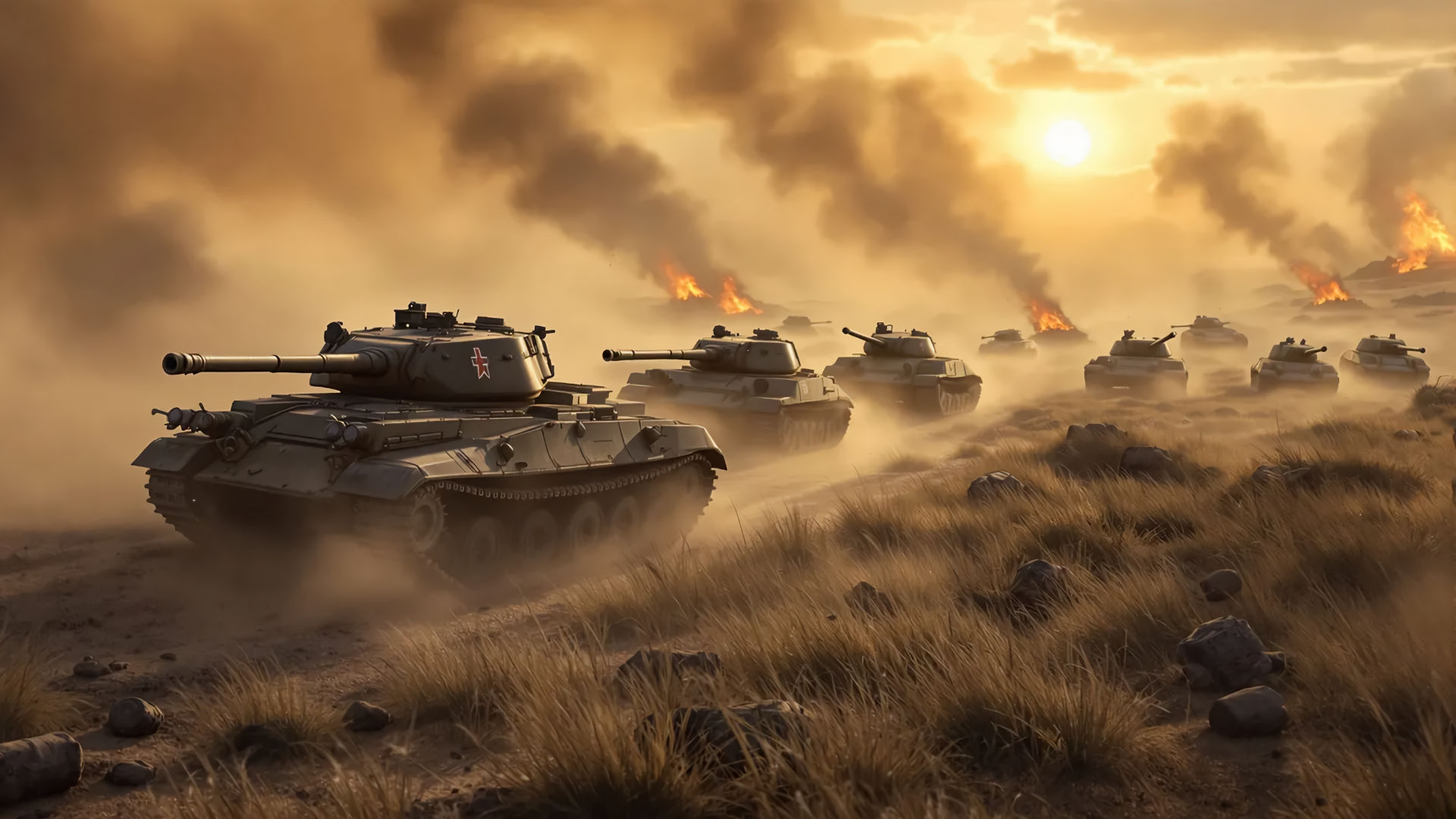
The southern attack under Hoth made faster progress in the first week. The steppe around Belgorod offered better tank country, and German Panzer divisions exploited local breaches with skill, punching into the second defensive belt on the shoulders of the salient. On 12 July, the fiercest fighting erupted near the railway halt of Prokhorovka, west of the Psel River. Two powerful armoured groupings collided: the II SS Panzer Corps on the German side and the Fifth Guards Tank Army under Rotmistrov on the Soviet side. Prokhorovka has often been described as the largest tank battle in history. That label depends on definitions, but the scale was enormous, the ranges were short, and the losses were heavy.
Soviet tank brigades attacked at speed to close the range with Tiger and Panther gunners. Dust, smoke and the tight spaces between anti-tank obstacles and rivers forced engagements into chaotic, close-quarters fights. Many Soviet tanks were knocked out by German fire, others bogged or collided in the press, while German vehicles suffered from mechanical troubles and mines and could not break free into open exploitation. The day ended with the Germans bloodied and checked, the Soviets battered but still holding enough force to counterattack again. The following days saw further hard fighting, but the larger story was turning against Citadel.
The Air War
Above the fields around Kursk, the Luftwaffe and Red Air Force fought their own battle for initiative. German pilots began the offensive with a technical edge in aircraft like the Fw 190 fighter-bomber and the Ju 87D dive bomber, with improved armour, but the Soviet VVS brought numbers, shorter supply lines, and a growing cadre of well-trained pilots. Air superiority swung back and forth by day and sector, rather than belonging to one side consistently. The Soviets improved their low-level air defence with dense belts of light anti-aircraft guns, which raised the cost of Stuka attacks on batteries and bridges. Interdiction of roads and rail lines mattered less than quick, reliable support for units in contact. Here, Soviet ground controllers and forward airfields paid dividends as the battle wore on.
Why Citadel Failed
Citadel was an operational gamble lodged between strategic contradictions. The German plan relied on concentrating quality against a known target, yet that target had months to build layered defences. The Wehrmacht expected that new armour and experienced troops could break a fortified salient quickly enough to avoid exhaustion. Yet, the delay in launching the operation allowed the Soviets to mine, wire and register every approach. German logistics were good by 1943 standards, but not good enough to maintain a high offensive tempo once minefields slowed the advance and artillery fire consumed ammunition at extraordinary rates. Finally, the wider war intruded. On 10 July, the Western Allies landed in Sicily. Within days, Hitler began to pull formations and air units away from the Eastern Front. Even without that diversion, the German spearheads were losing strength faster than they could be replenished at the point of contact.
Soviet Counteroffensives
The Red Army had planned its riposte in two blows. Operation Kutuzov, launched on 12 July against the Orel salient to the north, forced Model to pull units away from the Kursk attack and give ground. The second blow, Operation Rumyantsev in early August, struck the German positions around Belgorod and Kharkov in the south. These counteroffensives combined multiple fronts, dense artillery preparation, and concentrated tank armies aimed at seams rather than strongpoints. By the end of August, Belgorod and Kharkov had fallen, and German forces withdrew to shorter, hastily prepared lines along the Dnieper. Kursk had begun as a German bid to regain the initiative. It ended with the Soviets holding it for good.
Tanks, Guns and Myths
Kursk is often portrayed as a tank battle, sometimes framed as Panthers and Tigers against T-34s. Armour was central, yet artillery and anti-tank guns did most of the killing. Soviet defensive doctrine placed guns in depth, at angles that created overlapping fields of fire, and used camouflage to keep positions alive through the first enemy bombardments. Self-propelled guns like the SU-152, nicknamed Zveroboy or beast killer, could crack heavy German armour at close range when sited carefully. German optical sights and gunnery were excellent, but they could not erase the effects of mines, crossfires and the sheer number of guns covering likely corridors. Air power mattered, though it rarely operated with the freedom seen on the Western Front in 1944. The dominant impression from diaries and after-action reports is of dust, noise, fragmentation and the slow crush of mine belts and artillery barrages rather than sweeping Panzer manoeuvre.
Command and Control
Both sides entered Kursk with better staff systems than they had possessed a year earlier. German army and corps staff still handled combined-arms battles with efficiency at the tactical scale, moving artillery groups and engineer companies into breached sectors and feeding fresh battalions into tight fights. The Soviet command system had matured into a machine capable of coordinating fronts across hundreds of kilometres, using radio networks, liaison officers and pre-planned fire schedules to keep the mass moving. Where the Red Army remained weaker was in tactical flexibility at the lowest levels, which it compensated for with planning, preparation and a willingness to move reserves rapidly along pre-surveyed routes.
Losses and Costs
Casualty figures for Kursk vary by source, methodology, and the time window selected. A cautious summary is that both sides suffered very heavy losses in men and machines across July and August, with the Soviets losing more tanks in absolute numbers yet replacing them faster, and the Germans losing a higher proportion of their best-trained crews and hard-to-replace vehicles. Aircraft attrition was severe on both sides. The actual strategic cost to Germany was the loss of offensive potential. After Kursk, the Wehrmacht on the Eastern Front could still counterattack locally and inflict painful defeats, but it never again assembled the men, tanks and fuel to launch a theatre-level offensive of choice against prepared Soviet forces.
Civilians and the Wider War
The battle unfolded across farmland, towns and villages that had already suffered occupation, deportations and scorched earth. Civilians hid in cellars and ravines while artillery duels and air strikes passed overhead. As the front moved west after July, Soviet authorities faced the twin tasks of restoring railways and clearing minefields, a labour-intensive emergency that relied on civilians and soldiers alike. The wider war pressed in. Italy’s collapse drew German divisions to the Mediterranean, and Allied bombing strained German industry. Soviet factories east of the Urals and along the Volga, relocated in the crises of 1941, now delivered tanks and guns in volumes that outpaced German replacement capacity.
What Kursk Decided
Kursk did not end the Eastern Front. It did decide the rhythm of the remainder. After July 1943, the initiative belonged to the Red Army. The Soviet counteroffensives following Citadel did not stop at the old boundaries. They carried forward through the Dnieper Line into Ukraine and Belarus, and set the stage for the great encirclements of 1944. German commanders could argue for elastic defence or for holding ground as ordered, but they could not create the fuel, tanks and trained replacements that a renewed offensive would require. At the strategic level, the German leadership faced the two-front reality that its generals had long warned about. Kursk crystallised that reality with shells and steel.
Lessons
Kursk offers a few practical lessons that endure through technological change. First, preparation and depth can defeat quality and surprise. The most sophisticated armour loses much of its edge when it is channelled into corridors registered by artillery and laced with mines. Second, logistics and repair underpin operational tempo. The side that can recover damaged vehicles, patch them, and push them back into line faster will slowly tilt the balance, even if daily losses look similar. Third, good intelligence and patience matter. The Soviets resisted the urge to attack early and forced the Germans to expend their cutting edge against planned defences. Finally, air power is decisive in effect rather than in appearance. Control of the sky in short windows and over key sectors matters more than an abstract count of sorties.
The Field Today
Today, the region around Kursk bears memorials, museums and quiet fields that once held belts of wire and mines. Prokhorovka has a bell tower and exhibits that commemorate the armour clash. The ground itself explains parts of the story better than any map. The gentle rises that hide a gun position until the last fifty metres, the long, shallow valleys that force a column into single file, and the vast fields where a commander hopes for manoeuvre only to find dust and range limits are still there. As at many battlefields, the scale is both ordinary and vast. A wheat field is a wheat field, until you imagine five hundred tanks moving across it under shellfire.
Final Word
The Battle of Kursk was less a single titanic clash than a sequence of linked operations in which Germany staked its remaining offensive strength on a double envelopment and the Soviet Union answered with depth, firepower and a timed counterstroke. Citadel opened with confidence and new machines, met a wall of mines and guns, and stalled. The Soviet riposte pushed the front west and marked the moment when initiative changed hands for the rest of the war in the east. If Stalingrad proved that the Wehrmacht could be defeated, Kursk proved that it could be denied its way of war. After July 1943, the Red Army set the pace, and the road to the Dnieper, to Belarus, and eventually to Berlin lay ahead.
The Battle of Kursk FAQ
It was Germany’s plan to cut off the Kursk salient with a double envelopment from Orel and Belgorod, destroy Soviet forces inside, and regain initiative on the Eastern Front.
Months of Soviet preparation created deep mine belts, strong anti-tank zones, and multiple defensive lines. Delays gave the Red Army time to fortify, while attrition, logistics and the wider war drained German momentum.
It was one of the largest close-range armoured clashes, but Kursk as a whole was a series of operations. Artillery and anti-tank guns inflicted the majority of losses on both sides.
Soviet counteroffensives at Orel and Kharkov pushed the front west. From late 1943 the Red Army held the initiative, leading to advances across Ukraine and Belarus and setting conditions for 1944–45.