The Battle of the Plains of Abraham
In the summer of 1759, the global Seven Years’ War reached a decisive moment above the St Lawrence River. Britain sought to break France’s North American empire by seizing Quebec, the fortress city that dominated the waterway linking the Atlantic to the interior. Major General James Wolfe commanded the British expeditionary force. The Marquis de Montcalm led the French field army, supported by Canadian militia and Indigenous allies, while Governor Vaudreuil oversaw the wider defence. After months of manoeuvre, bombardment and naval risk-taking, the war would pivot on a brief, violent encounter on a pasture outside Quebec’s walls.
Why Quebec Mattered
Quebec controlled the corridor between the Atlantic coast and the Great Lakes. If Britain captured the city, French posts inland would be cut off from supplies and reinforcements. The French strategy relied on delaying the British until winter, when ice would drive fleets away and siege lines would become untenable. For Wolfe, time worked against him. Disease thinned his ranks, ammunition and food were finite, and autumn storms threatened to eject the fleet from the river. He needed a way to force Montcalm into a field battle on ground of his choosing before the season closed.
The Armies and Their Leaders
Wolfe commanded roughly 8,000 to 9,000 effectives around Quebec, supported by a powerful Royal Navy squadron under Admiral Charles Saunders. His troops included seasoned regular battalions, light infantry, rangers and marines. Training emphasised controlled volley fire at close range, aggressive light troops to screen and probe, and a willingness to attempt amphibious moves in tight river spaces.
Montcalm’s immediate field force around Quebec numbered about 4,500 to 5,000 on the day of battle, with additional garrison troops in the city and detachments along the river. His army blended French regulars with Canadian militia and Indigenous fighters whose strengths lay in skirmishing, marksmanship and movement through broken ground. Artillery batteries on the heights and within the city supported the defence. Montcalm’s problem was operational. He had to guard dozens of miles of shoreline against British landings while keeping a credible reserve ready to counter any breakthrough.
The Geography of Decision
Quebec sits on a high promontory above the north bank of the St Lawrence. Sheer cliffs and narrow coves protect much of the approach. To the west of the city stretched the Plains of Abraham, a rolling pasture belonging to the Abraham Martin family in the seventeenth century, which by 1759 offered open ground suitable for formed infantry. The French assumed the British could not scale the cliffs west of town in force. Most attention focused on the Beauport shore to the east, where earlier British assaults had met strong resistance from entrenchments, shoals and concentrated fire.
Siege, Raids and a Stalemate
Through July and August, Wolfe probed relentlessly. He bombarded the lower town, burned supply depots, landed raiding parties to cut crops and disrupt logistics, and searched for weaknesses along both banks of the river. A set-piece assault at Beauport on 31 July failed under heavy fire, confirming that a direct approach would be costly and likely futile. Sickness spread in the British camps. Wolfe himself suffered from an illness that left him thin and exhausted, yet he continued to plan a manoeuvre that would outflank the French positions entirely.
The Night Climb at Anse-au-Foulon
The key lay at a small cove west of Quebec called Anse-au-Foulon, where a narrow path zigzagged up the cliff to the plateau. In the early hours of 13 September, Wolfe committed to a daring plan. Protected by darkness and the river’s tricky currents, a column of boats drifted downstream on the ebb tide. Naval officers had rehearsed the timing and cleared earlier obstacles, including chains and pickets that patrolled the water. Some accounts note that British officers used French passwords and accents to mislead sentries along the bank. More important was speed and silence. When the boats reached the cove, light infantry scrambled ashore, overpowered a small guard and pulled themselves up the path using roots and rocks. By dawn, battalions were forming on the heights, musket muzzles flashing in the morning cold.
Montcalm’s Dilemma
The news that British regulars stood on the plateau west of Quebec forced an instant decision. If he waited, the British would entrench and bring up more troops from the river by boat. If he attacked at once, he might disrupt their deployment before the position hardened. Governor Vaudreuil favoured waiting for the capable Chevalier de Lévis, who was marching with reinforcements, but Montcalm judged that delay would be fatal. He chose to strike immediately and ordered his line forward from the city and the Beauport camp into the open ground of the Plains of Abraham.
Deployment on the Plains
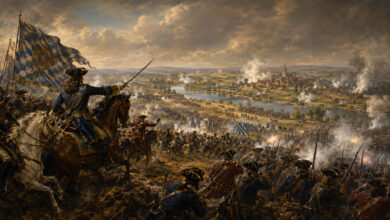
Wolfe arrayed his infantry in two ranks rather than the traditional three, widening his frontage and maximising firepower. Light infantry and rangers screened the flanks, while a small reserve stood ready. He instructed his men to hold fire until the French closed within lethal distance. The British line was not large, but it was well-dressed and supported by a handful of guns that sailors and artillerymen hauled up the path after the infantry. Every minute brought more redcoats to the plateau as boats shuttled across the narrow river bend.
Montcalm’s line advanced with spirit, but many of his troops were exhausted from a rapid march. The ground was slightly uneven, broken by fences and patches of scrub that disordered formations. Skirmishers moved ahead and peppered the British line, but the decisive moment came when formed bodies closed the gap and the British unleashed a simultaneous volley at short range, followed by a second devastating fire. Contemporary accounts agree on the effect. The front of the French line crumpled. British battalions stepped forward with bayonets and delivered controlled platoon fire as they advanced.
Wolfe and Montcalm Fall
Battles often turn on the fate of leaders at the critical point. Wolfe was struck twice and then mortally wounded as he led the advance on the right. He lived long enough to hear that the enemy was giving way. Montcalm, rallying his men near the centre, was also fatally wounded while riding within range of musketry. The near-simultaneous loss of both commanders became part of the battle’s legend. On the field, it left French command and control vulnerable at a moment that required steady nerve.
The Retreat into Quebec
As the French line broke, Canadian militia and regulars attempted to cover the withdrawal. Some units fought hard in the streets and ditches near the town walls, but the open ground belonged to the British. Within hours, British troops were close enough to invest the city. The garrison, now under the Chevalier de Ramezay, weighed its choices. Supplies were low, the British controlled the heights, and the fleet still commanded the river. After short negotiations, Quebec capitulated on 18 September. The British secured the city, but not the wider war.
After the Victory: Sainte-Foy and Montreal
The campaign did not end with Wolfe’s success. Over the winter, the British garrison in Quebec suffered from cold, hunger and scurvy. In the spring of 1760, the Chevalier de Lévis advanced with a strong French force and defeated the British outside the city at the Battle of Sainte-Foy on 28 April. It was a bloody reversal that pushed the British back into Quebec’s defences. Yet naval power again proved decisive. When British relief ships reached the St Lawrence and French vessels did not, Lévis could not maintain the siege and withdrew upriver. In September 1760, a British three-pronged advance converged on Montreal. With supplies gone and no realistic prospect of relief, the remaining French forces capitulated. The fall of Montreal ended organised French rule in Canada. The Treaty of Paris in 1763 formalised the cession.
Indigenous Allies and Canadian Militia
Indigenous warriors from several nations fought alongside the French, as they had throughout the conflict. Their strengths were scouting, ambush and knowledge of the riverine landscape. On the day of the Plains, their methods were less suited to the formal, open exchange of volleys that unfolded on the pasture, thereby reducing their influence on that specific action. Canadian militia were present in numbers, and many fought with determination in skirmishes, raids and the later battle at Sainte-Foy. The common portrayal of the battle as a duel of European regulars overlooks how local fighters shaped months of operations before and after the single morning on the Plains.
Tactics, Firepower and Discipline
The outcome on 13 September turned on a sequence that British training prized. Two-rank lines allowed more muskets to fire at once. Holding fire until the last moment conserved ammunition and maximised effect. A controlled forward movement kept pressure on a shaken opponent. None of this worked without discipline under stress. The climb demanded steadiness. The deployment required quiet drill on unfamiliar ground. The volley depended on iron control. Naval cooperation mattered too. Without the fleet’s precise navigation, the boats would not have reached the cove together, and the fragile bridge of movement between river and plateau would have snapped.
Myths and Realities
The drama of the cliff ascent has invited embellishment. The path at Anse-au-Foulon was real, as were the sentries, but the climb was not a fantastical sheer-face assault. It was a daring, rapid movement along a difficult but practicable route that succeeded because of surprise and timing. Another myth imagines the battle as a long struggle. In reality, the main exchange lasted perhaps fifteen minutes of concentrated fire and advance once both lines were engaged. The battle’s brevity magnified the importance of preparation and first moves.
Logistics and the River
The St. Lawrence was both a highway and a hazard. British mastery of river operations enabled landings along the banks to stretch French responses thin. Small boat work at night, in currents and with shifting sandbars, demanded seamanship of a high order. The army’s siege operations relied on naval guns, sailors to man batteries ashore, and a steady flow of powder and shot ferried in barges. French defenders, conversely, depended on overland routes and interior waterways that became harder to use once British patrols prowled the river bends.
Politics and Command
Montcalm and Vaudreuil represented different strands of French command culture in Canada. Montcalm favoured European regular tactics and sought decisive battle when conditions seemed right. Vaudreuil understood the strengths of Canadian militia and Indigenous allies and preferred a war of posts and skirmishes. Their partnership was strained by personality and policy, which complicated the defence. On the British side, Wolfe was young, ambitious and creative, sometimes to the point of friction with subordinates. Even critics admitted that he pushed joint operations farther than many would have dared, and on the crucial night, the system worked.
The Wider War and the Atlantic World
The Plains of Abraham mattered because they unlocked a chain of consequences across the Atlantic world. With Canada lost, France shifted focus to the Caribbean and to European theatres. Britain gained control of vast new territories in North America, which created administrative and financial burdens that would echo into the next decade. The Quebec Act of 1774, which protected French civil law and Catholic practice in Canada, was one of several imperial measures that angered some British colonists to the south, helping to seed grievances that fed the American Revolution. A short morning’s fight on a Quebec pasture thus rippled outward into the politics of empire and revolution.
Memory and Commemoration
For generations, the deaths of Wolfe and Montcalm have framed the story. Paintings enshrined a romantic image of noble opponents falling honourably in the same hour. Modern scholarship stresses the collective labour that made the moment possible, from sailors rowing silently against the current to light infantry hauling themselves up a cold slope before dawn. The battlefield today forms part of a public park in Quebec City. Visitors can look across the river bend, trace the lines of advance and imagine how a quiet pasture could host a decision of continental scale.
Archaeology and the Ground
Today, archaeological work on and around the Plains has recovered musket balls, buttons and fragments that complement the written record. Map study reveals how fences and small rises shaped the lines of sight and the timing of volleys. The Anse-au-Foulon area has changed with urban growth, yet the contours that mattered remain visible. Such studies reinforce a simple lesson. Battles are not abstractions. They happen in places where a path, a fence and a river current can decide who fires first.
Why the Battle Ended as It Did
The British took a calculated risk and moved faster than their opponent could adjust. Surprise created the foothold on the heights. Discipline turned the foothold into a line. Firepower at close range broke the first French assault. Naval control of the river locked in the strategic result by enabling a quick investment and preventing French relief. Montcalm faced a terrible choice and chose action. Had he waited for Lévis, the British might have entrenched and created a siege platform that would have been equally difficult to dislodge. History often offers unkind options. On that September morning, minutes decided decades.
Final Word The Battle of the Plains of Abraham was a brief clash with very long shadows. It fused audacity with drill, naval skill with infantry firepower, and turned geography into an advantage. Wolfe and Montcalm died at the crest of a decision neither could fully control once set in motion. Quebec fell, Montreal followed, and the map of North America changed. For students of warfare, the battle stands as a case study in timing, joint operations and the power of a single manoeuvre to unlock a strategic position. For the people who lived with its consequences, it shaped law, language, allegiance and memory for centuries to come.
The Battle of the Plains of Abraham FAQ
A short, decisive battle fought on 13 September 1759 outside Quebec City during the Seven Years’ War, where British forces under James Wolfe defeated French forces under the Marquis de Montcalm.
A surprise night ascent at Anse-au-Foulon put disciplined infantry on the plateau. Formed in two ranks, they held fire until close range and delivered controlled volleys that shattered the French line before it could settle.
Yes. Royal Navy control of the river enabled the stealth landing, sustained the army with guns and supplies, and later prevented French relief, making Quebec’s capitulation inevitable.
Quebec fell on 18 September. After a spring reversal at Sainte-Foy, British naval relief secured the city, Montreal fell in 1760, and the 1763 Treaty of Paris transferred Canada to Britain, reshaping North America.