
The Battle of the Somme
By the end of 1915, the First World War had ground itself into a stalemate that nobody had planned for, and nobody knew how to escape. The Western Front stretched from the North Sea to the Swiss border, locked in trench systems that had barely moved in over a year. Casualties were already staggering, yet neither side could deliver a decisive breakthrough. For the Allies, something had to change in 1916, not because victory was within reach, but because inaction meant slow exhaustion and eventual collapse.
The immediate pressure came from the east. In February 1916, Germany launched a massive offensive against the French at Verdun, deliberately targeting a position the French felt compelled to defend at any cost. The objective was not to seize ground, but to inflict sustained casualties that would exhaust the French Army. By spring, French casualties were mounting at an alarming rate, and their capacity to sustain the war was in real danger. Britain, whose army was still expanding and relatively untested, was now expected to take on a far larger role.
The Somme offensive emerged from this crisis. Originally planned as a joint Anglo-French attack designed to break through German lines, events at Verdun reshaped it into a relief operation. The objective became simpler and far more grim: force the Germans to divert troops away from Verdun by attacking along the River Somme, where British and French forces operated side by side. If a breakthrough could be achieved, so much the better, but even failure might still serve a strategic purpose by easing pressure elsewhere.
British leadership also saw the Somme as a necessary proving ground. Lord Kitchener’s volunteer army, raised in 1914 and 1915, was now ready for large-scale combat. These were not professional soldiers, but civilians turned infantrymen, trained quickly and sent into an industrial war that rewarded experience above all else. The Somme would be their first major test, whether the army was ready or not.
Underlying all of this was a deeply flawed belief shared by many commanders on both sides. There was confidence that a massive artillery bombardment could destroy German defences, cut barbed wire, and shatter morale to the point where infantry could simply walk forward and occupy the enemy trenches. It was an idea born from hope, theory, and limited evidence, rather than battlefield reality. The Battle of the Somme happened because the Allies felt they had no better option, and because the true nature of modern industrial warfare was still being learned the hardest way possible.
The Plan That Looked Good on Paper
The plan for the Battle of the Somme rested on confidence in artillery. Allied commanders believed that modern firepower could solve the problem that trenches had created. If the German front line could be smashed thoroughly enough, the infantry advance that followed would face little organised resistance. It was an attractive idea because it promised a breakthrough without catastrophic losses, or at least with losses that could be justified as necessary and controlled.
At the centre of this belief was the preliminary bombardment. For seven days before the attack, British and French guns would pound German positions along a broad front. More than a million shells were fired, targeting trenches, dugouts, machine gun nests, and barbed wire. Commanders expected the wire to be cut, the trenches to collapse, and the defenders either killed or too shaken to fight effectively. Reports from aerial reconnaissance were often optimistic, reinforcing the belief that the bombardment was working.
The infantry plan reflected this optimism. British soldiers were ordered to advance in long lines, maintaining formation and pace rather than charging forward. This was not carelessness so much as assumption. If the bombardment had done its job, speed and aggression would be unnecessary. Men would cross no man’s land, occupy the shattered German trenches, and push on before reserves could respond. The attack would be broad rather than deep, designed to overwhelm the enemy everywhere at once.
There were, however, serious weaknesses baked into the plan. Many British shells were poorly manufactured and failed to explode on impact. Others were the wrong type for cutting wire or destroying reinforced concrete dugouts. German defences were also far stronger than Allied intelligence appreciated. Deep shelters allowed defenders to survive the bombardment and emerge once it lifted. Machine gun positions, often well protected, remained largely intact.
Communication was another critical flaw. Once the attack began, commanders would struggle to receive accurate information from the front. Telephone lines were easily cut by shellfire, runners were slow and vulnerable, and visual signals were unreliable in smoke and chaos. Despite this, the plan assumed that progress could be monitored and adjusted in real time.
On paper, the Somme offensive appeared methodical, overwhelming, and modern. In reality, it relied on assumptions that had not been properly tested in conditions like those on the Western Front. The gap between theory and battlefield reality would become brutally clear once the bombardment ended and the infantry climbed out of their trenches.
1 July 1916, The Bloodiest Morning
The Battle of the Somme began at 7:30 a.m. on 1 July 1916, immediately becoming the bloodiest day in the history of the British Army. Along a front of roughly 25 kilometres, tens of thousands of soldiers climbed out of their trenches and advanced towards German lines that, contrary to expectations, were largely intact. By nightfall, the scale of the disaster was impossible to hide.
The preliminary bombardment ended moments before the attack, lifting to targets further back to allow the infantry to move forward. Instead of shattered defences, many German units emerged from deep dugouts that had protected them throughout the shelling. Machine guns, pre-sighted and well supplied, were quickly brought back into action. As British troops advanced across open ground, often carrying heavy equipment and ordered to maintain formation, they were met by concentrated fire.
The casualty figures tell the story starkly. On the first day alone, the British Army suffered around 57,000 casualties, including more than 19,000 killed. Entire units were devastated within minutes. Some battalions lost over half their men before reaching the German wire. In certain sectors, soldiers never got close enough to test whether the bombardment had cut the defences at all.
The experience varied along the front. In a few areas, particularly where French forces attacked further south, some gains were made. French artillery was generally heavier and more accurate, and their infantry tactics more flexible. These successes, however, did little to offset the catastrophe unfolding in the British sectors, where most attacks failed almost immediately.
Command and communication problems compounded the disaster. Many senior officers believed progress was being made because no contrary information was reaching them. Telephone lines were cut, runners were killed or delayed, and smoke obscured the battlefield. In some cases, attacks continued long after it was clear on the ground that they had no chance of success.
For the soldiers who survived, 1 July was a traumatic initiation into industrial warfare. Expectations of a manageable advance collapsed in the face of mechanised killing on a massive scale. The first day of the Somme did not break the German line, nor did it significantly relieve pressure on Verdun. What it did do was reveal, in the clearest possible terms, how deadly the gap between planning and reality had become. The battle would continue for months, but the Somme’s reputation was sealed within its opening hours.
Life, Death, and Stalemate in the Trenches
After the catastrophe of 1 July, the Battle of the Somme did not end. Instead, it settled into a grinding pattern that would define the rest of the campaign. Attacks were renewed again and again, often on the same ground, with limited objectives and limited gains. Villages, woods, and ridgelines were fought over repeatedly, changing hands at enormous cost. Progress was measured in yards, not miles, and rarely held without further fighting.
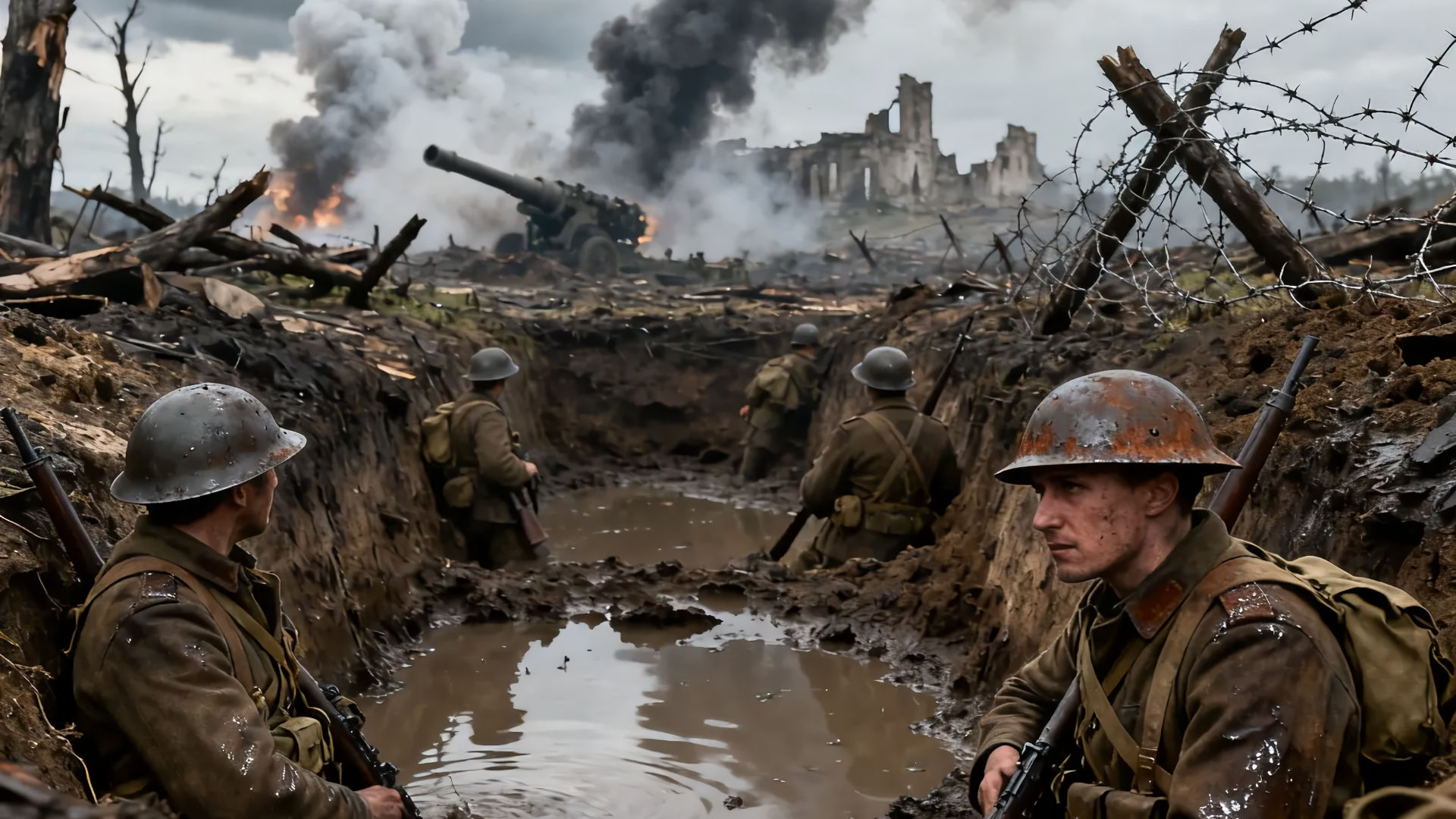
Life in the trenches during the Somme was brutal even by First World War standards. Constant shellfire collapsed trench walls, buried men alive, and destroyed any sense of safety. Mud was everywhere, filling trenches, weighing down equipment, and making movement exhausting. In wet conditions, soldiers stood for hours in waterlogged positions, leading to trench foot and infections. Sleep was irregular and often impossible, broken by bombardments or orders to move.
Death came in many forms. Artillery remained the greatest killer, with shells falling unpredictably and without warning. Snipers picked off anyone who exposed themselves above the parapet. Raids at night added another layer of danger, as patrols slipped into no man’s land to gather intelligence or harass enemy positions. Even when no major attack was underway, casualties mounted steadily through accidents, illness, and routine exposure to danger.
Psychological strain became as serious as physical injury. Prolonged exposure to noise, fear, and exhaustion led to what was then called shell shock. Men broke down, becoming unable to function under fire. At the time, understanding of psychological trauma was limited, and responses ranged from sympathy to punishment. The Somme played a major role in forcing armies to confront the mental toll of modern warfare, even if solutions remained crude.
Despite months of fighting, the strategic situation barely shifted. German defences adapted quickly, building new trench lines and reinforcing key positions. Each attack prompted a counterattack, restoring the familiar pattern of stalemate. For soldiers on the ground, the Somme became a battle without a clear beginning or end, just an endless cycle of preparation, attack, and survival.
By late summer and early autumn, it was clear that victory would not come through a single decisive blow. The Somme instead became a test of endurance, both for armies and for the societies supporting them. The human cost continued to rise, while the front line crept forward almost imperceptibly, locked in a struggle where survival itself became the primary objective.
New Weapons, Old Problems
As the Battle of the Somme dragged on, it became a testing ground for new technologies intended to break the deadlock of trench warfare. Commanders recognised that traditional infantry assaults were failing, yet alternatives were limited. Innovation was driven by necessity, but new weapons arrived before doctrine, training, or coordination had fully caught up.
The most famous of these innovations was the tank. In September 1916, British forces deployed tanks for the first time in battle during the attack at Flers-Courcelette. These early machines were slow, mechanically unreliable, and often broke down before reaching the front line. When they did appear, however, they had a powerful psychological effect. Tanks could cross trenches, crush barbed wire, and provide mobile fire support, briefly disrupting German defences that had grown accustomed to predictable infantry advances.
Artillery also continued to evolve. Counter-battery fire, aimed at destroying enemy guns rather than just front-line positions, became more systematic. The creeping barrage, where artillery fire moved forward in timed stages ahead of advancing infantry, was refined to provide better protection. These methods showed promise, but success depended on precise timing and communication, which remained difficult under combat conditions.
Despite these developments, many fundamental problems remained unresolved. Tanks were too few in number to achieve decisive breakthroughs, and their limitations often turned initial gains into isolated advances vulnerable to counterattack. Artillery, while devastating, still struggled to destroy deep dugouts and well-constructed machine gun positions. Infantry units, exhausted and understrength, were frequently asked to attack before they had recovered from previous losses.
The German Army also adapted. Defences became more flexible, with forward positions lightly held and stronger forces positioned further back to counterattack once an assault stalled. This elastic defence reduced the effectiveness of prolonged bombardments and made breakthroughs even harder to exploit. Every innovation on one side prompted a response on the other, reinforcing the cycle of stalemate.
The Somme demonstrated that technology alone could not solve the problems of industrial warfare. New weapons offered glimpses of change but failed to deliver immediate transformation. The battle became a lesson in adaptation rather than revolution, showing that success required not just better tools, but new ways of thinking about how wars were fought.
What the Somme Changed, and What It Didn’t
When the Battle of the Somme finally ended in November 1916, the gains on the map were modest. The Allied advance had pushed the front line forward by a few miles at enormous cost. Casualty figures on both sides ran into the hundreds of thousands, with little sense of a clear victory. Yet judging the Somme purely by territory gained misses its longer-term significance.
One undeniable change was the balance of pressure on the Western Front. The German army suffered severe losses and was forced onto the defensive for much of 1917. The battle also succeeded, at least partially, in relieving pressure on Verdun by tying down German reserves. While these outcomes came at a terrible price, they shaped the strategic environment for the rest of the war.
The Somme accelerated changes in how armies fought. Artillery tactics improved, coordination between infantry and guns became more sophisticated, and the importance of flexible defence and depth was increasingly understood. The first use of tanks, though limited, pointed towards the future of mechanised warfare. By the later years of the war, many of the lessons learned painfully on the Somme would be applied more effectively.
However, much remained unchanged. The war was still one of attrition, dependent on industrial output and manpower rather than decisive manoeuvre. Breakthroughs remained rare and difficult to exploit. Soldiers continued to face appalling conditions, and casualty rates stayed high. The Somme did not end trench warfare, nor did it provide a simple solution to the problems of modern war.
Perhaps the most lasting impact was psychological. For Britain, the Somme became a symbol of sacrifice on an unprecedented scale. Entire communities were affected as volunteer battalions suffered devastating losses. The battle altered public perceptions of the war, eroding early optimism and replacing it with a more sober understanding of its cost. In historical terms, the Somme stands as a turning point rather than a triumph. It exposed the limits of pre-war thinking and forced adaptation through experience rather than theory. What it changed was how war was understood and fought. What it did not change was the fundamental reality of industrial conflict, where progress was slow, victory was uncertain, and the price was paid overwhelmingly by those on the front line.
The Battle of the Somme FAQ
The Battle of the Somme was a major Allied offensive on the Western Front during the First World War, fought between July and November 1916 in northern France.
The Somme was launched to relieve pressure on French forces at Verdun and to attempt a breakthrough of German defences through a large-scale offensive.
On 1 July 1916, British troops advanced against well-prepared German positions that had survived the artillery bombardment, resulting in massive casualties from machine gun and artillery fire.
The battle failed to achieve a decisive breakthrough but did weaken German forces and contributed to shifting the strategic balance later in the war.
The battle resulted in over one million casualties across all sides, making it one of the deadliest battles in human history.


