The Battle of White Mountain
By the early seventeenth century, Bohemia sat on a political and religious fault line, primed for explosion. For decades, the region had been a patchwork of uneasy compromise between Catholic rulers and a predominantly Protestant nobility. This balance was held together not by harmony but by paperwork, most notably the Letter of Majesty issued in 1609, which guaranteed religious freedoms to Bohemia’s Protestant estates. It worked, in the way that loose floorboards work, until someone stepped too hard.
That someone turned out to be the Habsburg dynasty. When Ferdinand II, a devout Catholic with a firm belief in absolute rule, became King of Bohemia in 1617, alarm bells rang across Prague. Ferdinand made little effort to disguise his intentions. He viewed Protestant privileges not as rights but as temporary inconveniences. Churches were closed, Protestant officials were sidelined, and imperial authority was asserted with a heavy hand. To the Bohemian estates, this looked less like governance and more like a rollback of hard-won freedoms.
Tensions finally snapped in May 1618 with an event that became legendary almost instantly: the Defenestration of Prague. Protestant nobles, furious at imperial interference, stormed Prague Castle and hurled two royal governors out of a window. They survived the fall, but politically, the damage was fatal. This act was not just rebellion; it was a declaration that Bohemia would no longer quietly accept Habsburg control.
The revolt that followed was both idealistic and naive. The Bohemian estates deposed Ferdinand and elected Frederick V, a Protestant prince from the German states, as their new king. Frederick was young, ambitious, and disastrously underprepared. His supporters believed Protestant Europe would rally to their cause. In reality, promised allies hesitated, funding dried up, and internal divisions weakened the rebel position almost from the start.
Meanwhile, Ferdinand proved far more effective than his opponents expected. Drawing on the resources of the Habsburg lands and the military muscle of the Catholic League, he framed the conflict not merely as a political rebellion but as a holy struggle. This allowed him to attract experienced generals, disciplined troops, and crucially, legitimacy in the eyes of Catholic Europe.
By 1620, Bohemia stood isolated. Its armies were underpaid and poorly coordinated, its leadership fractured by rival ambitions. What had begun as a defence of religious liberty was sliding towards catastrophe. The stage was set just outside Prague, on a modest plateau called White Mountain, where years of simmering tension would be resolved not by debate or decree, but by force.
A Crown on Shaky Ground: Frederick V and the Bohemian Gamble
When Frederick V accepted the Bohemian crown in August 1619, it was less a calculated move than a leap of faith. At just twenty-three years old, Frederick was already Elector Palatine of the Holy Roman Empire, a prestigious position within the Protestant Union of German states. The offer of kingship elevated him dramatically, but it also placed him directly in the path of the most powerful dynasty in Europe. The crown of Bohemia was not a prize so much as a live grenade.
Frederick’s decision was shaped by ideology as much as ambition. He saw himself as a champion of Protestantism at a time when Catholic resurgence seemed to be rolling back gains made during the Reformation. His wife, Elizabeth Stuart, daughter of King James I of England, added another layer of confidence. Their marriage symbolised Protestant unity, and Frederick believed, wrongly, that this family connection would translate into decisive English support. It did not.
Once crowned in Prague, Frederick discovered that ruling Bohemia was far more complicated than accepting its throne. The kingdom was divided along religious, political, and ethnic lines. Many Bohemian nobles supported the revolt only cautiously, seeing it as leverage against Habsburg authority rather than a complete break from imperial rule. Frederick, however, treated the situation as a permanent revolution, pushing openly Protestant policies that alienated moderates and alarmed Catholics.
Worse still, Frederick struggled to command loyalty. He was a foreign ruler in a land deeply suspicious of outsiders, and his court was dominated by German advisers who often misunderstood local customs and politics. Prague’s Catholic population felt marginalised, while Protestant factions squabbled among themselves. Instead of presenting a united front, Bohemia became a stage for infighting, indecision, and poor communication.
Militarily, Frederick’s position was fragile from the outset. He lacked a standing army and relied on mercenaries who required constant payment and firm leadership, neither of which was reliably available. Promised reinforcements from the Protestant Union failed to materialise, mainly because its members feared provoking the full wrath of the emperor. Even potential allies viewed Frederick’s gamble as reckless and were reluctant to risk their own territories for Bohemia’s cause.
As months passed, Frederick’s confidence drained away. He remained in Prague while imperial and Catholic League forces advanced, hesitating to take decisive action. His court indulged in ceremony while his enemies mobilised with ruthless efficiency. By the autumn of 1620, Frederick was already earning a cruel nickname among his critics: the Winter King, a ruler whose reign seemed destined to last no longer than a single season.
The gamble was failing. Frederick had won a crown, but not the power, unity, or allies needed to defend it. White Mountain would soon decide whether his kingship had any future at all.
Armies, Allies and Ambition: Who Turned Up and Why
By the summer of 1620, the Bohemian revolt had moved beyond angry proclamations and into the cold arithmetic of soldiers, money, and alliances. This was the point at which ideals began to matter less than logistics, and Bohemia was already losing the numbers game. While the rebels argued over strategy and funding, their enemies assembled a coalition that was disciplined, well-financed, and driven by shared purpose.
On one side stood the Bohemian forces, loyal to Frederick V. In theory, he commanded a broad Protestant alliance. In reality, his army was a fragile patchwork of mercenaries, regional levies, and reluctant allies. Command was divided, pay was unreliable, and morale was uneven. Soldiers who were not paid regularly tended to desert, loot the countryside, or both. The army existed, but it lacked cohesion and confidence.
Frederick’s biggest problem was not manpower, but trust. The Protestant Union, which might have provided decisive backing, kept its distance. Its leaders feared turning a Bohemian rebellion into a continent-wide religious war. Saxony, another potential ally, chose neutrality and even cooperated with the emperor when it suited its interests. The Bohemian cause was increasingly isolated, supported more by hope than by hard commitments.
Facing them was a far more formidable force. Ferdinand II had transformed the crisis into a test of imperial authority and Catholic survival. He drew support from Spain, the Austrian Habsburg lands, and above all, the Catholic League, a powerful alliance led by Maximilian I. This was not a loose coalition, but a coordinated military machine with clear leadership and deep pockets.
The Catholic League’s army was commanded by Johann Tserclaes, Count of Tilly, a veteran general known for strict discipline and methodical tactics. Tilly’s troops were experienced, well-supplied, and drilled to fight as a unit. Alongside them marched imperial forces under Charles Bonaventure de Longueval, Count of Bucquoy, adding further strength and professionalism. This was not an army hoping to win; it was an army that expected to.
Crucially, Ferdinand framed the campaign as both a political necessity and a religious duty. This narrative attracted funding, manpower, and moral support from Catholic Europe. Soldiers were paid, supplies flowed, and commanders shared a unified goal. Where the Bohemians hesitated, the imperial forces advanced steadily, reclaiming territory and tightening the noose around Prague.
By the time both armies approached White Mountain, the imbalance was obvious. One side marched with uncertainty and internal doubt, the other with clarity and confidence. The battle ahead would be short, but the forces assembled made its outcome increasingly hard to avoid.
The Battle of White Mountain: Two Hours That Changed Central Europe
On the morning of 8 November 1620, the fate of Bohemia was decided in a matter of hours. The battlefield lay on a gently rising plateau just west of Prague, a position chosen less for strength than convenience. The Bohemian army, loyal to Frederick V, had taken up defensive positions along low ridges and vineyard walls, hoping the terrain might compensate for its weaknesses. It was a thin hope.
Opposing them were the combined forces of the Catholic League and the Holy Roman Empire. Their troops were better trained, better paid, and far more confident. While the Bohemians hesitated, Tilly and Bucquoy saw an opportunity to strike quickly and decisively.
The battle began with probing attacks against the Bohemian left. At first, the defenders held firm, repelling initial assaults and briefly raising hopes that the line might hold. But these early successes masked deeper problems. Units were poorly coordinated, reserves were slow to respond, and commanders disagreed on whether to counterattack or remain on the defensive. Momentum slipped away almost as soon as it appeared.
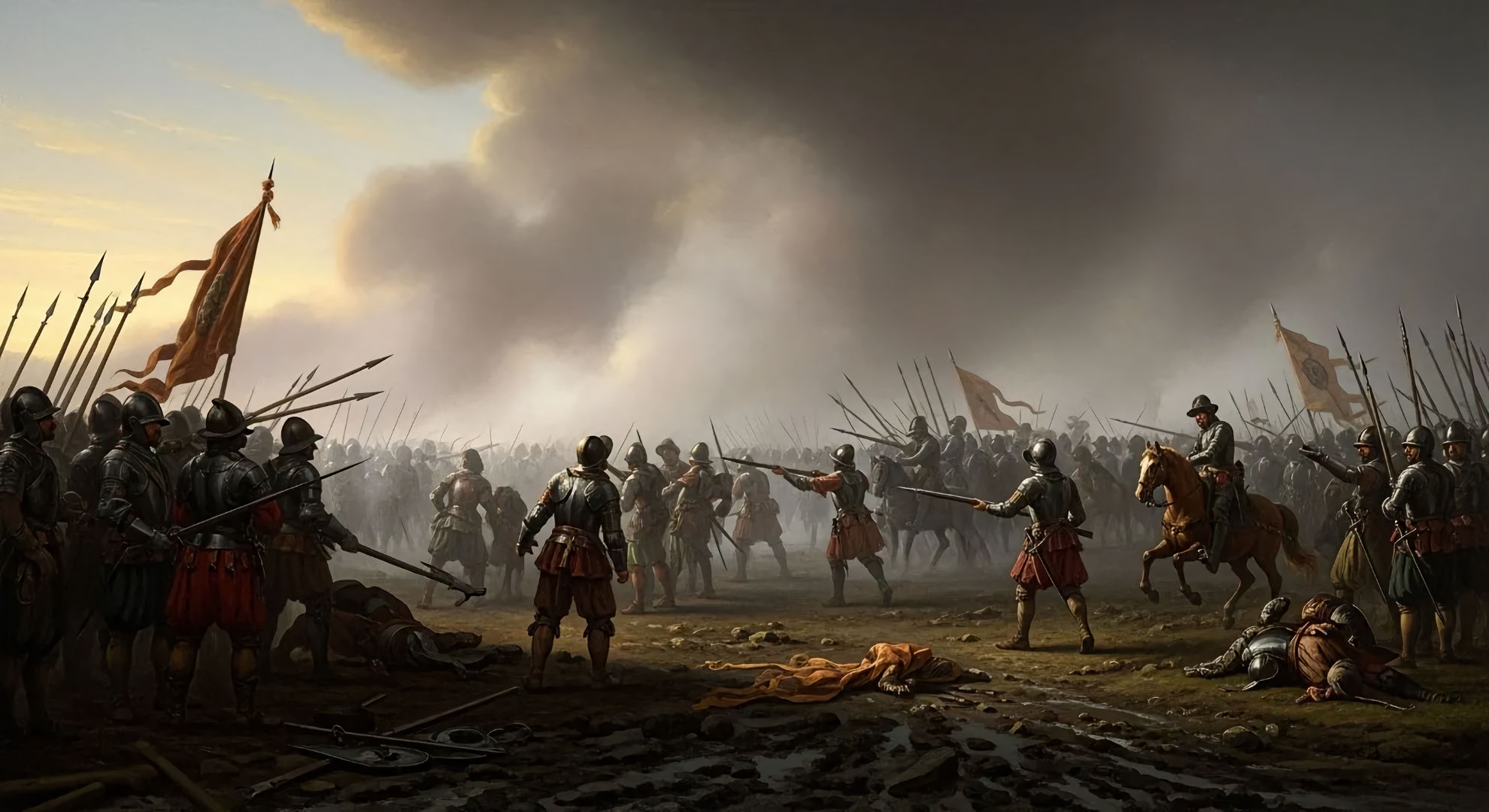
The turning point came when Catholic League infantry pushed uphill against Bohemian positions that were supposed to be secure. Once one section of the line began to buckle, panic spread rapidly. Mercenary units, already sceptical of the cause and short on pay, began to fall back or abandon the field entirely. Cavalry support failed to arrive where it was needed most, and attempts to rally the troops collapsed under the pressure of sustained, disciplined attacks.
What followed was less a heroic last stand and more a rapid unravelling. Imperial forces exploited every weakness, advancing steadily while maintaining tight formation. Bohemian resistance crumbled, and within two hours the army was in full retreat. Some soldiers fled towards Prague, others scattered across the countryside, discarding weapons and banners as they ran. Casualties were relatively light by the standards of early modern warfare, but the psychological damage was immense.
Frederick himself was nowhere near the fighting. Remaining in Prague, he received news of the defeat before the imperial troops had even finished securing the battlefield. By the time night fell, the outcome was beyond doubt. The Battle of White Mountain was over almost as soon as it had begun, yet its impact would echo across Europe for decades.
In those brief hours, Bohemia’s rebellion collapsed. What had started as a defence of religious liberty ended in chaos, flight, and the irreversible triumph of imperial power.
Collapse and Consequences: Defeat, Executions and Exile in Prague
The defeat at White Mountain did not merely end a battle; it shattered Bohemia’s political and cultural leadership in a single stroke. Within days, imperial authority swept back into Prague, and the consequences for those who had supported the revolt were swift and unforgiving. Ferdinand II had no intention of allowing Bohemia to rebel again.
Frederick V fled Prague almost immediately, abandoning his crown and his supporters. His escape cemented his reputation as the “Winter King”, a ruler whose reign had lasted barely a season. Exile followed, along with the loss of his hereditary lands in the Palatinate, which were transferred to Catholic control. Frederick would spend the rest of his life as a wandering claimant, his early gamble defining his entire legacy.
For Bohemia’s rebel leaders, escape was not an option. In June 1621, the imperial authorities staged a brutal public reckoning. Twenty-seven nobles and intellectuals were executed in Prague’s Old Town Square, their deaths intended as both punishment and warning. Heads were displayed on the Charles Bridge, a grim reminder of the price of defiance. This was not justice in any conciliatory sense; it was theatre, designed to crush resistance through fear.
Confiscation followed execution. Vast estates belonging to Protestant nobles were seized and redistributed to loyal Catholic supporters, many of them foreign aristocrats with little connection to Bohemia. This permanently altered the country’s social structure, transferring wealth and influence away from native elites and embedding Habsburg control at every level of governance. Those who were not executed often faced exile, forced conversion, or economic ruin.
Religious life was transformed just as dramatically. Protestantism was effectively outlawed, and the Catholic Church, backed by imperial power, launched an aggressive campaign of re-Catholicisation. Churches were closed or rededicated, clergy were expelled, and families were forced to choose between conversion and exile. Tens of thousands left Bohemia, taking with them skills, education, and cultural memory.
Prague itself became a city under occupation. Imperial officials replaced local authorities, censorship tightened, and political autonomy vanished. What had once been a kingdom with significant self-rule was reduced to a firmly controlled Habsburg possession. The defeat at White Mountain thus marked not only the end of a rebellion, but the beginning of a long period of cultural suppression and political subordination.
The battlefield had been quieted in hours. The reckoning that followed would reshape Bohemia for generations.
The Shockwave Across Europe: Why White Mountain Lit the Fuse of the Thirty Years’ War
The Battle of White Mountain was brief, but its consequences were anything but. What might have remained a contained rebellion in Bohemia instead became the opening act of one of Europe’s most destructive conflicts. The defeat sent a clear message across the continent: the balance between Protestant and Catholic power had shifted decisively, and the Holy Roman Emperor intended to enforce that shift by force.
For Ferdinand II, White Mountain was a vindication of both policy and faith. He emerged not merely as a ruler restoring order, but as a champion of Catholic resurgence. This success emboldened him. Rather than seek compromise, Ferdinand doubled down, pushing aggressive re-Catholicisation and centralisation throughout his territories. What had been framed as a defensive action now became an ideological campaign, alarming Protestant states far beyond Bohemia.
The shockwaves travelled quickly through the fragmented political landscape of the Holy Roman Empire. Protestant princes who had hesitated to support Frederick V now faced the consequences of imperial victory. Frederick himself was stripped of his lands and titles, a warning that neutrality offered no protection. His dispossession created a dangerous precedent: religious dissent could now justify permanent political ruin.
This fear pushed other powers into action. Denmark soon intervened, followed later by Sweden under Gustavus Adolphus, each seeking to halt the spread of imperial dominance. What began as a Bohemian revolt expanded into a pan-European struggle involving Spain, France, the Dutch Republic, and numerous German states. The war ceased to be only about religion and became a contest for influence, territory, and survival.
The scale of destruction that followed would have been unthinkable to those standing on White Mountain in 1620. Over the next three decades, large parts of Central Europe were devastated. Armies lived off the land, cities were looted, populations collapsed from famine and disease, and entire regions were left economically ruined. The conflict blurred the line between soldier and civilian suffering, reshaping how war was experienced and remembered.
In hindsight, White Mountain stands as the moment when restraint failed. It marked the end of negotiated coexistence within the empire and the beginning of absolutist rule enforced by arms. The battle’s real legacy lies not in its tactics or casualty figures, but in its demonstration that religious and political conflict had reached a point where compromise was no longer enough.
Two hours on a hillside outside Prague helped ignite thirty years of war. Europe would spend a generation paying the price.
The Battle of White Mountain FAQ
The Battle of White Mountain was fought on 8 November 1620 near Prague between Protestant Bohemian forces and the Catholic armies of the Habsburg Holy Roman Emperor. It was a decisive early battle of the Thirty Years’ War.
The battle crushed the Bohemian Revolt, secured Habsburg control over Bohemia, and helped turn a regional uprising into the wider Thirty Years’ War, which devastated much of Europe for the next three decades.
The fighting lasted less than two hours. Despite its short duration, the outcome had enormous political, religious, and military consequences across Europe.
The Catholic Habsburg forces won a decisive victory over the Protestant Bohemian army, leading to the execution or exile of Bohemian leaders and the re-Catholicisation of the region.
The defeat ended Bohemian independence, strengthened Habsburg power, intensified religious repression, and contributed directly to the escalation of the Thirty Years’ War across Central and Western Europe.