The Tangiwai Rail Disaster
On Christmas Eve in 1953, as families across New Zealand prepared for festive celebrations, the Wellington to Auckland express made its routine journey north. The passengers aboard were a mix of excited children heading home for the holidays, parents eager for a few days of rest, and service members looking forward to reunions with loved ones. What none of them could have known was that a geological event upstream had set in motion a tragedy that would become one of the darkest moments in New Zealand’s history. The Tangiwai rail disaster stands today as a solemn reminder of the unpredictable power of nature and the importance of vigilance when lives depend on infrastructure. It is a story of a bridge weakened by forces unseen, a train that arrived at precisely the wrong moment, and a nation that mourned together on what should have been the happiest night of the year.
The Setting and Geography
The disaster took place near the town of Tangiwai, a rural area on the North Island. The railway line crossed the Whangaehu River on a steel-and-concrete bridge that had served the country reliably since its construction in the early twentieth century. Looming above the landscape was Mount Ruapehu, an active volcano with a jagged peak crowned by a crater lake. That lake, held back by walls of volcanic ash and ice, had a long history of sudden releases of water and debris. When those natural barriers collapsed, the result was a high-speed surge known as a lahar. While scientists were aware of the volcano’s potentially destructive behaviour, the means to predict or track these events remotely did not yet exist.
The Train and Its Passengers
The Wellington to Auckland express was a familiar sight on the New Zealand Government Railways network. On 24 December 1953, it carried around 285 passengers and crew. Families returning home for Christmas dominated the carriages, along with soldiers from Waiouru Military Camp just ahead on the line. The locomotive crew included experienced operators who had no reason to suspect anything unusual as they approached Tangiwai. They were making excellent time, the coal-fired engine working efficiently, and the countryside sliding past in the deepening twilight of a warm summer evening.
The Hidden Threat on Mount Ruapehu
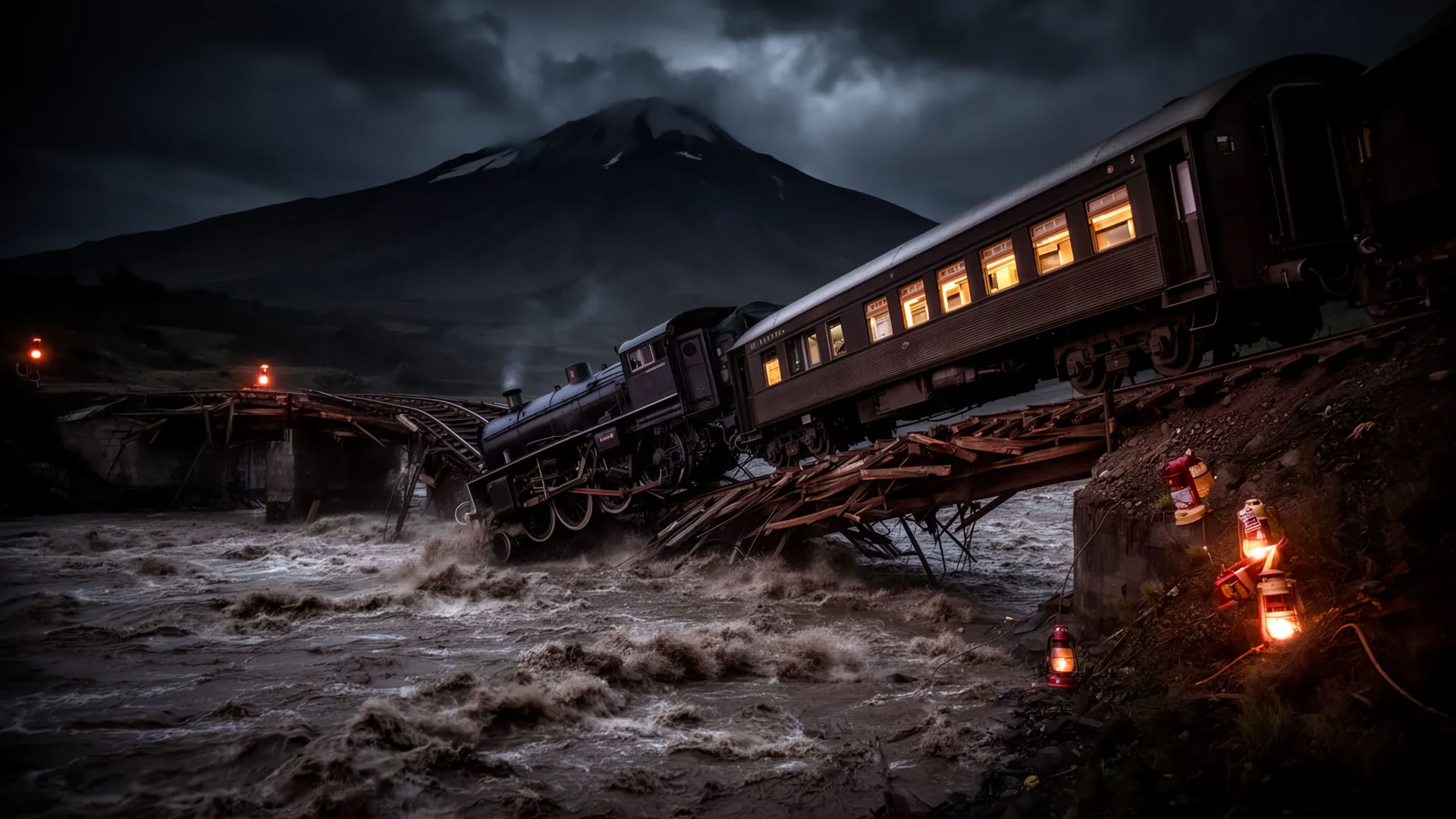
Though the train glided north without trouble, events high on Mount Ruapehu had already laid a trap. The crater lake at the summit had been steadily eroding the unstable wall containing it. At approximately 8 pm, the pressure became too great. The natural dam gave way, and millions of litres of acidic, sediment-filled water surged down the mountain in a roaring wave. As the lahar raced into the Whangaehu River gorge, it carried boulders, mud, volcanic ash, and debris at tremendous force. This torrent crashed into the Tangiwai rail bridge, slamming against the concrete piers until they shifted from their foundations. The central span collapsed into the churning river below. When the waters briefly settled, the damage remained hidden in the darkness, and there was no warning system to alert the railway network to the danger.
Christmas Eve Turns to Horror
Just minutes before 10.21 pm, the express train approached the bridge at full speed. The crew could not see that the track ahead was no longer in contact with solid ground. However, someone else had noticed that something was terribly wrong. A local man, Cyril Ellis, had seen the lahar hit the bridge and realised the train was coming. Racing to the tracks with a torch, he attempted to signal the driver. The locomotive’s crew saw the light but had too little time to react. The driver, Charles Parker, cut the throttle and applied the brakes, but the heavy engine’s momentum carried it forward. The damaged structure could not hold. The locomotive and the first several carriages plunged into the raging river. Those in the detached rear section survived the fall from the tracks but experienced violent jolts as the remainder of the train came to a halt on the unstable edge of the collapsed bridge.
The Force of the River
Inside the carriages that fell into the Whangaehu, chaos erupted. Water smashed through windows and doors, sweeping passengers out into the torrent. The fast-moving lahar had filled the river with thick, acidic mud, making swimming nearly impossible. Many passengers were trapped, pinned by seats or debris, while others were swept downstream into the darkness. Despite desperate attempts to reach those in peril, the river claimed lives quickly. Only a few managed to escape by breaking free, clinging to floating wreckage, or fighting their way to the banks, where rescuers braved dangerous conditions to pull them clear.
Heroes in the Dark
Although the disaster unfolded in a matter of seconds, the rescue effort began almost immediately. Local residents rushed to the scene with ropes, lanterns, and sheer determination. Among the survivors was Cyril Ellis, who worked tirelessly to save others after his warning failed to stop the train in time. The fireman, Lance Redman, survived the plunge and continued assisting in rescue efforts until exhaustion overtook him. Through the night, rescuers battled the river to retrieve survivors and recover the deceased. Their bravery and compassion offered a faint light in a night otherwise defined by loss.
A Nation in Mourning
News of the tragedy spread rapidly. By Christmas morning, the scale of the disaster became clear. Of the roughly 285 people on board, 151 lost their lives. Many of the victims were young soldiers returning to spend the holidays with family, and their loss was felt particularly sharply by military communities. New Zealanders awoke to headlines that replaced festive joy with national grief. Families gathered not for celebration but for anxious confirmation of who had been lost and who had survived. Prime Minister Sidney Holland and the Duke of Edinburgh visited the site soon after, underscoring the profound sense of collective sorrow.
Investigation and Findings
In the months that followed, investigators examined the bridge and the surrounding environment. They determined that the lahar was responsible for undermining the structure and dislodging its central supports. While the bridge met the engineering standards of the time, it was not designed to withstand the extraordinary pressures generated by a volcanic surge of this magnitude. The tragedy exposed a need for better monitoring of environmental risks in areas where critical infrastructure intersected with active geological landscapes. Authorities soon implemented new precautions, including enhanced observation and data sharing between geological and transportation agencies. However, it would take decades for more sophisticated automated warning systems to become standard.
Commemoration and Recovery
In the years after the disaster, efforts were made to honour those lost. A memorial was constructed at the site near the banks of the Whangaehu River. Each Christmas Eve, people gather there to remember the victims and reflect on how quickly life can change. The recovered bodies of unidentified victims were laid to rest in a common grave at Karori Cemetery in Wellington, where a memorial plaque stands. For the families of those who died, the holiday season would forever be associated with heartbreak rather than celebration. Yet many have noted that the strong communal support shown in the aftermath became a lasting part of New Zealand’s identity.
Legacy and Lessons
The Tangiwai rail disaster remains one of the worst railway accidents in New Zealand and a seminal moment in the country’s disaster history. It led to closer cooperation between scientists and engineers and encouraged the development of monitoring technologies to provide earlier warnings of volcanic processes. Mount Ruapehu continued to experience lahar events in later decades, but the lessons learnt from Tangiwai improved preparedness and reduced the risk of another catastrophe of this kind. The story of that night continues to be taught and remembered to ensure that safety procedures evolve alongside our understanding of the natural world.
Final Word
Christmas Eve 1953 should have been a night filled with laughter, arrival halls, and warm embraces. Instead, it became a marker of profound loss, etched into New Zealand’s history by a swift and merciless surge of volcanic water. The Tangiwai rail disaster demonstrated that the beauty of the country’s volcanic landscape carries with it unavoidable risk. Although time has softened the raw edges of the tragedy, the memories endure in memorials, in families still affected, and in the national commitment to never again allow nature’s warnings to go unnoticed. The river continues to flow beneath the rebuilt bridge at Tangiwai, but every December it flows beneath a moment of silence, a reminder that even in the season of joy, sorrow can strike without warning.
The Tangiwai Rail Disaster FAQ
A volcanic lahar from Mount Ruapehu undermined the railway bridge, causing the central span to collapse just before the train reached it.
151 passengers and crew lost their lives.
It happened late in the evening on Christmas Eve, 24 December 1953.
A lahar is a fast-moving flow of volcanic debris and water that travels down the slopes of a volcano and can destroy structures in its path.
It led to improved monitoring of Mount Ruapehu and stronger coordination between geological and transport authorities to warn of future volcanic hazards.