
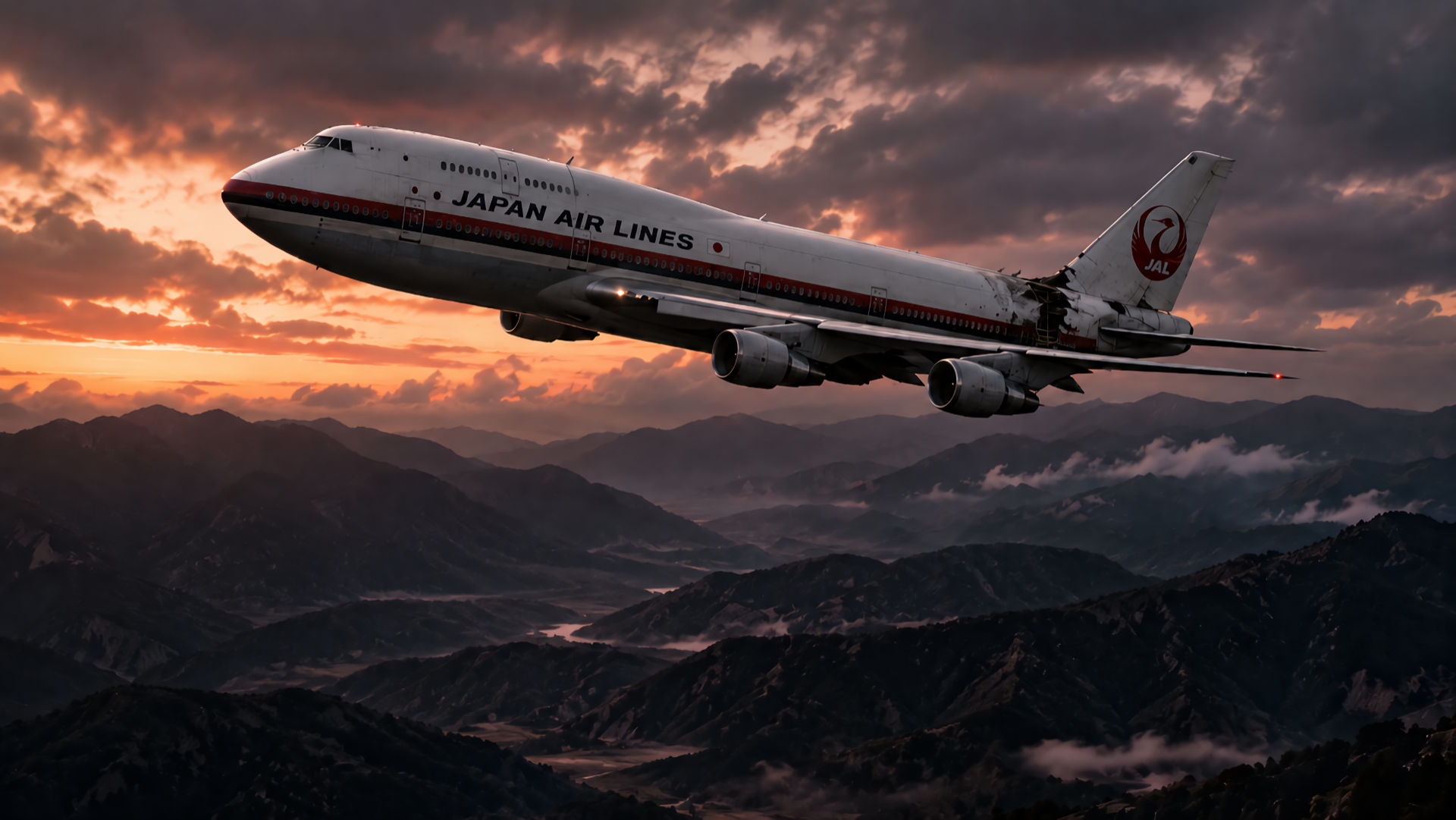
The Japan Air Lines Flight 123 Disaster
On the evening of 12 August 1985, Japan Air Lines Flight 123 prepared to leave Tokyo’s Haneda Airport for Osaka Itami Airport. It was a short domestic journey, the kind of flight that thousands of passengers across Japan took without giving it much thought. The aircraft was a Boeing 747SR, a short-range version of the famous jumbo jet designed for busy domestic routes where large numbers of passengers needed to be moved quickly between major cities.
This particular flight was especially full because it fell during the Obon holiday period, when many people in Japan travel to visit family, honour ancestors, or return to their hometowns. On board were 509 passengers and 15 crew members, making 524 people in total. For many, this was not the beginning of an adventure, but simply a practical journey across the country, the aviation equivalent of catching a crowded train.
The aircraft, registration JA8119, had already completed several domestic flights that day before becoming Flight 123. Its crew included Captain Masami Takahama, First Officer Yutaka Sasaki, and Flight Engineer Hiroshi Fukuda. Like the passengers behind them, they expected an ordinary sector, with the usual rhythm of climb, cruise, descent, landing, and paperwork, aviation’s least glamorous but most reliable choreography.
Flight 123 departed Haneda at 6:12 in the evening. Its destination, Osaka, was less than an hour away. The weather was not the central problem, and there was no immediate sign that anything unusual was about to happen. From the passenger cabin, the flight would have felt like countless others: seat belts fastened, engines roaring, Tokyo falling away below, and the cabin settling into the familiar quiet of early flight.
Yet hidden inside the rear of the aircraft was a weakness that no passenger could see and no crew member could feel. It had begun years earlier, after a previous accident involving the same aircraft. A repair had been carried out, the aircraft had returned to service, and for thousands of flights afterwards, nothing obvious appeared to be wrong.
That is one of the most unsettling features of the Flight 123 disaster. It did not begin with a storm, a hijacking, or a sudden pilot error. It began with damage repaired years before, buried inside the structure of a huge aircraft, waiting through take-off after take-off until one ordinary evening, the aircraft exposed what had been missed.
The Hidden Damage Waiting in the Tail
Seven years before the disaster, in June 1978, the same Boeing 747 suffered a tail strike while landing at Osaka Itami Airport. A tail strike happens when the rear underside of an aircraft contacts the runway, usually during take-off or landing. In many cases, it is repairable, but the forces involved can damage parts of the fuselage that are absolutely vital to the aircraft’s structure.
In this case, the rear pressure bulkhead was damaged. The pressure bulkhead is not a glamorous piece of aircraft engineering, and passengers never see it, which is probably why it has never had the celebrity status of wings, engines, or cockpit windows. Yet it is critically important. It forms part of the barrier that allows the passenger cabin to remain pressurised while the aircraft flies at altitude.
After the 1978 tail strike, repairs were carried out by Boeing technicians. The problem was that the repair to the aft pressure bulkhead was later found to have been improper. Instead of restoring the full intended strength of the structure, the work left a joint weaker than it should have been. The aircraft was returned to service, and on the surface, life went on as normal.
For years, JA8119 flew domestic routes, repeatedly climbing, pressurising, descending, and depressurising. Each flight placed stress on the repaired area. The weakness did not reveal itself all at once. Instead, fatigue cracks gradually developed and spread through the repaired section of the bulkhead. This is the quiet horror of metal fatigue: it does not announce itself with dramatic music; it simply grows.
By 1985, the aircraft had completed thousands of flights since the repair. Every successful landing may have reinforced the impression that the repair had worked, but the pressure cycles were steadily doing their work. The flaw was hidden, not harmless. The plane had become a flying example of how a maintenance mistake can remain invisible until the moment it becomes catastrophic.
The passengers boarding Flight 123 had no reason to suspect any of this. Nor did the crew. The aircraft had passed through normal operations, and nothing about the flight’s departure suggested that the rear of the fuselage was nearing failure. That is what made the disaster so devastating from a safety perspective.
Flight 123 was not doomed because a single thing went wrong in the cockpit on the day. It was doomed because a structural weakness had been allowed to survive inside the aircraft for years. At 24,000 feet, that weakness would finally tear open, and the crew would suddenly find themselves flying an aircraft that no longer behaved as an aircraft should.
Twelve Minutes After Take-off, Everything Changes
About twelve minutes after take-off, as Flight 123 climbed towards cruising altitude, the hidden failure became terrifyingly visible. At around 6:24 p.m., there was a loud booming sound from the rear of the aircraft. The rear pressure bulkhead had ruptured, allowing pressurised air from the cabin to blast backwards into the unpressurised tail section with immense force.
The consequences were immediate and catastrophic. The decompression damaged the rear fuselage, blew away parts of the tail cone and auxiliary power unit, and tore away a large part of the vertical stabiliser. Even worse, the damage severed all four hydraulic systems. On a Boeing 747, hydraulic power is essential for moving the main flight control surfaces, including the elevators, ailerons, and rudder.
In an instant, the crew lost the normal means of controlling the aircraft. They were still airborne, the engines were still running, and the aircraft was not yet falling out of the sky in the simple sense. But the machine had been transformed. It was now a huge, wounded aircraft with crippled control systems, missing tail structure, and flight behaviour that was becoming violently unstable.
Inside the cockpit, the crew understood that something extremely serious had happened, though they could not see the full damage from their seats. They declared an emergency and attempted to return to Haneda. In the cabin, oxygen masks dropped, passengers became aware that this was no routine technical problem, and the crew began preparing people as best they could under unimaginable conditions.
The aircraft entered unstable motions known as Dutch roll and phugoid oscillations. In plain English, it rolled from side to side and pitched up and down in a terrifying cycle of climbs, dives, speed changes, and banking movements. This was not turbulence, and it was not something the pilots could correct with a few careful inputs. The aircraft’s normal control responses had largely vanished.
The crew tried to control the plane using the only tools that still offered some influence: engine thrust and limited remaining aerodynamic effects. By adjusting power between the engines, they could sometimes affect the aircraft’s direction and attitude, but this was crude, delayed, and desperately difficult. It was like trying to steer a shopping trolley down a mountain using only stern words and wishful thinking, except the trolley weighed hundreds of tonnes.
For the passengers, the next half hour must have been beyond fear. Some wrote farewell notes to loved ones. Others sat in silence, prayed, or clung to family members. The aircraft was still flying, but everyone on board was trapped inside a machine fighting physics with almost none of the tools it had been designed to use.
Thirty-Two Minutes of Impossible Flying
What followed was one of the most extraordinary struggles in aviation history. Flight 123 remained airborne for about thirty-two minutes after the structural failure. That fact alone is remarkable. With the vertical stabiliser badly damaged and all four hydraulic systems lost, the aircraft should have been almost impossible to control. Yet, the crew kept it flying long enough to cross a large area of central Japan.
Captain Takahama, First Officer Sasaki, and Flight Engineer Fukuda worked under pressure that is difficult to imagine. They faced unreliable control responses, violent aircraft motion, alarms, radio communication, passenger safety, and the grim awareness that their available options were shrinking. They attempted to manage altitude and direction while trying to find a way back towards an airport, but the aircraft was no longer capable of normal manoeuvring.
The pilots used engine thrust to influence the aircraft’s movement. Increasing power could help raise the nose, while reducing it could help bring the aircraft down, but the response was slow and imprecise. Differential thrust between engines could sometimes affect heading, but not with the accuracy needed for a controlled landing. The cockpit crew were not flying in the normal sense. They were negotiating with a severely damaged aircraft that kept changing the terms.
The route became erratic. Flight 123 climbed and descended, swung through turns, and moved away from the neat certainty of an intended airport return. Air traffic controllers tried to assist, but no controller on the ground could restore missing hydraulics or replace the torn-away tail. The crew’s battle was happening second by second, inside a cockpit where every decision had to be made with damaged tools and dwindling hope.
In the cabin, the crew continued their duties with extraordinary courage. Flight attendants helped passengers put on oxygen masks, adopt brace positions, and prepare for what might come next. Their work mattered, even though the odds were dreadful. In disasters, the line between chaos and some form of human order often comes down to people doing their jobs while every instinct must be telling them to freeze.
As the aircraft approached the mountains of Gunma Prefecture, the situation became increasingly hopeless. The crew could not line up for a runway, could not properly descend under control, and could not stabilise the aircraft. The landscape below was no longer the urban sprawl around Tokyo, but rugged, forested terrain where any impact would be devastating.
Still, Flight 123 stayed in the air far longer than many damaged aircraft would have. That does not soften the tragedy, but it does matter. The crew’s efforts did not save the aircraft, yet they delayed the crash and showed an extraordinary fight against mechanical failure. In aviation, heroism is often quiet, technical, and recorded in clipped cockpit exchanges. Here, it lasted thirty-two minutes.
The Crash on Mount Takamagahara and the Delayed Rescue
At about 6:56 p.m., Flight 123 struck mountainous terrain in Gunma Prefecture, near Mount Takamagahara and the ridge commonly associated with Mount Osutaka. The aircraft first clipped trees and terrain before crashing into the forested mountainside. The impact destroyed the Boeing 747 and scattered wreckage across a remote and difficult landscape.
Of the 524 people on board, 520 died. Only four survived, all of them female passengers seated towards the rear of the aircraft. Their survival was extraordinary and only occurred because the rear section of the aircraft offered a small pocket of survivable space left after impact. In disasters of this scale, survival can depend on inches, angles, seating position, and cruel luck.
The crash site was difficult to locate and reach. It was dark, mountainous, and remote, with rough terrain that slowed rescue access. Aircraft searched from above, and the approximate area was identified, but getting people physically to the wreckage was another matter. The first official rescuers did not reach the crash site until the following morning.
The delay became one of the most painful parts of the disaster’s aftermath. Later accounts suggested that some passengers may have survived the initial impact but died during the night from injuries, shock, or exposure. This point must be handled carefully, because rescue operations in remote mountains after a major crash are complex and dangerous. Even so, the thought that more people might have been saved has haunted the memory of Flight 123 ever since.
For families waiting for news, the hours after the crash were almost unbearable. A domestic flight had vanished into the mountains, and confirmation came slowly. The disaster site, once reached, revealed devastation on a scale that stunned even experienced responders. Personal belongings, aircraft fragments, and human loss were mixed together across the mountainside.
The four survivors were eventually rescued and taken for medical care. Their testimony provided rare human detail from inside the final hours of the disaster. One survivor, off-duty flight attendant Yumi Ochiai, later described hearing sounds after the crash, including voices and signs that others were alive. Such accounts deepened public anguish and sharpened questions about the speed and coordination of the rescue.
Flight 123 was already the deadliest single-aircraft accident in aviation history. The delayed rescue added another layer of sorrow, because the tragedy did not end at the moment of impact. It continued through the night, in the cold and darkness of the mountains, while injured survivors waited for help that came too late for almost everyone.
The Investigation, the Faulty Repair, and the Legacy of Flight 123
The investigation into Flight 123 focused on the structural failure at the rear of the aircraft. Investigators concluded that the aft pressure bulkhead had ruptured because fatigue cracks had spread through the improperly repaired section from the 1978 tail strike damage. When the bulkhead finally failed, the explosive decompression damaged the tail, tore away key structure, and severed all four hydraulic systems.
The central lesson was brutally clear. A repair that looks complete on paper can still be dangerous if it does not restore the original structural strength. Aircraft maintenance is not merely a matter of replacing parts or closing panels. It depends on exact procedures, correct engineering judgement, careful inspection, and the willingness to treat hidden structural areas with the seriousness they deserve.
The disaster also showed how deeply aviation safety depends on learning from failure. Modern air travel is safe precisely because accidents are investigated in painstaking detail, not because aircraft are magically immune to catastrophe. Flight 123 became a case study in structural repair, inspection standards, hydraulic vulnerability, emergency response, and the importance of safety culture across manufacturers, airlines, and regulators.
Japan Air Lines faced intense public outcry and loss of trust. In later years, the airline created a Safety Promotion Center, where wreckage and records from Flight 123 are preserved as part of safety education. The purpose is not morbid display. It is remembrance with a practical purpose: to confront employees and visitors with the real human cost of aviation failure.
The crash also occupies a particular place in Japan’s national memory. It happened during a holiday period, involved families and ordinary travellers, and killed 520 people on a route that should have been routine. Among the dead was Kyu Sakamoto, the singer internationally known for “Sukiyaki”, which gave the tragedy an additional public resonance. Yet the scale of the loss goes far beyond famous names. The overwhelming majority of victims were people whose stories mattered deeply to families, friends, colleagues, and communities.
There is no tidy ending to the story of Flight 123. The crew fought with extraordinary determination, but the aircraft could not be saved. Four people survived, but hundreds did not. The investigation found a cause, but a cause is not the same as comfort. What remains is a disaster that changed how aviation professionals think about repair, inspection, accountability, and emergency response. Flight 123 is remembered not only because so many died, but because the chain of events began years earlier with a hidden maintenance failure. In that sense, its warning is painfully simple: in aviation, there is no such thing as a small mistake when it is built into the structure of an aircraft.
The Japan Air Lines Flight 123 Disaster FAQ
Japan Airlines Flight 123 was a domestic passenger flight from Tokyo Haneda Airport to Osaka Itami Airport. On 12 August 1985, the Boeing 747SR operating the flight crashed into mountainous terrain in Gunma Prefecture after suffering catastrophic structural and hydraulic failure.
There were 524 people on board Japan Airlines Flight 123. Of those, 520 were killed, making it the deadliest single-aircraft accident in aviation history.
Yes. Four passengers survived the crash. All four were seated towards the rear of the aircraft, where a small survivable section remained after impact.
The crash was caused by the failure of the aircraft’s rear pressure bulkhead. Investigators found that the bulkhead had been improperly repaired after a tail strike years earlier. When it failed, the resulting decompression damaged the tail and severed all four hydraulic systems.
The disaster remains important because it highlighted the life-or-death importance of correct aircraft repairs, structural inspections, maintenance oversight, emergency response, and aviation safety culture. It is still studied as a major lesson in how hidden technical failures can become catastrophic.