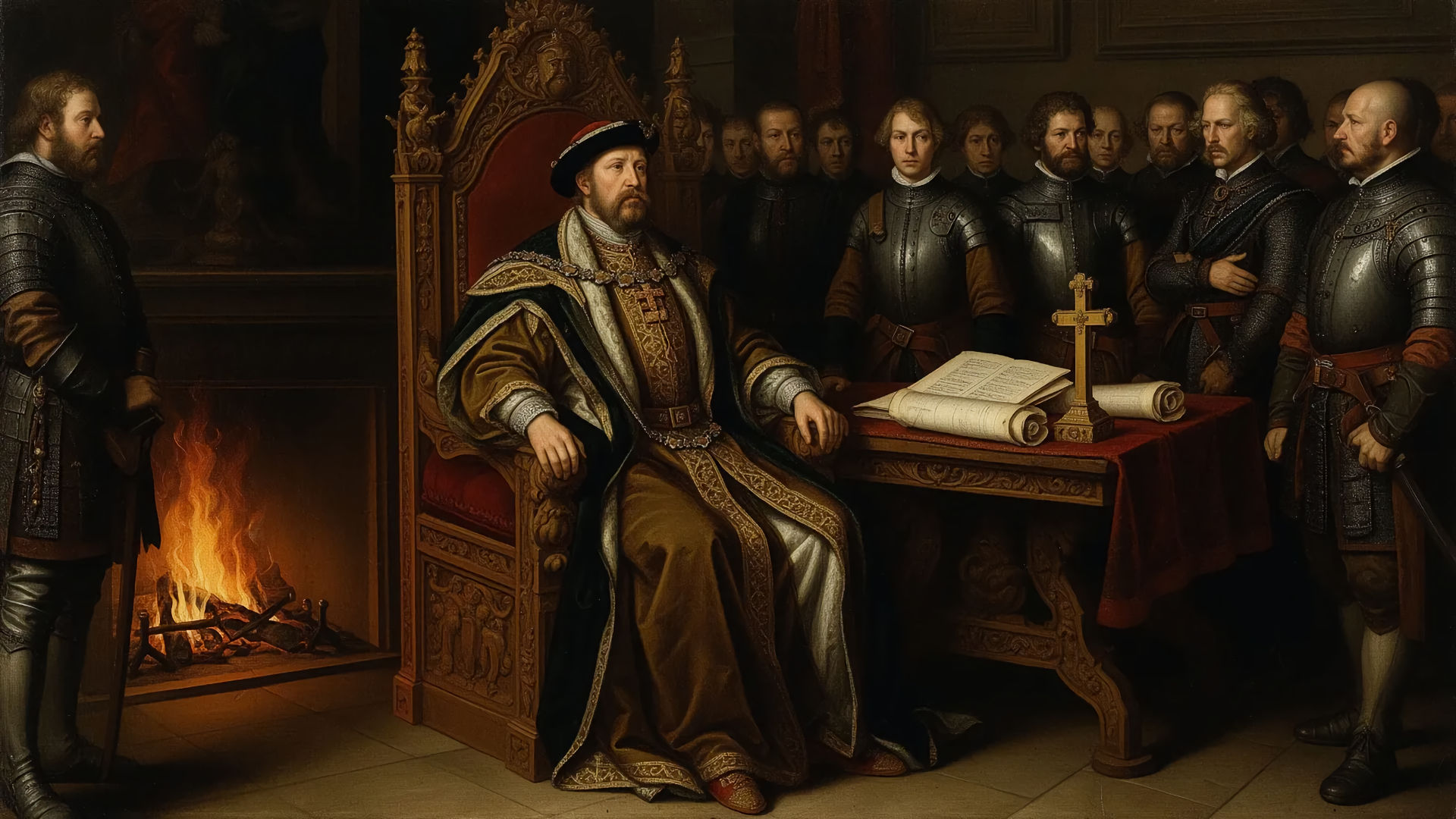
Cnut the Great’s Conquest of England
When most people think of England being conquered, their minds jump straight to 1066. Harold with the arrow, William with the swagger, and thousands of schoolchildren being forced to sketch the Bayeux Tapestry in crayon. Yet half a century before that famous invasion, England had already fallen to a foreign ruler. His name was Cnut the Great. He was a Danish prince who transformed Viking ferocity into a polished imperial strategy, built a North Sea empire, and, rather annoyingly for his enemies, turned out to be exceptionally good at kingship. For a man who secured his throne through war and calculated ruthlessness, he ultimately shaped England with stability and vision. This is the tale of how he seized a kingdom, one axe swing, one gamble, and one clever marriage at a time.
At the dawn of the eleventh century, England was a kingdom under immense pressure. Viking raids had hammered the country for more than a century, especially in the eastern regions known as the Danelaw, where many settlers from Scandinavia had already put down roots. The English crown, held by King Æthelred II, struggled to maintain any sense of security or authority. His nickname, Æthelred the Unready, was not the kindest historical footnote. The “Unready” did not mean he forgot to set an alarm but came from the Old English word “unræd,” suggesting that he was ill-advised and prone to blunders of the catastrophic variety. His reign was marked by panic, bribes to keep Vikings at bay, and a general sense that the kingdom was being held together with a bit of twine and desperate optimism.
One of Æthelred’s most infamous decisions came in 1002 when he ordered the St Brice’s Day massacre, intended to wipe out Danes living in England before they could pose a threat. It was a spectacular misjudgment. Instead of solving the “Viking problem,” the act enraged one of the most formidable rulers in Europe: Sweyn Forkbeard, King of Denmark. With vengeance now a matter of royal honour, Sweyn prepared not just more raids but a full-scale conquest.
By 1013, Sweyn’s forces swept through England like a storm. The response from England’s powerful nobles was a mass demonstration of the survival instinct. Many swiftly submitted to the Danish king. Meanwhile, Æthelred fled to Normandy with his family, hoping that distance and denial might solve his difficulties. It did not.
Sweyn enjoyed being King of England for only a few weeks before he suddenly died, leaving the throne to his son Cnut. The English aristocracy, sensing an opportunity to restore the old order, invited Æthelred back. It says something about their desperation that, despite all his errors, they preferred him to a Danish teenager backed by an army of angry Scandinavians.
Cnut’s first attempt to rule England in 1014 was short-lived. Lacking enough dependable troops, he withdrew to Denmark. But instead of sulking, he regrouped, refined his strategy, and returned with a determination that would define his young career. The conquest he would launch the following year was planned with far more precision, and considerably more muscle.
In 1015, Cnut returned to England with a formidable army composed of elite warriors and seasoned commanders. The English nobility was deeply fractured, and the king’s authority had been damaged beyond easy repair. As the Danes pushed inland, chaos and shifting loyalties defined the political scene. One of the most complex figures in this story was Eadric Streona, the Earl of Mercia, a man whose allegiance was as stable as a seesaw in a hurricane. At various times he supported the English king and then the Danes, switching sides whenever he sensed the wind blowing in a different political direction. He was the kind of ally who made everyone check their backs at regular intervals.
The campaign escalated rapidly. Æthelred, weakened by illness and battered by political missteps, died in April 1016. For once, England caught a lucky break with a succession: his son Edmund took the crown and finally gave the country something it had sorely lacked, leadership with backbone. Edmund earned the nickname Ironside for his tenacity and courage in fighting, a dramatic contrast to his father’s relatively flexible approach to national defence.
The struggle between Edmund and Cnut became a dramatic two-man contest for control of the kingdom. Battles raged across England, from Penselwood to Sherston and finally in and around London. The capital became a symbol of resistance. Cnut’s men controlled vast parts of the countryside, but London refused to yield. Edmund rode tirelessly from battle to battle, throwing his forces into desperate engagements to keep the Danes out of the city.
The tension broke at the Battle of Assandun in October 1016. There, in a brutal and decisive confrontation, fate and Eadric Streona’s latest betrayal tilted the balance toward Cnut. Edmund survived, and both leaders agreed to divide England between them. The compromise was strangely fitting: the ancient Wessex heartland remained with Edmund, while everything else fell under Danish control. It might have grown into an uneasy but workable arrangement, except that Edmund died only weeks later. The precise cause remains one of those conveniently murky medieval mysteries, with rumours of assassination whispering through the centuries.
Suddenly, the entire kingdom was Cnut’s to claim.
Ruling a freshly conquered land was always the true test of any Viking. Cnut had proven he could win through war. Now he needed to rule without constant uprisings, attempted assassinations, or angry nobles throwing their goblets across court halls. His first moves were calculated with astonishing precision. Rivals who might challenge him soon found themselves invited to take long, fatal trips or quietly vanish from the political landscape. Those who had supported him, including prominent English nobles, were rewarded with positions of power. And the man most skilled at betrayal, Eadric Streona, discovered that Cnut had a notably limited tolerance for treachery. The execution of the Earl of Mercia sent a message that switching sides only worked until it didn’t.
Perhaps the most brilliant step came in Cnut’s marriage to Emma of Normandy, the widow of Æthelred and mother of future English kings. By pairing a Viking conqueror with a respected Norman-English royal, Cnut blended legitimacy with fearsome authority. The wedding was not a romantic affair, but politically, it was a masterstroke that united different factions and stabilised his new government.
Once secure on the throne, Cnut transformed himself from warrior-king to statesman. He embraced Christianity not merely as a box-ticking exercise but as a genuine pivot in rulership, forging strong ties with the Church. He financed churches, supported the clergy, and travelled to Rome as a pious monarch seeking divine approval and political partnerships alike.
This new phase of his rule surprised many. The man who had arrived with swords and longships turned out to be thoughtful, highly competent, and determined to build a prosperous, unified realm. England thrived at a level not seen in years, benefiting from both peace and international trade. The Scandinavian influence blended with the sophisticated Anglo-Saxon administrative systems, creating a hybrid government that effectively maintained order across the kingdom.
Cnut’s ambition did not stop at England’s shores. He also ruled Denmark and later Norway, forming what historians now call the North Sea Empire. For a time, the region was more united than ever before or since, connected by fleets, commerce, shared rulership, and a growing sense that the Viking age had evolved into something less chaotic and far more influential. England was the wealthiest and most powerful of these lands, positioned as the empire’s beating heart rather than its battered victim.
Despite his many transformations, Cnut’s legacy in popular memory is often distilled into a single story: the king commanding the sea to stop its tide, sitting in a chair on the shoreline as the water rose around him. The tale is frequently misunderstood as an account of royal arrogance, as if the king genuinely believed he could order the ocean around. In fact, the moment was a demonstration of the limits of power. Cnut, deeply annoyed by sycophantic flattery, was reminding his court that even the greatest king could not defy the laws of nature. It was a thoughtful rebuke disguised as theatre, revealing a man who understood authority far more clearly than some of his predecessors.
But even the greatest kings meet an ending they cannot negotiate. Cnut died in 1035, relatively young but having achieved more in fifteen years than most monarchs managed in fifty. With him gone, the empire he built quickly began to crumble. His sons squabbled over England and Denmark, and none possessed his ability to keep such a complex realm united. Within a generation, the crown passed back to the West Saxon royal line. The Vikings, who had once been unstoppable conquerors, began to lose their grip on the English throne. Before long, another foreign invasion, this time led by William of Normandy, would change the island forever.
Even though his dynasty did not endure, Cnut the Great left a mark that history has only recently begun to appreciate fully. He was not merely a Viking with ambitions. He was a ruler who understood that conquering a kingdom requires strength, but keeping it requires vision and trust. England under Cnut enjoyed peace, flourishing commerce, religious patronage, and international stature. He was both feared and admired, a conqueror who convinced his new subjects that he deserved their loyalty.
Cnut’s conquest of England was more than a violent chapter in the Viking age. It was a turning point after which the English monarchy, politics, and culture shifted on a Scandinavian axis. By the time Normandy’s rulers arrived in 1066, they were stepping into a land already shaped by Norse influence and accustomed to foreign kings who arrived by ship. And before the Normans set their eyes on England’s crown, the Danes had already worn it, and they wore it magnificently.
Cnut the Great’s Conquest of England FAQ
Cnut was the Danish prince, son of Sweyn Forkbeard. After Sweyn briefly took the English throne in 1013, Cnut returned to press Danish claims, aiming to control a wealthy kingdom and secure dominance in the North Sea world.
The English resistance under Edmund Ironside in 1016, the indecisive campaigning across Wessex and the Midlands, and the Danish victory at the Battle of Assandun were pivotal, followed by a political settlement that split rule before Cnut became sole king.
He retained and rewarded English earls, relied on a household force and a paid fleet (thething), balanced Danish and English interests, married Emma of Normandy, and issued laws to present himself as a just Christian king.
Continuity with reform: existing shires, law codes and the Church remained central, but royal power was stabilised by Scandinavian military strength, North Sea diplomacy and tighter fiscal control.