The Battle of Waterloo
In early 1815, Europe was trying, very deliberately, to relax. After more than two decades of near-constant war, the defeat of Napoleon Bonaparte in 1814 had promised a return to stability. Napoleon had been exiled to the Mediterranean island of Elba, the Bourbon monarchy restored in France, and Europe’s great powers gathered in Vienna to redraw borders and restore order. The assumption was simple: the age of revolutionary and Napoleonic war was over.
That assumption lasted less than a year.
On 26 February 1815, Napoleon escaped from Elba with a small group of followers and sailed for the French coast. What followed was not a conquest by force but a political resurrection. As he marched north, troops sent to arrest him instead joined him. Royal officials fled. Crowds welcomed him as a symbol of national pride and military glory. By 20 March, Napoleon entered Paris without firing a shot. King Louis XVIII fled, and the empire was reborn.
Across Europe, the reaction was immediate and visceral. Napoleon’s return shattered the fragile sense of security that the Congress of Vienna had been trying to construct. For Britain, Austria, Prussia, and Russia, this was not merely the comeback of a defeated ruler but the reappearance of a destabilising force that had repeatedly overturned the European order. Memories of invasion, occupation, and endless mobilisation were still painfully fresh.
The major powers responded with rare unity. Within days, they declared Napoleon an outlaw and committed themselves to war. This was not a negotiation or a defensive posture. It was a collective decision to remove Napoleon permanently. The stakes were existential. If Napoleon survived this challenge, the entire post-war settlement would collapse before it had even been finalised.
Napoleon, meanwhile, understood the urgency better than anyone. France was not the military juggernaut it had once been. Years of war had drained manpower, finances, and public patience. His strategy depended on speed. He aimed to strike quickly in Belgium, defeat the British and Prussian armies before they could fully coordinate, and force the coalition into negotiations on favourable terms. Delay would be fatal.
Europe, therefore, entered the spring of 1815 holding its breath. Armies mobilised across borders, alliances hardened, and commanders prepared for a decisive confrontation. There would be no drawn-out campaign, no gradual escalation. The coming clash would determine not just the fate of Napoleon, but the future balance of power on the continent.
By the time Napoleon marched north toward Belgium, Europe was no longer edging toward war. It was sprinting. Waterloo would not be an accident or an isolated battle. It would be the final test of whether one man could once again bend Europe to his will, or whether the age of empire forged by revolution was finally coming to an end.
The Opposing Commanders: Napoleon, Wellington and Blücher
At Waterloo, the fate of Europe rested not just on armies, but on three commanders whose styles, instincts, and past experiences could not have been more different. The battle would become a contest not only of numbers and firepower, but of leadership under pressure.
At the centre stood Napoleon Bonaparte, arguably the most famous battlefield commander of his age. By 1815, Napoleon was no longer the restless revolutionary general of Italy or the master tactician of Austerlitz. Years of war, exile, and declining health had taken their toll. Yet his reputation still inspired fierce loyalty among French troops, many of whom believed his return marked a restoration of national honour. Napoleon’s strength lay in his ability to read a battlefield quickly and strike decisively, concentrating force at critical moments. His weakness, increasingly, was overconfidence in systems and subordinates that no longer performed as reliably as they once had.
Opposing him was Arthur Wellesley, the British commander known as much for caution as for competence and who had been installed as the Duke of Wellington on 3 May 1814 as recognition of his campaigns in the Peninsular War.
Wellington had built his reputation fighting Napoleon’s marshals in Spain and Portugal, where defensive positioning, discipline, and logistics mattered more than grand manoeuvres. He was not a romantic commander, but a meticulous one. Wellington excelled at choosing ground, using terrain to absorb enemy attacks, and keeping his army intact under extreme pressure. He trusted preparation over improvisation and expected his officers to do the same.
Where Napoleon sought decisive blows, and Wellington focused on endurance, Gebhard Leberecht von Blücher brought raw aggression. Blücher was old, impulsive, and famously stubborn, but he was also relentless. He hated Napoleon with a personal intensity shaped by earlier defeats and humiliations. As commander of the Prussian army, Blücher favoured attack over caution, even when his forces were exhausted or disorganised. His value lay not in tactical subtlety but in determination. Once committed, he would not disengage.
The alliance between Wellington and Blücher was one of necessity rather than comfort. They commanded different armies, spoke different languages, and operated under separate chains of command. Trust had to be earned quickly, and coordination relied on timing rather than constant communication. Napoleon understood this and hoped to exploit it by defeating each army separately before they could unite.
Each commander entered the campaign with clear strengths and dangerous flaws. Napoleon relied on speed and shock. Wellington depended on resilience and positioning. Blücher embodied persistence and revenge. Waterloo would test all three simultaneously, under conditions none of them could fully control.
In the end, the battle would not reward brilliance alone. It would favour cooperation, endurance, and the ability to hold on when plans began to unravel.
The Road to Waterloo: Strategy, Timing and Fatal Delays
The campaign that led to Waterloo unfolded at breakneck speed, driven by Napoleon’s need to act before Europe’s armies could fully unite against him. Time was his greatest enemy. The longer he waited, the more coalition forces would assemble, coordinate, and overwhelm France through sheer weight of numbers. His plan was bold, familiar, and risky: strike first, strike hard, and defeat his enemies separately.
Napoleon chose Belgium as his battlefield. British and Prussian forces were stationed there, guarding the approaches to France. By attacking north, he could place himself between Wellington and Blücher, preventing them from supporting each other. If successful, he could crush one army before turning on the other, repeating the formula that had brought him victory so many times before.
The opening moves seemed promising. In mid-June 1815, French forces crossed into Belgium with speed and surprise. Napoleon won a hard-fought victory over the Prussians at Ligny on 16 June, while a separate French force under Marshal Ney engaged Wellington at Quatre Bras. The situation looked favourable. The Prussians were beaten, and the British had not committed fully to battle. Yet crucial opportunities slipped away.
The problem was execution. Napoleon’s subordinates failed to deliver decisive results. Ney did not push aggressively enough at Quatre Bras, allowing Wellington to withdraw in good order. After Ligny, the French pursuit of the Prussians was poorly coordinated, allowing Blücher’s army to retreat rather than collapse. These were not dramatic blunders, but cumulative hesitations that gave the coalition breathing space.
Weather then intervened. Heavy rain soaked the battlefield on the night before Waterloo, turning fields into mud and delaying French attacks. Napoleon postponed his assault to allow the ground to firm up, hoping to maximise the effectiveness of artillery. This delay, though tactically sensible, proved strategically costly. Every hour bought Wellington time to prepare his defences and increased the chance that the Prussians might return.
Meanwhile, Wellington withdrew to a ridge near the village of Waterloo and prepared to stand his ground. He positioned his forces carefully, anchoring them to strong defensive points and concealing troops behind the slope. His strategy was simple: hold long enough for Prussian reinforcements to arrive. The entire plan depended on endurance and coordination rather than brilliance.
By the morning of 18 June, the stage was set. Napoleon had failed to destroy either opposing army. Wellington was entrenched. Blücher, battered but unbroken, was marching toward the sound of the guns. What began as a campaign of speed and separation was now becoming a race against time.
The road to Waterloo was paved with narrow margins. Small delays, cautious decisions, and imperfect coordination transformed Napoleon’s bold strategy into a gamble. The outcome would be decided not by grand design alone, but by how each commander adapted when control began to slip away.
The Battle of Waterloo: Mud, Musketry and Relentless Assaults
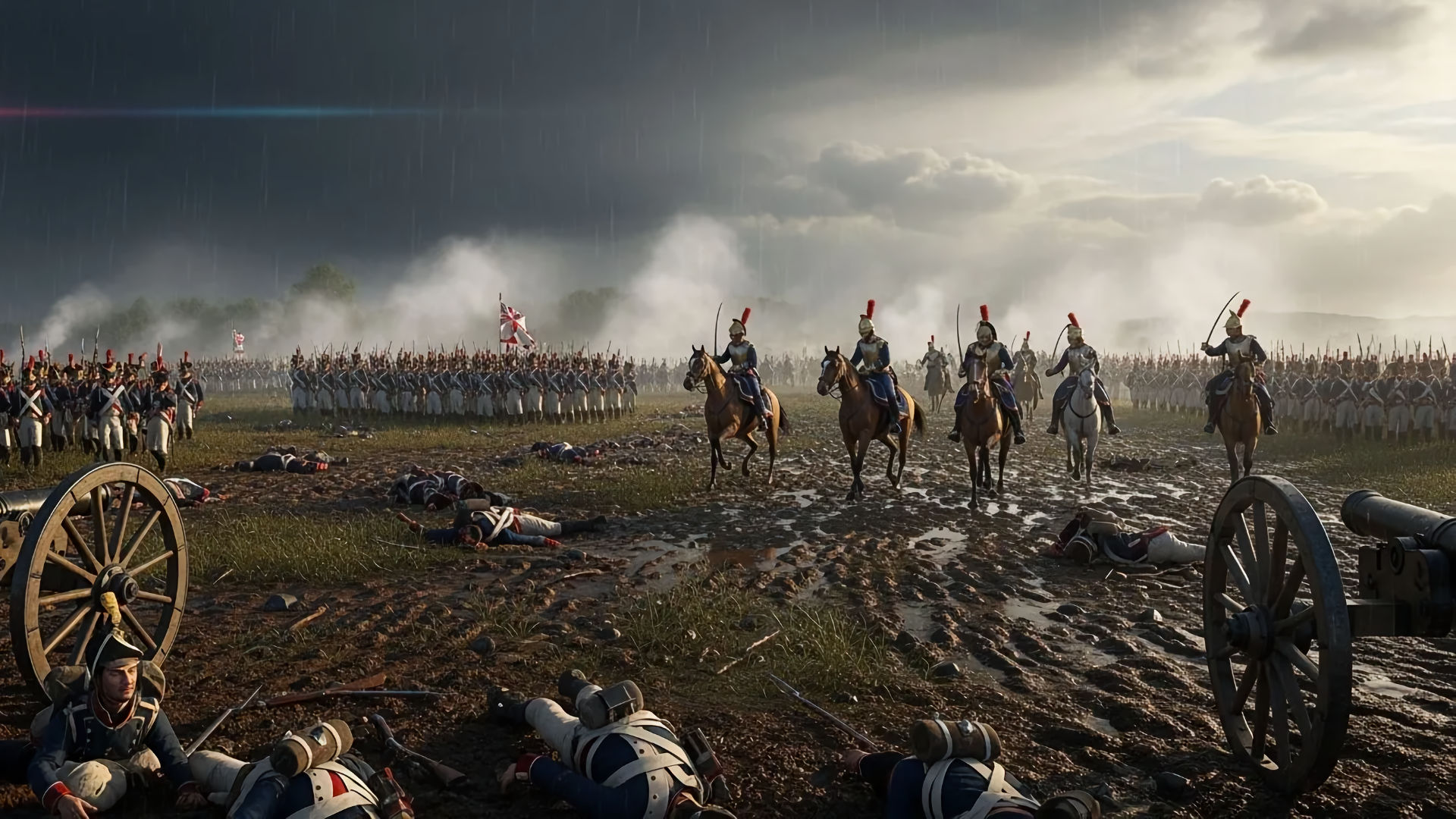
The Battle of Waterloo began late in the morning of 18 June 1815, delayed by the previous night’s torrential rain. The soaked ground mattered enormously. Cannon sank into mud, cavalry struggled for traction, and movement across the battlefield was slower and more exhausting than Napoleon had hoped. Still, by late morning, Napoleon Bonaparte committed to battle, convinced that a determined assault could break the Anglo-allied army before Prussian reinforcements arrived.
The fighting opened with a French attack on the fortified farmhouse of Hougoumont, on the allied right flank. Intended as a diversion, it quickly escalated into a brutal, all-day struggle. French troops repeatedly assaulted the complex, while British guards and their allies clung to it with stubborn determination. Men fought at point-blank range, doors were forced, buildings burned, and casualties mounted. Crucially, Hougoumont never fell, and French forces were drawn into a costly fight that drained manpower without delivering a breakthrough.
Napoleon then turned his attention to the centre. A massive artillery bombardment preceded a frontal infantry assault aimed at Wellington’s main line. French columns advanced uphill through the mud, drums beating, flags flying, only to be met by disciplined volleys from infantry concealed behind the ridge. As the smoke cleared, the French formations wavered, stalled, and in many cases collapsed under sustained fire. Again and again, assaults were launched and repelled.
Cavalry charges followed. Marshal Ney, believing the allied line was weakening, unleashed waves of French cavalry against Wellington’s positions. Horsemen thundered uphill, sabres raised, only to find infantry formed into tight squares bristling with bayonets. Musket fire ripped through the attackers at close range. Charge after charge broke against the squares, leaving the field littered with men and horses. It was courage without coordination, bravery spent for little gain.
Throughout the afternoon, the battle became a test of endurance. Wellington’s army absorbed punishment but held its ground, rotating battered units and plugging gaps as they appeared. Ammunition ran low, casualties mounted, and pressure never eased. Yet the defensive system held, anchored by terrain, discipline, and leadership.
By late afternoon, Napoleon faced a grim reality. His attacks had been relentless, but not decisive. The French army was bleeding strength with every failed assault. Time, the one resource he could not afford to lose, was slipping away. The battle had become a grinding struggle, and the longer it lasted, the more the odds tilted against him.
Waterloo was no elegant manoeuvre. It was a brutal contest of attrition, fought in mud and smoke, where success depended less on brilliance than on the ability to endure unrelenting pressure.
The Prussians Arrive: The Moment the Tide Turned
As the fighting raged through the afternoon at Waterloo, a new sound began to haunt the French rear, distant at first, then unmistakable. Cannon fire to the east signalled the approach of Gebhard Leberecht von Blücher and the Prussian army. For Napoleon Bonaparte, this was the moment he had hoped to prevent and feared most. The battle was no longer just about breaking Wellington’s line. It was now a race against encirclement.
The Prussians had been badly beaten at Ligny two days earlier, but they were not destroyed. Blücher, injured yet defiant, rallied his forces and marched toward Waterloo with remarkable speed. His decision to support Arthur Wellesley was an act of trust and determination. He knew that arriving late was better than not arriving at all. If Wellington fell, Prussia would face Napoleon alone.
The first Prussian units clashed with French troops near the village of Plancenoit on Napoleon’s right flank. What followed was savage and chaotic fighting, street by street and house by house. Napoleon was forced to divert elite troops, including elements of the Imperial Guard, to contain the threat. These were soldiers he could ill afford to spare from the main battle against Wellington.
As Prussian pressure increased, the French position became dangerously stretched. Napoleon could no longer concentrate his forces where he wanted. Every unit sent east weakened his attacks in the centre. Meanwhile, Wellington, battered but unbroken, sensed the shift. His army, which had spent the day absorbing punishment, now had hope that survival might turn into victory.
The decisive moment came in the early evening. Napoleon launched a final assault with the Imperial Guard, his most trusted and feared formation. Their advance up the slope was meant to shatter Wellington’s line at last. Instead, they were met with devastating fire and forced to retreat. For the first time, the Guard had failed. The psychological impact was enormous.
Almost instantly, the French army began to collapse. The retreat of the Guard spread panic. Shouts of “La Garde recule” rippled through the ranks, “The guard retreats!” Units that had fought doggedly all day broke and ran. At the same time, Prussian forces pressed harder from the flank, turning retreat into rout.
The arrival of the Prussians did not merely add numbers to the battlefield. It broke Napoleon’s ability to control events. From that point on, Waterloo was no longer a contest. It was the unravelling of an army and the end of an empire.
Aftermath and Legacy: The Battle That Ended an Era
The defeat at Waterloo was not merely a lost battle for Napoleon Bonaparte; it was the definitive end of his political and military career. Within days of the rout, Napoleon returned to Paris to find support evaporating. The French legislature moved quickly, the army was in disarray, and the allies were advancing. On 22 June 1815, he abdicated for a second time. This time, there would be no dramatic return.
Napoleon surrendered to the British and was exiled to the remote island of Saint Helena in the South Atlantic, a prison surrounded by ocean rather than armies. There, under constant surveillance, he would spend the remaining years of his life reflecting, rewriting his own legend, and slowly declining in health until his death in 1821. Waterloo ensured that Napoleon would leave history not as a fallen ruler awaiting redemption, but as a figure conclusively defeated.
For Europe, the battle delivered what two decades of war had failed to secure: finality. The coalition powers moved swiftly to restore and reinforce the political settlement already being negotiated at the Congress of Vienna. Borders were stabilised, monarchies strengthened, and a new balance of power established to prevent any single state from dominating the continent again. The goal was not progress, but stability, and after years of upheaval, stability was welcomed.
Britain emerged with its reputation enhanced. Wellington became a national hero, though he himself treated the victory with sombre restraint, famously describing it as “a damn close-run thing”. Prussia gained prestige and influence, setting it on a path toward greater power in German affairs. France, defeated but not dismantled, was reintegrated into the European system rather than punished into permanent isolation, a deliberate choice aimed at long-term peace.
Waterloo also reshaped how war was remembered. It became a symbol of decisive battle, studied by soldiers and historians alike as an example of coalition warfare, leadership under pressure, and the limits of individual genius. The myth of the unstoppable commander was replaced by a harsher lesson: no leader, however brilliant, could overcome coordination, endurance, and numerical superiority forever.
The legacy of Waterloo lies in its closure. It marked the end of the revolutionary wars, the collapse of Napoleonic ambition, and the beginning of a century-long effort to manage European politics through diplomacy rather than constant conflict. The battlefield itself was small. The consequences were continental. Waterloo did not just defeat Napoleon. It closed a chapter in European history, one written in blood, ambition, and relentless war, and forced a weary continent to finally turn the page.
The Battle of Waterloo FAQ
The Battle of Waterloo was fought on 18 June 1815 in present-day Belgium between Napoleon Bonaparte’s French army and a coalition led by the Duke of Wellington and supported by Prussian forces.
Waterloo ended Napoleon’s rule, concluded the Napoleonic Wars, and reshaped Europe’s political balance for decades.
Napoleon was defeated by Allied forces under the Duke of Wellington, with decisive support from the Prussian army led by Gebhard Leberecht von Blücher.
Key factors included poor weather, delayed attacks, strong Allied defensive positions, and the timely arrival of Prussian reinforcements.
Napoleon abdicated shortly after the battle and was exiled to Saint Helena, while Europe entered a period of diplomatic reconstruction.