The Black Prince
Edward of Woodstock, more famously remembered as the Black Prince, was one of medieval Europe’s most formidable knights. He was the son destined for a throne he would never sit upon, yet his legacy remains etched into the history of England and France alike. His victories defined the early years of the Hundred Years’ War, and his reputation as both a chivalric hero and a brutal commander has continued to shape his legend. The Black Prince lived a life woven with triumph and tragedy, honour and controversy, and a fate that changed the future of a kingdom.
A Prince Born for Greatness
Edward was born on 15 June 1330 at Woodstock Palace in Oxfordshire. He was the eldest son of King Edward III of England and his queen, Philippa of Hainault. From the start, he was the centre of royal attention. England had known political turmoil in the previous generation, but with Edward III now firmly on the throne, the future looked brighter and more secure.
Young Edward was raised to be a monarch of power and prestige. He was tutored in languages, governance, and most importantly, the arts of war. Medieval kingship required a talent for battle, and from childhood, the Prince displayed both discipline and daring. His parents instilled in him a strong sense of chivalry, shaping an image that would follow him onto every battlefield.
The Hundred Years’ War Begins
The war that would define his life began when Edward III pressed his claim to the French throne in 1337. Conflict with France was hardly new, but this struggle developed into a prolonged contest of power and pride, later known as the Hundred Years’ War.
Edward was only a boy when hostilities broke out, but he would soon play a decisive part in the fighting. At sixteen years old, he was given command during one of the most famous battles in medieval history.
The Battle of Crécy
On 26 August 1346, English forces faced a much larger French army near the village of Crécy. The English were outnumbered and surrounded by heavily armoured knights and crossbowmen. Yet they held a crucial advantage: the longbow.
Despite his youth, the Black Prince fought with remarkable composure. English archers unleashed waves of arrows that shattered French charges. The terrain worked in their favour, and discipline overcame numbers.
By day’s end, France had suffered a devastating defeat. Edward III refused to let his son kneel in thanks to him, famously declaring that the Prince had earned the right to stand tall beside his king.
The young heir became a national hero overnight. Songs praised his courage, and tales of his battlefield presence spread across Europe. It was at Crécy that his legend truly began.
A Crown Won in War
Two years later, the English turned their attention to Calais, a strategic port city. Edward played a role in its capture, and Calais would remain an English stronghold for centuries to come. He received the Principality of Aquitaine as his domain, giving him vast territories in southwestern France to govern in his own name.
But his most significant military triumph was still ahead.
In 1356, the Black Prince led a campaign deep into French lands. King John II of France marched to confront him with a superior force. Once again, Edward faced overwhelming odds, and once again, his tactical brilliance reshaped history.
At Poitiers, English troops anchored their defence behind natural obstacles. Archers created deadly barriers of arrows, while mounted knights executed swift counterattacks. In the chaos, the French king was captured.
To capture a monarch on the battlefield was an almost unimaginable victory. Edward treated his royal prisoner with exaggerated courtesy, a display that reinforced his reputation as the perfect knight: fearless in combat and generous in triumph.
The capture of King John forced France into uneasy negotiations that favoured England. Edward returned home, celebrated as the greatest warrior of his age.
The Origins of a Name
The nickname “the Black Prince” does not appear in records until after his death. Historians debate whether it referred to the colour of his armour or to the darker aspects of his warfare.
While he embodied ideals of chivalry, he was also capable of harsh measures. Medieval war was brutal, and Edward sometimes authorised destructive campaigns to force submission. His legacy is therefore a complex blend of heroism and ruthlessness.
Prince of Aquitaine
While victories on the battlefield had brought him glory, ruling Aquitaine proved far more challenging. The region was culturally diverse and politically fragmented. Local nobles resented English oversight and rebelled repeatedly.
Edward taxed heavily to finance the war and maintain authority, generating resentment. His belief in the righteousness of his cause sometimes made him inflexible. Although he possessed charisma and military skill, the delicate craft of regional governance tested him in new ways.
Love and Loyalty
In 1361, the Prince married Joan of Kent, a cousin renowned for her beauty and charm. The match was based on genuine affection rather than political necessity. Since Joan was already a mother, their marriage created a blended family that seemed unusually warm by royal standards. Love and partnership brought Edward stability as political pressures mounted.
The couple had two sons, Edward, born in 1365, who died in childhood and Richard, born in 1367, who would later become King Richard II.
Fatherhood added yet another dimension to his responsibilities and fears for the future.
Decline in Health
Throughout his life, Edward was physically powerful, yet his health deteriorated dramatically in the 1360s. Some historians suggest dysentery, others kidney failure or cancer. Regardless of the cause, his vigour faded rapidly.
Even as illness weakened him, war calls continued. In 1370, he led a brutal campaign against towns allied with France. In Limoges, a rebellion prompted a siege that ended with significant bloodshed. Critics later condemned the level of violence, contrasting it with his earlier reputation for honourable conduct.
These final years emphasised the cost of constant conflict. The Prince aged before his time, his once-mighty frame bearing the weight of years filled with war.
A Throne Never Claimed
Edward returned to England permanently in 1371, too frail to continue fighting or ruling abroad. The heir who had been destined to inherit the crown now struggled to endure his illness.
He died on 8 June 1376 at the age of just forty-five. England mourned deeply. The king had lost his eldest son, and the nation had lost its greatest defender.
One year later, Edward III died. The crown passed not to the Black Prince, but to his young son Richard, a boy of ten. The kingdom entered a new era marked by uncertainty and political turmoil.
History still wonders how differently things might have unfolded if Edward of Woodstock had lived long enough to become king.
Legacy of a Warrior Prince
The Black Prince’s story is inseparable from the history of the Hundred Years’ War. His victories at Crécy and Poitiers remain among the most celebrated in English history. His leadership expanded the reach of the English crown and proved that strategy and resolve could overcome even the most daunting odds.
He symbolises the chivalric ideal. He was a knight who served his king with loyalty, a commander whose courage inspired an army, and a prince whose life was spent forging his destiny on the battlefield
Yet his legacy also carries the darker realities of warfare. His harsh campaigns and iron rule over Aquitaine remind us that glory often comes with a human cost.
The Dual Nature of His Legend
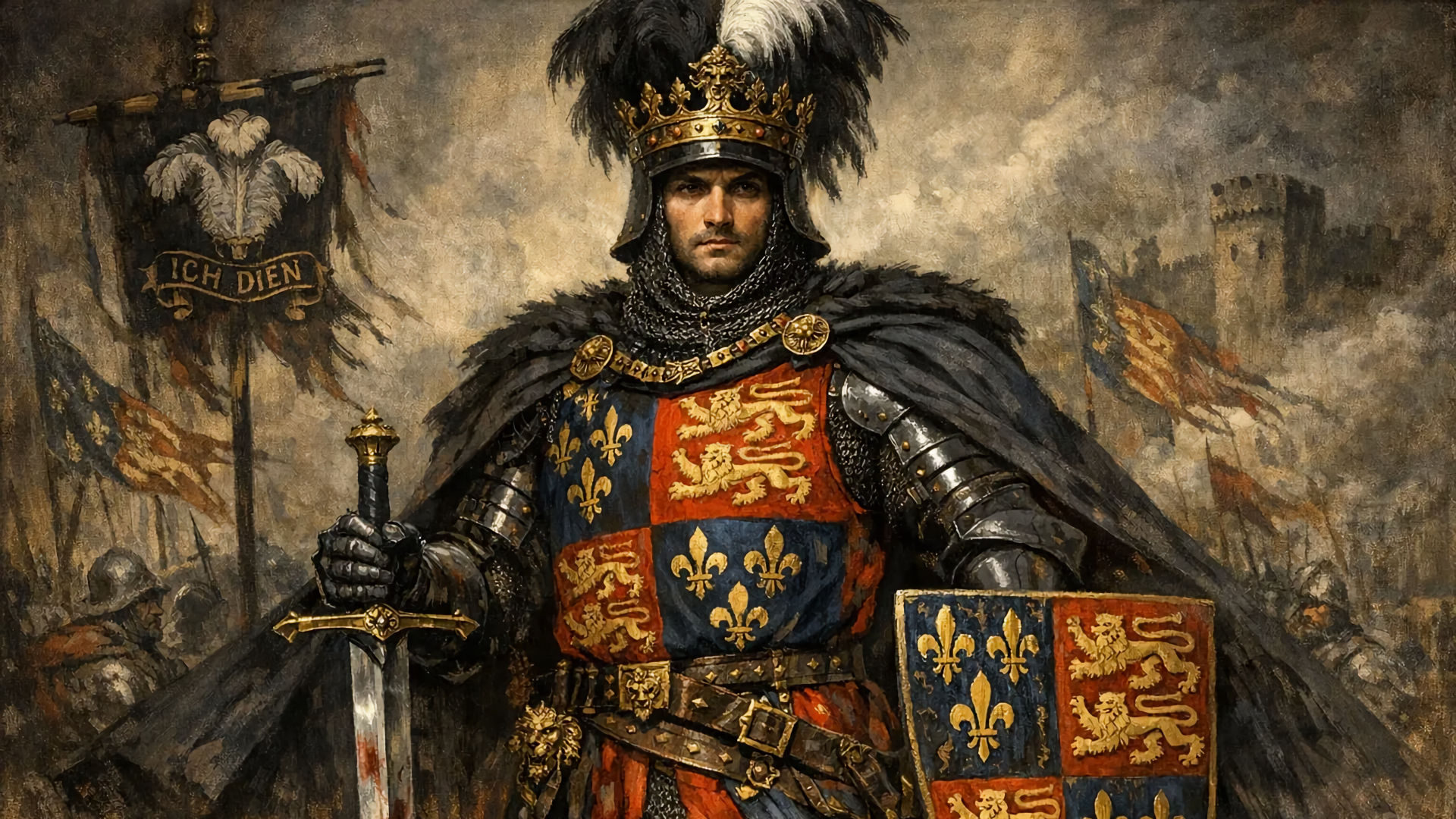
To many, the Black Prince is a romantic figure. Artists depict him in shining armour. Chroniclers praise his knightly virtues. His tomb in Canterbury Cathedral, with his great helm and armour displayed, continues to awe visitors centuries later.
But beneath the polished reputation is a more complex truth. He was both protector and conqueror, idealist and realist, hero and terror. His story reflects the contradictions of the age in which he lived.
Final Word
Edward of Woodstock, the Black Prince, was a warrior who shaped nations and a leader who inspired loyalty and fear in equal measure. He embodied the chivalry his era prized, yet he did not shy from the harsh necessities of war. He was a prince who earned everything except the crown that seemed his birthright.
He remains a vivid reminder that history is not only shaped by kings who rule, but by those whose lives change the kingdom long before the crown could ever rest upon their heads.
His victories still echo through the centuries, and his story continues to invite admiration, reflection, and fascination. The Black Prince lived boldly, fought fiercely, and left behind a legacy that stands unchallenged among the greatest warriors of the medieval world.
The Black Prince FAQ
The Black Prince was Edward of Woodstock, eldest son of King Edward III and one of the most famous English military commanders of the medieval period.
The nickname appeared after his death and may refer to his armour or to his fearsome reputation in warfare.
He is best known for his role at the Battles of Crécy and Poitiers, two major English victories during the Hundred Years’ War.
No. He died before his father, Edward III. The throne later passed to his son, Richard II.
He is remembered as the embodiment of medieval chivalry and as a commander whose tactics reshaped European warfare.