The Battle of Poitiers
By the mid-fourteenth century, the Hundred Years’ War had shifted from dynastic argument to brutal reality. What began as a dispute over succession and sovereignty had become a grinding contest of endurance, resources, and nerve. By 1356, England and France were no longer testing each other’s claims. They were testing each other’s ability to survive sustained pressure.
England’s strategy in this phase of the war relied on speed, destruction, and psychological impact rather than territorial conquest. English armies crossed into France not to occupy cities permanently, but to devastate the countryside in fast-moving raids known as chevauchées. These campaigns burned villages, destroyed crops, looted towns, and undermined confidence in the French crown’s ability to protect its people. The aim was economic warfare and political destabilisation, not map-colouring.
France was particularly vulnerable. The kingdom was wealthy but overstretched, its authority uneven, and its military leadership divided by rivalries and tradition. The memory of the catastrophic French defeat at Crécy in 1346 still lingered, along with the loss of Calais shortly afterwards. These failures had not led to reform so much as denial. French commanders remained committed to ideas of chivalric warfare and decisive battle, despite growing evidence that such ideals were ill-suited to English tactics.
By the 1350s, England was pressing this advantage relentlessly. Raiding forces struck deep into French territory, draining royal revenues and humiliating local lords. The countryside bore the cost of war far more heavily than fortified cities, and resentment simmered among populations expected to fund defence but rarely see it delivered. Each successful English raid weakened the legitimacy of the French monarchy.
The situation deteriorated further as internal pressures mounted. France was still reeling from the demographic and economic shock of the Black Death, which had reduced populations, disrupted labour systems, and strained finances. Taxation increased to fund the war effort, often provoking unrest. The crown needed a decisive success, not merely to defeat England militarily, but to reassert authority at home.
England, meanwhile, could not sustain endless raids without risk. Chevauchées were dangerous operations. They depended on mobility, discipline, and the enemy’s hesitation. If caught and forced into battle on unfavourable terms, a raiding army could be destroyed. The English command understood this, but calculated that French leadership would eventually feel compelled to fight, regardless of conditions.
By 1356, that moment was approaching. A major English force was operating deep in western France, inflicting damage and daring the French crown to respond. The pressure to act became overwhelming. Honour, politics, and public expectation converged on the same conclusion: France could no longer afford restraint.
The stage was set for confrontation. What followed would not be a clash sought by both sides on equal terms, but the collision of a raiding strategy designed to provoke and a kingdom desperate to end humiliation in a single, decisive blow. Poitiers would emerge from that tension, not as an accident of war, but as its inevitable consequence.
The Black Prince in France: Edward on Campaign
At the centre of England’s aggressive strategy in the 1350s stood Edward, the Black Prince, the eldest son of Edward III and already one of the most formidable commanders of his age. By 1356, Edward was not merely a royal figurehead leading troops in name. He was an experienced battlefield leader with a clear grasp of how England fought, and how France tended to lose.
Edward’s campaign that year followed the established English pattern of chevauchée. Moving rapidly from his base in Aquitaine, his army struck north and east through French territory, burning estates, looting towns, and destroying economic infrastructure. These raids were calculated acts of provocation. They inflicted material damage, but more importantly, they advertised French weakness. Every unopposed march eroded confidence in the crown and increased pressure on the French king to act.
The Black Prince commanded a relatively small but highly disciplined force, likely numbering around six to seven thousand men. Its strength lay not in size, but in composition and cohesion. English longbowmen formed the backbone of the army, supported by dismounted men-at-arms who were trained to fight defensively in tight formations. This was an army designed to absorb attacks and punish overconfidence, not to charge gloriously across open ground.
Edward understood his limitations as well as his advantages. Deep in enemy territory, with extended supply lines and limited reinforcements, he could not afford a reckless battle. His objective was not conquest, but leverage. By threatening key regions and avoiding unnecessary engagements, he aimed to force the French into a poorly chosen fight, one in which their numerical superiority would count for less than they believed.
Leadership style mattered. Edward cultivated loyalty among his commanders and maintained strict discipline, essential for keeping an army intact during long raids. Plunder was controlled rather than chaotic, ensuring the force remained mobile and cohesive. Morale was high, reinforced by confidence in tactics that had already humiliated French armies at Crécy and elsewhere.
The prince was also politically astute. Every mile his army advanced without resistance strengthened England’s negotiating position. If France refused battle, it looked weak. If it accepted battle under unfavourable conditions, it risked catastrophe. Either outcome benefited England. Edward’s campaign was designed to make delay impossible.
By late summer 1356, however, the balance of risk began to shift. The deeper Edward moved into France, the more likely it became that French forces would eventually corner him. Reports of a massive French army gathering under royal command reached the English camp. The window for safe withdrawal was narrowing.
Edward now faced a critical choice. He could retreat south, abandoning much of the damage already inflicted, or he could stand and fight if pressed. His preparations suggest he expected confrontation, but on his terms. The campaign had done its work. France was mobilising. The trap was set.
When the French army finally closed in, the Black Prince would not seek escape at all costs. He would choose his ground, anchor his defence, and trust that discipline, terrain, and patience could once again turn French confidence into ruin.
France Gathers Its Strength: John II Seeks Decisive Battle
By the late summer of 1356, the pressure on the French crown had become unbearable. English raids had torn through the countryside with impunity, undermining royal authority and exposing the limits of France’s defensive system. For John II of France, known as John the Good, the situation demanded action. Honour, politics, and survival all pointed toward the same conclusion: the English army had to be confronted and destroyed.
John II was not an incompetent ruler, but he was an insecure one. He had inherited a kingdom still traumatised by defeat at Crécy and weakened by plague, taxation, and internal unrest. The legitimacy of the monarchy rested heavily on its ability to protect the realm and uphold chivalric ideals of kingship. Allowing the English to raid freely was not merely a military failure; it was a personal humiliation for a king who defined his authority through martial virtue.
The French response was therefore massive. John mobilised an army far larger than anything the Black Prince could hope to face on equal terms. Estimates vary, but the French force likely numbered at least twice, and possibly three times, the size of the English army. Nobles from across France answered the call, bringing contingents of knights, men-at-arms, and supporting infantry. This was intended to be an overwhelming force, a demonstration that France could still dominate the battlefield through numbers and courage.
Yet size came with problems. The French army was slow, unwieldy, and difficult to coordinate. Command structures were layered with noble rank and tradition, making unified control challenging. Many commanders believed victory was inevitable and focused more on honour and personal reputation than on tactical cohesion. Lessons from earlier defeats were acknowledged in theory, but not fully absorbed in practice.
John II’s determination to force a battle shaped every decision. Rather than shadowing the English and cutting off escape routes gradually, the French pursued aggressively, eager to bring the raiders to heel. Negotiation was briefly considered, but quickly dismissed. Allowing the Black Prince to withdraw would look like weakness. Capturing or killing him, on the other hand, promised prestige, leverage, and the restoration of royal authority in one dramatic stroke.
There was also a dynastic dimension. Edward was not just an English commander; he was the heir to the English throne. His capture would be a prize of enormous political value. It would give France bargaining power unmatched by any territorial gain. This prospect sharpened French resolve and encouraged risk-taking.
As the French army closed in near Poitiers, confidence ran high. The English were deep in hostile territory, outnumbered, and burdened with prisoners and loot. From the French perspective, escape was impossible. The coming battle was seen not as a gamble, but as the inevitable correction of earlier humiliations.
What John II and his commanders underestimated was not English bravery, but English patience. By committing so fully to a decisive confrontation, France once again allowed its enemy to choose how and where the fighting would unfold. At Poitiers, the French crown believed it was about to restore order through strength. Instead, it was walking toward another devastating lesson.
Choosing the Ground at Poitiers: Terrain, Tactics and Preparation
When confrontation became unavoidable in September 1356, the outcome would hinge less on courage than on where and how the fighting took place. The English were deep in hostile territory and heavily outnumbered. Their survival depended on denying the French the kind of battlefield they preferred and forcing them into one that punished mass and momentum.
Edward chose his ground carefully near Poitiers, anchoring his position amid hedges, vineyards, and narrow lanes. The area was broken and uneven, criss-crossed by natural obstacles that restricted movement and funnelled attackers into confined approaches. This terrain neutralised the French advantage in cavalry and prevented large bodies of troops from deploying effectively. It was, in essence, a battlefield designed to compress superiority into frustration.
The English army prepared defensively. Men-at-arms dismounted and formed a solid core, while longbowmen were positioned on the flanks and behind natural cover. Stakes and rough ground protected their front. This was not a posture of desperation, but of intention. The English expected to be attacked and had arranged their forces to absorb and punish that attack in stages.
Preparation extended beyond formation. Edward ordered strict discipline, ensuring that troops held position and conserved strength. Ammunition was distributed carefully. Escape routes were considered but de-emphasised; the plan assumed that if the French attacked, the English would stand and fight. Morale was steadied by clarity of purpose. The army knew its role and trusted its methods.
The French approached with confidence that bordered on impatience. Their army was vast, but the terrain complicated its use. Narrow approaches forced French commanders to feed troops into the fight piecemeal rather than unleashing overwhelming force at once. Hedges and lanes constrained attempts to manoeuvre, and the crowded field made coordination difficult.
Crucially, French planning struggled to adapt. While there were discussions about dismounting knights and attacking methodically, chivalric expectations and the desire for a swift, decisive blow persisted. Many French nobles believed courage and numbers would suffice. The battlefield offered warnings, but they were not fully heeded.
Edward exploited this predictability. He anticipated that the French would attack frontally, seeking to crush resistance through repeated assaults. The English defence was built to endure exactly that, forcing attackers into killing zones where arrows and controlled counterattacks could inflict maximum damage.
By choosing ground that restricted movement, obscured lines of command, and favoured disciplined defence, the English reshaped the coming battle before it began. Poitiers would not be decided by who had the larger army, but by whose tactics aligned with the land beneath their feet.
When the fighting started, the battlefield would reveal its true allegiance. It had already been claimed by the side that understood it best.
The Battle of Poitiers: Longbows, Dismounted Knights and Collapse
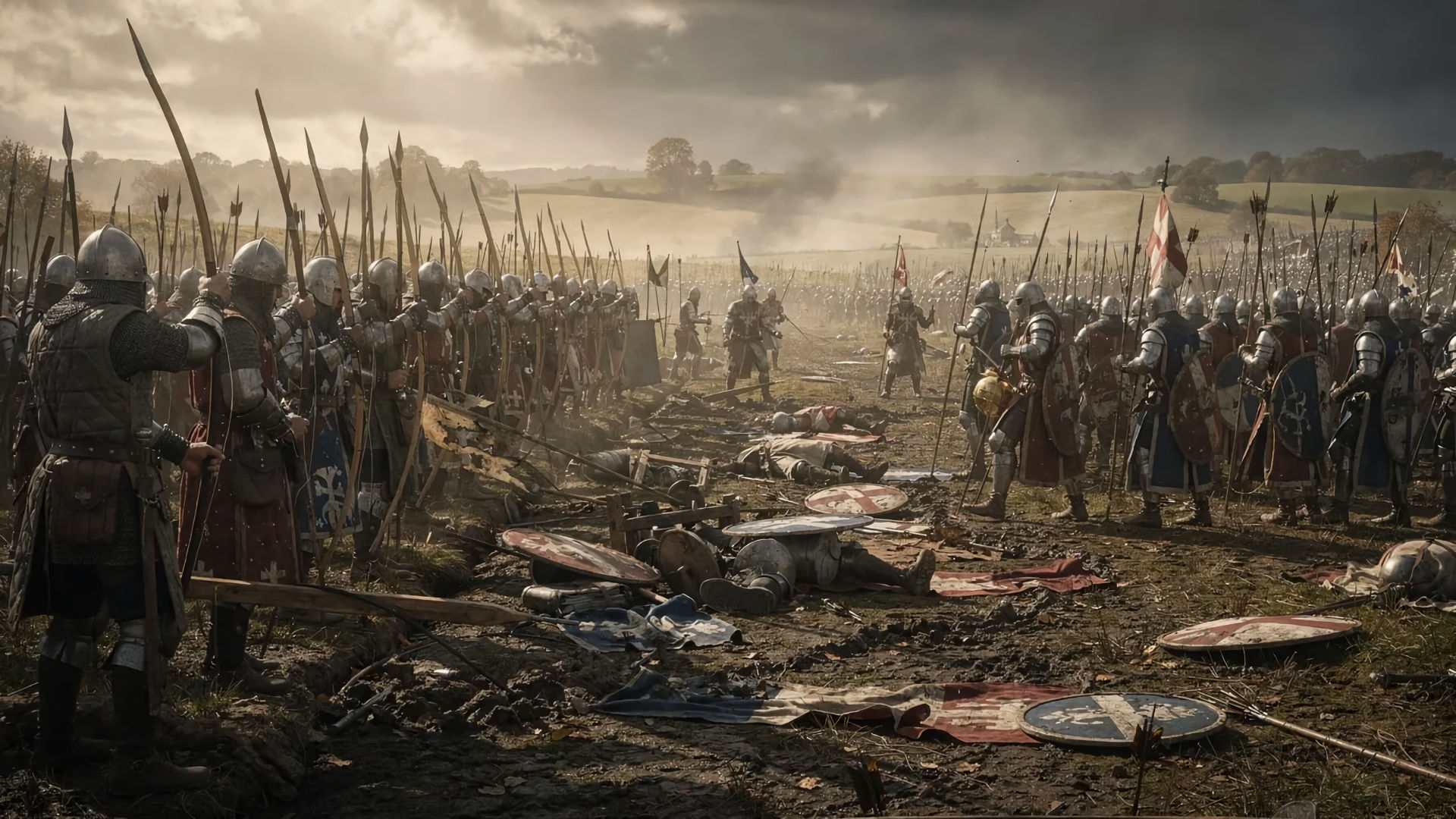
The battle of Poitiers unfolded on 19 September 1356 as a brutal test of patience and discipline rather than a single dramatic charge. The French army, vastly superior in numbers, attacked in waves against the English defensive position, exactly as Edward had anticipated. What followed was not heroic chivalry, but controlled destruction.
French commanders began by dismounting many of their knights, attempting to avoid the mistakes of Crécy by advancing on foot. In theory, this showed learning. In practice, it created new problems. Heavily armoured men-at-arms were forced to advance through narrow lanes and uneven ground under constant arrow fire. Progress was slow, exhausting, and chaotic. Units became entangled, formations broke down, and coordination dissolved almost immediately.
English longbowmen now did their work. Positioned on the flanks and partially concealed by hedges and vineyards, they poured arrows into the advancing French. The longbow did not need to penetrate armour to be effective. Horses were wounded, men were unbalanced, visors were struck, and panic spread. Every step forward cost lives and energy. The French advance became a grinding ordeal before contact was even made.
When French troops finally reached the English line, they met disciplined resistance. English men-at-arms, fighting dismounted, held firm behind makeshift obstacles. Close combat was savage but controlled. The English line bent but did not break. Exhausted French attackers were pushed back or cut down, creating piles of dead and wounded that further blocked the approaches.
Wave after wave followed, each less effective than the last. The sheer size of the French army worked against it. Reinforcements arrived piecemeal, funnelling into the same killing zones as their predecessors. Commanders struggled to impose order amid dust, noise, and mounting casualties. Momentum bled away with every failed assault.
The decisive moment came when John II of France committed his own division, determined to force victory through personal courage. Fighting at the centre of the action, John’s presence stiffened resistance but could not reverse the tide. The French line faltered under sustained pressure, and English counterattacks began to exploit gaps and confusion.
As French cohesion collapsed, the English seized the moment. A mounted reserve, held back throughout the fighting, struck the flanks of the disordered French troops. This sudden movement shattered what remained of French resistance. Units broke. Retreat turned into flight. The battlefield descended into chaos as men attempted to escape the narrow terrain that had betrayed them.
King John II fought on stubbornly, refusing to flee. Surrounded and overwhelmed, he was eventually captured along with many of the highest-ranking nobles in France. The capture of the king transformed defeat into catastrophe. What had begun as a confident attempt to crush a raiding army ended with the French monarchy itself in enemy hands.
At Poitiers, the English did not outfight France through numbers or daring. They won through preparation, terrain, and discipline. The battle was not a fluke or an accident. It was the predictable outcome of forcing a proud army to attack on ground that punished every instinct it relied upon.
Aftermath and Legacy: A King Captured and a Kingdom Shaken
The aftermath of Poitiers was devastating for France and transformative for the wider course of the Hundred Years’ War. The capture of John II of France was not just a military embarrassment; it was a political catastrophe. Never before had a reigning French king been taken prisoner in battle by an English army. The defeat struck at the very legitimacy of the French crown and exposed the fragility of royal authority.
John was taken to England and treated with respect befitting his rank, but his absence created a power vacuum at home. France was left effectively leaderless at a moment of extreme vulnerability. The regency fell to the Dauphin, the future Charles V, who faced a kingdom wracked by war exhaustion, economic strain, and rising social unrest. Taxation increased to meet English demands, fuelling resentment among towns and nobles alike.
The financial consequences were severe. John’s ransom was enormous, set deliberately high to maximise English leverage. Meeting its demands drained the royal treasury and destabilised the economy. To raise funds, the French crown was forced to make concessions to representative bodies, temporarily weakening central authority. Popular revolts, most notably the Jacquerie uprising, erupted as peasants lashed out against a system that seemed incapable of protecting them yet relentless in its demands.
For England, Poitiers was a triumph that reinforced confidence in its methods of war. The victory validated a strategy based on disciplined infantry, defensive positioning, and longbow fire rather than traditional knightly charges. English prestige soared, and the capture of the French king gave England enormous bargaining power in negotiations. The Treaty of Brétigny, signed in 1360, reflected this shift, granting England extensive territories in France and formally renouncing Edward III’s claim to the French crown in exchange.
Yet Poitiers did not end the war. Like Crécy before it, the battle exposed structural weaknesses in the French military and political organisation but did not destroy France’s capacity to recover. Over time, the French monarchy adapted. Under Charles V, the crown reformed its approach to war, avoided pitched battles, and focused on attrition and recovery. The lessons of Poitiers were painful, but they were learned.
Militarily, Poitiers joined Crécy and later Agincourt as part of a grim pattern. Again and again, French armies committed themselves to decisive battle against a smaller, well-prepared English force and paid the price. The battle became a warning about the dangers of pride, poor coordination, and underestimating defensive tactics.
Historically, Poitiers is a reminder that medieval warfare was not governed by honour alone. Organisation, discipline, and terrain mattered more than noble birth or personal bravery. The capture of a king proved that even the highest authority could fall victim to strategic failure. Poitiers did not destroy France, but it shook the kingdom to its core. It forced political adaptation, military reform, and a rethinking of how power was defended. In that sense, the battle’s legacy lies not only in defeat, but in the hard lessons that would eventually allow France to endure, recover, and continue the long war that defined a century.
The Battle of Poitiers FAQ
The Battle of Poitiers was fought on 19 September 1356 between English and French forces during the Hundred Years’ War, resulting in a major English victory.
The English army was led by Edward, the Black Prince, son of King Edward III of England.
The battle is significant because the English captured King John II of France, weakening French authority and forcing major political and financial concessions.
The English used defensive positions, dismounted men-at-arms, and longbowmen to break repeated French attacks, similar to earlier victories like Crécy.
King John II was taken prisoner to England, and his capture led to instability in France and eventually the Treaty of Brétigny.