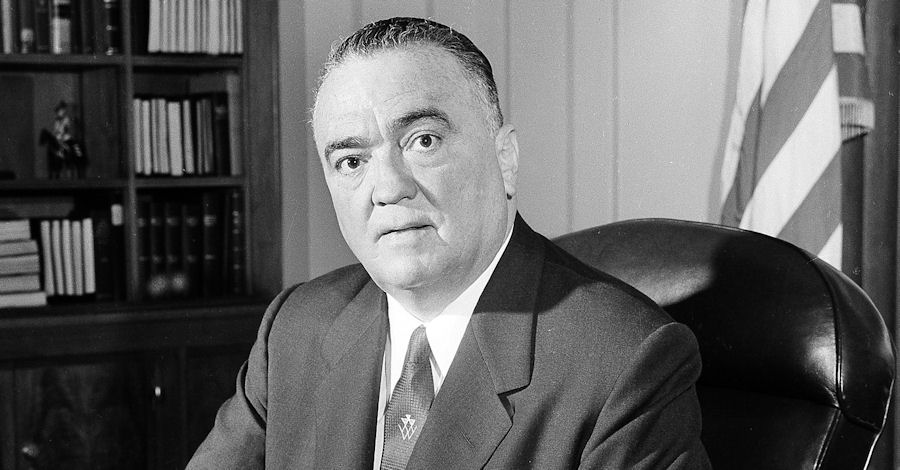
J. Edgar Hoover
J. Edgar Hoover Biography
John Edgar Hoover was born on 1 January 1895 in Washington, D.C., in the United States. His mother, Anna Marie, was of Swiss-German descent. There was also German ancestry, mixed with English, in his father’s background. Interestingly, although two of his siblings had birth certificates, which was a requirement at the time in Washington, John Edgar didn’t have one. Furthermore, no birth certificate would be filed for him until 1938, when he was 43 years old.
Hoover’s first job came along when he was eighteen years old, in 1913. It was this job, as a messenger in the orders department for the Library of Congress, that Hoover credited with laying the foundation for collecting and collating material and information, something that would prove profoundly important when he began to accumulate evidence and profiles during his work at the FBI.
Hoover grew up in the neighbourhood of Capitol Hill, in an area called Eastern Market, and attended Central High School. He taught himself to speak at a fast pace to overcome a stutter, and this characteristic persisted into adulthood. After High School, J. Edgar attended the George Washington University Law School, from which he graduated with a Bachelor of Laws degree in 1916. He received a master’s degree in law the following year.
As soon as he received his master’s degree, he was hired by the Justice Department’s War Emergency Division and became head of the Alien Enemy Bureau, which was given the power to arrest and detain, without trial, at the beginning of World War I, any foreigners deemed to be disloyal.
After the war, in 1919, J Edgar Hoover became head of the new General Intelligence Division within the Bureau of Investigation and later in 1921 became the Bureau’s deputy head. On May 10, 1924, he was appointed the sixth director of the Bureau of Investigation by President Calvin Coolidge. When he took over, Hoover was found to be unpredictable in his management style, often firing agents or managing them out of the Bureau simply for looking stupid or because they were “pinheads”. Law enforcement officers around the country, however, often received praise and support from Hoover, a tactic that enabled him to create a vast network of support and admiration nationwide.
During the 1930s, J. Edgar Hoover sought to have certain crimes, such as bank robberies and the activities of criminal gangs, recognised as federal crimes so that his department could become involved and take credit for apprehending suspects. Eventually, this paid off, after some setbacks, most notably in Hoover’s attempt to arrest notorious bank robber John Dillinger, which came close to ending his career. However, Hoover’s men started to gain notable successes. Machine Gun Kelly was arrested in 1933 and sent to Alcatraz, John Dillinger was killed by Bureau agents in 1934, and on 1 May 1936, a year after the Bureau changed its name to the Federal Bureau of Investigation, or the FBI for short, the gangster Alvin Karpis was arrested by Hoover himself.
In the late 1930s and the lead-up to the Second World War, the FBI investigated any possibility of German saboteurs planning attacks within the United States and was the primary agency responsible for counterespionage in the United States. It was during the war that the FBI received permission to wiretap individuals suspected of subversive activities from President Roosevelt, although this included a requirement for the Attorney General to be informed of each case in which wiretaps were used. The Attorney General at the time, though, General Robert H. Jackson, essentially left it up to Hoover to decide when these methods would be deployed.
After World War II had ended and into the 1950’s Hoover became increasingly of the opinion that more action should be taken against those who had dangerous political opinions, most notably those of communist persuasion. He would become increasingly frustrated, though, with the decisions made by the U.S. Supreme Court, which limited his ability to act. At the same time, Hoover seemed to turn a blind eye to organised crime, such as prostitution and extortion and the vice rackets operated by the Mafia. He even went as far as to deny that the Mafia was operating in the United States at the time. However, when the fact that the Apalachan Meeting had taken place and been attended by an estimated 100 Mafiosi members from all over the country hit the newspaper front pages, Hoover had no choice but to take action, and the fight against organised crime suddenly became the FBI’s top priority.
After the assassination of President John F. Kennedy in November 1963, the new president, Lyndon B. Johnson, removed the mandatory retirement age of 70 for Government employees, thus allowing Hoover to stay on at the FBI indefinitely. Hoover personally led the investigation into Kennedy’s assassination and testified at the Warren Commission hearings.
During his time at the FBI, J Edgar Hoover became almost too powerful, but there was little that various administrations at the time were able or even willing to do about it. Both President Kennedy and President Truman considered removing him, but ultimately decided that the political fallout would be too great to tolerate. Even when Richard Nixon took office in 1969, when Hoover was 74 years old, he proved too difficult to remove due to the amount of power he wielded in Washington.
J Edgar Hoover remained as Director of the FBI until May 2, 1972, when he suffered a heart attack at his home in Washington and died. His body lay in state at the Rotunda of the U.S. Capitol and was then buried in the Congressional Cemetery in Washington, D.C., next to the graves of his parents and sister.
J. Edgar Hoover FAQ
J. Edgar Hoover was the first Director of the Federal Bureau of Investigation (FBI) of the United States, serving from 1924 to 1972. He was instrumental in shaping the FBI into a powerful national law enforcement agency.
Hoover modernised policing with fingerprint databases, forensic labs, and centralised intelligence gathering. He expanded the FBI’s authority and helped create the image of federal agents as elite professionals.
While praised for building the FBI, Hoover was criticised for overreaching his power, keeping secret files on political figures, and using surveillance tactics against civil rights leaders and perceived radicals, especially through the COINTELPRO programme.
Hoover served for 48 years, across eight U.S. presidents, making him one of the most enduring and powerful unelected officials in American history.
[this article originally appeared on 5MinuteBiographies.com on 18 October 2018]