The Zodiac Killer
Before anyone knew the name Zodiac, northern California already had the right ingredients for a nightmare that would refuse to end. The late 1960s were a restless time around the San Francisco Bay Area, a place associated with counterculture, political protest, music, freedom, and reinvention. Yet just beyond that image of bright rebellion were quiet roads, lovers’ lanes, isolated parking spots, and suburban edges where darkness gathered quickly. It was in those spaces, not in the grand theatre of the city itself at first, that fear began to take shape.
The story generally begins on 20 December 1968, on Lake Herman Road near Benicia. David Faraday and Betty Lou Jensen were teenagers, young enough that their deaths carried the particular horror of lives barely begun. They had parked in a remote area, a setting that should have meant privacy, awkward conversation, and the ordinary nerves of young romance. Instead, they were shot and killed beside their car, leaving police with a brutal crime, grieving families, and very few answers.
At that point, there was no Zodiac mythology. There was no crosshair symbol, no famous phrase, no coded taunts, no endless suspect lists, and no army of amateur detectives staring at photocopied letters late into the night. There was simply a double murder. Investigators had to treat it as a crime in its own right, not as the opening chapter of a larger campaign. That is one reason the case became so difficult later, because the pattern only became obvious once more blood had been spilt.
The next confirmed attack came months later, during the Fourth of July weekend in 1969. Darlene Ferrin and Michael Mageau were attacked at Blue Rock Springs Park in Vallejo. Ferrin was killed, while Mageau survived, badly wounded but able to provide information about what had happened. The fact that one victim lived mattered enormously. The killer was no longer just a shadow in the aftermath. There was now a witness, however traumatised and limited by the sudden violence of the attack.
After the Blue Rock Springs shooting, the person responsible made a call to the police and claimed responsibility for both that attack and the Lake Herman Road murders. That act changed the character of the case. Many killers hide from recognition, but this one seemed to want acknowledgement, control, and a relationship with the authorities. He was not content with leaving behind crime scenes. He wanted to narrate them.
By the summer of 1969, the Bay Area had not yet met “Zodiac” by name, but the outline was forming. Two attacks, three dead, one survivor, and a voice on the telephone claiming ownership of the violence. The public did not yet know it, but the killer’s next move would not simply be another attack. It would be a media strategy, because this murderer was about to discover that terror travelled faster when delivered through the post. The Zodiac Killer is generally believed to have murdered at least five people in northern California between 1968 and 1969, with several later claims and possible links remaining controversial.
The First Attacks and the Birth of a Pattern
The Lake Herman Road and Blue Rock Springs attacks gave investigators a grim foundation, but a pattern in a murder case is rarely neat at the beginning. Similarities can be obvious in hindsight while still being uncertain in the moment. Both attacks involved young couples in parked cars, both took place in relatively isolated spots, and both suggested an assailant who approached suddenly and left quickly. Yet police could not simply assume the same person was responsible without evidence. Murder investigations are not crossword puzzles, even when the killer later insists on turning them into one.
Michael Mageau’s survival after the Blue Rock Springs attack was vital, but eyewitness evidence from a violent encounter is complicated. A victim may remember clothing, build, movements, light, sound, or the terrifying sequence of seconds, yet every detail has to be handled carefully. The attack happened at night, under extreme stress, and with a gunman who did not remain politely still for the benefit of future police sketches. It was enough to give investigators something, but not enough to give them the clean identification everyone wanted.
The case sharpened again on 27 September 1969 at Lake Berryessa in Napa County. Bryan Hartnell and Cecelia Shepard were relaxing near the lake when a man approached them wearing a bizarre hooded costume marked with the now infamous crossed-circle symbol. This was not a simple ambush from darkness. It was theatrical, deliberate, and chillingly staged. The attacker tied them up and stabbed them. Hartnell survived, while Shepard died from her injuries two days later.
Lake Berryessa widened the horror of the case because it changed the method. The earlier confirmed attacks had involved shootings, but here the killer used a knife and a costume. That could have weakened the pattern, yet the killer made sure the connection could not be ignored. He wrote a message on Hartnell’s car door, listing dates of earlier attacks and adding the Lake Berryessa assault to the tally. It was evidence, confession, signature, and grotesque scoreboard all at once.
The final confirmed murder came on 11 October 1969 in San Francisco. Paul Stine, a taxi driver, picked up a passenger and was shot in the Presidio Heights neighbourhood. This attack was different again. Stine was not part of a young couple, and the crime took place in a city setting rather than a remote lovers’ lane. If investigators had been trying to build a tidy offender profile, Zodiac seemed determined to kick the filing cabinet over and walk away smirking.
Yet the Stine murder also brought the case closer to capture than ever before. Witnesses saw a man near the cab, and police produced a composite sketch based on descriptions. Officers responded quickly, but the suspect escaped. Later, the killer sent pieces of Stine’s bloodstained shirt with letters, proving that the correspondence was not merely the work of a crank taking credit from a newspaper report. It was a direct link between the writer and the murder.
By late 1969, the pattern had become both clearer and stranger. The confirmed Zodiac attacks involved different locations, different weapons, and different victim circumstances. What linked them was not only the violence, but the performance after the violence. This was the defining feature of the case. The Zodiac Killer did not merely kill and disappear. He returned through letters, symbols, ciphers, and claims, turning the investigation into a public contest that he believed he was controlling.
Letters, Ciphers, and a Killer Who Wanted an Audience
The Zodiac case became infamous not only because of the murders, but also because of the way the killer forced himself into public view. On 31 July 1969, letters were sent to three Bay Area newspapers, each claiming responsibility for the Lake Herman Road and Blue Rock Springs attacks. Each letter included part of a cipher, with instructions that the newspapers publish them. The threat was simple and ugly: if the papers refused, more people would die. It was murder as blackmail, with the press dragged into the machinery.
This was the moment the case became something more than a police investigation. Newspapers had to decide how to handle a killer who was demanding space in print. Police had to weigh public safety against the danger of rewarding him with attention. The public, meanwhile, found itself reading words supposedly written by a murderer who seemed to be speaking directly from the page. In modern terms, he understood the power of audience capture long before anyone had the misfortune of inventing that phrase.
The first cipher, made up of 408 characters, was solved quickly by Donald and Bettye Harden, a schoolteacher and his wife from Salinas. The message did not reveal the killer’s identity, despite his implication that it might. Instead, it gave the world a glimpse of his self-dramatising cruelty, his spelling errors, and his desire to make murder seem like a philosophy rather than a crime. That was part of the manipulation. He wanted to be treated as a terrifying intellect, not merely a violent offender hiding behind paper and postage stamps.
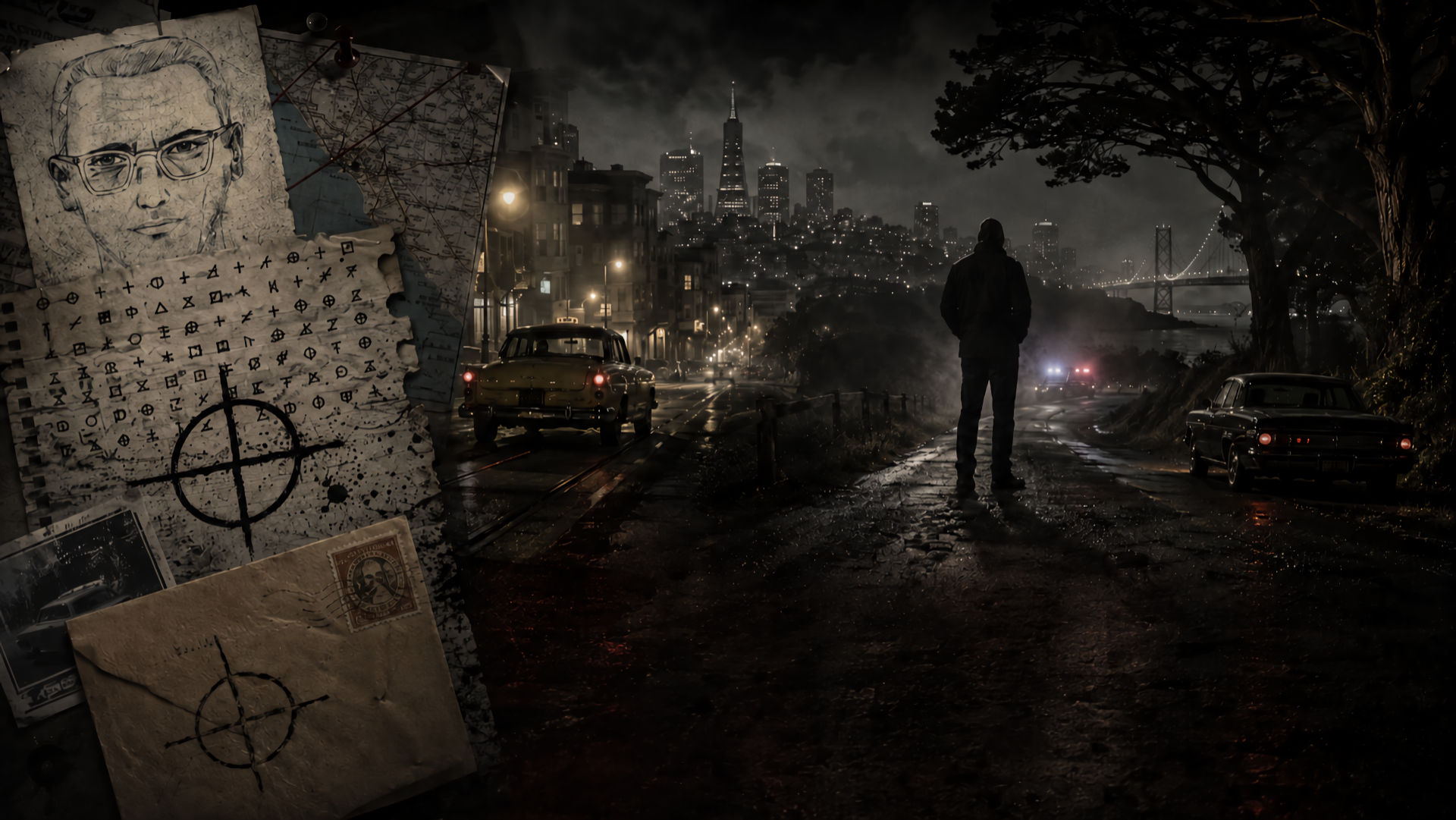
On 4 August 1969, another letter arrived, beginning with the phrase that would become inseparable from the case: “This is the Zodiac speaking.” The name had now appeared. It was a brand, really, and an extremely grim one. With that line, the killer turned himself into an identity that could outlive the person behind it. The crosshair-like symbol, the letters, the codes, and the staged claims all helped build a persona that was both specific and elusive.
The ciphers remain one of the reasons the case has held public attention for so long. Codes invite participation. They suggest that there is a hidden door, and that if someone is clever enough, patient enough, or obsessive enough, the answer might finally appear. The Zodiac exploited that instinct brilliantly. He made the public feel as if the mystery itself was part of the crime scene.
The most famous unsolved cipher, the 340-character message sent in November 1969, resisted solution for more than 50 years. In 2020, a team made up of David Oranchak, Sam Blake, and Jarl Van Eycke solved it, and their later paper described it as involving both transposition and homophonic substitution. The solution was historically important, but it did not name the killer. Once again, the great revelation turned out to be more performance than confession.
That was the particular cruelty of the Zodiac letters. They promised meaning while withholding resolution. They taunted police, frightened readers, and gave future generations endless material to analyse. But beneath all the symbols and riddles were dead people, wounded survivors, and families left with grief instead of answers. The codes made the case famous. The murders made it matter.
Fear Spreads as the Investigation Widens
As the letters continued, the Zodiac case expanded beyond the original crime scenes. It became a regional fear, a media event, and a law enforcement headache shared across jurisdictions. Benicia, Vallejo, Napa County, San Francisco, Solano County, and state and federal agencies all became connected in one way or another. That mattered because serial investigations are difficult even when one department controls the evidence. In the Zodiac case, the geography itself worked like fog.
The killer seemed to understand that confusion could be useful. He claimed responsibility for crimes, hinted at others, threatened schoolchildren, discussed bombs, and shifted between murder, fantasy, and manipulation. Some claims had evidence behind them, such as the Paul Stine shirt pieces. Others were uncertain, disputed, or likely false. Investigators had to separate confession from theatre, fact from bait, and possible evidence from attention-seeking rubbish. It was not glamorous detective work. It was sorting a nightmare with a ruler and a headache.
The public fear was especially sharp because Zodiac appeared unpredictable. Lovers’ lanes were frightening enough after the first attacks, but then came Lake Berryessa with its costume and knife, followed by the killing of a taxi driver in San Francisco. If the victims had all fitted one narrow pattern, the public might have imagined the danger as avoidable. Do not park in remote places, do not go to certain roads, and do not sit in cars at night. But the Stine murder suggested something broader and more random. The fear moved from the edges into the city.
Media coverage fed that fear, but it also reflected a genuine public emergency. Newspapers were not simply sensationalising a distant crime. They were receiving communications from someone linked to murders. The killer was using the press as a delivery system, and each publication risked giving him exactly what he wanted. At the same time, refusing to publish could feel dangerous when he made threats against strangers. It was a nasty bargain, the sort where every option looked wrong under a flickering fluorescent light.
Police sketches and witness descriptions gave the public an image, but not a name. The Presidio Heights composite became one of the most recognisable elements of the case, a face that seemed frustratingly ordinary. That was part of the terror. Zodiac was not depicted as a monster from folklore, but as a bespectacled man who might have been standing behind someone in a shop queue. If the sketch was accurate, he did not need to look remarkable. He needed to pass.
The investigation also had to contend with hoaxes. Once the case became famous, it attracted false confessions, suspicious letters, and people who wanted proximity to the horror. This is one of the less cinematic problems in major cases. A famous unsolved murder becomes a magnet for the unstable, the malicious, the bored, and the self-important. Every false lead wastes time, but every ignored lead might be the one that matters. That is how a case becomes a maze.
By the early 1970s, Zodiac’s confirmed violence appeared to have stopped, but the letters and possible communications kept the fear alive. The killer’s public presence had become detached from the certainty of his crimes. He could haunt the Bay Area through a postmark, a symbol, or a line of text. That is why the case remained active in the imagination even as the trail cooled. He had created a mystery that could continue without him. CBS reported that the FBI confirmed the 340 cipher solution in 2020 and said the Zodiac case remained an ongoing investigation for the FBI San Francisco division and local law enforcement partners.
Suspects, Dead Ends, and the Problem of Proof
No part of the Zodiac case generates more argument than the question of suspects. The absence of a confirmed identity has created a vacuum, and vacuums attract theories the way jam attracts wasps. Some are careful and evidence-based. Others are built from coincidence, wishful thinking, and the classic true-crime habit of deciding a man looks suspicious because he owned glasses and once visited California. The trouble is that a case like this can make almost any fragment seem meaningful if it is held close enough to the light.
The most frequently discussed suspect has long been Arthur Leigh Allen, a Vallejo man whose name appears again and again in books, documentaries, and online discussions. He attracted attention for several reasons, including his location, background, and the suspicions of some investigators. Yet suspicion is not proof. Allen was investigated, but he was never charged as the Zodiac Killer, and the case against him has never been conclusively established. In a case this famous, that distinction is not a minor legal nicety. It is the difference between history and accusation.
The problem of proof runs through the entire Zodiac investigation. The killer left letters, fingerprints may have been collected, handwriting was analysed, witnesses gave descriptions, and physical evidence existed in fragments. Yet none of it has produced the decisive public answer. Handwriting analysis can suggest, compare, and challenge, but it is rarely the final trumpet blast people imagine. Eyewitness accounts can help enormously, but they are human records of traumatic moments. Even physical evidence can degrade, disappear, or become difficult to interpret decades later.
Other suspects have emerged over the years, some from police work, others from private investigators, journalists, relatives, or self-styled case breakers. In 2021, a group claimed that Gary Francis Poste, who had died in 2018, was the Zodiac Killer. The claim received media attention, but law enforcement did not accept it as a closed-case solution. That is a recurring pattern in the Zodiac story. A name is announced, headlines flare, experts argue, and then the central fact remains unchanged. The Zodiac Killer has not been officially identified.
This is where the case becomes especially difficult for responsible storytelling. It is tempting to treat each suspect as a dramatic reveal, building suspense around whether this person was secretly the monster. But real people have families, victims have families, and history should not be rewritten around unproven claims simply because they make a tidy ending. The lack of resolution is frustrating, but forcing one would be worse. A false solution is not justice. It is just another form of noise.
The Zodiac himself made the proof problem harder by mixing confirmed facts with claims. He said he killed far more people than the five confirmed victims generally attributed to him. Some unsolved crimes have been proposed as possible Zodiac cases, including the 1966 murder of Cheri Jo Bates in Riverside, but such links remain disputed. The killer benefited from ambiguity. Every possible connection enlarged his legend, whether or not he deserved it.
That may be one reason the case remains so culturally powerful. It sits at the uncomfortable intersection of evidence and imagination. There is enough information to keep people searching, but not enough to stop them arguing. Arthur Leigh Allen remains the suspect most often cited, but it must be made clear that his identification as Zodiac has never been substantiated and that later claims about Gary Francis Poste were rejected by law enforcement.
The Unsolved Case That Became a Modern Obsession
The Zodiac Killer case endures because it contains almost every element that keeps an unsolved crime alive in public memory. There are confirmed murders, surviving witnesses, letters, ciphers, a symbol, a police sketch, disputed suspects, possible hoaxes, and a killer who seemed to understand publicity with unnerving skill. It is not just a murder case. It is a story about fear, media, ego, evidence, and the limits of investigation. It also has the one ingredient that guarantees endless attention: no confirmed ending.
That lack of resolution has allowed the case to evolve with each generation. In the 1970s, it was newspaper columns, police bulletins, and local fear. Later, it became books, television specials, documentaries, message boards, podcasts, YouTube channels, and sprawling online archives. The internet did not create Zodiac obsession, but it gave it a permanent meeting room with terrible lighting and unlimited coffee. Every letter can be enlarged, every symbol compared, every suspect re-examined, and every theory revived with a new thread title.
There is value in public interest when it is careful. Amateur researchers have contributed to the wider understanding of the case, and the 340 cipher solution showed that outsiders with skill, persistence, and technology could help solve a piece of the puzzle. But obsession has a darker side. It can flatten victims into clues, turn suspects into characters, and treat grief as entertainment. The Zodiac case is especially vulnerable to that because the killer himself tried to make the story about him. Responsible retelling has to resist that trap.
The victims deserve to remain central. David Faraday, Betty Lou Jensen, Darlene Ferrin, Cecelia Shepard, and Paul Stine were not supporting cast members in a villain’s performance. Michael Mageau and Bryan Hartnell were not merely “survivors” in an abstract sense, but people whose lives were violently changed. The families did not receive neat closure when the letters stopped arriving or when a cipher was solved. They inherited uncertainty, which is a uniquely cruel kind of aftermath.
The case also changed how people think about serial crime and publicity. Zodiac was not the first killer to communicate with the press, but his combination of letters, codes, threats, and self-branding made him a grim prototype for the media-conscious murderer. He understood that fear could be multiplied through language. He also understood that mystery could outlive violence. That may be his most poisonous legacy, the idea that a murderer could become a puzzle and, through that puzzle, remain famous.
Yet the mystery should not be mistaken for brilliance. The Zodiac Killer was not some superhuman criminal mastermind. He made mistakes, left witnesses, relied on luck, and escaped in part because investigations in 1968 and 1969 lacked tools that later generations would take for granted. DNA databases, digital mapping, instant communication between agencies, and modern forensic systems might have changed the case dramatically. The legend grew partly because the evidence never quite caught up with the man.
Today, the Zodiac case remains officially unresolved. That is the uncomfortable final shape of the story, at least for now. The 340 cipher has been solved, suspects have been examined, and countless theories have been tested in public and private, but no one has been legally and conclusively identified as the killer. The case endures not because it gives us answers, but because it denies them with almost theatrical precision. The final horror is not only that Zodiac killed. It is that he managed to leave behind a silence loud enough to echo for more than half a century.
The Zodiac Killer FAQ
The Zodiac Killer was an unidentified murderer who operated in northern California in the late 1960s. He became infamous for attacking victims, sending letters to newspapers, and using coded messages and a distinctive symbol.
The Zodiac ciphers were coded messages sent to newspapers. Some were solved, including the 408-character cipher and the 340-character cipher, but none has publicly revealed the killer’s identity.
No. The Zodiac Killer has never been officially identified, arrested, or convicted. Several suspects have been proposed over the years, but no confirmed legal solution has been reached.
The case remains famous because it combines brutal crimes, surviving witnesses, cryptic letters, unsolved ciphers, disputed suspects, and the mystery of an unidentified killer who deliberately sought public attention.
The Zodiac Killer is generally linked to five confirmed murders, although he claimed to have killed many more. Several other crimes have been discussed as possible Zodiac cases, but those links remain disputed.