The Mystery of the Shugborough Inscription
In the grounds of Shugborough Estate in Staffordshire stands a monument that seems, at first glance, like the sort of elegant garden feature an 18th-century gentleman might install to impress his guests. It has classical columns, a carved relief, a sense of cultured melancholy, and just enough ancient-world atmosphere to suggest that somebody involved had recently returned from a Grand Tour and wanted everyone to know about it. Yet beneath the surface of polite Georgian taste sits one of Britain’s most stubborn little mysteries, a short line of letters that has managed to irritate historians, tempt treasure hunters, and lure codebreakers into a very attractive intellectual trap.
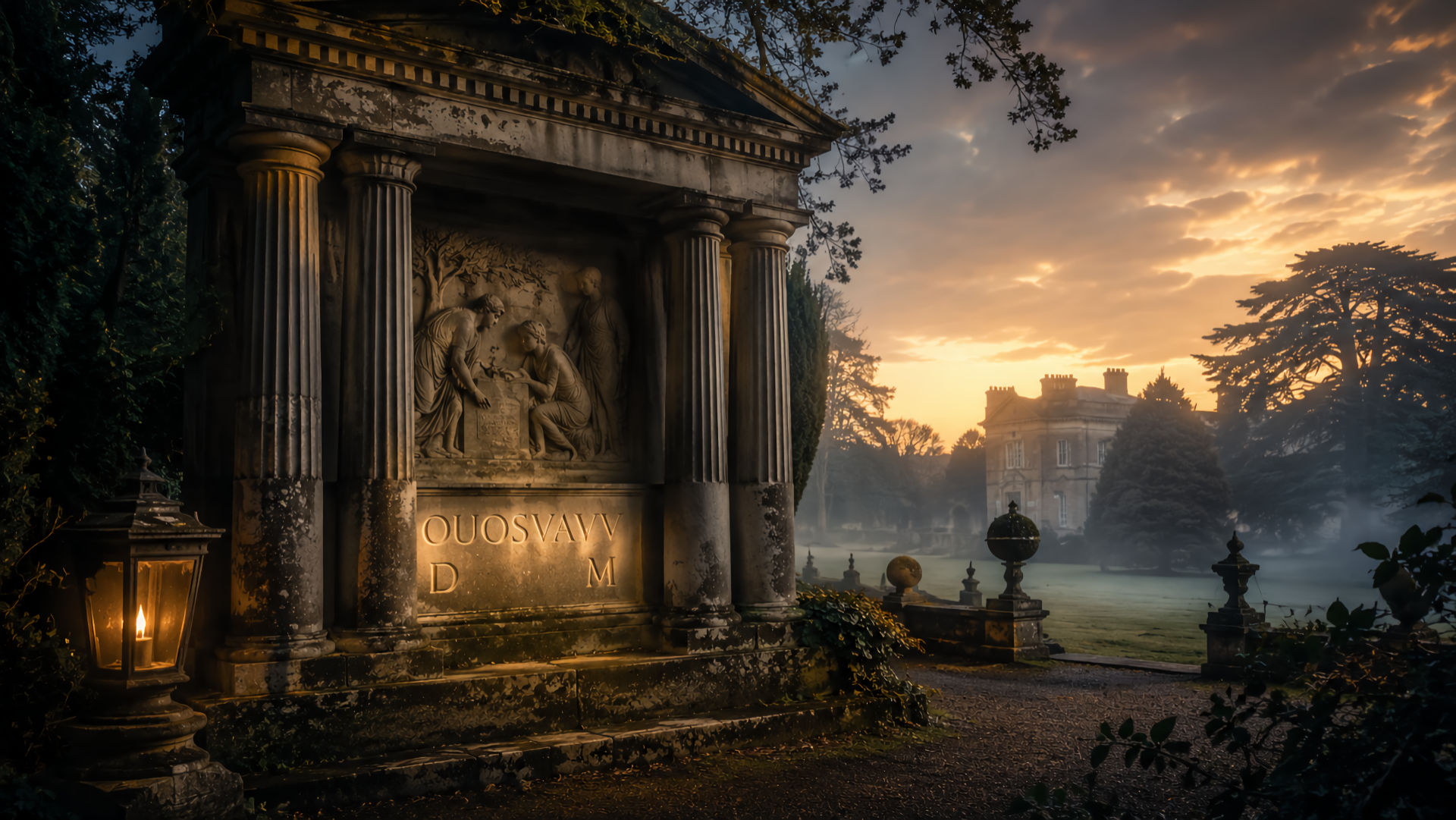
The inscription itself is famously brief. It consists of the eight letters OUOSVAVV, with the letters D and M placed below, one at either side. That is all. No helpful explanation, no signature, no date, no smug note saying, “Well done, you have solved it.” It is not a sprawling manuscript or a hidden chamber full of symbols. It is ten letters carved in stone, and for more than two centuries, those ten letters have refused to behave like a normal message.
Part of the fascination lies in the setting. Shugborough was not a remote ruin or a half-forgotten medieval site, but a carefully shaped aristocratic estate. Its owners had money, education, social connections, and a taste for classical references. This means the inscription was probably not random scratching by someone with a chisel and too much spare time. It was placed deliberately, beneath a carefully chosen image, on a monument designed to be seen, contemplated, and perhaps understood by someone.
That possibility is what gives the mystery its grip. If the letters are meaningless, the story ends quickly and rather rudely. But if they mean something, then the question becomes far more interesting. Who was the message for? Was it a private memorial, a family joke, a religious clue, a coded confession, or something stranger? Before we can attempt to read the letters, we first need to understand the world that placed them there, because Shugborough was no ordinary garden. The Anson family were no ordinary country-house owners.
The Shepherd’s Monument and the World Thomas Anson Built
Shugborough’s 18th-century transformation was largely the work of Thomas Anson, a man whose life and interests were shaped by travel, taste, wealth, and the fashion for turning landscapes into expressions of learning. Thomas came from a family that had held the estate for generations. Still, the Shugborough that visitors recognise today was shaped during a period when Britain’s elite were obsessed with classical culture, exotic design, and the idea that a garden could tell a story. A rich estate was not merely a place to live. It was a stage on which a family could display education, status, imagination, and very expensive landscaping decisions.
Thomas Anson’s ambitions were helped enormously by his brother, Admiral George Anson. George became famous for his circumnavigation of the globe between 1740 and 1744, a voyage marked by hardship, disease, naval violence, and huge financial reward. His capture of a Spanish treasure galleon brought immense wealth into the family orbit, and that money helped fund the reshaping of Shugborough. The estate became a place filled with buildings, monuments, and references to distant cultures and ancient worlds. It was a Georgian landscape with the confidence of a man saying, “Yes, I have read the classics, and yes, I would like a grotto.”
The Shepherd’s Monument belongs within that world of symbolism and display. It is not simply a stone ornament dropped randomly into the grounds. Historic descriptions identify it as a formal structure with Doric columns and a carved relief by Peter Scheemakers, a sculptor who worked on several important British monuments. The relief shows a version of Nicolas Poussin’s painting often known as The Shepherds of Arcadia or Et in Arcadia Ego. In the scene, shepherds examine a tomb while a female figure watches, creating an image full of mortality, memory, and classical moodiness.
This matters because the inscription is not isolated. It sits beneath an image already concerned with reading, death, and hidden meaning. The shepherds in the relief are themselves looking at words on a tomb, while the viewer looks below them at another set of words, or at least letters, that resist interpretation. It is a mystery about reading placed beneath a scene about reading. That feels far too neat to be accidental.
So the monument prepares the viewer for a puzzle. It asks us to think about death, commemoration, classical learning, and the limits of interpretation. The next question is whether the famous letters are actually a code, or whether generations of investigators have been trying to unlock a door that was never locked in the first place.
OUOSVAVV: The Code That Refuses to Speak
At the heart of the mystery are the letters themselves: OUOSVAVV, with D and M below. One of the few relatively firm points is that D M may refer to Dis Manibus, a Latin funerary phrase commonly used on Roman tombs, meaning “to the spirits of the dead” or “to the Manes.” If that reading is correct, then the inscription may belong to the language of memorials rather than treasure maps. It may be about death, dedication, grief, or remembrance, which would fit neatly with the Poussin-inspired image above it.
The difficulty begins with the eight central letters. They do not form an obvious word in English, Latin, French, Greek, or anything else conveniently available to the impatient investigator. They might be initials. They might be a cipher. They might be an abbreviation. They might refer to a poem, a motto, a family story, a religious phrase, a personal name, or something that made perfect sense to one small circle of people in the 18th century and now makes everyone else feel slightly underqualified.
If the letters are initials, then the mystery becomes a problem of reconstruction. Each letter could begin a word in a sentence, perhaps in Latin or English. This has produced many proposed solutions, some solemn, some ingenious, and some carrying the faint aroma of a theory assembled during a long evening with a notebook and a heroic amount of tea. The trouble with initialisms is that they are dangerously flexible. Given enough patience, almost any string of letters can be made to stand for something. The test is not whether a phrase can be invented, but whether there is evidence that the phrase existed and mattered.
If the letters are a cipher, the problem is even harder. A good cipher needs a key, and the key may have been lost. It might be hidden in the artwork, in the estate’s history, in the Anson family papers, in classical literature, or in some private arrangement between the person who commissioned the monument and the person who carved it. Without that key, the inscription becomes a locked box with no guarantee that the contents survived.
This is why the Shugborough Inscription has lasted so long. It is short enough to seem solvable, but too short to give much away. Longer codes provide patterns, repetitions, frequencies, and mistakes. This one gives almost nothing. It is the cryptographic equivalent of a cat sitting on a manuscript, entirely confident that you will never get any useful work done.
Love, Death, Treasure and the Holy Grail
Because the inscription sits beneath a funerary image, many of the more restrained theories have treated it as a private memorial. One line of thought suggests that it may commemorate a woman, perhaps through initials forming a Latin dedication. Some proposed readings imagine a grieving husband, a beloved wife, or a message linked to virtue, loss, and remembrance. These ideas have the advantage of fitting the monument’s mood. They do not require secret societies, buried gold, or a convenient medieval conspiracy popping out from behind a shrub.
Yet Shugborough has also attracted much more dramatic theories. One reason is the use of Poussin’s Et in Arcadia Ego, a painting that has long been a magnet for symbolic interpretation. Poussin’s shepherds, the tomb, the phrase about Arcadia, and the haunting presence of death in paradise have all encouraged speculation. Once people begin looking for secret meanings in Poussin, it is only a short walk, possibly through very misty woodland, to the Holy Grail, the Knights Templar, and claims that someone hid a world-altering truth in a country-house garden in Staffordshire.
The Holy Grail theory gained wider attention through the atmosphere created by books such as The Holy Blood and the Holy Grail and, later, the popularity of The Da Vinci Code, even though Shugborough itself does not need Dan Brown to be interesting. The idea is tempting because it turns the inscription into a breadcrumb. Perhaps the letters point to a location. Perhaps the Poussin relief is not merely decorative. Perhaps the Ansons, with their wealth, travels, and classical interests, were guardians of something astonishing. It is wonderfully cinematic, which is both its strength and its warning label.
Treasure theories have also flourished, especially because Admiral George Anson’s real life included captured Spanish silver and global naval adventure. That gives the imagination something solid to work with. If an Anson returned from the Pacific with enormous wealth, why not suppose that some secret remained hidden? The problem, as ever, is evidence. A theory can be colourful, internally clever, and still rest on very little stone beneath its feet.
The more grounded possibility is that the inscription was meaningful within the Anson circle and not intended for universal decoding. It may have been a private allusion, a memorial reference, or a deliberately elegant puzzle for educated guests. That would explain why it feels meaningful yet refuses to open fully. But if that is the case, the next stage of the story belongs not to treasure seekers, but to the people who have tried to solve it properly.
The Codebreakers, Historians and Sceptics Move In
The Shugborough Inscription’s reputation grew partly because serious people have taken it seriously. It is one thing for a mystery to attract enthusiastic amateurs, and quite another for it to draw the attention of trained codebreakers and scholars. In 2004, veterans associated with Bletchley Park were invited to examine the inscription, a publicity-friendly moment that gave the puzzle an irresistible headline. If people linked with the wartime world of Enigma codebreaking could not crack it immediately, then perhaps the little Staffordshire inscription really was something formidable.
Yet the Bletchley connection also reveals a problem. Wartime codebreaking and 18th-century epigraphy are not the same task. Enigma messages belonged to an operating communication system, with volume, repetition, structure, and context. The Shugborough Inscription offers none of that. It is a tiny sample, possibly not a cipher at all, embedded in art-historical and family context. To solve it, one may need Latin, genealogy, classical symbolism, estate history, sculptural knowledge, and the emotional habits of Georgian aristocrats. In other words, it is less a locked safe and more a very smug historical onion.
Historians have therefore approached the problem differently. They ask who commissioned the monument, when it was made, what the relief meant in 18th-century taste, and how the Anson family’s friendships and losses might connect to the letters. Some recent interpretations have looked at names linked to the Ansons and their social circle, suggesting that the letters could form a memorial dedication rather than an encrypted treasure clue. These attempts are valuable because they begin with context instead of starting with a desired answer and then dragging the letters towards it.
Sceptics, meanwhile, perform the necessary but unpopular work of refusing to be impressed too quickly. They point out that many proposed solutions rely on invented expansions, loose translations, or assumptions that cannot be tested. A Latin phrase may sound convincing, but if the grammar is strained and no documentary evidence supports it, the solution remains fragile. An English acrostic may be charming, but if the supposed source poem cannot be traced, charm alone will not do the heavy lifting.
This is where the mystery becomes more sophisticated. The real challenge may not be finding a possible answer. There are plenty of possible answers. The challenge is finding an answer strong enough to exclude the others. Until that happens, the Shugborough Inscription remains suspended between history and imagination, which is exactly where a good mystery likes to make itself comfortable.
Why the Shugborough Inscription Still Keeps Its Secret
The Shugborough Inscription endures because it sits at the perfect point between clue and silence. It gives us enough to begin, but not enough to finish. The letters are real, the monument is real, the Ansons are real, the classical imagery is real, and the setting is full of legitimate historical interest. Yet the meaning of the inscription remains just out of reach, like a whispered sentence in the next room. You can hear that something is being said, but not quite what.
Part of the problem is proof. A proposed solution can sound elegant and still fail to prove itself. If someone says the letters stand for a Latin memorial phrase, we can ask whether the phrase fits the grammar, whether it fits the period, whether it fits the people involved, and whether there is any independent evidence for it. If someone says the letters point to the Holy Grail, we can ask rather more loudly for evidence, preferably something stronger than “Poussin looks suspicious.” Mysteries thrive in the gap between plausibility and proof, and Shugborough has made a permanent home there.
There is also the possibility that the inscription’s secrecy is not accidental. It may have been designed as a private code, intelligible only to a small number of people. In that case, the modern public is not missing something obvious. We are eavesdropping on a message whose context died with its intended readers. The letters may have made someone smile, grieve, remember, or reflect. They may never have been meant to survive as a universal puzzle, and yet here they are, still making strangers argue over vowels.
That is what makes the inscription so compelling for Compact Mysteries. It is not merely a code. It is a reminder that the past does not always explain itself just because we have preserved the stone. Objects survive more easily than meanings. A monument can remain upright, a relief can still show its figures, and carved letters can still be read aloud, but the private world that gave them meaning can vanish completely.
So the mystery remains. In a Staffordshire garden, beneath shepherds contemplating a tomb, ten carved letters continue to do what they have done for generations. They invite interpretation, reward curiosity, punish overconfidence, and politely refuse to confirm anything. The Shugborough Inscription may one day be solved by a document, a forgotten letter, or a brilliantly argued piece of scholarship. Until then, it remains one of Britain’s most elegant puzzles, small enough to fit on a stone plaque, and stubborn enough to outlast almost everyone who has tried to master it.
The Shugborough Inscription FAQ
The Shugborough Inscription is a mysterious sequence of letters carved beneath the Shepherd’s Monument at Shugborough Estate in Staffordshire. The main letters read OUOSVAVV, with the letters D and M placed below them.
The inscription is located on the Shepherd’s Monument in the grounds of Shugborough Estate, near Great Haywood in Staffordshire, England.
No definitive solution has been accepted. Many theories have been proposed, including memorial messages, coded phrases, treasure clues and Holy Grail links, but none has been proven beyond doubt.
The inscription appears beneath a relief based on Nicolas Poussin’s painting The Shepherds of Arcadia. Because that painting has itself been linked with symbolic and speculative interpretations, the monument has attracted theories involving hidden messages and secret knowledge.
Yes, that is one of the more grounded theories. The letters D and M may refer to a Latin funerary phrase, which could suggest that the inscription was connected to remembrance, death or a private dedication.