The Mystery of the London Monster
London in the late eighteenth century was a city bursting with life, opportunity, and noise. By the 1780s, it had grown into one of the largest cities in Europe, its streets crowded with merchants, labourers, aristocrats, and the endless flow of carts and carriages that rattled through its narrow lanes. The city was a place of theatres, coffee houses, markets, and grand Georgian buildings, but it was also a place where danger could lurk just around the corner. Lighting was poor, policing was inconsistent, and the sheer size of the city meant that crime often flourished in the shadows.
At night, especially, London could feel unpredictable. Oil lamps flickered in the streets, casting long shadows across cobblestones and alleyways. Travellers walking home after dark often relied on luck as much as caution. Highwaymen sometimes roamed the roads leading into the city, while pickpockets and thieves worked the busy crowds within it. Yet even in a place familiar with crime, the events that began unfolding in 1788 would cause a level of fear that few Londoners had experienced before.
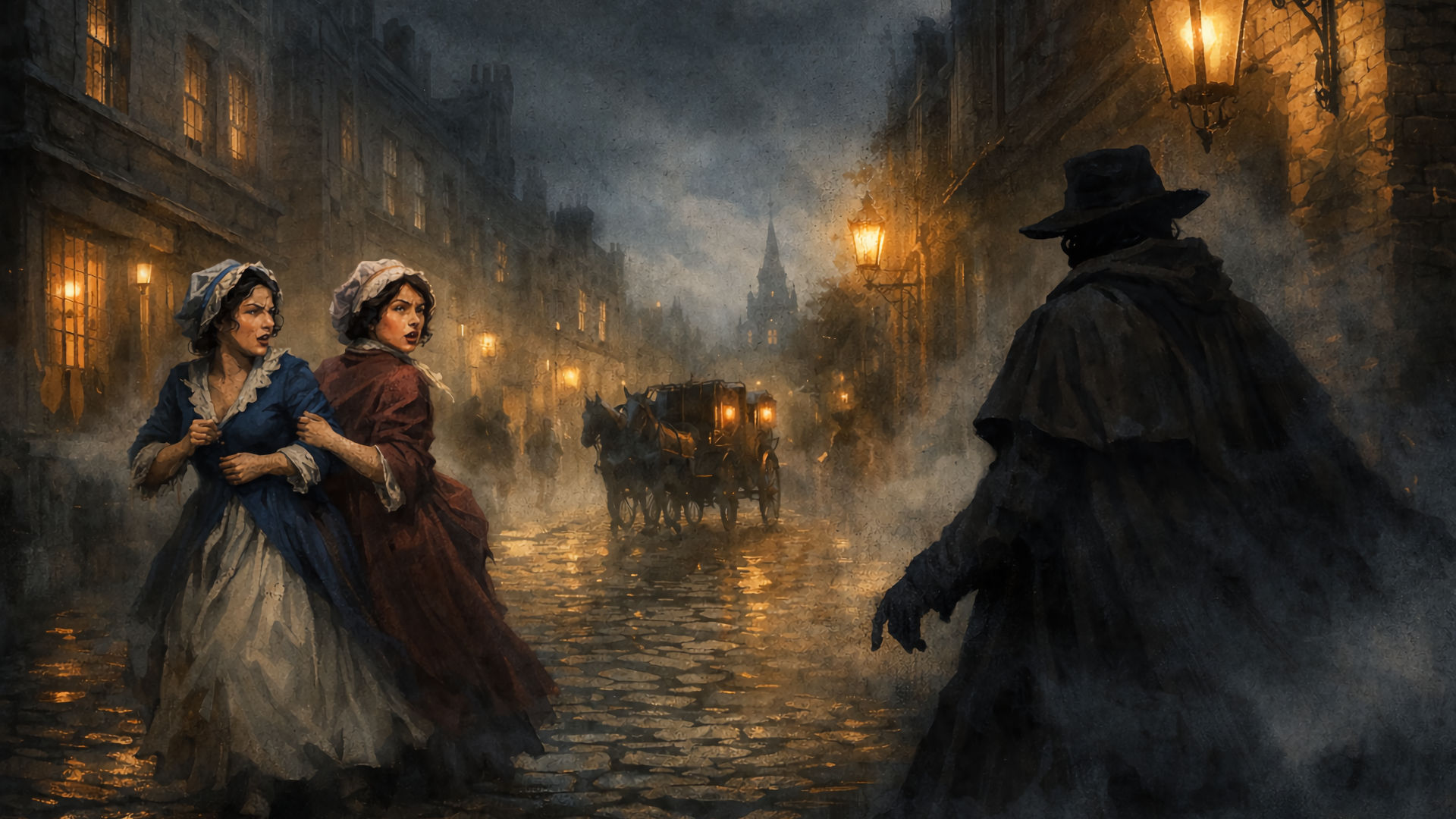
Reports started to circulate of a mysterious attacker targeting women in the streets. The incidents were strange and unsettling. Victims described a man who approached them suddenly, often from behind, before making a quick slash at their clothing. In many cases, the attacker used a knife or a sharp instrument to cut open dresses or petticoats. The attacks were frightening but often left the victims physically unharmed, which only made the incidents more confusing.
At first, these encounters seemed isolated, the kind of strange street incidents that occasionally appeared in newspapers before fading from public memory. But the reports did not stop. Instead, they began to multiply. Women across different parts of London started describing encounters with a similar figure. Some said the attacker wore dark clothing or a cloak. Others described a man who spoke politely before suddenly striking. Many accounts agreed on one detail: the attacker moved quickly and vanished before anyone could stop him.
Soon, the newspapers began reporting on the attacks more frequently. What had started as a series of disturbing incidents quickly turned into a wider public concern. The mysterious figure was given a dramatic nickname by the press and the public alike. He became known as the London Monster.
Once the name appeared in print, the story took on a life of its own. Rumours spread quickly through taverns, markets, and drawing rooms. Women became increasingly cautious about travelling alone, especially after dark. Some carried knives or pins for protection. Others avoided certain streets altogether.
Within a short time, the idea of the London Monster had become more than a criminal investigation. It had become a citywide fear. Londoners were no longer simply hearing about isolated attacks. They believed a strange and unpredictable predator was stalking the streets of their city, and no one seemed able to stop him.
The Strange Attacks Begin
By the spring of 1788, the disturbing encounters that had begun appearing in scattered reports were becoming harder to ignore. What had initially seemed like isolated incidents now appeared to follow a pattern. Women across different districts of London began describing encounters with a man who behaved in a similarly strange and unsettling way.
The attacks usually took place in the evening or at night, when the streets were quieter, and the flickering glow of oil lamps left plenty of shadowy corners. Many victims reported that the man approached them suddenly, often pretending to ask a polite question or request directions. The interaction might begin harmlessly enough, but within seconds, the situation would change.
Several women described how the man would suddenly pull out a knife or sharp blade and slash at their clothing. In many cases, he cut through dresses or petticoats before quickly running away. Although the attacks were terrifying, most victims were not seriously injured. The attacker seemed more focused on damaging clothing than causing physical harm, which made the crimes even more puzzling.
The suddenness of the attacks made them difficult to prevent. London’s crowded streets could provide cover for someone who knew how to disappear quickly into the flow of pedestrians, alleyways, and side streets. By the time victims gathered themselves and called for help, the mysterious assailant was often already gone.
At first, the authorities struggled to determine whether the reports were connected. Some officials suspected exaggeration or mistaken identity. Others believed that multiple attackers might be responsible. But as more accounts surfaced, the similarities became harder to dismiss.
Victims described a man of average height and build, often wearing dark clothing or a cloak that helped conceal his identity. In some reports, he appeared well-dressed and spoke politely, which made his sudden violence even more shocking. Several women recalled that he seemed calm and confident, as if he had committed the act many times before.
Newspapers soon began publishing detailed descriptions of the attacks, and these reports spread the story across the city. Each new article seemed to add another victim to the growing list. The more the incidents were discussed, the more women came forward claiming they had experienced something similar.
Before long, Londoners began to believe that a single individual was responsible for the attacks. The image of a mysterious figure prowling the streets at night began to take hold in the public imagination. Fear grew as the attacks appeared to occur in different neighbourhoods, suggesting that the culprit could be almost anywhere.
By the end of 1788, the strange attacker was no longer just a rumour whispered among victims. He had become a figure widely discussed throughout the city. People spoke about him in markets and coffee houses, and newspapers increasingly treated the attacks as a serious public concern.
The crimes themselves were baffling enough, but the inability to catch the attacker made them even more disturbing. Londoners were beginning to realise that someone was committing these strange acts again and again, and no one seemed able to stop him.
Panic, Rumours, and a Growing Legend
As the strange attacks continued, fear began to spread far beyond the women who had encountered the mysterious assailant. What had started as a series of unsettling incidents soon became one of the most talked-about topics in London. The city’s newspapers played a major role in transforming the story from a criminal investigation into something much larger.
Late eighteenth-century London was a place where news travelled quickly. Newspapers were widely read, and sensational stories often attracted the most attention. Reports of the mysterious attacker were exactly the kind of story that captured the public imagination. Each new incident was described in detail, and the newspapers began printing dramatic accounts of the attacks.
It was during this period that the attacker acquired the name that would make him famous. The press began referring to the unknown figure as the London Monster. The nickname immediately added a sense of menace and mystery to the story. Instead of being seen as a strange criminal committing unusual crimes, the attacker was now portrayed as something more sinister, almost like a villain from a gothic tale.
Once the name took hold, the story seemed to grow rapidly. Reports appeared claiming that dozens of women had been attacked. Some stories described the assailant as striking without warning before vanishing into the night. Others suggested that he deliberately targeted well-dressed women in fashionable districts of the city. With each retelling, the image of the London Monster became more dramatic.
Rumours began circulating throughout the city. Some people claimed the attacker carried hidden blades designed specifically to slice through clothing. Others insisted that he had accomplices who helped him escape after each attack. A few even suggested that the crimes were part of a bizarre game or challenge among wealthy young men seeking excitement.
In coffee houses and taverns, Londoners debated the identity of the mysterious figure. Was he a madman acting alone, or part of a larger group? Could he be a gentleman disguising himself in dark clothing, or perhaps a criminal who blended easily into the crowds? Without any clear answers, speculation only grew stronger.
Fear soon began to affect daily life in certain parts of the city. Women became increasingly cautious about travelling alone, particularly after dark. Some carried sharp hatpins or small knives in case they needed to defend themselves. Others chose to walk only with companions. Streets that had once been busy with evening activity sometimes grew quieter as people avoided areas where attacks had been reported.
The authorities also began to feel the pressure created by the growing panic. The more the newspapers reported on the attacks, the more Londoners demanded action. The idea that a mysterious figure could roam freely through the city, repeatedly committing crimes without being caught, was deeply unsettling.
By the end of 1788, the London Monster was no longer just a criminal suspect. He had become a legend of the city’s streets. Yet for all the rumours and fear surrounding him, one crucial question remained unanswered: who exactly was the London Monster?
The Hunt for the Attacker
As fear and frustration spread through London, pressure mounted on the authorities to catch the mysterious attacker. The growing number of reported incidents had convinced many people that the London Monster was real and active, and the public wanted action. City officials, magistrates, and private citizens all began searching for ways to bring the strange crime wave to an end.
Policing in London during the 1780s was very different from the organised police forces that would appear in the nineteenth century. There was no centralised police service like the Metropolitan Police that would later patrol the city. Instead, law enforcement relied on a mixture of watchmen, constables, and private citizens who reported crimes or attempted to apprehend suspects themselves. This system often worked reasonably well for ordinary offences, but it struggled to deal with a mysterious criminal who seemed to appear and disappear without warning.
As reports of the attacks continued to circulate, a group of concerned citizens decided to take matters into their own hands. In 1788, a group of wealthy and influential Londoners formed an organisation called the “No Monster Club.” The club offered a reward for information that would lead to the capture of the attacker. The reward was significant enough to attract widespread attention, and notices describing the offer appeared in newspapers and on posters around the city.
The reward encouraged people to watch more carefully for suspicious behaviour. Some men volunteered to escort women through the streets at night, hoping to catch the attacker in the act. Others began patrolling neighbourhoods where previous attacks had taken place. The idea that ordinary citizens might help catch the London Monster gave many people hope that the mystery might soon be solved.
At the same time, authorities attempted to gather descriptions from victims in order to identify a suspect. Witness statements were collected and compared, but they did not always agree. Some victims described a tall man, while others believed the attacker was shorter. Clothing descriptions also varied. This made it difficult to identify a single individual who matched every account.
Despite these difficulties, suspicion gradually began to focus on certain individuals. Whenever a man behaved strangely or appeared near the scene of an attack, rumours quickly spread that he might be the London Monster. On several occasions, crowds even chased suspected attackers through the streets, only to discover that they had caught the wrong person.
The growing hysteria made the situation even more complicated. Some officials began to worry that the fear itself was causing exaggeration. It was possible that some reported attacks had been misunderstood, or even fabricated, as the legend of the London Monster spread.
Nevertheless, the search continued. With rewards offered, citizens watching the streets, and authorities under increasing pressure to make an arrest, many believed it was only a matter of time before the mysterious attacker would finally be identified. Eventually, in early 1790, a suspect would emerge who seemed to fit the role of the London Monster better than anyone before him.
The Arrest of Rhynwick Williams
After months of fear, rumours, and unsuccessful searches, Londoners were eager for a breakthrough. By early 1790, the pressure to identify the mysterious attacker had reached its peak. The public wanted answers, the newspapers demanded action, and authorities were determined to prove that the London Monster could be caught.
The man who would soon become the centre of the investigation was named Rhynwick Williams. Williams was a young man from Wales who had been living in London and working in various trades. In January 1790, his name began to appear in connection with the attacks after a woman claimed she had been assaulted by a man matching the descriptions associated with the London Monster.
According to reports, the incident that led to Williams’ arrest involved a woman named Anne Porter. She claimed that a man had approached her in the street and slashed at her clothing before fleeing the scene. Porter later identified Williams as the attacker, and her testimony quickly drew the attention of authorities who had been searching for the mysterious criminal.
Williams was arrested and brought in for questioning. News of the arrest spread rapidly through London. Newspapers eagerly reported that the man believed to be the infamous London Monster had finally been captured. For many people in the city, this seemed to be the long-awaited end to the strange crime wave that had terrified women for nearly two years.
However, the case against Williams quickly became complicated. During the investigation, several other women came forward claiming that they, too, had been attacked and that Williams was responsible. These testimonies strengthened the prosecution’s case, but they also raised questions. Some observers wondered whether the growing panic surrounding the London Monster might have influenced witnesses.
When Williams was brought to trial, the courtroom was packed with spectators eager to hear the evidence. The trial attracted enormous public attention, with newspapers covering every detail. Witnesses described attacks that matched the pattern reported across the city, and several victims identified Williams as the man who had frightened or assaulted them.
Williams denied the accusations. He insisted that he was innocent and argued that the witnesses were mistaken. His defence suggested that the hysteria surrounding the London Monster had created a situation where people were eager to blame someone, even if the evidence was uncertain.
Despite these arguments, the jury ultimately found Williams guilty of several assaults. However, the charges were not exactly what many people expected. Instead of being convicted as a violent criminal responsible for a citywide campaign of attacks, Williams was found guilty of damaging clothing and frightening women.
The court sentenced him to six years in prison. For many Londoners, the verdict seemed to provide closure. The newspapers reported that the London Monster had been caught, and the strange attacks soon appeared to stop.
Yet even at the time, some people were not entirely convinced that the mystery had truly been solved.
Monster, Myth, or Miscarriage of Justice?
With Rhynwick Williams sentenced to prison, many Londoners believed the long and unsettling mystery of the London Monster had finally been solved. The newspapers reported that the attacker responsible for terrifying women across the city had been captured and punished. The strange wave of attacks that had dominated conversation for nearly two years appeared to stop, and life in London gradually returned to normal.
On the surface, the case seemed closed. Authorities had arrested a suspect, witnesses had identified him, and a jury had delivered a guilty verdict. Yet even at the time, there were people who questioned whether the real story had truly been uncovered.
One of the biggest doubts centred on the evidence presented at trial. Although several women identified Williams as their attacker, the descriptions of the London Monster had varied widely throughout the investigation. Some victims described a tall man, while others described someone shorter. Clothing descriptions also differed from case to case. Critics argued that the widespread publicity surrounding the attacks may have influenced witnesses, causing them to see Williams as the culprit once his name appeared in the newspapers.
Another question concerned the sheer number of reported attacks. Some newspapers had claimed that dozens of women had been assaulted during the London Monster scare. Yet Williams was only convicted in connection with a small number of incidents. If he truly was responsible for the entire wave of attacks, why had more victims not identified him during the trial?
Historians have also wondered whether the panic itself played a role in shaping the story. Once the name “London Monster” began appearing in newspapers, it captured the public imagination. Rumours spread rapidly through the city, and people began interpreting unusual encounters through the lens of the growing legend. It is possible that some incidents were exaggerated or misreported as the story became more sensational.
Another possibility is that the attacks were committed by more than one person. London was a huge and crowded city, and copycat crimes were not unheard of. Once the idea of the London Monster became widely known, it is conceivable that other individuals carried out similar attacks, either deliberately imitating the original offender or simply taking advantage of the confusion.
There is also the chance that Williams truly was responsible for at least some of the crimes. The fact that several victims confidently identified him cannot be dismissed entirely. But whether he was the single mastermind behind the entire series of attacks remains uncertain.
More than two centuries later, the story of the London Monster still sits somewhere between crime, legend, and social panic. It is remembered as one of the earliest examples of a media-driven crime scare, where rumours, newspapers, and public fear combined to create a powerful urban legend. In the end, the London Monster remains exactly what the name suggests: a mystery. Was Rhynwick Williams the true culprit, or simply the man who happened to be blamed when a frightened city demanded answers? The streets of eighteenth-century London never fully revealed the truth.
The Mystery of the London Monster FAQ
The London Monster was the name given to a mysterious attacker who reportedly targeted women in London during the late 1780s, often slashing their clothing with a knife before fleeing.
Most reports of the attacks took place between 1788 and 1790, when fear of the mysterious figure spread across London.
Rhynwick Williams was a Welshman arrested in 1790 and convicted of several assaults connected to the attacks. Many people believed he was the London Monster.
Historians remain divided. Some believe Williams was responsible for at least some attacks, while others think the panic may have led to a wrongful conviction.
The case attracted intense newspaper coverage, and the dramatic nickname helped turn the mystery into one of the earliest examples of a media driven crime scare.