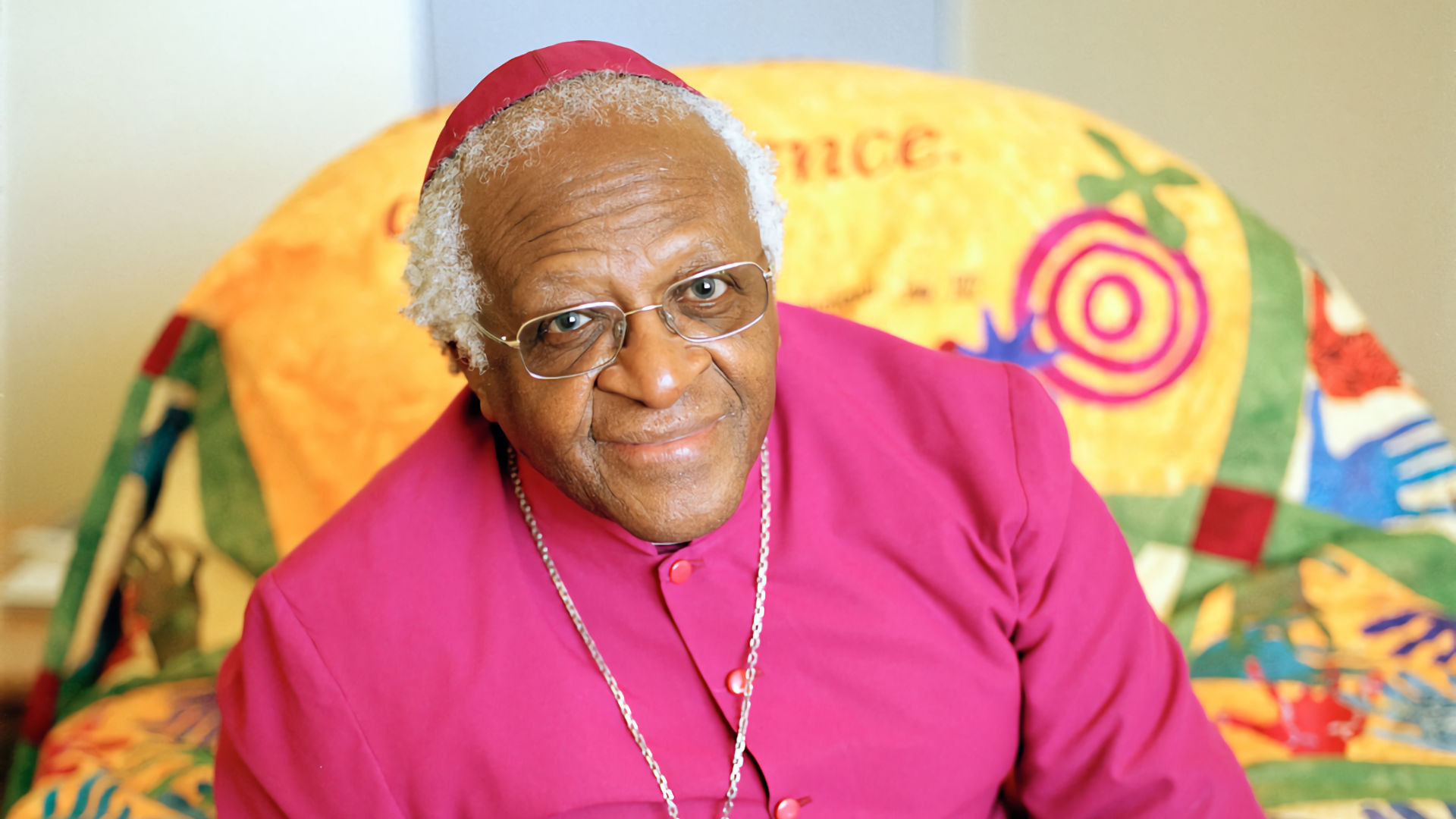
Archbishop Desmond Tutu
Archbishop Desmond Mpilo Tutu stands as one of the most compassionate, charismatic and courageous moral leaders of the twentieth and early twenty-first centuries. In a world too often defined by conflict, injustice and the denial of human dignity, he emerged as a voice of resolute hope and unyielding moral clarity. His life intertwined faith and justice, transforming the struggle against apartheid in South Africa and inspiring movements for human rights across the globe.
Tutu’s legacy is defined not only by his unwavering opposition to institutionalised racism, but also by his belief in reconciliation, forgiveness and the inherent worth of every human being. His journey was shaped by deep spiritual conviction, humble origins, principled resistance and a singular gift for turning pain into purpose. He demonstrated that moral leadership need not be harsh or angry, but could be persuasive, joy-filled and unshakably truthful.
Childhood and Early Influences
Desmond Mpilo Tutu was born on 7 October 1931 in Klerksdorp, in the Transvaal Province of South Africa. The son of a teacher, his early life was shaped by modest means but abundant spiritual and familial strength. The Tutu family was deeply rooted in the Methodist tradition, a religious context that emphasised service, compassion and the conviction that every person bears the image of the divine.
His father, Zachariah Tutu, worked as a schoolteacher and clerk, and instilled in young Desmond a profound respect for education. His mother, Aletta Tutu, nurtured his spiritual sensibilities and encouraged him to see beyond the limitations of circumstance. From an early age, Tutu demonstrated a quiet resolve, a sharp intellect and an ease with people of all ages and backgrounds.
Education was a thread that wove through his youth. At a time when racial segregation restricted opportunities for Black South Africans, Tutu excelled academically. Even as apartheid policies tightened their grip, he pursued his studies with a determination that transcended the barriers of his environment.
The Call to Ministry
After completing his secondary schooling, Tutu briefly trained as a teacher, following in the footsteps of his father. Yet his sense of purpose pushed him beyond the classroom. In 1954, he enrolled at St Peter’s Theological College in Johannesburg, driven by a growing sense that his ministry would be not only spiritual but also deeply engaged with the pressing social issues of his time.
He was ordained as an Anglican priest in 1960, a pivotal year in South African history. That year, the Sharpeville massacre revealed the brutal extent of the apartheid regime’s repression and marked a turning point in the resistance movement. For many, apartheid was not merely an abstract political system but a lived reality of violence, separation and dehumanisation.
In this context, Tutu’s faith became inseparable from his sense of moral outrage. He understood the church not as a sanctuary of retreat but as a frontline of resistance. His sermons blended theological insight with clear moral denunciations of racial injustice. His voice, gentle yet unwavering, carried authority not because it was loud, but because it was rooted in integrity and compassion.
Rise to Prominence
Tutu’s ascension in the Anglican hierarchy coincided with some of South Africa’s darkest years. As the struggle against apartheid intensified, so did state repression. Tutu’s leadership became both a source of hope and a direct challenge to the legitimacy of the apartheid regime.
He became the first Black General Secretary of the South African Council of Churches, a position that amplified his voice nationally and internationally. In this role, he confronted the government’s systemic racism, urging the world not to look away from injustice. He travelled widely, speaking to congregations, universities and political organisations, all while holding firmly to a message of non-violence. For Tutu, moral authority did not rest on force but on truth.
Tutu’s critique of apartheid was sharp and direct. He recognised apartheid not only as political oppression but as a moral evil that corrupted the souls of both oppressor and oppressed. In his speeches, he did not frame the struggle solely in terms of political liberation. He described it as a struggle for human dignity, for the restoration of relationships severed by hatred, fear and systemic inequality.
A Global Voice for Justice
By the late 1970s and throughout the 1980s, Desmond Tutu had become a global figure. His message resonated far beyond the borders of South Africa. He was a tireless advocate for economic sanctions against the apartheid state, urging the international community to hold the regime accountable for its abuses. His advocacy helped shift global opinion, making apartheid a moral as well as a political issue.
The apartheid government responded with hostility. Tutu was labelled a troublemaker, a subversive, and someone to be marginalised. Yet the attempts to silence him only amplified his influence. He remained resolute, affirming that moral leadership must confront injustice even when it carries personal risk.
In 1984, he was awarded the Nobel Peace Prize, a recognition of his unwavering commitment to non-violent resistance and reconciliation. Rather than personal accolade, Tutu viewed the prize as an affirmation of the broader struggle for justice. He accepted it not for himself but on behalf of all who suffered under apartheid and all who worked for its dismantling.
The Architecture of Reconciliation
When apartheid finally began to crumble in the late 1980s and early 1990s, South Africa faced not only political transformation but profound moral reckoning. The transition from institutionalised separation to inclusive democracy was fraught with tension, fear, resentment and the risk of violent backlash.
In this moment, Tutu’s voice became even more vital. Recognising that justice could not be defined solely by retribution, he championed a process of truth and reconciliation that would allow the nation to confront its past with honesty while laying the foundation for a shared future.
In 1995, Tutu was appointed chair of the Truth and Reconciliation Commission, a body established to investigate human rights violations committed under apartheid. The commission was not merely a legal mechanism but a moral forum designed to give voice to victims and, where possible, to allow perpetrators to offer testimony. The work of the commission was deeply emotional, painful and controversial. Yet Tutu maintained that truth was a necessary precursor to healing, and that forgiveness could not be imposed, but only chosen.
Under his leadership, the commission held hearings that brought to light unspeakable abuses, but also stories of courage, resilience and unexpected compassion. Tutu emphasised that reconciliation did not mean forgetting, minimising or denying suffering. Rather, it required acknowledgement, accountability and a collective willingness to move forward without replicating cycles of hatred.
A Theology of Joy
What made Tutu distinct from many other leaders confronting injustice was not merely his moral clarity but his capacity for joy. Tutu’s faith was not cloaked in solemnity alone. He believed that love and laughter were essential to a healthy spirit and that joy could exist even amidst suffering.
He often spoke about the interplay between grief and gratitude, recognising both as authentic human experiences. His speeches combined sharp critique with humour, pain with hope, and prophetic urgency with grace. In confronting one of the most oppressive systems of the modern era, he refused to surrender to bitterness.
His theology emphasised that every person, regardless of race, class or background, bore intrinsic dignity. He questioned not only apartheid but any ideology that dehumanised others. His message was expansive, inclusive and deeply rooted in a conviction that love ultimately stands stronger than fear.
A Global Advocate for Human Rights
After the dismantling of apartheid and the work of the Truth and Reconciliation Commission, Tutu’s influence continued on the global stage. He spoke out against injustice in all its forms, including militarism, poverty, discrimination, and environmental degradation.
He lent his voice to campaigns against homophobia, arguing that discrimination against LGBTQ+ people was incompatible with the inherent dignity of the human person. He criticised economic systems that entrenched inequality and urged nations to consider the moral consequences of their policies. In his later years, he was unafraid to challenge powerful leaders and institutions when their actions contradicted humanitarian values.
Tutu saw global interconnection not merely as a political concept but as a moral reality. He believed that empathy should not be selective, that injustice anywhere diminishes justice everywhere, and that each person’s fate is bound up with the fate of all.
Personal Life and Inner Strength
Despite his public prominence, Tutu’s personal life was marked by both deep joy and profound loss. He married Nomalizo Leah Shenxane in 1955. Their partnership spanned decades, grounded in mutual respect, deep affection and shared commitment to justice and compassion. Tutu always spoke of Leah as his anchor, emphasising the stabilising influence she had on his life.
The death of his daughter, Theresa, in 1997 was an immeasurable grief. Yet even in mourning, he articulated his pain with honesty and faith, offering words that resonated with others facing similar losses. He acknowledged that suffering was part of the human condition, but he also affirmed that suffering could deepen empathy rather than destroy hope.
Tutu’s personal resilience was rooted in a spiritual strength that combined humility with confidence, vulnerability with courage, and realism with hope. He never pretended that justice was easy or that reconciliation was simple. Yet he also never wavered in his belief that human beings could rise above cruelty and fear when guided by compassion and truth.
An Unforgettable Voice for the Ages
Archbishop Desmond Tutu died on 26 December 2021 at the age of 90, closing a life defined by moral courage, spiritual depth, and an unwavering commitment to human dignity. His death was announced by the South African presidency, which described him as a champion of justice and reconciliation whose voice had shaped the conscience of the nation and the world. In his final years, Tutu had lived quietly, stepping back from public life as his health declined, yet his influence never faded. Tributes poured in from across the globe, from political leaders, faith communities, activists, and ordinary people who had drawn strength from his words and example.
Archbishop Desmond Tutu’s life was a testament to moral leadership defined not by power but by principled witness. He stood at the intersection of faith and justice, showing that religious conviction can nourish ethical action rather than merely justify belief. His legacy continues to reverberate across movements for human rights, reconciliation and global responsibility.
He understood that true justice requires both accountability and mercy. He recognised that dignity cannot be granted by decree but must be acknowledged by society. He insisted that change begins not with indifference but with empathy, the ability to place oneself in another’s circumstances and to remain open to transformation.
Tutu’s voice was prophetic in its moral seriousness, but it was also deeply human. He invited people not to abandon their hearts in the face of systemic evil, but to engage the world with courage and joy, even when courage seemed difficult and joy elusive. His influence extended beyond South Africa, shaping international approaches to peacebuilding, restorative justice and interfaith cooperation.
He spoke often of ubuntu, an African ethic summarised as “I am because you are,” emphasising that humanity is communal rather than solitary, and that each person’s dignity is woven into the tapestry of collective life.
Archbishop Desmond Tutu FAQ
Desmond Tutu was a South African Anglican archbishop, anti-apartheid leader, and global advocate for human rights and reconciliation.
He played a crucial role in opposing apartheid and later chaired the Truth and Reconciliation Commission during South Africa’s transition to democracy.
It was a national process that investigated human rights abuses under apartheid, allowing victims to be heard and promoting healing through truth rather than revenge.
He believed justice must be paired with compassion, forgiveness, and recognition of shared humanity.
His ideas on reconciliation, dignity, and moral leadership continue to influence global human rights movements and peacebuilding efforts.