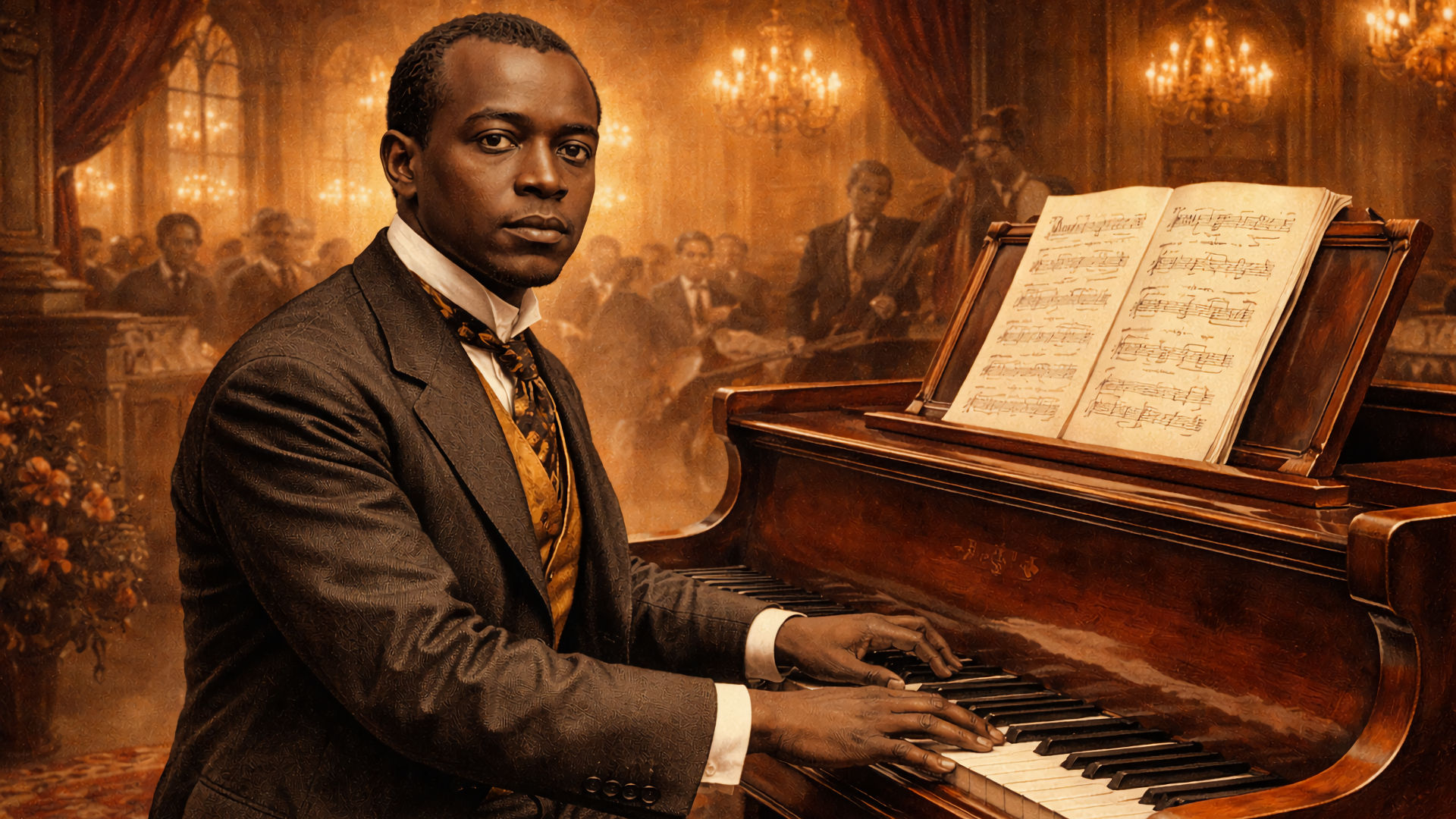
Scott Joplin
Scott Joplin was born sometime between June 1867 and January 1868, most likely near Linden in northeast Texas. Like many African Americans born in the years immediately following the Civil War, the precise details of his birth were poorly recorded, a reflection of both the era and his family’s circumstances. What is clear is that he was born into a world still adjusting to emancipation, where opportunity existed in theory but remained sharply limited in practice.
His father, Giles Joplin, was a former enslaved person who worked as a labourer on farms and railroads. His mother, Florence Givens Joplin, was a domestic worker who also played music, sang, and performed on the banjo. Music was not a luxury in the Joplin household; it was part of daily life. Spirituals, work songs, and folk melodies formed the background soundtrack of Scott’s childhood, and from an early age, it was clear that he had an unusual aptitude for music.
The family moved frequently, following work opportunities, eventually settling in Texarkana, a growing railroad town on the Texas-Arkansas border. It was there that Joplin’s musical talents began to take shape. As a boy, he taught himself to play the piano, often practising on instruments in homes where his mother worked. Unlike many self-taught musicians of the period, Joplin showed a strong interest not just in performance, but in structure, harmony, and composition.
A crucial figure in his early development was Julius Weiss, a German-born music teacher living in Texarkana. Weiss recognised Joplin’s talent and, unusually for the time, provided him with formal instruction. Under Weiss’s guidance, Joplin studied European classical music, including composers such as Bach, Beethoven, and Mozart. He learned music theory, notation, and discipline, skills that would later distinguish his work from that of many contemporaries.
This blending of traditions became central to Joplin’s identity. He absorbed the rhythms and melodies of African American musical culture while mastering the technical foundations of classical composition. Even in his teens, he was thinking beyond popular tunes toward something more ambitious, music that was entertaining but also carefully constructed.
By the mid 1880s, Joplin had left home to pursue music professionally. He travelled through Texas and neighbouring states, playing piano wherever work could be found, in bars, dance halls, social clubs, and informal gatherings. These early years were formative. They exposed him to a wide range of musical styles and audiences, and they taught him the realities of earning a living as a Black musician in post-Reconstruction America.
Long before ragtime made his name, Scott Joplin had already laid the foundations of his art. His early life combined hardship, mobility, self-education, and rare formal training, shaping a composer who would later insist that popular music could be both accessible and serious, disciplined, and enduring.
Education, Touring, and Life as a Working Musician (1885–1895)
By the mid 1880s, Scott Joplin had committed himself fully to life as a professional musician. Leaving Texarkana while still a teenager, he joined the long tradition of travelling performers who moved from town to town in search of work. This period of constant movement was not glamorous, but it was essential to his development. It exposed him to a broad range of audiences and musical styles, and it forced him to refine his craft in demanding, unpredictable conditions.
Joplin supported himself primarily as a pianist, playing in saloons, dance halls, clubs, and at social events. These venues required versatility. One night might call for lively dance music, another for sentimental songs or popular tunes of the day. Joplin learned quickly how to read a room and adapt his playing, but he also began experimenting with more complex rhythms and syncopated patterns that set his music apart. Even while performing commercially, he was quietly developing a distinctive voice.
During these years, Joplin continued his musical education informally. While he may not have had the means to attend a conservatory, he remained deeply interested in theory and composition. He studied scores when he could find them and paid close attention to how different musical traditions interacted. The blending of African American rhythmic traditions with European harmonic structure became more deliberate in his playing, suggesting a composer in the making rather than simply an entertainer.
By the early 1890s, Joplin had gravitated towards the Midwest, particularly Missouri, where opportunities for musicians were expanding. He spent time in cities such as St Louis and Sedalia, both of which had thriving musical scenes connected to railroads, universities, and a growing leisure culture. These environments offered something Joplin had rarely enjoyed before, relative stability. Instead of moving constantly, he could begin forming professional relationships and refining his compositions.
In Sedalia, Joplin became associated with George R Smith College, an institution established to educate African American students. Although it remains unclear whether he formally enrolled, he is known to have studied music there and interacted with other trained musicians. The influence of a more structured musical environment is evident in his growing confidence as a composer and arranger during this period.
Crucially, Joplin also began to think seriously about publication. Touring had shown him the limits of live performance as a means of securing long-term success. Sheet music offered permanence, reach, and financial independence, at least in theory. He started writing down his compositions with greater care, preparing them for a market that was still taking shape.
By 1895, Scott Joplin was no longer just a pianist drifting from job to job. He was an experienced professional with a developing compositional style, grounded in years of performance, study, and observation. These touring years were his apprenticeship, shaping both his music and his ambitions, and preparing him for the moment when ragtime would step out of the dance halls and onto the national stage.
Sedalia, Ragtime, and the Road to Recognition (1895–1900)
By the mid 1890s, Scott Joplin had found himself in the right place at the right time. Sedalia, Missouri, was a small but lively railroad town with a growing entertainment culture, and it proved to be the setting where Joplin’s years of experimentation finally began to pay off. Here, ragtime was emerging from informal performance into a recognisable musical style, and Joplin was at its centre.
Sedalia’s saloons, clubs, and social venues provided steady work for musicians, and Joplin quickly established himself as one of the town’s most respected pianists. Unlike many performers who relied on improvisation alone, Joplin approached ragtime with discipline and structure. He carefully composed his pieces, writing them down in full and insisting that they be played as written rather than freely embellished. This insistence on precision would become a defining feature of his career.
In 1897, Joplin published several early compositions, including Original Rags, which began to circulate beyond local audiences. While these works did not yet bring widespread fame, they demonstrated his distinctive style, a steady left-hand pattern supporting a syncopated, rhythmically complex right hand. The music was lively and accessible, but beneath the surface lay careful craftsmanship and formal balance.
The turning point came in 1899 with the publication of Maple Leaf Rag. Named after the Maple Leaf Club in Sedalia, a popular African American social venue, the piece was released by the publisher John Stark. Unlike many ragtime compositions of the era, Maple Leaf Rag was technically demanding, aimed at skilled pianists rather than casual amateurs. Joplin reportedly negotiated a royalty arrangement rather than a one-time payment, an unusual and forward-thinking decision.
The success of Maple Leaf Rag was not immediate, but it was steady and enduring. Over time, it sold hundreds of thousands of copies, establishing Joplin as the leading figure in ragtime music. More importantly, it set a standard. Ragtime was no longer just dance music played in bars and clubs. It was now a published, performable genre with defined form and lasting appeal.
Sedalia provided more than a commercial opportunity. It gave Joplin a community of musicians, patrons, and students who recognised his seriousness as a composer. He taught music, mentored younger performers, and continued refining his style. The years between 1895 and 1900 transformed him from a respected local musician into a nationally recognised name.
By the turn of the century, Scott Joplin had achieved what he had long sought, recognition not just as a performer, but as a composer of substance. Ragtime, shaped by his discipline and ambition, was ready to spread far beyond Sedalia, and Joplin was poised to lead it.
Fame, Fortune, and the Ragtime Explosion (1900–1907)
At the turn of the twentieth century, Scott Joplin stood at the peak of his public success. Ragtime had become a national craze, and Joplin was widely recognised as its leading composer. The steady sales of Maple Leaf Rag provided him with a degree of financial security rare for Black musicians of the era, allowing him to focus more fully on composition rather than constant performance.
Joplin relocated to St Louis, one of the most important cultural and commercial centres in the Midwest. The city was a hub for publishing, theatre, and popular entertainment, and it offered Joplin greater access to publishers and audiences. During this period, he produced a remarkable volume of work, publishing dozens of ragtime compositions that helped define the genre. Pieces such as The Entertainer, Elite Syncopations, and The Easy Winners displayed his growing confidence and technical refinement.
Despite ragtime’s popularity, Joplin was deeply concerned about how the music was performed. Many pianists played ragtime at excessive speed, turning carefully structured compositions into chaotic displays of virtuosity. Joplin resisted this trend. He famously insisted that ragtime should never be played fast, and he included performance notes in his sheet music urging musicians to respect tempo and phrasing. For Joplin, ragtime was not novelty entertainment. It was serious music, deserving of care and discipline.
Commercial success did not entirely translate into comfort. While Maple Leaf Rag continued to sell well, many of Joplin’s other works brought in modest returns, and he faced ongoing racial barriers within the publishing industry. Nonetheless, his reputation grew steadily. He was widely referred to as the “King of Ragtime,” a title that reflected both public admiration and his central role in shaping the form.
During these years, Joplin also expanded his ambitions beyond piano rags. He composed marches, songs, and theatrical works, exploring ways to elevate African American music within broader artistic traditions. His growing interest in large-scale composition hinted at a desire to move beyond the constraints of popular taste and assert his place as a composer in the classical sense.
By the mid 1900s, ragtime was everywhere, in parlours, dance halls, and on the emerging phonograph recordings. Yet Joplin remained focused on longevity rather than fashion. He believed the genre could endure if it were treated with seriousness and respect. This conviction would soon lead him toward his most challenging and risky project, one that tested both his finances and his emotional resilience.
These years represented the height of Joplin’s fame and influence. He had helped transform ragtime from regional entertainment into a national musical language. But even at the peak of success, he was already looking beyond popularity, determined to prove that his music could stand alongside any serious artistic tradition.
Ambition, Opera, and Personal Decline (1907–1916)
By the late 1900s, Scott Joplin had grown increasingly dissatisfied with being known only as a popular entertainer. While ragtime continued to bring him recognition, Joplin wanted more than commercial success. He wanted artistic legitimacy. Above all, he wanted to prove that African American music could sustain large-scale, serious forms traditionally reserved for European composers.
This ambition found its fullest expression in opera. Joplin had already experimented with theatrical music earlier in his career, but in 1907, he devoted himself to an ambitious new work, Treemonisha. Unlike the stereotypes that dominated popular entertainment at the time, the opera portrayed African American characters with dignity, intelligence, and moral agency. Set in the post slavery South, it told the story of education triumphing over superstition, reflecting Joplin’s lifelong belief in learning, discipline, and self-improvement.
The project consumed him creatively and financially. Unable to secure a publisher or theatrical backing, Joplin paid for the opera’s publication himself. A piano vocal score was released in 1911, but without a full orchestral production, the work gained little attention. One small-scale performance was mounted in 1915, but it lacked the resources needed to convey the opera’s scope. Audiences and critics largely ignored it, and the disappointment was profound.
At the same time, Joplin’s health was deteriorating. He was suffering from the effects of syphilis, a disease that caused physical weakness, memory loss, and periods of confusion. As his condition worsened, his ability to compose declined. The precision and control that had defined his music became harder to maintain, and his output slowed dramatically.
Ragtime itself was also falling out of fashion. New musical styles, particularly early jazz, were capturing public attention, leaving Joplin’s carefully structured compositions sounding old-fashioned to some listeners. The man who had defined the genre was now being left behind by the market he had helped create.
By the mid 1910s, Joplin was increasingly isolated, struggling financially and physically. He continued to believe in the value of his work, particularly Treemonisha, but recognition remained elusive. His final years were marked by frustration rather than triumph, as his greatest artistic ambition failed to find an audience during his lifetime.
This period represents the most tragic phase of Joplin’s life. Having raised ragtime to national prominence, he found himself unable to make the leap from popular success to lasting institutional recognition. The cost of that ambition, emotional, financial, and physical, was devastating, and it set the stage for a quiet and largely uncelebrated end.
Death, Rediscovery, and a Legacy Reclaimed (1917 and Beyond)
Scott Joplin died on 1 April 1917 at the Manhattan State Hospital in New York City. He was forty-nine years old. The official cause of death was complications related to syphilis, a disease that had steadily undermined his physical and mental health during his final years. At the time of his death, ragtime was fading from public taste, and Joplin himself had largely slipped from view. There were no major tributes, no surge of renewed interest, and no sense that American music had just lost one of its most important figures.
In the decades that followed, Joplin’s reputation continued to decline. Jazz came to dominate American popular music, and ragtime was increasingly dismissed as a quaint or outdated form. Joplin’s more ambitious works, particularly Treemonisha, were almost entirely forgotten. His insistence that ragtime be treated as serious, carefully composed music seemed out of step with a culture that preferred spontaneity and improvisation. By the mid-twentieth century, his name survived mainly as a footnote, if it survived at all.
The turning point came in the 1960s and 1970s, as scholars, musicians, and historians began reassessing early African American contributions to American music. Ragtime was rediscovered not as novelty entertainment, but as a foundational genre that helped shape both jazz and popular song. Joplin emerged at the centre of this reassessment, recognised for the discipline, structure, and originality of his compositions.
Public revival followed academic interest. New recordings of his music reached wide audiences, and The Entertainer became especially well known after its use in the 1973 film The Sting. For many listeners, this was their first exposure to Joplin’s work, and it sparked a renewed fascination with ragtime more broadly. Concert performances, sheet music reissues, and scholarly editions soon followed.
The most significant rehabilitation of Joplin’s reputation came with Treemonisha. Long dismissed or ignored, the opera was finally staged in full in the 1970s, revealing it as a bold and thoughtful work that had been decades ahead of its time. What once seemed like overreaching ambition came to be understood as visionary persistence.
In 1976, nearly sixty years after his death, Scott Joplin was awarded a Pulitzer Prize Special Citation for his contribution to American music. It was a symbolic recognition, arriving far too late to benefit him personally, but powerful nonetheless. Today, Joplin is widely regarded as the central figure in ragtime and one of the architects of American music itself. His legacy rests not only on popularity but on principle. He believed that music rooted in the African American experience could be disciplined, complex, and enduring. History eventually agreed with him.
Scott Joplin FAQ
Scott Joplin was an American composer and pianist known as the King of Ragtime. His music helped popularise ragtime in the late nineteenth and early twentieth centuries.
His most famous composition is Maple Leaf Rag, published in 1899, which became one of the best-known ragtime pieces ever written.
Scott Joplin primarily composed ragtime music for piano, though he also wrote operas and other musical works.
Yes. Ragtime helped shape the early development of jazz, and Joplin’s compositions influenced many later jazz musicians.
Scott Joplin was born in Texas, most likely in 1868, near the town of Texarkana.