The Great Chicago Fire
By the autumn of 1871, Chicago was a booming city that had grown faster than its own common sense. In just a few decades, it had transformed from a small frontier settlement into a major industrial and transport hub, driven by railroads, stockyards, grain trading, and relentless westward expansion. Its population had exploded to around 300,000 people, many of them recent immigrants, and housing had been thrown up quickly, cheaply, and with little regard for fire safety.
Wood was everywhere. Chicago sat near vast forests, timber was cheap, and it was used not just for homes but for sidewalks, shops, warehouses, and even some streets. Entire neighbourhoods were effectively built from kindling. Roofs were often wooden shingles, fences were wooden, and barns and sheds packed tightly behind houses stored hay, coal, and fuel. Fire-resistant materials like brick and stone existed, but they were more expensive and far less common in working-class areas.
The summer of 1871 had been brutally dry. From July through early October, Chicago received barely a few inches of rain. The city was already suffering from smaller fires, with firefighters stretched thin by repeated call-outs. On the night of 7 October, just one day before the Great Fire began, the Chicago Fire Department had battled a large blaze that left crews exhausted and equipment in poor condition.
Firefighting technology itself was limited. The city relied on hand-pulled steam engines, leather hoses, and a water system that was not designed for sustained, city-wide emergencies. Water mains could fail under heavy demand, and communication depended on human runners and alarm boxes that were easily misread or delayed. A single error could send crews racing to the wrong location while flames gained ground elsewhere.
Urban planning also worked against the city. Buildings were packed tightly together, especially near the city centre and along the river. The Chicago River itself, polluted with industrial waste, grease, and debris, could actually catch fire rather than stop it. Firebreaks were rare, and zoning laws were minimal or ignored.
By early October 1871, Chicago was prosperous, confident, and dangerously vulnerable. All it lacked was a spark.
The Night the Flames Took Hold
Late on the evening of Sunday, 8 October 1871, a fire broke out in a small barn behind 137 DeKoven Street on Chicago’s southwest side. The property belonged to Patrick and Catherine O’Leary, Irish immigrants who kept a cow in the shed. At around 8.30 pm, a neighbour noticed flames licking up from the structure and raised the alarm. By the time help was summoned, the fire had already gained a foothold.
The first response went wrong almost immediately. The Cook County Courthouse night watchman sent firefighters to the wrong location, about 1.5 miles away from the scene of the fire. When crews finally arrived at DeKoven Street, the blaze had grown beyond a simple barn fire. Dry timber, high winds from the southwest, and nearby wooden buildings allowed flames to leap rapidly from structure to structure. Within minutes, the fire was spreading eastward toward the heart of the city.
The Chicago Fire Department, already exhausted from the previous night’s major blaze, struggled to contain it. Steam engines were slow to manoeuvre through narrow streets crowded with wooden houses, sheds, and stables. Water pressure fluctuated, hoses leaked, and sparks carried by the wind ignited rooftops far ahead of the main fire line. Efforts to create firebreaks by demolishing buildings were largely ineffective as embers managed to jump the gaps.
By midnight, the fire had crossed the South Branch of the Chicago River, an event many believed impossible. The river was choked with industrial waste, oil, and floating debris, allowing flames to travel across its surface. Once the fire reached the densely packed commercial district, the situation deteriorated rapidly. Warehouses full of grain, coal, and alcohol burned intensely, generating extreme heat and towering fire whirls.
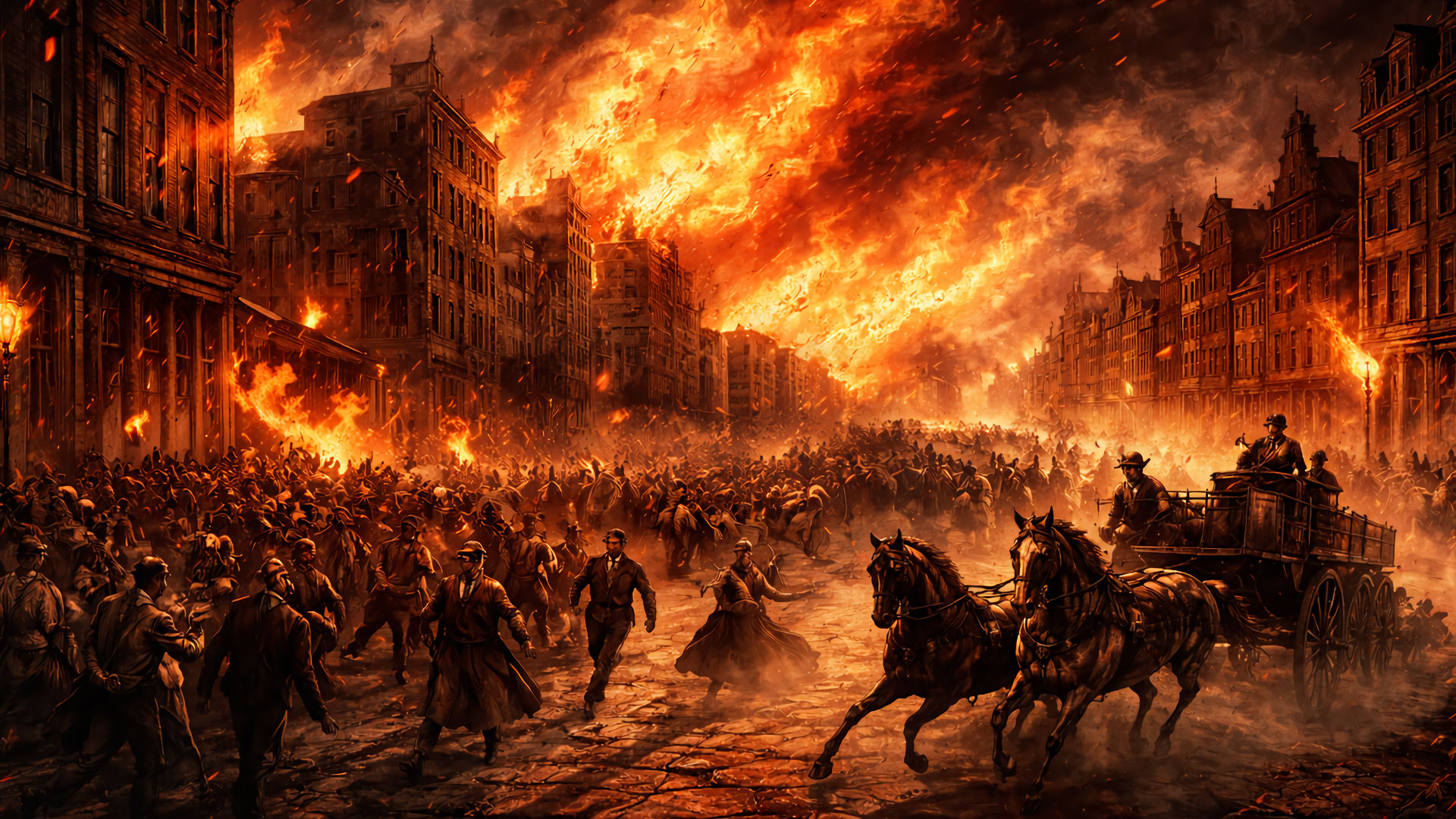
Panic spread alongside the flames. Families fled on foot or with horse-drawn wagons, clogging streets as they tried to escape east and north. Police and firefighters abandoned attempts to save individual buildings and focused on moving people out of danger. Church bells rang, alarm boxes sounded continuously, and the glow from the fire was reportedly visible as far away as Milwaukee.
By the early hours of 9 October, the Great Chicago Fire was no longer a local emergency. It had become a full-scale urban inferno, driven by wind, fuel, and fatal delays, with no clear way to stop it.
When the Firestorm Became Unstoppable
As dawn broke on Monday, 9 October 1871, Chicago faced a catastrophe unlike anything it had ever experienced. The fire had grown into a true firestorm, generating its own weather. Winds intensified as superheated air rose, drawing in fresh oxygen and driving flames forward with terrifying speed. Fire whirls, some described as tornado-like columns of flame, ripped through streets, lifting debris and hurling burning timbers across entire blocks.
Attempts to control the blaze collapsed. Firefighters were forced to retreat repeatedly as the heat became unbearable and equipment failed. Water pressure dropped sharply when the city’s pumping station was threatened, and in some areas supplies stopped altogether. Without reliable water, crews could do little more than rescue civilians and flee. Mayor Roswell B. Mason eventually ordered an evacuation of large sections of the city, an unprecedented move that acknowledged the fire could no longer be fought.
The fire swept through the central business district, destroying hotels, theatres, banks, and government buildings. The Courthouse and City Hall burned to the ground, along with records, archives, and legal documents. The destruction of these buildings removed not only physical structures but also the administrative heart of the city. Prisoners were released from the county jail as guards fled, and law enforcement effectively ceased to function.
By late morning, the fire jumped the main branch of the Chicago River and raced north into residential districts. Thousands of homes burned in quick succession, leaving families with minutes, sometimes seconds, to escape. The North Side, thought by many to be safe, was rapidly overwhelmed. Cemeteries, churches, and schools offered no protection as embers ignited rooftops and wooden interiors.
The scale of the disaster became undeniable. Smoke darkened the sky, ash fell like snow, and daylight faded to an eerie orange glow. People crowded along the shores of Lake Michigan, seeking refuge from the heat, while others fled into the water itself. Reports later described people standing waist-deep in the lake as sparks rained down around them.
By the afternoon of 9 October, Chicago was effectively defenceless. The fire burned unchecked across miles of cityscape, its advance slowed only when it finally ran out of fuel.
Survivors, Chaos, and a City in Ruins
By the time the fire finally began to subside on the evening of 9 October 1871, Chicago had been transformed into a landscape of ash, twisted iron, and smouldering rubble. An estimated 17,000 buildings had been destroyed across roughly three and a half square miles of the city. Around 100,000 people, nearly one-third of Chicago’s population, were left homeless almost overnight. Official estimates placed the death toll at around 300, though the true number was likely higher, with many victims never identified in the ruins.
Survivors emerged exhausted, injured, and traumatised. Entire families were separated in the chaos of evacuation, and thousands had fled with nothing more than the clothes they were wearing. Makeshift refugee camps sprang up along the lakefront, in public parks, and on the outskirts of the city. Food, clean water, and shelter were in desperately short supply, and October nights grew cold.
Order was slow to return. With police stations and courthouses destroyed, authority was fractured. Looting was reported in some areas, prompting the mayor to request assistance from state and federal authorities. Illinois militia units were deployed to patrol the city, enforce curfews, and guard relief supplies. Martial law was not formally declared, but the city operated under emergency conditions.
Relief efforts began almost immediately. Aid poured in from across the United States and overseas, including donations from Britain, France, and even former rival cities such as St. Louis and Cincinnati. Trains arrived loaded with food, clothing, and medical supplies. Temporary housing was constructed from donated lumber, and churches and charitable organisations coordinated soup kitchens and shelters.
The human cost was matched by economic devastation. The fire destroyed much of Chicago’s commercial core, including banks, warehouses, and factories. Insurance losses exceeded 190 million dollars, bankrupting many insurers and businesses. Yet even amid the destruction, signs of resilience appeared. Within days, newspapers resumed publication, merchants reopened from tents and carts, and city leaders began discussing reconstruction.
Chicago had survived, but it was a city stripped bare. What emerged next would redefine not just its skyline, but its identity.
Blame, Myths, and the Search for a Cause
Almost as soon as the flames died out, Chicago began looking for someone, or something, to blame. In the absence of clear answers, rumours spread rapidly. The most enduring story claimed that a cow belonging to Catherine O’Leary had kicked over a lantern in her barn, igniting the fire. The tale was vivid, simple, and easy to repeat, and it quickly became accepted as fact despite a lack of evidence.
In reality, the exact cause of the fire was never definitively proven. The O’Leary family denied the cow story from the beginning, and later investigations found no reliable witnesses to support it. A reporter later admitted he had invented the detail to make the story more colourful. Despite this, Catherine O’Leary was vilified for years, becoming a symbol of carelessness and, more broadly, a convenient target as an Irish Catholic immigrant woman in a city rife with prejudice.
Other theories emerged. Some suggested sparks from a nearby chimney or a discarded cigar started the blaze. Others speculated about arson, pointing to the fact that several large fires had broken out in the city around the same time. One of the more unusual claims blamed fragments from a comet, based on reports of fires igniting simultaneously across the Midwest that same night. No physical evidence ever supported this theory, but it captured the public imagination.
Official inquiries focused less on assigning individual guilt and more on systemic failure. Investigators highlighted the city’s overreliance on wooden construction, the lack of effective firebreaks, exhausted firefighting crews, and failures in communication and water supply. The conclusion was uncomfortable but clear. The disaster was not the result of one mistake, but of many long-standing vulnerabilities aligning at the worst possible moment.
In 1997, more than a century later, the Chicago City Council formally exonerated Catherine O’Leary and her cow, acknowledging the injustice done to her reputation. By then, the story had long outgrown the truth.
The Great Chicago Fire became a lesson in how myths can overshadow reality, and how disasters are often easier to personalise than to understand.
Ashes to Architecture: How Disaster Reshaped the City
In the immediate aftermath of the fire, Chicago faced a choice that would define its future. Rebuild quickly and risk repeating the same mistakes, or rebuild differently. City leaders, architects, and engineers chose the second option. Within weeks, new building regulations were introduced that restricted the use of wood and promoted fire-resistant materials such as brick, stone, and iron. Entire districts were redesigned with wider streets and clearer firebreaks, reshaping the city’s layout.
Reconstruction moved at remarkable speed. Despite the scale of destruction, Chicago’s population rebounded rapidly as workers, investors, and entrepreneurs returned, drawn by opportunity rather than deterred by disaster. By 1875, much of the city centre had been rebuilt, stronger and more modern than before. Insurance companies re-entered the market, banks reopened, and commerce resumed at a pace that surprised observers nationwide.
The fire also helped make Chicago a laboratory for architectural innovation. The need to build densely, safely, and efficiently encouraged experimentation with new construction techniques. Steel-frame buildings began to replace traditional masonry, laying the groundwork for what would become the modern skyscraper. Architects such as William Le Baron Jenney and later figures of the Chicago School transformed necessity into ambition, turning the city into a global centre of architectural design.
Fire safety became a permanent priority. Improvements to water infrastructure, fire alarm systems, and professional firefighting standards followed. The disaster influenced building codes across the United States, as other cities studied Chicago’s experience and adopted similar regulations to reduce their own risk. The Great Chicago Fire did not destroy the city’s future; it redirected it. From the ruins emerged a more resilient Chicago, defined by innovation, regulation, and a determination to rise higher than before. What had been a devastating urban disaster became a catalyst for modern urban planning, architecture, and disaster preparedness, with lessons that still resonate today.
The Great Chicago Fire FAQ
The fire began on 8 October 1871 in a barn owned by the O’Leary family, though the exact cause was never definitively proven.
Probably not. The famous cow story became popular later and unfairly blamed Catherine O’Leary, despite no evidence.
The fire burned for roughly three days, from 8 to 10 October 1871.
Around three square miles of the city were destroyed, including much of the central business district.
Most buildings were made of wood, conditions were extremely dry, and firefighting resources were stretched thin.