
The South Sea Bubble
When the War of the Spanish Succession ended in 1714, Britain emerged victorious but financially exhausted. More than a decade of near-continuous warfare had transformed the country into a major military and naval power, yet it had also saddled the state with an unprecedented level of national debt, estimated at around £50 million. Servicing that debt absorbed a large share of government revenue and created constant pressure on Parliament to find innovative and politically palatable solutions.
Britain’s financial system was already evolving rapidly. The late seventeenth century had seen the creation of the Bank of England in 1694, the growth of a secondary market in government bonds, and the rise of joint-stock companies as vehicles for pooling capital. Credit, speculation, and public investment were no longer the preserve of a narrow elite. Merchants, professionals, and even skilled tradespeople were becoming participants in financial markets, often for the first time.
At the same time, peace brought opportunity. Britain’s expanding empire, growing maritime trade, and dominance of Atlantic shipping fuelled a belief that wealth could be generated almost indefinitely through overseas commerce. Exotic goods, distant markets, and imperial monopolies captured the public imagination. The idea that trade could convert debt into profit seemed not just plausible, but inevitable.
Politically, the situation was volatile. The early Georgian period was marked by factional rivalry, fragile ministries, and a Parliament deeply entangled with commercial interests. Members of Parliament frequently invested in companies whose fortunes were directly shaped by legislation. Corruption, insider dealing, and patronage were common, and widely tolerated. Financial schemes that promised to stabilise public debt while enriching private investors were therefore attractive across the political spectrum.
Crucially, Britain lacked a clear framework for regulating speculative investment. There were few meaningful disclosure requirements, little oversight of company promotion, and no real distinction between realistic commercial ventures and pure financial engineering. Confidence often substituted for evidence, and reputation carried more weight than balance sheets.
Into this environment stepped a new kind of promise: the conversion of government debt into shares in a trading company that would supposedly generate vast profits from overseas markets. It was a solution that appealed to ministers desperate to reduce interest payments, investors hungry for returns, and a public increasingly convinced that modern finance had found a way to make money multiply.
The conditions that produced the South Sea Bubble were not accidental or irrational. They were the logical outcome of a post-war economy awash with debt, ambition, and belief in progress, combined with a financial culture that rewarded optimism far more generously than caution.
The South Sea Company: Monopoly Promises and Financial Alchemy
The South Sea Company was founded in 1711, not as a bold commercial enterprise, but as a financial instrument designed to solve a political problem. Britain’s government needed a way to manage its enormous war debt without raising taxes or risking public unrest. The solution was to convert debt into equity, and the South Sea Company was created to make that transformation appear profitable.
At its core, the company’s purpose was simple. It would assume a large portion of the national debt, and in return, the government would grant it generous privileges. Chief among these was a monopoly on British trade with South America, then largely controlled by Spain. The promise was intoxicating. South America was imagined as a land of silver, gold, exotic goods, and limitless commercial opportunity. In reality, Britain’s access to these markets was severely restricted by Spanish law and diplomacy.
The company’s actual trading rights were modest. Under the Treaty of Utrecht, signed in 1713, Britain obtained the asiento, a contract allowing it to supply enslaved Africans to Spanish colonies, along with limited permission to send one trading ship per year. This was a far cry from the sweeping monopoly advertised in promotional material. The asiento was risky, tightly regulated, and far less profitable than investors were led to believe.
What made the South Sea Company powerful was not trade, but financial engineering. The company proposed successive schemes to take on more government debt in exchange for issuing new shares. Bondholders were encouraged to swap secure, interest-bearing government debt for South Sea stock, lured by the prospect of rising share prices and future dividends. The government benefited by reducing its interest obligations, while the company gained political backing and prestige.
Key figures in government actively supported the scheme. Ministers, senior officials, and even members of the royal household held shares. This created a feedback loop of confidence. If Parliament endorsed the company and elites invested heavily, ordinary investors assumed the scheme must be sound. Parliamentary approval was interpreted as financial validation.
The company’s directors carefully cultivated secrecy and optimism. Financial details were vague, profits were implied rather than demonstrated, and confidence was sustained through controlled information and strategic announcements. Each new debt conversion was presented as proof of success, even though little actual trading revenue existed to support rising valuations.
By 1720, the South Sea Company had become less a trading company than a mechanism for speculation, propped up by political authority and public belief. Its value rested not on ships or goods, but on confidence that the next investor would pay more than the last.
This was the essential alchemy of the South Sea Company: debt was transformed into stock, stock into speculation, and speculation into the illusion of national prosperity. It worked spectacularly, until confidence ran out.
1720: Share Price Mania and the Explosion of Public Speculation
The year 1720 marked the point at which the South Sea scheme tipped from ambitious financial manoeuvre into full speculative frenzy. At the start of the year, South Sea Company shares traded at around £128. By the summer, they would peak at over £1,000, a near eightfold increase driven less by commercial reality than by collective belief that prices could only continue to rise.
The catalyst was a new proposal approved by Parliament in April 1720. The South Sea Company offered to assume almost the entire remaining national debt, estimated at more than £30 million, in exchange for issuing additional shares. Bondholders were invited to convert government annuities into South Sea stock at generous terms. This vastly increased demand for shares while simultaneously reducing the supply available on the open market, pushing prices sharply upward.
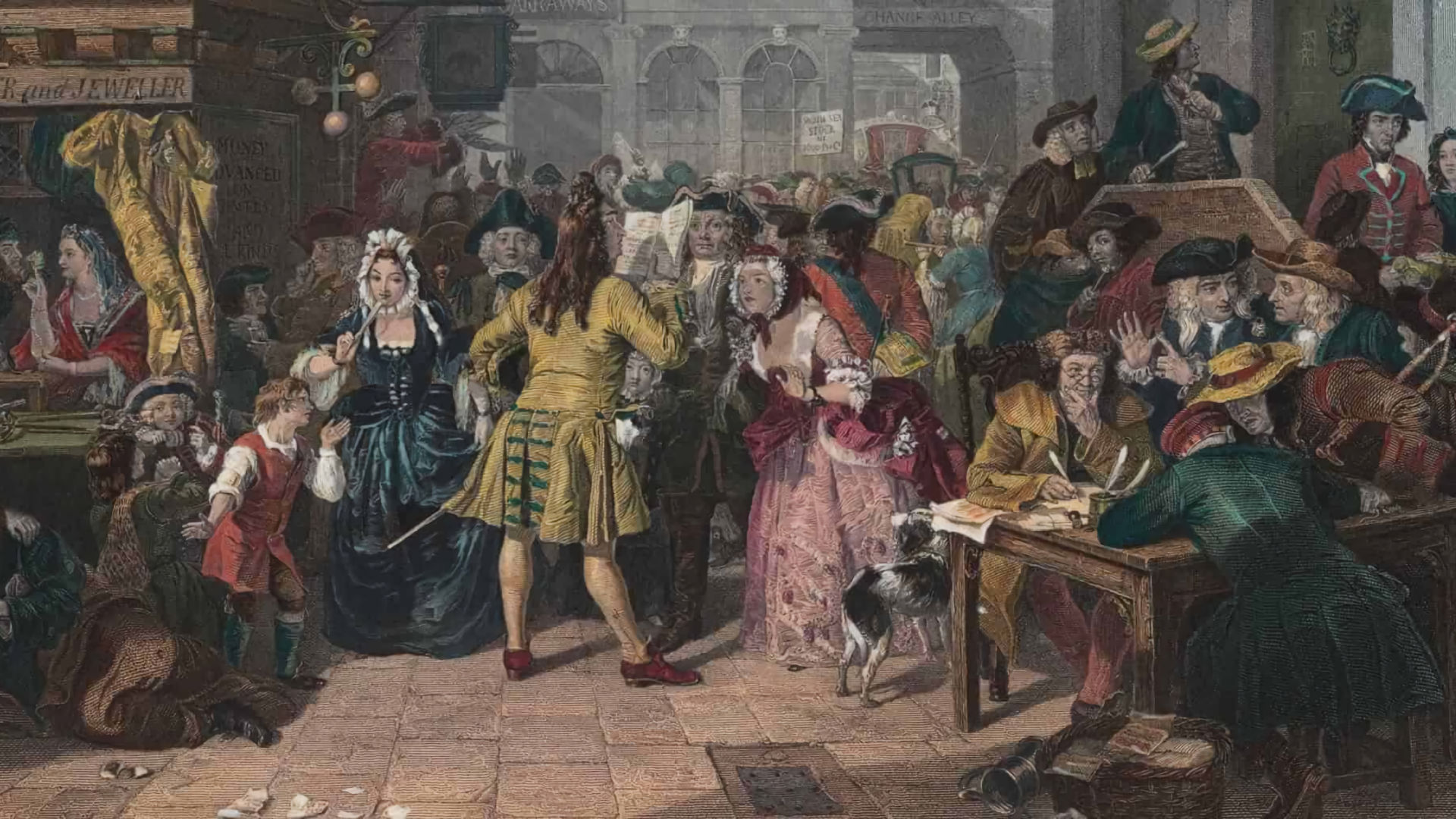
As prices rose, speculation spread far beyond London’s financial elite. Merchants, shopkeepers, clergy, widows, and servants all sought to participate. Coffee houses became informal trading floors where rumours, tips, and half-understood schemes circulated freely. Many investors bought shares on credit, assuming they could sell at a profit before payment was due. The idea of risk was overshadowed by the visible fact of rising prices.
The South Sea Company actively encouraged the mania. Directors released optimistic statements hinting at future dividends and vast trading profits, while carefully avoiding specific figures. Loans were extended to investors using South Sea shares as collateral, further inflating demand. The company also orchestrated controlled share subscriptions, creating artificial scarcity and reinforcing the impression that access itself was a privilege.
The speculative fever was not confined to the South Sea Company. Dozens of imitation ventures emerged, promising profits from fantastical enterprises. One notorious, and likely satirical prospectus, advertised “a company for carrying on an undertaking of great advantage, but nobody to know what it is.” These schemes, later dubbed “bubble companies”, thrived in an environment where credibility mattered less than confidence.
Alarmed by the proliferation of dubious ventures, Parliament passed the Bubble Act in June 1720, restricting the formation of joint-stock companies without royal charter. Ironically, this move concentrated speculative energy even more tightly around the South Sea Company, which possessed full political approval. Investors interpreted the act not as a warning, but as confirmation that South Sea stock was uniquely safe.
By midsummer, the market had detached entirely from reality. Share prices rose because they had risen before. Warnings were dismissed as jealousy or ignorance. Fortunes appeared to be made overnight, reinforcing the belief that participation itself was proof of intelligence.
The South Sea Bubble had reached its most dangerous phase: a market sustained not by profit, but by the conviction that someone else would always pay more tomorrow.
The Crash: Losses, Ruin, and the Collapse of Confidence
The collapse of the South Sea Bubble came as swiftly as its rise. In late August 1720, after months of relentless speculation, confidence began to falter. South Sea Company shares, which had peaked at just over £1,000, started to slide. At first, the decline was modest, dismissed as a temporary correction in an otherwise unstoppable ascent. Within weeks, it became clear that the market’s faith had broken.
Several factors converged to trigger the fall. Company insiders, including directors and politically connected shareholders, began quietly selling their holdings to lock in gains. This increase in supply put downward pressure on prices just as doubts about the company’s real profitability resurfaced. At the same time, credit tightened. Lenders who had previously been willing to advance money against South Sea shares demanded repayment or additional security. Investors who had bought on margin were forced to sell into a falling market, accelerating the decline.
By September 1720, panic had set in. Share prices fell rapidly, dropping below £500, then £300, and continuing downward as buyers vanished. Rumours of fraud, insider dealing, and falsified accounts circulated through London’s coffee houses. Confidence, the very substance that had sustained the bubble, evaporated almost overnight.
The human consequences were severe. Thousands of investors were ruined, many having converted stable government annuities or family savings into South Sea stock at inflated prices. Clergy lost church funds, widows lost pensions, and merchants lost working capital. Bankruptcy spread through the commercial classes, dragging down businesses that had been solvent only weeks earlier. Suicides were reported, and contemporary pamphlets described scenes of despair and public humiliation among former speculators.
By December 1720, South Sea shares had fallen back to around £100, close to their value before the mania began. Fortunes that had existed on paper only months earlier had vanished. Those who had entered late bore the heaviest losses, while early sellers and insiders often emerged comparatively unscathed.
The crash also damaged trust in Britain’s financial system. Joint-stock companies, public credit, and even government-backed schemes were viewed with suspicion. The idea that Parliament itself had endorsed the company intensified public anger. What had been promoted as a national solution to debt now appeared as a spectacular betrayal.
The South Sea Bubble ended with a grinding realisation that the wealth created in 1720 had never truly existed. When belief collapsed, nothing solid remained beneath it.
Blame, Scandal, and Parliament’s Response
As the scale of the collapse became undeniable in late 1720, public anger turned rapidly into demands for accountability. The South Sea Bubble was not seen as a private misfortune but as a national scandal, made worse by the visible involvement of senior politicians, officials, and courtiers. The question was no longer whether the scheme had failed, but who had allowed it to happen.
Parliament moved quickly to investigate. A Committee of Secrecy was established in December 1720 to examine the conduct of the South Sea Company’s directors and their political allies. What emerged was a picture of extensive corruption, insider dealing, and manipulation. Company records revealed that large blocks of shares had been allocated to influential figures at favourable prices, often without payment upfront. These shares could then be sold at enormous profit once prices rose, a practice that amounted to sanctioned insider trading.
Several prominent figures were implicated. John Aislabie, the Chancellor of the Exchequer, was found to have accepted South Sea stock and to have used his position to promote the scheme. In 1721, he was expelled from Parliament and imprisoned in the Tower of London. Other politicians avoided jail but suffered reputational ruin. The scandal reached into the royal household, with even King George I having benefited indirectly from South Sea dealings, a fact that Parliament handled with careful discretion.
The company’s directors fared little better. Their estates were seized to compensate victims, with individual fortunes capped at levels deemed “reasonable” by Parliament. Some directors were left with only a fraction of their wealth, while others fled abroad to avoid prosecution. Although not all losses were recovered, the process signalled that financial misconduct could carry real consequences, even for the well-connected.
Public fury was fuelled by the sense that the authority of Parliament itself had misled ordinary investors. The company’s schemes had been approved by law, promoted by ministers, and framed as a patriotic solution to national debt. When that endorsement collapsed, it undermined trust not just in markets, but in governance.
Parliament’s response was therefore both punitive and defensive. It sought to punish visible wrongdoing while preserving the credibility of the state and its financial system. The narrative that emerged framed the disaster as the result of individual corruption and excess, rather than structural flaws in speculative finance.
In reality, the South Sea Bubble exposed how deeply politics and finance had become intertwined. The scandal was not an aberration. It was a warning that when government power, private profit, and public optimism align without restraint, the consequences can be economically and politically explosive.
After the Bubble: Financial Regulation and Lasting Lessons
After the South Sea Bubble burst, Britain was left shaken but not broken. In the months and years that followed 1720, Parliament faced a delicate task: restore confidence in public credit without encouraging another speculative frenzy. The response was cautious, conservative, and deliberately restraining.
One immediate outcome was the tightening of controls on joint-stock companies. The Bubble Act of 1720, passed at the height of the mania, remained in force for more than a century. It restricted the formation of new joint-stock companies without royal charter or explicit parliamentary approval. While intended to curb fraud and speculation, it also had the side effect of slowing legitimate corporate innovation. Britain’s financial system became more stable, but also more cautious, favouring banks and partnerships over publicly traded companies.
Public debt management was quietly repaired rather than reinvented. Government annuities were restructured, and confidence in state borrowing gradually returned, aided by Britain’s growing commercial and imperial strength later in the eighteenth century. The Bank of England emerged with its reputation largely intact, reinforcing the distinction between regulated public finance and speculative corporate schemes.
Culturally, the bubble left a deep mark. Satirists, poets, and pamphleteers portrayed speculation as moral failure, greed, and collective madness. Jonathan Swift, Alexander Pope, and others mocked the irrationality of markets driven by hope rather than substance. The phrase “South Sea Bubble” entered the language as a permanent warning, shorthand for financial delusion and the danger of believing that paper wealth could replace real value.
Importantly, the disaster reshaped attitudes toward risk. Speculation did not disappear, but it became associated with social stigma rather than glamour. For decades, British investors preferred land, government debt, and established enterprises. The memory of 1720 lingered as an informal regulator, reinforcing restraint where law alone could not.
The South Sea Bubble also established a pattern that would repeat throughout financial history. Complex financial instruments were presented as solutions to structural problems. Political endorsement was mistaken for economic soundness. Early profits masked underlying fragility. When confidence failed, losses were socialised, while many of the architects escaped lasting punishment.
In hindsight, the South Sea Bubble was not a primitive mistake made by an unsophisticated society. It occurred in one of the most advanced financial systems of its time. That is its enduring lesson. Financial disasters are rarely caused by ignorance alone. They emerge from optimism reinforced by authority, from systems that reward belief faster than they reward verification. Three centuries on, the mechanisms have changed, but the pattern remains familiar. The South Sea Bubble endures not because it was unique, but because it was the first clear demonstration that modern finance, left unchecked, can turn confidence itself into a weapon.
The South Sea Bubble FAQ
The South Sea Bubble was a financial crash in 1720 caused by speculative investment in the South Sea Company.
Shares rose due to debt-conversion schemes, political backing, and widespread speculation rather than real trading profits.
They rose from around £128 at the start of the year to over £1,000 at their peak.
Loss of confidence, insider selling, tightening credit, and the realisation that profits were exaggerated.
It led to tighter controls on joint-stock companies and long-lasting scepticism toward speculative finance.