The Rahway Jane Doe Murder
In the early hours of 25 March 1887, four men walking to work made a discovery that would unsettle the town of Rahway, New Jersey and echo far beyond it. Lying near the Rahway River, close to the junction of Central Avenue and Jefferson Avenue, was the body of a young woman. She was fully clothed, carefully positioned, and unmistakably dead. No one present recognised her. From that moment on, she would be known only as Rahway Jane Doe.
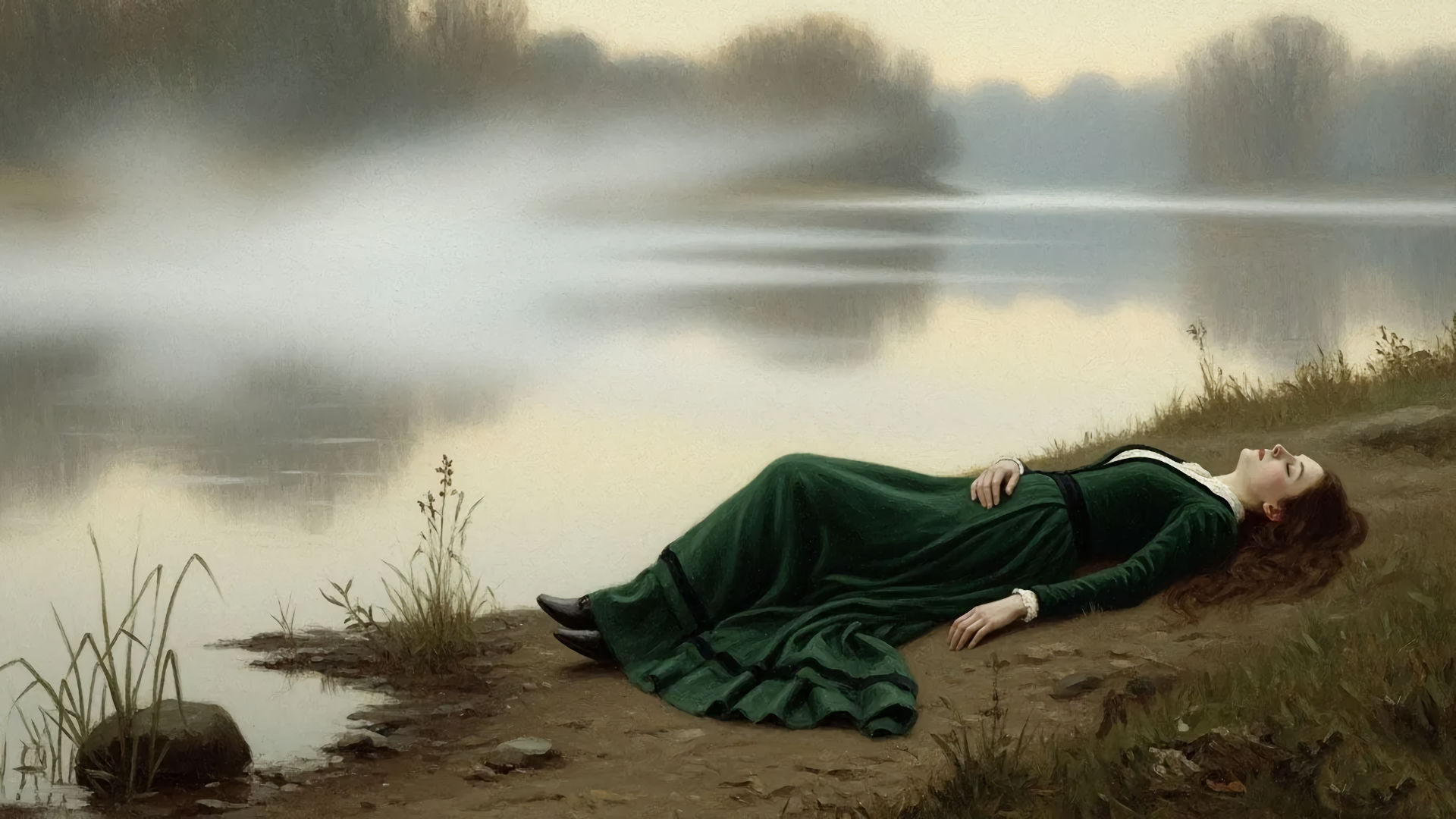
At first glance, the scene suggested deliberation rather than accident. The woman’s body was not concealed, but neither was it abandoned carelessly. She had been placed on her back, her clothing relatively neat, her appearance calm. There were no signs that she had drowned in the river or fallen by chance. This was not misadventure. It was the aftermath of a violent act carried out elsewhere or earlier, and then staged with intention.
Word spread quickly through Rahway, a growing industrial town with close-knit neighbourhoods and a keen sense of who belonged and who did not. Local residents gathered at the scene, followed soon after by police and medical officials. Yet despite the attention, no one could provide a name. No missing person matched her description. No local family came forward. In a town where strangers stood out, her anonymity was as striking as her death.
The woman appeared to be in her late teens or early twenties. She was well dressed by the standards of the time, wearing a green dress that later became one of her defining identifiers. This detail mattered. Her clothing suggested she was not destitute, nor transient in appearance. Whoever she was, she had not arrived at the riverbank empty-handed or abandoned by society. That contradiction would haunt the case from the outset.
Authorities quickly realised they faced two problems, not one. They needed to determine how she had died, but first, they needed to establish who she was. Without an identity, every line of inquiry stalled before it could properly begin. No personal effects offered answers. No initials were sewn into her clothing. No documentation was found.
By the end of the day, the body had been removed, examined, and prepared for burial. Newspapers seized on the mystery, publishing descriptions and appeals in the hope that someone, somewhere, would recognise her. None did. The case began not with a suspect or a motive, but with silence.
That silence, the absence of a name in a town accustomed to knowing its own, would become the defining feature of the Rahway Jane Doe murder, shaping every investigation that followed.
What the Autopsy Revealed
The post-mortem examination of Rahway Jane Doe was carried out later on 25 March 1887, and it quickly confirmed what investigators already suspected. This was not an accidental death. The young woman had been murdered, and the nature of her injuries pointed to a deliberate and violent act.
The cause of death was determined to be strangulation. Marks were found on her neck consistent with sustained pressure, not a brief or incidental force. There were no indications of hanging or self-inflicted injury. Whoever killed her had used their hands or a ligature with enough strength and intent to cut off her air supply until death occurred. The lack of hesitation implied familiarity with violence rather than panic.
Importantly, the examination suggested that Jane Doe had not been killed at the riverbank where she was discovered. There were no signs of a struggle at the scene, no disturbed ground, and no defensive injuries on her hands or arms. This indicated that her body had been transported and placed deliberately after death. The river location was a dumping ground, chosen for visibility or convenience rather than necessity.
The autopsy also revealed that she had been sexually assaulted. While forensic science in the late nineteenth century was limited, doctors were able to conclude that the assault occurred either shortly before or at the time of death. This finding immediately reframed the investigation. The crime was no longer simply a killing, but an act driven by domination and brutality, narrowing the likely circumstances of her final hours.
Physically, the woman appeared healthy and well cared for. She showed no signs of long-term illness or malnutrition. Her teeth were in good condition, and her hands did not bear the calluses associated with heavy manual labour. These details suggested a background that conflicted with early assumptions that she might be a transient or someone living on the margins of society.
Her clothing was examined in detail. The green dress, well-made and clean, became central to her posthumous identity. It showed no significant damage consistent with a prolonged struggle, reinforcing the conclusion that the fatal violence occurred elsewhere. The absence of mud, water saturation, or tearing ruled out the river as the primary crime scene.
By the end of the examination, investigators were left with a clearer picture of how Jane Doe had died, but no closer to understanding who she was or who had killed her. The autopsy stripped away any lingering ambiguity about the nature of the crime, replacing mystery with certainty in one respect and deepening it in another.
They now knew she had been murdered deliberately, assaulted, and transported. What they still lacked was the one detail that could give those facts meaning: her name.
Reconstructing a Life from Fragments
With no name to pursue, investigators turned to what little the body itself could reveal about Rahway Jane Doe as a living person rather than a crime scene. In an era before fingerprints or DNA, this meant careful attention to small, often ambiguous details, fragments that might suggest where she came from and how she had lived.
Her clothing remained the strongest clue. The green dress she wore was well-made and in good condition, suggesting it had been purchased rather than improvised or heavily worn. It was fashionable but not extravagant, the kind of dress worn by a respectable young woman rather than someone living in extreme poverty. This led investigators to speculate that she may have been employed in domestic service, factory work, or another occupation that required neat appearance but did not confer social prominence.
No jewellery was found on her body, nor any handbag, purse, or personal papers. That absence raised difficult questions. It was unclear whether such items had been taken during the assault or whether she had been travelling light. Either possibility carried implications. Theft suggested motive beyond violence alone. Absence from the outset suggested she may not have anticipated danger or planned a long journey.
Physical examination indicated that she was likely in her late teens or early twenties. Her hands lacked the roughness associated with heavy manual labour, and her overall condition suggested someone accustomed to regular meals and shelter. These details complicated early assumptions that she might have been homeless or transient. Instead, she appeared to belong somewhere, to a household or workplace where her disappearance should have been noticed.
Language and accent were matters of conjecture rather than evidence. Newspapers at the time speculated that she might have been an immigrant, possibly Irish, reflecting common migration patterns into New Jersey in the late nineteenth century. However, no firm proof supported this theory, and it remained just that, speculation shaped by the social context of the period.
Investigators circulated detailed descriptions of her appearance and clothing to surrounding towns and cities. Notices were published in newspapers across New Jersey and New York, asking whether anyone recognised the woman in the green dress. Boarding houses, factories, and employers were questioned. None could place her.
Each unanswered inquiry sharpened the central contradiction of the case. Jane Doe appeared to have lived an ordinary, structured life, yet she had died without leaving a trace that anyone could claim. The fragments suggested familiarity, not isolation, but no connection ever surfaced.
By the time these efforts stalled, investigators were forced to confront a bleak possibility. Either her identity lay beyond the reach of local records and memories, or someone who knew her had chosen silence. In either case, the life that ended at the Rahway River remained frustratingly out of focus, defined more by what could not be found than by what could.
Theories, Suspects, and Dead Ends
As the initial shock faded and the search for an identity stalled, the Rahway investigation shifted toward speculation. Without a name, police were forced to work backwards, building theories about who Rahway Jane Doe might have been and who could have had both access to her and reason to kill her. The result was a case built on inference, local rumour, and leads that never quite held together.
One early theory centred on the idea that Jane Doe had been employed locally, perhaps as a domestic servant or factory worker. Investigators questioned employers, boarding house keepers, and families known to hire young women. The logic was straightforward. Someone living and working nearby would have been noticed missing. Yet no employer reported a disappearance that matched her description, and no household claimed a missing servant. This absence quietly undermined the theory, suggesting either that she had arrived in Rahway very recently or that she lived elsewhere.
Attention also turned to transient populations. Rahway sat along established rail lines, and the late nineteenth century saw frequent movement between towns in New Jersey and New York. Some speculated that Jane Doe had been travelling through the area and encountered her killer by chance. This theory explained her anonymity but raised new problems. Her clothing and physical condition did not align easily with a life of constant movement, and no railway records or lodging houses produced a match.
Suspects were few and poorly defined. Police interviewed men known for violent behaviour, individuals with criminal records, and those who lived near the riverbank. None could be linked convincingly to the crime. There were no witnesses to her final hours, no reports of a struggle, and no evidence placing a specific individual with her shortly before death. The lack of a clear crime scene further weakened every line of inquiry.
Public speculation filled the void left by evidence. Newspapers printed theories ranging from secret romances to illicit relationships gone wrong. Some suggested the killer may have been someone known to her, a lover or acquaintance whose identity was protected by silence. Others imagined a stranger acting opportunistically. These narratives reflected social anxieties more than investigative progress.
Each theory ultimately collapsed under the same weight. Without an identity, motive remained abstract. Without a motive, suspects could not be prioritised. The case circled itself, returning repeatedly to the same unanswered questions.
By the end of 1887, the investigation had reached a quiet impasse. There was no dramatic failure, no single mistake, just a slow erosion of possibility. The Rahway Jane Doe murder did not go cold in a moment. It faded, leaving behind a file thick with conjecture and thin on certainty, and a crime defined less by what was known than by everything that could not be proven.
Decades of Silence and Renewed Efforts
After the investigation stalled in 1887, the murder of Rahway Jane Doe slipped gradually from active inquiry into archival memory. There was no formal declaration that the case was closed, but without new evidence or an identified victim, there was little that local authorities could do. Files were stored, witnesses aged or died, and the riverbank where her body had been found returned to ordinary use. The silence that followed was not dramatic; it was administrative.
For decades, the case resurfaced only occasionally, usually prompted by anniversary articles or brief mentions in local histories. Each retelling repeated the same known facts: the date of discovery, the green dress, the lack of identification, the unanswered questions. No new names were added. No new suspects emerged. The murder existed in a kind of historical suspension, remembered but untouched.
The twentieth century brought dramatic advances in forensic science, but most of them arrived too late to benefit this case directly. Fingerprinting, dental comparison, and later DNA analysis all depended on preserved biological material and comparative records. In Rahway Jane Doe’s case, neither survived in usable form. Burial records were sparse, and by the time interest in re-examination grew, exhumation posed ethical and practical barriers with uncertain benefit.
What did change was perspective. Later historians and criminologists began to view the case not simply as an unsolved murder, but as an example of the limits of nineteenth-century policing. The investigation had not failed through negligence or corruption, but through absence, absence of identity, absence of witnesses, absence of technology capable of bridging the gap between a body and a life.
Local efforts to revive interest focused instead on public awareness. Her story was retold in newspapers, historical journals, and later online archives, often accompanied by appeals for information passed down through families. The hope was slim but persistent: that somewhere, a memory had survived where records had not.
These renewed efforts did not produce a breakthrough, but they altered the tone of the case. Rahway Jane Doe was no longer just an unsolved crime; she became a symbol of how easily ordinary lives could vanish from the historical record, especially those of young women without wealth or status.
Identity, Justice, and What Remains Unanswered
More than a century after her body was found, Rahway Jane Doe remains exactly what she was on the morning of 25 March 1887: unidentified, unclaimed, and unresolved. No name has been attached to her life, no suspect has been definitively linked to her death, and no evidence has been uncovered that could reopen the case in any meaningful legal sense. What survives is not a mystery waiting to be solved, but a set of unanswered questions that history has learned to live with.
The absence of identity remains the most profound failure of the case. Everything else, the theories, the stalled investigation, the lack of prosecution, flows from that single void. Without knowing who she was, investigators could not trace her movements, reconstruct her relationships, or determine who might have noticed her disappearance. The crime was frozen at the moment of discovery, unable to move forward because it had nowhere to go.
Justice, in the conventional sense, was never achieved. No one was arrested, tried, or held accountable. Yet the case also resists being framed as a failure of will or competence. In 1887, policing relied heavily on community recognition, paper records, and personal testimony. When none of those connected to Jane Doe, the system had little left to offer. This was not a case undone by corruption or neglect, but by the structural limits of its time.
What endures instead is her symbolic weight. Rahway Jane Doe has come to represent the countless victims whose lives passed beyond documentation, particularly young women whose movements were lightly recorded and easily erased. Her green dress, once a clue, became a stand-in for identity itself, something visible but ultimately insufficient.
Modern readers often ask what might still be possible. Could a name emerge from a family story, an old letter, or an overlooked record? Theoretically, yes. Practically, the distance of time has narrowed those possibilities almost to nothing. Memory fades faster than paper, and paper faster than certainty.
The Rahway Jane Doe murder endures not because it promises resolution, but because it exposes how fragile identity can be once it slips beyond record and recognition. A young woman lived, travelled, and died, and history caught only the final moment. Everything before it remains lost. What remains unanswered is not just who killed her, but who she was allowed to be in life, and how easily that life disappeared without leaving a trace.
The Rahway Jane Doe Murder FAQ
Rahway Jane Doe was an unidentified young woman whose body was discovered on 25 March 1887 near the Rahway River in Rahway, New Jersey. Her real name has never been confirmed.
She was killed by strangulation and had also been sexually assaulted. Medical examination at the time ruled out accident or drowning.
Her body was found near the Rahway River, close to Central Avenue and Jefferson Avenue in Rahway, New Jersey.
No. Despite early investigation and public appeals, no suspect was ever charged and the case went cold within months.
She carried no identifying documents, no personal items, and no missing person reports matched her description. Record keeping in the late 19th century was limited, particularly for young women without strong family ties.
The case highlights the limitations of early criminal investigation and how easily a person could disappear from the historical record, leaving justice impossible.