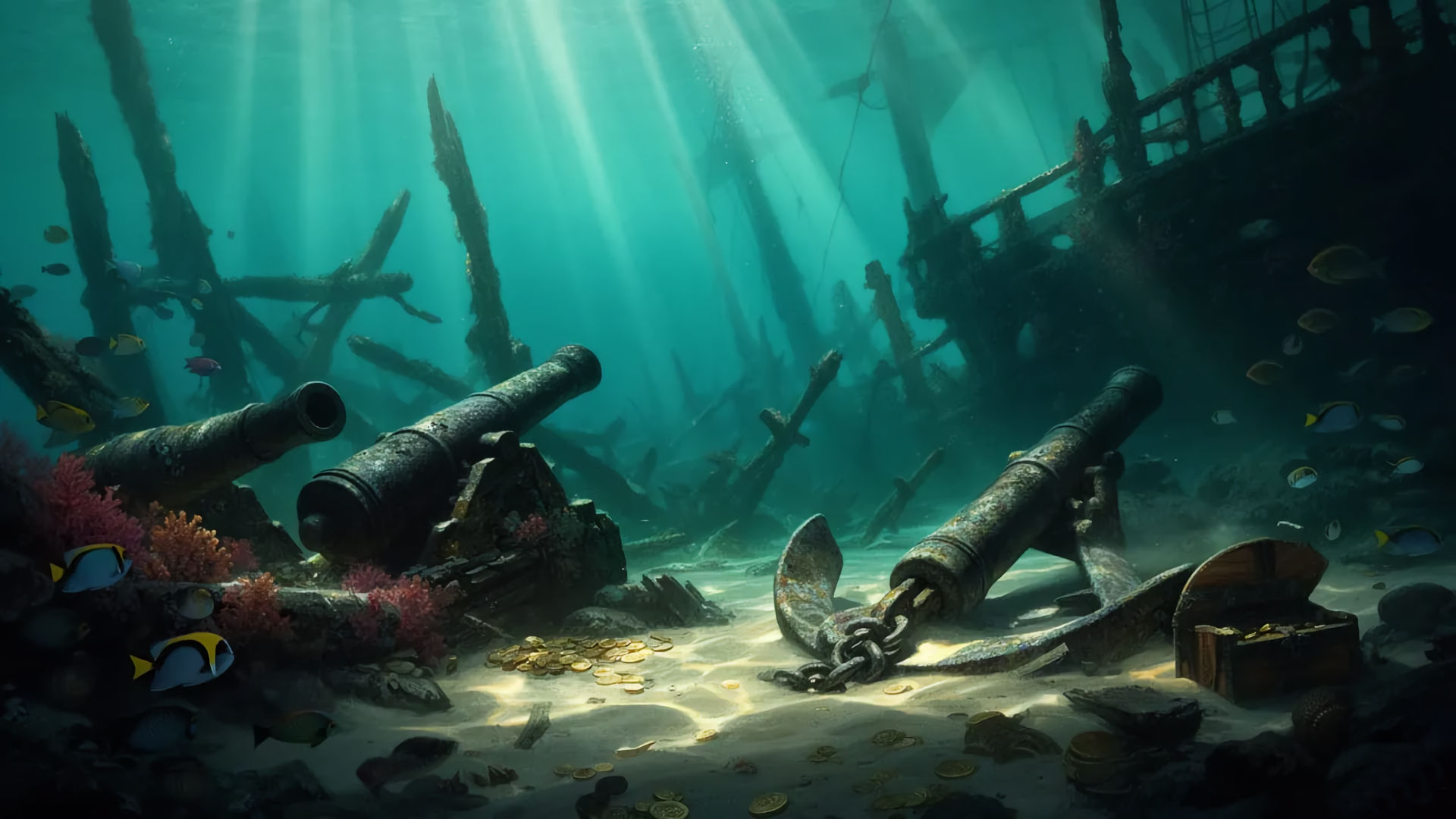
The Mystery of Captain Kidd’s Lost Ships
In the final years of the seventeenth century, when fortunes could be made faster than a cannonball could travel and lost just as quickly, a Scottish-born sailor named William Kidd set sail into the whirlpool of empire, commerce, and crime. Was he a pirate king or a loyal privateer framed by the powerful? A swashbuckling villain or a scapegoat sacrificed for political theatre? A man who stole a fortune or someone who simply knew too much about those who did? In death, Captain Kidd became a legend. In life, he was far more complicated. Yet his enduring mystery rests not only in the contradictions of his character, but in the ships he commanded, vessels that seem to slip through history like ghosts, their final resting places drawing treasure hunters and dreamers across centuries.
Two ships form the heart of this mystery: the Adventure Galley and the Quedagh Merchant — one a wonder of naval engineering built for pursuit, the other a captured prize whose riches sealed Kidd’s fate. Their stories are intertwined with betrayal, fear, and the eternal question of where the truth of Captain Kidd really lies.
William Kidd was not born to be a pirate. In fact, he spent much of his early career fighting pirates. He earned the respect of English merchants and officials by hunting down the very rogues he would later be accused of joining. Kidd’s rise was helped along by the right patronage at the right time, especially a group of influential English nobles who believed that sending a bold sea captain to protect trade routes from French and pirate vessels would be both profitable and patriotic. What could possibly go wrong?
Plenty. Kidd accepted the mission under a commission that allowed him to seize any enemy of the Crown and share the spoils with his backers. It seemed a straightforward way to grow rich while defending England’s interests. With political blessing secured and enthusiasm running high, Kidd received command of a custom-built ship that would make even a seasoned seafarer grin.
The Adventure Galley was an engineering marvel for its time, a hybrid vessel with both sails and banks of oars. This meant she could keep moving even when the wind refused to cooperate, making her ideal for chasing down pirates who relied on light and nimble ships to escape capture. Armed with heavy guns and crewed by men hungry for prize money, she sailed from London in 1696, bearing the hopes of powerful investors and the nervous loyalty of her captain.
But from the beginning, something about the voyage felt cursed. Many of Kidd’s sailors were press-ganged from taverns and portside crowds, unwilling recruits who resented their captain and the strict discipline he attempted to impose. Fights broke out. Morale plummeted. Supplies dwindled faster than planned. Worse still, Kidd struggled to find legitimate French or pirate targets. The oceans were large, and the profits increasingly difficult to spot.
Crewmen muttered that their captain was too timid. They were itching for loot, and Kidd’s patience was not patience in their eyes; it was weakness. Tension boiled.
Then fate delivered the moment upon which Kidd’s entire legacy, and the mystery surrounding his ships, would turn. Off the coast of India, he intercepted a massive vessel: the Quedagh Merchant, a richly laden Armenian ship carrying treasure from the East. In Kidd’s view, she was a lawful prize. Though not a French vessel, she was captained by an Englishman travelling under a French pass, a passport of convenience that sailors often used for protection. Kidd believed that this technicality placed the ship firmly in the category of “fair game.” Many historians since have argued that this decision was reasonable, supported by his commission. Others say Kidd knew exactly how risky it was.
Regardless, the capture brought a sudden change to Kidd’s fortunes. Gold, silk, spices, and other precious goods filled her holds, wealth beyond anything his restless men had dared to imagine. They erupted in celebration, convinced that their voyage had finally paid off. Kidd renamed the ship the Adventure Prize, sent the unhappy Adventure Galley limping after him as best she could, and made for safe haven.
But while Kidd celebrated, his enemies were already sharpening their knives. Rumours reached England, painting him as a pirate running wild, taking ships that belonged not to enemies but to allies and merchants whose losses echoed in the counting houses of London. Kidd’s backers, fearful that they might be implicated in acts of piracy, were swift to distance themselves. Influential figures who once toasted Kidd were now prepared to sacrifice him to protect themselves.
Meanwhile, the Adventure Galley, once a proud and clever predator of the waves, was dying. Her hull leaked. Her engines of oar and sail were failing. She was a heavy, slow burden in the tropical waters. Eventually, Kidd was forced to scuttle his beloved ship off the coast of Madagascar. One of the most innovative warships of the century slipped beneath the water, lost to time and speculation. Were coins hidden in her timbers? Did Kidd bury a portion of his treasure before sending her to the deep? The stories say yes, and treasure hunters have listened closely ever since.
With the crew now sailing aboard the Adventure Prize, Kidd made for the Caribbean, hoping to clear his name and present the captured ship’s papers as proof of his innocence. But whispers followed him like vultures. Flags changed colours too easily at sea, and those who had accused Kidd of piracy were influential men who made sure the accusations stuck. When Kidd reached New York, the trap snapped shut. He was arrested, shipped back to England, and placed on trial.
Kidd entered the courtroom insisting he was a loyal subject of the Crown. He demanded that the French pass be presented that legitimised the capture of the Quedagh Merchant, but that document had mysteriously vanished. He begged for witnesses to come forward who could confirm his actions were lawful and performed in the service of England. Those witnesses were conveniently nowhere to be found. He asked for the support of the nobles who had funded his enterprise. They stood silent.
History rarely lacks for irony. Captain Kidd was executed at Execution Dock in 1701, the very year that the French pass that might have saved him suddenly reappeared. Too late. The man was dead.
And his ships? Their stories had only begun.
The Adventure Galley, lost near Madagascar, has long been the subject of passionate searches. Claims of findings have come and gone like the tides. Some expeditions swear they have located her remains, only for experts to argue over timelines and origins. Was she burned before sinking? Was treasure aboard? Did Kidd hide a chest beneath a coral shelf before the sea claimed the hull? The evidence remains frustratingly thin, as if the ocean enjoys mocking those who try to solve the mystery.
But the Adventure Prize, the ship responsible for everything, the gold, the accusations, the noose, she vanished even more completely.
Kidd left her under guard while he tried to negotiate his freedom in America. After his arrest, the men guarding the vessel melted into the world like shadows. For centuries, maps, rumours, and wild theories suggested that the ship lay buried in Caribbean sands or hidden deep in mangrove swamps, her treasure untouched and waiting.
Then, in 2007, divers working off the coast of the Dominican Republic spotted something remarkable: the remains of a 17th-century shipwreck nestled beneath clear blue waters. Cannon style and hull construction matched descriptions of the Quedagh Merchant. Bronze guns bore markings consistent with Kidd’s era. It seemed the mystery had finally spat out an answer.
At long last, a named shipwreck with roots deep in Kidd’s tragedy was found not in the Caribbean’s wild frontier but almost casually resting near the shore of Catalina Island, visible even to snorkellers who dare to float above history.
An archaeological analysis published in 2016 concludes that the wreck “very likely” is the Quedagh Merchant; the material remains align with written records, including its construction, armament, ballast, and anchors, well enough for scholars to accept the identification.
Importantly, the wreck shows no signs of large-scale looting. Despite centuries of treasure hunters scouring the area for legends, the site remained remarkably intact until its scientific investigation.
Despite the positive identification, not everything about the wreck is intact or known. The upper-hull structure, such as decks, masts, and rigging, has not survived. This is not unusual for wooden ships that sink shallow and long ago; wood decays, marine consumption degrades, and storms tear apart exposed timbers.
The “cargo hold”, where, in 1699, the ship may have carried valuables, appears to be empty of gold or silver treasure. The archaeological team concludes that any movable cargo was likely removed long ago, either by Kidd’s men, other scavengers, or subsequent looters and locals.
So, the discovery has raised fresh questions. Had Kidd ordered the ship stored there for safekeeping? Had his men sold portions of the cargo and abandoned her? Or had nature simply ended the story, dragging the vessel beneath the waves during a storm no one recorded?
And yet, even now with a location confirmed, doubt lingers around the edges of the story like mist over a harbour. Were all the riches removed before sinking? Did Kidd squirrel away another stash in some secret cove? Was there a hidden vault that only those with a forgotten map can uncover? Legend has a way of filling silence with treasure, and silence is something the sea knows how to provide.
Captain Kidd’s mystery lives on because it embodies a perfect storm of human flaws and dreams. It is a tale where justice is uncertain, where paperwork decides life and death, where oceans conceal evidence better than courts reveal truth. Kidd wanted to be a respectable man, to climb the ladder of society, to serve the Crown, and to grow wealthy doing so. Instead, he achieved immortality by falling from that ladder directly into folklore.
His ships, whether lying intact somewhere below sunlit waves or rotted into memory, represent the unanswered question: Was William Kidd the villain history wanted him to be, or was he the victim of a convenient narrative? If we find every plank of the Adventure Galley, every nail from the Adventure Prize, and every gold coin from both, will we finally know the truth?
Or will we discover only more complications, more hints of shadowed dealings, and more evidence that Kidd’s greatest crime was trusting the men whose wealth and status outweighed his own?
Visit the Dominican coast today, and you can dive among the remains thought to be the Quedagh Merchant, sunlight shifting across timbers once packed with the riches that doomed a captain. Swim along Madagascar’s reefs, and you may be searching the watery gravesite of the Adventure Galley, where oars once dipped silently into black seas. And in every crash of the surf, there lingers the suggestion that somewhere, still undiscovered, lies a chest of secrets that could rewrite the legend.
The sea does not give up its truths easily. It preserves mysteries better than any archive. It hides guilt as readily as it hides gold.
But it also has a habit of revealing just enough to keep hope alive.
Captain Kidd’s ships are not merely shipwrecks. They are chapters ripped from a history book no one has finished writing. They are the echo of a man standing at the gallows shouting that he was innocent. They are the promise that one day, perhaps, the ocean will whisper back where the rest of his story lies buried. Until that happens, the legend sails on.
The Mystery of Captain Kidd’s Lost Ships FAQ
William Kidd was a seventeenth century sailor commissioned as a privateer who was later accused of piracy and executed in London.
It was Kidd’s specially built ship designed for speed and pursuit, combining sails with oars, later scuttled near Madagascar.
It was a captured treasure ship whose seizure led to Kidd being labelled a pirate despite his claims of acting lawfully.
The ship believed to be the Quedagh Merchant was discovered in 2007, but any significant treasure was removed long before the wreck was found.
Unresolved questions remain about what happened to missing cargo and whether Kidd hid additional treasure before his arrest.