The Mystery of the Georgia Guidestones
Tucked away on a quiet hilltop in rural Georgia once stood one of America’s strangest, most controversial monuments, a towering granite structure engraved with cryptic messages about the future of humanity. The Georgia Guidestones, sometimes called the “American Stonehenge,” were not ancient ruins or archaeological leftovers. They were modern, commissioned in 1979 and unveiled in 1980. Yet the intent behind them remains clouded in secrecy.
Who built them? Why did they contain rules for a “New World Order”? And why did the man who ordered them insist on hiding his true identity forever? For over forty years, the Georgia Guidestones attracted curious tourists, conspiracy theorists, philosophers, and those uneasy about a future someone thought needed… guidelines. Then, in 2022, they were destroyed in an explosion, leaving behind questions that may now never be fully answered.
This is a story about a mystery carved into stone, and a message that outlived its monument.
A Monument Appears Out of Nowhere
Our tale begins in June 1979, in the small town of Elberton, Georgia, a place known for granite. That summer, a well-dressed stranger walked into the Elberton Granite Finishing Company. He introduced himself not by a real name, but under a pseudonym: R. C. Christian. The initials alone carried a whiff of legend. Was it a reference to the Rosicrucians, a secretive mystical order? Or simply a clever alias designed to confuse? He never said, and no one could prove otherwise.
Christian claimed to represent a small group of loyal Americans with a vision for the world. They wanted a monument built as a guide for future generations, especially in the event of a global catastrophe. He asked for a structure that would withstand the end of civilisation, something designed to last for millennia. And he wanted it engraved in multiple languages so his message could not be lost to time or translation.
It sounded like the start of a thriller. But it was real.
Designing the Rules for Humanity
The project was ambitious. Six massive granite slabs, arranged like a compass, weighing over 100 tonnes in total. Some pieces rose more than 19 feet high. A capstone rested on top. Thoughtful alignments were incorporated into the design: a slit through the central stone that marked the sun’s position on the solstices, a hole aimed directly at the North Star, and a calendar feature tracking the passage of days.
But the most striking element was the message, ten guiding principles engraved in eight modern languages: English, Spanish, Russian, Arabic, Chinese, Hindi, Hebrew, and Swahili. These were not gentle tips for healthy living. They read like commandments for rebuilding civilisation.
And the first principle? “Maintain humanity under 500,000,000 in perpetual balance with nature.”
To many, that sounded more like a threat than guidance. A world with nearly eight billion people being told it should shrink to half a billion inspired alarm. The rest of the inscriptions called for a single global language, unified laws, population planning, environmental stewardship, and international courts, ideas that reflected both rational hope and unsettling control.
Who exactly felt entitled to write rules for the entire world? That question became the heart of the Guidestones mystery.
The Strange Secrecy of R. C. Christian
Everything about the funding and creation was wrapped in secrecy. Christian paid in cash. He demanded confidentiality about his identity and those he represented. Only two men ever knew his actual name: the banker who handled the financial trust and the president of the granite company. Both swore to protect the alias and took it as a solemn duty. Neither ever broke the promise.
Christian explained that the monument was intended for the survivors of a future disaster, whether natural or human-made. His group apparently believed the world was heading toward collapse, perhaps nuclear war, and felt responsible for offering wisdom to those who would rebuild.
After the stones were completed and installed in March 1980, Christian disappeared from public view. He exchanged occasional letters for a few years, but eventually the correspondence stopped. Whoever he was, he stepped back into the shadows.
A Message to the Future, or a Warning to the Present?
Over the decades, visitors arrived with different interpretations. Some saw the Guidestones as a peace-loving call for sustainability. Others viewed them as a blueprint for authoritarian world government. Several Christian groups denounced the monument as satanic. The text’s emphasis on reason over passion and global unity over national identity triggered suspicion among those already wary of government influence.
The site became surrounded by rumour. Was this the work of powerful elites preparing for the post-apocalypse? A cult predicting humanity’s downfall? Was Christian truly one man, or a symbolic name for an organisation with hidden influence?
The monument’s astronomical alignments showed scientific knowledge. Its linguistic diversity showed global ambition. The secrecy behind it showed distrust, not from the world toward its creators, but from its creators toward the world.
A monument designed to guide humans toward unity ironically became a lightning rod for division.
Conspiracy Culture Takes Hold
As the internet grew, so did the fascination. The Guidestones featured in late-night radio programmes, conspiracy forums, and television documentaries. Theories multiplied like ants in the Georgia heat.
Some believed the stones were part of a sinister global depopulation plan. Others pointed to the Rosicrucian reference in the name “Christian,” arguing links to esoteric secret societies and hidden knowledge. There were whispers of Freemasons, of occult numerology encoded in the measurements, even claims that the site marked a ley line of spiritual power.
Of course, none of these theories had evidence. But the absence of information can sometimes pour more fuel on imagination than facts ever could.
Acts of Defiance and Destruction
Suspicion eventually turned into hostility. Over the years, the Guidestones were repeatedly vandalised, graffiti accusing them of evil intent and anti-religious goals. Security cameras were installed. Signs were posted. Visitors were warned not to damage the stones.
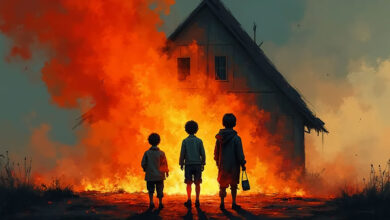
But in the early morning hours of 6 July 2022, someone took the attack much further. An explosive device shattered one of the slabs, sending debris into the dawn air. The remaining structure, now unstable, had to be demolished for safety reasons later that same day. The mysterious monument that had stood for 42 years was suddenly gone.
To some, the destruction was a triumph, the erasure of a symbol they believed dangerous. To others, it was a loss of cultural curiosity, a blow against history and unanswered questions.
For the rest of us, it was the conclusion of a mystery without resolution.
Interpretations Through the Sand of Time
So what were the Guidestones meant to be?
Some scholars see them as a philosophical message written by environmentalists reacting to Cold War anxieties, a survival plan in case life had to begin again. From that perspective, the stark population guideline was not a call for genocide, but a speculative suggestion for how many humans Earth could support sustainably if civilisation had to start fresh after a catastrophe.
Others believe the message was a political warning, that humanity’s inability to govern itself wisely could doom it. The text urges calm thinking, fairness, and cooperation, as if penned by someone afraid humanity was losing control.
Even those interpretations cannot dismiss the unsettling language. But maybe the strangeness was the point. Monuments do not always exist to reassure us. Sometimes, they exist to provoke.
Mystery in Granite and Dust
Today, only the foundation remains. A patch of Earth with a story that once reached around the world. The Guidestones’ destruction robbed us of a physical puzzle, but their legend continues, perhaps stronger, now that no one can visit the proof and form their own opinion.
The creators remain unknown. The true intent remains debated. And that first principle, coldly carved into stone, still echoes: maintain humanity under 500 million.
Was it a warning? A prophecy? A late-night thought experiment chiselled into permanence?
The absence of answers is what keeps the Guidestones lodged in our imagination like a moral riddle.
Final Word
The Mystery of the Georgia Guidestones endures because it asks a question humanity rarely confronts directly: what happens after everything falls apart? And who gets to decide how the world should be rebuilt?
Perhaps the monument was an act of care disguised as arrogance. Perhaps it was arrogance disguised as care. Or maybe it was something far stranger, the legacy of a hidden group preparing for a future they believed they understood better than anyone else.
Standing among those stones once meant looking at a vision of civilisation rewritten. Now, all we can do is remember and speculate, tracing the outlines of a vanished monument with the mind’s eye.
The man called R. C. Christian sought to guide humanity long after he and his group were gone. Their message outlasted their stone. Their identity remains buried deeper than any granite quarry. And the world they feared, chaotic and uncertain, is still very much the one we live in. The Georgia Guidestones are now dust. But the mystery they left behind? That may be carved in place forever.
The Mystery of the Georgia Guidestones FAQ
The Georgia Guidestones were a granite monument erected in 1980 in Elbert County, Georgia, featuring ten messages in eight languages promoting themes like population control, unity, and living in harmony with nature.
The monument was commissioned by a man using the pseudonym R.C. Christian. His true identity and motives remain unknown, adding to the mystery.
Many saw the monument’s messages, particularly those about population reduction, as ominous or authoritarian. Conspiracy theories linked it to secret societies and apocalyptic agendas.
In 2022, the monument was severely damaged by an explosion and later demolished for safety reasons. The culprits and their motives have not been officially confirmed.