The Battle of Alesia
Some battles decide the fate of armies, others shape the destiny of nations. But occasionally, one changes the balance of power for an entire continent. The Battle of Alesia was such a moment. In 52 BCE, on a windy plateau in central Gaul, a defiant confederation of Gallic tribes confronted the might of the Roman Republic. At stake was not merely land or loot but the very future of Gaul, freedom or assimilation, independence or empire. It was a fight that pitted Vercingetorix, a charismatic young chieftain determined to unite his people, against Julius Caesar, a general whose ambition was only matched by his talent for winning.
The story of Alesia begins long before the first trench was dug or the first spear thrown. Gaul, a patchwork of Celtic tribes, had resisted Roman influence for generations. While some chieftains traded with Rome and welcomed the glitter of Mediterranean goods, others looked south with suspicion, sensing that Roman “friendship” came with sharp edges.
Julius Caesar saw Gaul not merely as a frontier but as a ladder. A brilliant politician hungry for power, he became governor of the Roman provinces bordering Gaul. With legions under his command, he launched a stunning series of campaigns beginning in 58 BCE. Tribe by tribe, river by river, the Romans pushed further, using steel and strategy to dominate a region Rome had long coveted. Caesar wrote dispatches back to Rome describing his victories in glowing detail. The public adored him. The Senate felt increasingly uneasy. Success in Gaul fed Caesar’s reputation. And reputation in the late Republic was currency, the kind that could buy the highest office.
Not all Gauls submitted quietly. Rebellions flickered, negotiations faltered, and resentment simmered beneath the outward calm. In 52 BCE, the pressure finally exploded. Vercingetorix, whose name roughly translates to “Great Warrior King”, emerged as the leader of a united Gallic revolt. Charismatic, eloquent, and unusually strategic, he persuaded rival tribes to set aside old grudges for a greater cause. Under his leadership, Gaul struck back, burning Roman towns and harassing supply lines. Caesar suddenly found himself facing a coordinated enemy determined to drive Rome out forever.
Their confrontation reached a turning point at Gergovia, where Vercingetorix defeated Caesar, a rare humiliation that sent shockwaves through Rome. Caesar, normally invincible on the battlefield, appeared cornered by a force that understood the terrain and tactics of resistance far better than before. Yet even in retreat, Caesar was not defeated. He regrouped, gathered reinforcements, and waited for his moment.
That moment arrived when Vercingetorix made what he believed was a calculated decision. With his army needing space to regroup and resupply, he withdrew to the fortified hilltop town of Alesia. It sat atop a high plateau, surrounded by steep slopes and two rivers, a natural fortress. From there, he could hold off Caesar’s pursuit while awaiting reinforcements. But in choosing Alesia, Vercingetorix underestimated just how far Caesar was willing to go to break him.
When the Roman legions arrived and surveyed the high walls above, Caesar knew storming the position directly would lead to catastrophic losses. Instead, he chose a strategy that blended patience with merciless efficiency. He would starve the Gauls out.
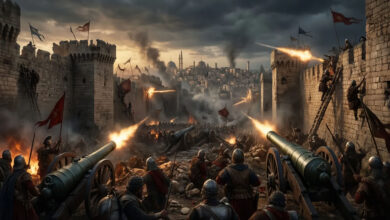
To seal the trap, Caesar ordered the construction of a massive ring of fortifications around Alesia, walls, ramparts, trenches, and watchtowers stretching miles across the countryside. The goal was simple: nobody in, nobody out. This alone would have been an astonishing engineering feat, built under constant threat of attack. But Caesar took the idea further. He realised that a Gallic relief army would surely come. So he built a second ring of defences, facing outward, to protect the besiegers from those who might try to rescue the besieged.
The result was a feat of military architecture that remains jaw-dropping two millennia later: a double line of fortifications enclosing an entire army and an entire town. The Gauls in Alesia were trapped like a fist enclosed in a Roman gauntlet.
Inside the walls, Vercingetorix watched the Roman defences grow daily. Food dwindled. Desperation crept in. Hoping to ration supplies, the Gauls expelled civilians from the city, women, children, and elderly ordered to leave, believing the Romans would show mercy and allow them through. Caesar refused. The people remained stranded in the no-man’s-land, starving and pleading beneath the walls. It was a horror that neither side wished to claim as their own, but war is governed by necessity, not sympathy. Vercingetorix could not feed them. Caesar would not.
As suffering inside Alesia worsened, help finally came, an enormous Gallic relief army, said by ancient sources to number in the hundreds of thousands. Even if those numbers were exaggerated, the force was unquestionably huge, drawn from tribes across Gaul, united under the vision that this was their final chance to break Roman domination. For the first time, the double fortifications mattered. Caesar and his legions were now a cork in the centre of a violently shaken bottle.
The stage was set for a battle fought on two fronts, perhaps the greatest test of command leadership Rome had ever seen.
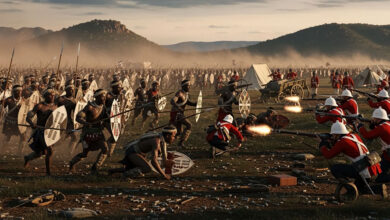
The fighting began with skirmishes, probing attacks designed to test Roman strength. It quickly escalated. The relief army hurled wave after wave of warriors against the Roman outer walls. Inside Alesia, Vercingetorix drove his men forward in synchronised assaults, hammering the inner defences. The Romans were caught between two storms, their lines stretched thin. Dust and battle cries filled the air while signal horns echoed across the valley. Every tack of the sun brought a new surge of violence.
Roman discipline held — barely. Siege engines and slingers rained destruction on the approaching Gauls. Cavalry units dashed out from hidden positions, striking where the enemy presses weakened. Caesar himself rode along the lines, visible to his troops, a symbol of resolve. For all his ambition, he was no tent-dwelling armchair general. His presence in armour, under fire, kept morale from cracking.
But the Gauls adapted. They aimed not to simply overwhelm the walls but to find their weakest seam. In one final, enormous push, they struck the northern sector where the Roman defences were lowest, and the slope favoured attackers. Warriors clambered up, hurling spears, axes, and themselves into the fray. The Romans bent under the force. Caesar rushed reinforcements to the breach, fighting personally in the thick of the melee. The battle tipped back and forth, a knife-edge poised between empire and freedom.
Then came the decisive moment: a cavalry charge led by Caesar’s trusted lieutenant, Labienus, who struck the Gallic relief army from the side just as the Roman infantry surged forward. The Gauls faltered. What had been hope a moment earlier became terror. The relief army broke, fleeing across the plains. Inside Alesia, Vercingetorix saw his last gamble collapse before his eyes.
Facing starvation and unwilling to let his people die for an impossible cause, he made a decision that turned defiance into dignity. The next morning, Vercingetorix donned his finest armour, mounted his horse, and rode out of the gates alone. Before Caesar and the Roman Senate envoy, he dismounted, removed his weapons, and laid them at Caesar’s feet. It was a gesture heavy with symbolism, the greatest Gallic leader acknowledging a new master.
The siege was over. Rome had won.
What followed was not triumph but transformation. Alesia broke the last united resistance to Roman rule in Gaul. Though skirmishes continued, the heart of the rebellion had been crushed. Caesar returned to Rome eventually as the man who had subdued Gaul, a conqueror whose fame would help propel him to absolute power and, ultimately, into the pages of history as one of its most influential figures.
For Gaul, the consequences were profound. Romanisation changed culture, religion, language, and identity. Over generations, the Gauls ceased to be Gauls as their world blended into the Roman one. The cities of France today, Lyon, Paris, Bordeaux, owe much to the new architecture and order that Rome imposed. But that does not erase the memory of those who fought against it, especially the man who dared to believe that Gaul could stand unified and free.
Vercingetorix spent six long years imprisoned in Rome before being executed after Caesar’s triumphal parade, a final act in the theatre of conquest. Yet his legacy only grew with time. To later generations, he became a symbol of French resistance, his statue gazing sternly across the land he failed to save but never betrayed. Even Caesar, in his Commentaries on the Gallic War, recognised his enemy’s rare leadership. Respect, even amidst brutality, left its mark.
The Battle of Alesia endures not merely as a military triumph but as a story of clashing destinies. Rome represented order, expansion, and a belief in superior civilisation. Gaul embodied independence, local identity, and the fierce pride of people defending their homeland. On the plains below that fortified hill, one future overcame another.
The battlefield today is a peaceful countryside, dotted with farms and trees that have no memory of the blood once spilt there. Archaeologists have uncovered the lines of Roman fortifications, confirming Caesar’s boasting was no exaggeration. Museums display artefacts, a spearhead here, a helmet fragment there, each a whisper of the men who fought and fell. And if you stand at dusk on the plateau where Vercingetorix rallied his warriors, the wind still sweeps across the plain as it did twenty centuries ago, as though it carries some echo of the defiance that once shook empires.
Alesia reminds us that war is not only measured in victories but in what those victories extinguish. Rome gained power, wealth, and glory. Gaul lost its autonomy but not its soul. From that fusion came a new identity, one that would later give rise to France, a nation that would leave its own marks upon the world.
In the end, Alesia was not just the defeat of a revolt. It was the moment European history changed direction.
A king surrendered, an empire solidified, and a continent stepped into a new age.
The Battle of Alesia FAQ
A decisive siege in 52 BCE during the Gallic War where Julius Caesar besieged Vercingetorix at Alesia and defeated a large Gallic relief army.
They built two continuous fortified lines: circumvallation facing inward to contain Alesia and contravallation facing outward to stop relief forces, with ditches, towers, traps and artillery.
Julius Caesar led the Roman legions with allied cavalry. Vercingetorix commanded the Arvernian-led coalition inside Alesia, while the relief force was led by Gallic nobles from multiple tribes.
The defeat shattered organised Gallic resistance and confirmed Roman control of Gaul, making Caesar’s political rise unstoppable back in Rome.