The Battle of Actium
By the final decades of the first century BC, the Roman Republic had already endured years of violence, political intrigue, and civil war. The assassination of Julius Caesar in 44 BC had been meant to restore the Republic, but instead it unleashed another struggle for power among Rome’s most ambitious men. Out of that chaos emerged the Second Triumvirate, an uneasy alliance between Caesar’s adopted heir Octavian, the brilliant general Mark Antony, and the lesser-known politician Lepidus. Together they ruled the Roman world, at least in theory, dividing its vast territories between them while hunting down Caesar’s assassins.
For a short time, the arrangement worked. Antony took control of Rome’s eastern provinces, Lepidus governed North Africa, and Octavian established himself in the west. Yet the Triumvirate was never a stable partnership. Each man understood that ultimate power in Rome could belong to only one individual. Rivalries simmered beneath the surface, and trust was in short supply.
Lepidus was the first to fall from power. After attempting to expand his authority in Sicily in 36 BC, he was quickly outmanoeuvred by Octavian and stripped of his political influence. Though he retained the ceremonial religious title of Pontifex Maximus, Lepidus was effectively removed from the political stage. With him gone, the Roman world was left divided between two dominant figures: Octavian in the west and Mark Antony in the east.
Mark Antony was one of the most experienced commanders in Rome. He had served as a trusted lieutenant to Julius Caesar and had proven himself a capable and charismatic leader. In the eastern Mediterranean, he ruled over wealthy territories that stretched from Greece to Syria. It was there that Antony formed a powerful and controversial alliance with Cleopatra VII, the queen of Egypt.
Cleopatra was no ordinary monarch. She commanded one of the richest kingdoms in the Mediterranean and possessed immense political skill. Her partnership with Antony was both romantic and strategic. Egypt’s wealth, fleets, and resources strengthened Antony’s position, while Antony offered Cleopatra protection and influence within the Roman world. Together they began to build a political bloc that rivalled the power of Octavian.
Back in Rome, Octavian carefully shaped the narrative. Through speeches, propaganda, and political manoeuvring, he portrayed Antony not as a Roman statesman but as a man who had fallen under the dangerous influence of an eastern queen. According to Octavian’s version of events, Antony was abandoning Roman traditions and allowing Cleopatra to control him.
By the early 30s BC, the fragile balance between the two leaders had completely collapsed. Alliances hardened, armies were mobilised, and fleets began to assemble across the Mediterranean. Rome, once again, stood on the brink of civil war. The coming confrontation between Octavian and Antony would decide not only who ruled Rome, but whether the Roman Republic itself would survive.
Alliances, Ambitions, and Cleopatra’s Gamble
As tensions between Octavian and Mark Antony escalated, the eastern Mediterranean became the centre of power in the coming struggle. Antony controlled Rome’s wealthy eastern provinces, but maintaining that dominance required enormous resources. Armies had to be paid, fleets built, and allies secured. In this environment, one partnership proved more significant than any other: Antony’s alliance with Cleopatra.
Cleopatra was already a figure of enormous political importance long before Antony entered her life. As the ruler of the Ptolemaic Kingdom, she governed Egypt, one of the richest and most strategically valuable regions in the ancient world. Its fertile lands produced vast supplies of grain, its ports commanded key trade routes across the Mediterranean, and its treasury held the wealth needed to sustain military campaigns on a massive scale. Cleopatra had also demonstrated remarkable political skill. She had secured her throne during a turbulent civil war and had previously formed a powerful alliance with Julius Caesar himself.
After Caesar’s death, Cleopatra needed a new Roman protector to ensure Egypt’s independence. Antony, meanwhile, required the wealth and stability Egypt could provide. Their meeting in 41 BC in the city of Tarsus quickly became the foundation of a political and personal partnership that would shape the fate of the Roman world.
Ancient writers often focused on the romance between Antony and Cleopatra, portraying their relationship as a dramatic love affair filled with luxury and excess. While their personal bond was undoubtedly real, their alliance was also a calculated political arrangement. Cleopatra provided ships, money, and supplies, all of which were essential for Antony’s military ambitions. In return, Antony confirmed her authority in Egypt and granted her control over additional territories in the eastern Mediterranean.
Together, they began to build a powerful eastern coalition. Antony launched campaigns in the region and reorganised the political landscape to strengthen his position. In a ceremony known as the Donations of Alexandria in 34 BC, he publicly granted lands and titles to Cleopatra and their children. These actions helped secure Cleopatra’s influence, but they also caused alarm in Rome.
To many Romans, Antony’s behaviour appeared increasingly troubling. Octavian seized the opportunity to turn public opinion against his rival. Through speeches, public declarations, and political manoeuvring in the Senate, he portrayed Antony as a man who had abandoned Roman traditions and placed himself under the control of a foreign queen. Cleopatra, in Octavian’s narrative, became a symbol of eastern decadence and a threat to Roman authority.
The propaganda campaign was highly effective. By framing the conflict as a defence of Rome against the influence of Cleopatra, Octavian was able to rally support among senators and citizens alike. What had begun as a power struggle between two Roman leaders was increasingly presented as a war against Egypt itself.
As both sides gathered allies, built fleets, and prepared for confrontation, Cleopatra made a decisive gamble. By fully committing Egypt’s wealth and navy to Antony’s cause, she tied the fate of her kingdom to his success. If Antony triumphed, they would dominate the eastern Mediterranean and shape the future of the Roman world. If he failed, the consequences would be catastrophic.
Two Fleets Gather in the Ionian Sea
By the summer of 31 BC, the political struggle between Octavian and Mark Antony had transformed into a massive military confrontation. Both sides understood that the coming conflict would decide the fate of the Roman world. The focus of the war shifted toward the Ionian Sea, along the western coast of Greece, where two enormous fleets began gathering for what would become one of the most decisive naval battles in ancient history.
Mark Antony established his main base near the promontory of Actium, a strategic location guarding the entrance to the Ambracian Gulf. From there, he could protect his supply routes and keep his fleet sheltered in a secure harbour. His forces were impressive. Ancient sources suggest that Antony commanded several hundred warships, many of them large and heavily armed vessels designed to dominate in close combat. These ships, some equipped with towers and reinforced hulls, carried large numbers of marines and archers.
Alongside Antony’s fleet stood the ships of Cleopatra. Egypt’s navy was a powerful force in its own right, and Cleopatra contributed dozens of vessels as well as vast financial support. Her presence with the fleet was unusual but significant. Cleopatra was not simply a distant ally providing resources. She was directly involved in the campaign, travelling with Antony and helping finance the war effort. Her ships were among the fastest in the fleet and would later play a dramatic role in the events that followed.
Yet Antony’s position was far from secure. While his fleet was formidable, his army and naval forces were spread across Greece and the eastern Mediterranean. Maintaining supplies for such a large force proved difficult, especially as the months dragged on. Disease began to affect the soldiers, and morale slowly declined as the campaign stalled.
Opposing Antony was Octavian, who had moved his forces into western Greece. Although Octavian was the political leader of the campaign, the real architect of his military success was his close friend and admiral, Marcus Vipsanius Agrippa. Agrippa was one of the most capable naval commanders of the age and had already proven his skill in earlier conflicts.
Rather than rushing into a direct confrontation, Agrippa launched a series of strategic operations designed to weaken Antony’s position. His fleet seized key ports along the Greek coastline, cutting off Antony’s supply lines and isolating his forces at Actium. These moves gradually tightened the pressure, limiting Antony’s ability to move freely or replenish his resources.
As the weeks passed, the situation became increasingly tense. Both fleets remained within striking distance, watching one another across the waters near Actium. Each commander understood that the coming battle would carry enormous consequences. For Antony and Cleopatra, victory offered the chance to challenge Octavian’s dominance and reshape the Roman world. For Octavian, defeating his rival would clear the final obstacle standing between him and absolute power.
By early September, the standoff could no longer continue. Supplies were running low, and Antony faced a difficult decision. He could remain trapped in Greece and slowly lose his strength, or he could attempt to break through Octavian’s blockade. The stage was now set for the naval battle that would decide the future of Rome.
The Clash at Actium
On the morning of 2 September 31 BC, the long standoff near Actium finally came to an end. After months of blockade and dwindling supplies, Mark Antony made the bold decision to break out of the Ambracian Gulf and force a passage past Octavian’s fleet. The battle that followed would become one of the most decisive naval engagements in Roman history.
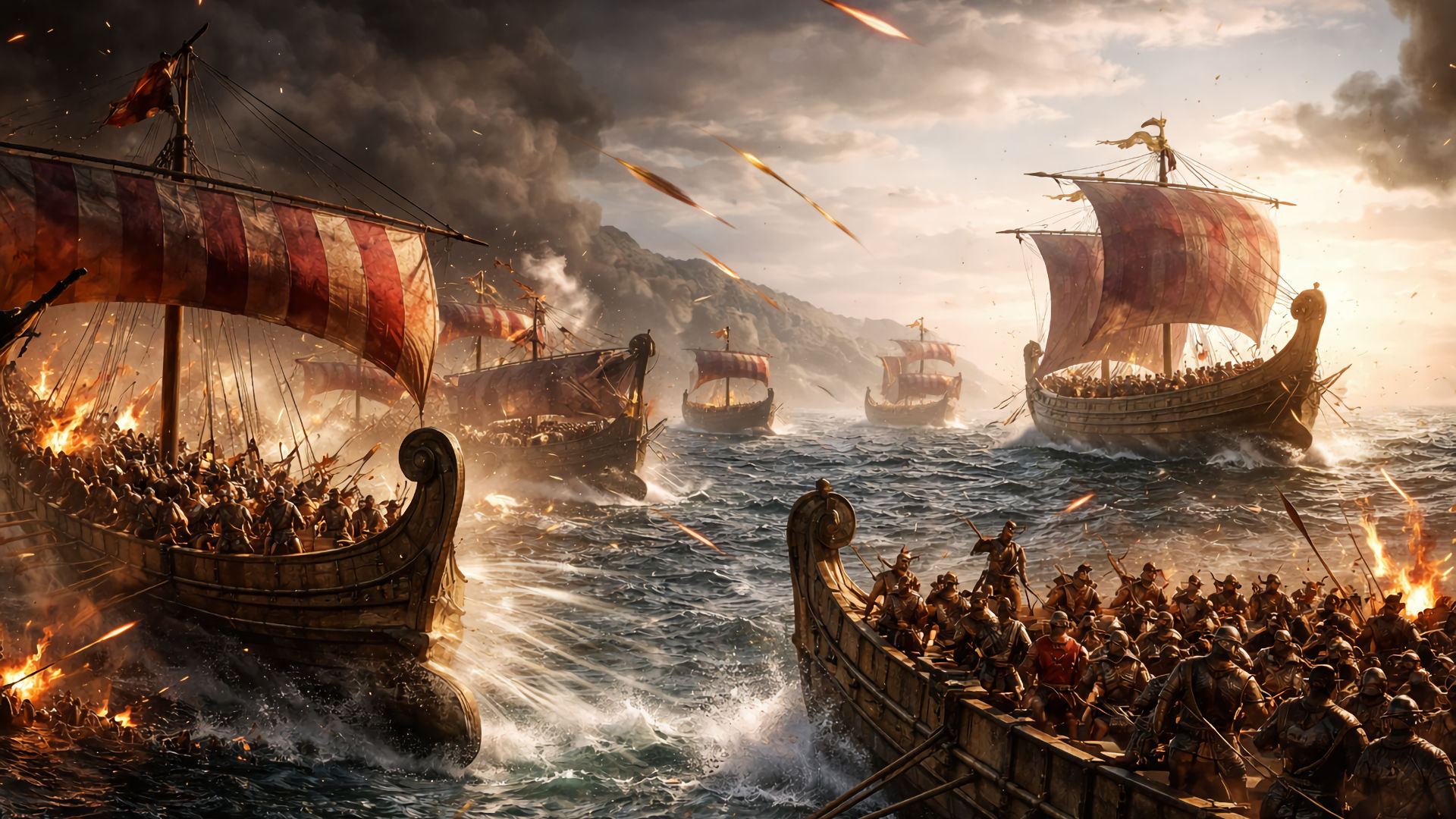
Antony’s fleet began to move out of the gulf in a carefully organised formation. His ships were among the largest war vessels of the ancient world. Many were heavy quinqueremes and even larger ships, built with reinforced hulls and equipped with towers filled with soldiers and archers. These floating fortresses were designed for brutal close combat, where they could ram enemy ships or grapple them and allow marines to fight hand to hand.
Octavian’s fleet, commanded by Agrippa, relied on a different approach. His ships were generally smaller and lighter, making them faster and more manoeuvrable. Rather than attempting to match Antony’s heavy ships in brute strength, Agrippa’s crews planned to use mobility, coordinated attacks, and careful positioning to wear down their opponent.
As Antony’s fleet emerged into open water, the two forces gradually formed battle lines. The sea between them filled with hundreds of warships, their crews preparing for combat under the late summer sun. Trumpets sounded, oars churned the water, and the fleets slowly advanced toward each other.
The fighting began as the ships closed the distance. Antony’s larger vessels attempted to use their weight and reinforced prows to smash into Octavian’s ships. When they succeeded, the impact could shatter hulls or cripple enemy vessels. But the size of these ships also made them slower and less responsive in open water.
Agrippa’s lighter ships took advantage of this weakness. His captains used their speed to avoid direct collisions, striking from the sides or retreating before Antony’s heavier vessels could trap them. Archers and missile troops exchanged volleys across the decks, while grappling hooks occasionally pulled ships together for fierce close combat.
For hours, the battle remained uncertain. The fleets pushed and pulled against each other across the sea, neither side gaining a clear advantage. Then, at a critical moment, Cleopatra’s squadron of Egyptian ships suddenly turned south and began sailing away from the battlefield.
Exactly why Cleopatra made this move has been debated by historians for centuries. Some believe it was a prearranged signal to withdraw if the battle went badly, while others argue that she saw an opportunity to escape the blockade and protect Egypt’s fleet. Whatever the reason, her ships cut a clear path through the fighting and headed into open water.
When Antony saw Cleopatra’s fleet departing, he made a dramatic and controversial decision. Abandoning much of his own fleet, he followed her with a small group of ships, sailing away from the battlefield. Left without their commander, many of Antony’s remaining ships continued fighting but soon found themselves surrounded.
With Antony gone and the fleet in disarray, Octavian’s forces gradually secured control of the battlefield. The Battle of Actium was effectively over, and the balance of power in the Roman world had shifted decisively.
A Battle Lost, an Empire Won
Although the naval clash at Actium had ended in chaos for Mark Antony’s fleet, the battle itself was only the beginning of the final act in the struggle for control of the Roman world. Antony and Cleopatra had escaped the battlefield with a small group of ships, sailing south across the Mediterranean toward Egypt. Yet their flight left the bulk of Antony’s forces behind, and the consequences were immediate.
Back at Actium, the remaining ships in Antony’s fleet fought on briefly but without coordination or leadership. Many were surrounded by Agrippa’s vessels and captured after fierce resistance. Others were burned or abandoned by their crews. Octavian’s forces soon secured control of the waters around Actium, delivering a crushing blow to Antony’s naval power.
The defeat at sea also had serious consequences on land. Antony still had a large army stationed in Greece, but with the fleet destroyed and supply lines severed, their position became increasingly hopeless. Morale collapsed as news spread that their commander had fled the battlefield. Within days, many of the soldiers began surrendering to Octavian’s forces or quietly shifting their allegiance to the victor.
Octavian moved quickly to exploit the situation. Rather than pursuing Antony recklessly, he consolidated control over Greece and the surrounding regions, ensuring that Antony could not rebuild his strength. Over the following months, Octavian steadily tightened his grip on the eastern Mediterranean while preparing for the final stage of the war.
Meanwhile, Antony and Cleopatra attempted to regroup in Egypt. Alexandria remained one of the wealthiest and most fortified cities in the Mediterranean, and Cleopatra still controlled significant resources. For a time, the pair hoped they could rebuild their power and mount a renewed defence against Octavian’s advance.
But the damage done at Actium proved impossible to overcome. Many of Antony’s former allies began abandoning him, recognising that the balance of power had shifted decisively. The aura of invincibility that had once surrounded the great Roman general had vanished. Instead of a confident war leader, Antony now appeared as a defeated commander whose fortunes had dramatically collapsed.
In 30 BC, Octavian launched his final campaign. His forces advanced into Egypt with little resistance. Antony attempted to organise a defence, but his remaining troops were few and unreliable. As Octavian’s army approached Alexandria, the situation became desperate.
According to ancient accounts, Antony received false reports that Cleopatra had taken her own life. Believing the struggle was over, he fell on his sword, dying shortly afterwards. Cleopatra, facing the certainty of defeat and unwilling to be paraded through Rome as a captive, also took her own life soon after, traditionally said to be by the bite of an asp.
With their deaths, Octavian stood unchallenged. The long cycle of Roman civil wars had finally produced a single victor. The defeat at Actium had not simply ended a battle. It had cleared the path for the creation of a new political order that would reshape Rome forever.
From Republic to Empire
The victory at Actium did far more than end a civil war between rival Roman leaders. It marked a decisive turning point in the history of Rome itself. For generations, the Roman Republic had operated under a system in which power was shared among elected magistrates and the Senate. Although powerful individuals often dominated politics, the idea of a single ruler had always been deeply controversial among Romans. The events following Actium would quietly but permanently change that reality.
After the deaths of Mark Antony and Cleopatra, Octavian stood as the undisputed master of the Roman world. No rival armies remained to challenge him, and the decades of civil conflict that had plagued Rome since the time of Julius Caesar finally came to an end. Octavian returned to Rome not as a conquering tyrant but as a leader who claimed to have restored peace and stability to a fractured republic.
Carefully managing his public image, Octavian avoided presenting himself as a traditional king or dictator. Romans had long associated monarchy with tyranny, and Julius Caesar’s assassination had shown how dangerous such a perception could be. Instead, Octavian adopted a more subtle strategy. In 27 BC, the Senate granted him the title Augustus, meaning “the revered one.” With this new title, he became the first Roman emperor, though the political system he created preserved the outward appearance of republican institutions.
In reality, Augustus held enormous authority. He commanded the Roman legions, controlled vast provincial territories, and exercised influence over the Senate itself. The old Republic technically survived, but real power had shifted into the hands of a single ruler. The Roman Empire had effectively been born.
The consequences of this transformation were immense. Under Augustus, Rome entered a period of relative stability known as the Pax Romana, or Roman Peace. Trade flourished across the Mediterranean, infrastructure expanded, and the empire’s borders were secured by professional legions stationed throughout its territories. While political freedom within Rome was reduced compared to the earlier republic, the empire gained a level of order and administrative strength that would sustain it for centuries.
The Battle of Actium became a powerful symbol in Augustus’s version of history. Roman writers and artists portrayed the battle as a heroic victory that saved Rome from foreign domination, often emphasising the role of Cleopatra as a dangerous eastern queen who threatened Roman traditions. In reality, the conflict had been another chapter in a long series of Roman civil wars, but the story told by Augustus helped legitimise his new rule.
Modern historians continue to debate how decisive the battle truly was. Antony still commanded large forces after Actium, and the final outcome was only sealed with the campaign in Egypt the following year. Yet Actium undeniably shattered Antony’s power and momentum. Without that defeat, the struggle for control of the Roman world might have continued for years. In the end, the waters off Actium witnessed more than a naval battle. They marked the moment when the Roman Republic, already weakened by decades of internal conflict, finally gave way to a new imperial age under Augustus.
The Battle of Actium FAQ
The Battle of Actium was a major naval battle fought on 2 September 31 BC between the fleets of Octavian and the combined forces of Mark Antony and Cleopatra. It took place near the Greek coast at the entrance to the Ambracian Gulf.
The battle effectively ended the Roman civil wars that followed the assassination of Julius Caesar. Octavian’s victory allowed him to become the first Roman emperor, Augustus.
Octavian’s fleet was commanded by his admiral Marcus Vipsanius Agrippa. Mark Antony led his own forces alongside Cleopatra, whose Egyptian fleet supported the campaign.
Ancient sources claim Cleopatra withdrew her fleet from the battle during the fighting. The reasons remain debated, but Antony followed her ships, leaving much of his fleet behind.
Following the defeat, Antony and Cleopatra retreated to Egypt. Octavian invaded the following year, leading to their deaths and the consolidation of Octavian’s power.