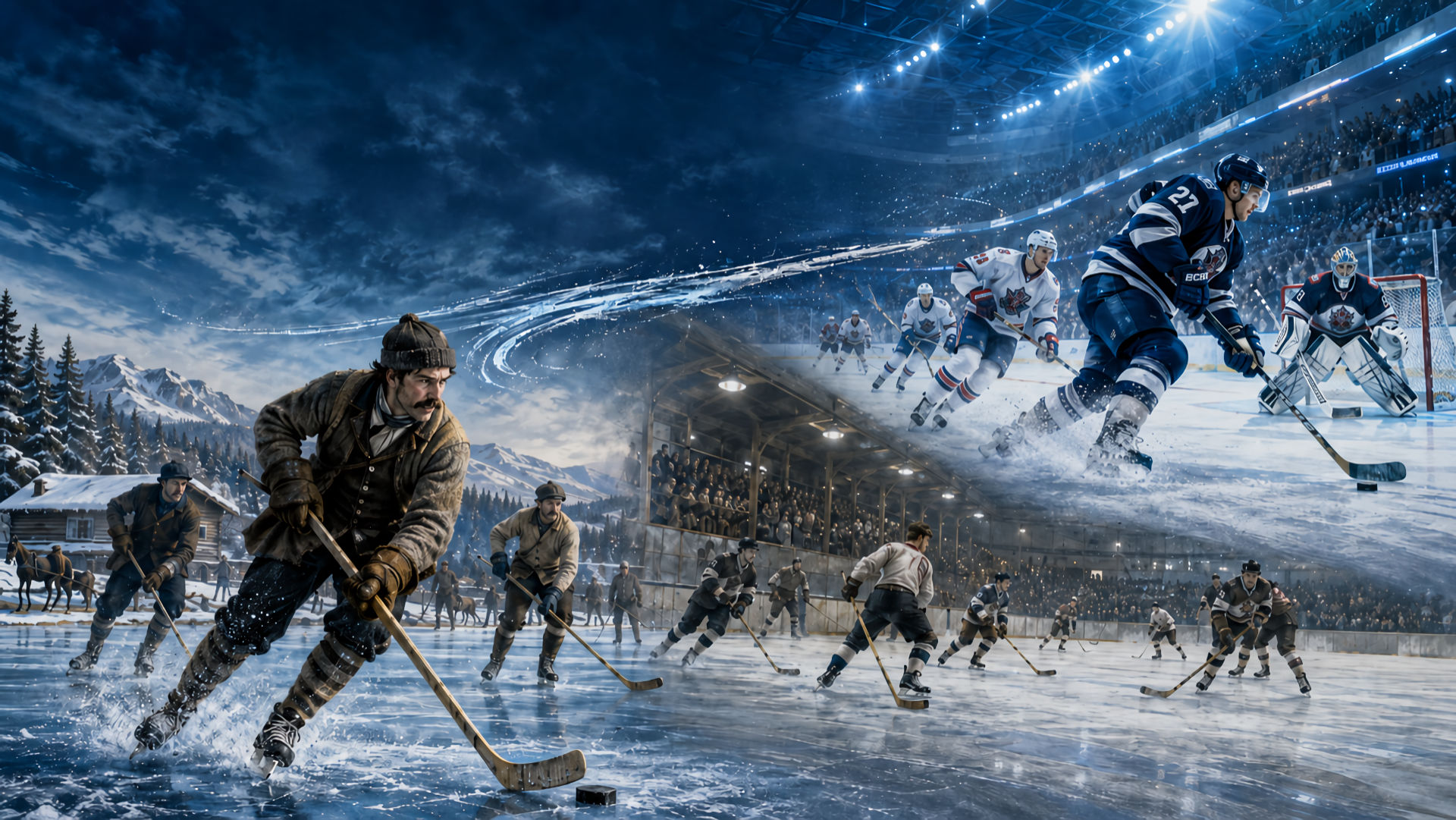
The History of Ice Hockey
Long before ice hockey had arenas, floodlights, referees, penalty boxes, and coaches looking as if they had just swallowed a wasp, people were already playing stick-and-ball games in cold places. Across Europe, games involving curved sticks and balls were played on fields, frozen ponds, rivers, and lakes for centuries. In Britain and Ireland, games such as shinty, hurling, and bandy helped establish the basic idea of using a stick to control and strike an object towards a goal.
These early games were not ice hockey as we know it today, but they mattered because they supplied the ingredients. They involved speed, balance, teamwork, competition, and the faintly chaotic possibility of being hit in the shin by someone with far too much enthusiasm. In the Netherlands, paintings from the seventeenth century show people skating on frozen canals while playing stick-and-ball games, suggesting that ice-based versions of these sports were already familiar in parts of Europe.
When British soldiers, settlers, and immigrants crossed the Atlantic, they brought many of these games with them. In Canada, those traditions met a climate almost aggressively suited to winter sports. Frozen lakes, rivers, and ponds were not occasional novelties; they were a major part of seasonal life. Children, soldiers, students, and workers all found that ice turned open space into a natural playing field.
Indigenous peoples also played important roles in this wider sporting culture. In parts of eastern Canada, Mi’kmaq artisans were known for making high-quality wooden sticks, and their designs influenced the equipment used by early players. As with many popular sports, the origins of ice hockey are not neat, tidy, or owned by one person. They are a mixture of cultures, climates, customs, and practical improvisation.
The shift from folk game to recognisable sport came gradually. Players needed rules, standard team sizes, agreed playing spaces, and something safer and more controllable than a ball flying around on ice. The use of a flat puck helped change the game, because it stayed lower and moved differently across the frozen surface. That one practical choice helped ice hockey become faster, sharper, and more distinct from the stick games that came before it.
By the nineteenth century, Canada had become the place where these influences began to combine into something new. The sport was still rough, informal, and locally varied, but it was starting to acquire an identity of its own. The next stage would take it away from ponds and open ice and into organised indoor competition. That is where ice hockey truly began to look like ice hockey.
From Ponds to Rules: How Ice Hockey Took Shape in Canada
The story of modern ice hockey becomes much clearer in nineteenth-century Canada, especially in Montreal. By this time, skating was a popular winter activity, and informal hockey-style games were being played in several Canadian communities. The game was still flexible, with different groups using different rules, but the basic attraction was obvious. It was fast, physical, skilful, and perfectly suited to a country where winter did not so much arrive as move in and unpack.
One of the most important early milestones came on 3 March 1875, when an organised indoor hockey match was played at the Victoria Skating Rink in Montreal. The game is often treated as a key moment in the birth of modern ice hockey because it took place indoors, involved published rules, and used a flat wooden puck rather than a ball. James Creighton, a figure often associated with early organised hockey in Montreal, helped bring structure to a game that had previously been much looser.
The indoor setting mattered more than it might first appear. On outdoor ice, boundaries were vague, the weather was unpredictable, and the game could easily become a sprawling winter chase with sticks. Indoors, the rink imposed limits. Players had to adapt to a confined space, and spectators could watch the action more clearly. This helped turn hockey from a rough outdoor pastime into something that could be staged, followed, and repeated.
Rules were essential to that transformation. Early hockey needed agreement over team sizes, offside, goals, equipment, and the handling of disputes, because nothing ruins a sport faster than everyone insisting they are playing the correct version. In 1877, students associated with McGill University helped set down written rules, giving the game greater consistency. These rules were not identical to the modern version, but they helped establish a shared framework.
Canadian universities, clubs, and amateur associations became central to hockey’s development. Students and young professionals had the time, organisation, and competitive spirit needed to turn a winter pastime into a regular sport. Matches between clubs encouraged standardisation, because teams could not compete properly if each arrived with its own private interpretation of reality. Gradually, hockey became more recognisable from one rink to the next.
The game also began to develop its own character. It was faster than many field sports, because skating allowed players to move quickly across the ice. It was more physical than many indoor games, because collisions were almost inevitable. It demanded both individual skill and collective structure, since a player could skate brilliantly and still lose the puck to a better-organised team.
By the late nineteenth century, ice hockey was no longer just an improvised winter amusement. It had rules, clubs, spectators, and a growing sense of tradition. The next step was competition on a wider scale, with trophies, rivalries, and institutions that gave the sport permanence. Once that happened, hockey was no longer merely played; it was followed, argued about, and cherished.
Clubs, Cups, and Competition: The Birth of Organised Hockey
As ice hockey became more structured, clubs began to give the game a lasting social shape. In Canadian cities such as Montreal, Ottawa, and Quebec City, teams formed around universities, athletic clubs, and local communities. These clubs created regular fixtures, built rivalries, and helped turn hockey into a winter sporting calendar rather than a casual activity. The game now had places to be, dates to keep, and supporters ready to complain about the result afterwards, which is always a sign that a sport has truly arrived.
In 1886, the Amateur Hockey Association of Canada was formed, becoming one of the first organised leagues in the sport. It brought together clubs under a common competitive structure and helped raise the standard of play. Players could now measure themselves across a season, rather than in isolated matches. Regular competition encouraged better tactics, better conditioning, and a stronger sense that hockey was becoming a serious athletic pursuit.
The most famous symbol of this era arrived through the Stanley Cup. In 1892, Lord Stanley of Preston, then Governor General of Canada, donated a trophy to be awarded to the country’s top amateur hockey team. The first Stanley Cup was awarded in 1893, and although it would later become associated with professional hockey and the National Hockey League, its origins belonged to the amateur game. Few trophies in sport have travelled so far from their original purpose while still keeping their old magic.
The Stanley Cup gave hockey something priceless: a prize that clubs could dream about. It encouraged competition between regions and intensified the prestige of victory. Challenge matches became major events, and teams from different cities began to test themselves against each other for national recognition. The Cup helped create stories, heroes, heartbreaks, and grudges, which are the essential food groups of sport.
During this period, hockey also spread beyond its early Canadian centres. New rinks, railway connections, newspapers, and urban growth all helped the sport reach wider audiences. Newspapers reported results and described matches, giving fans who were not present a way to follow the game. The railway made travel easier for teams, allowing competition between towns and cities that would previously have been awkward or impossible.
The style of play was still developing. Teams used more players than in the modern game, substitutions were limited or absent, and positions were not yet fully standardised. Equipment was basic, and goaltenders had far less protection than modern players, which suggests either courage, madness, or a worrying shortage of sensible alternatives. Yet the essential drama was already there: speed, skill, danger, tension, and sudden changes of fortune.
By the turn of the twentieth century, organised hockey had become deeply embedded in Canadian sporting life. Amateur ideals remained important, but the sport was attracting crowds, money, and ambitious players. That combination made professionalism almost inevitable. The game had grown too popular, too competitive, and too commercially attractive to remain purely amateur for long.
Turning Professional: Leagues, Stars, and the Rise of the NHL
Professional ice hockey emerged because the sport had become too successful to stay amateur. Strong clubs drew spectators, talented players became valuable, and rival teams wanted every possible advantage. By the early twentieth century, payment to players was becoming increasingly common, whether openly acknowledged or politely hidden behind the curtains. Amateur purity is easier to defend when nobody is selling tickets.
One of the first openly professional hockey leagues was the International Professional Hockey League, founded in 1904. It included teams from both Canada and the United States and showed that hockey could work as a paid spectator sport. Although the league lasted only a few seasons, it helped prove that professional hockey was commercially possible. It also marked a shift in how players saw the game, not merely as recreation, but as a potential livelihood.
The National Hockey Association followed in 1909, bringing together important Canadian clubs and introducing changes that shaped the modern game. It helped reduce the number of skaters on the ice, moving towards the six-player format that would become standard. The NHA also featured major teams and stars, including the Montreal Canadiens, founded in 1909. The Canadiens would become one of the most famous and successful clubs in hockey history.
In 1917, disputes among team owners led to the creation of the National Hockey League. The NHL began as a relatively small organisation, but it would eventually become the dominant professional ice hockey league in the world. Canadian teams shaped its early years, but American expansion soon followed. The Boston Bruins joined in 1924, becoming the first American NHL franchise, and other United States teams followed during the 1920s.
The professional game changed hockey’s rhythm and culture. Players trained more seriously, tactics grew more sophisticated, and clubs became commercial institutions. Arenas became central gathering places, especially in cold cities where hockey offered winter entertainment with genuine emotional force. Fans did not simply watch teams; they attached identity, pride, and local loyalty to them.
The Stanley Cup also changed during this period. Once a trophy for amateur teams, it gradually became the championship prize of professional hockey. By the mid-1920s, it was firmly tied to the NHL’s top competition. This gave the league a powerful sense of continuity, linking professional spectacle to the older traditions of Canadian hockey.
The NHL had difficult years, especially during the Great Depression and the Second World War, when financial pressure and player shortages affected teams. By 1942, the league had settled into the so-called Original Six era: Montreal Canadiens, Toronto Maple Leafs, Boston Bruins, Chicago Black Hawks, Detroit Red Wings, and New York Rangers. Despite the name, these were not the first six NHL teams, but they became central to hockey mythology.
This era produced legendary players, fierce rivalries, and a more stable professional structure. Hockey was now a major North American sport, with radio, newspapers, and later television bringing it to wider audiences. Yet while the NHL became the sport’s most famous league, ice hockey itself was never only a North American story. Its next great expansion would be international.
Beyond North America: Ice Hockey Becomes an International Game
Ice hockey’s international development began surprisingly early. As Canadian players, soldiers, students, and expatriates travelled, they carried the game with them to Europe and elsewhere. Countries with cold winters and skating traditions were natural places for hockey to take root. The sport found audiences in places such as Britain, Switzerland, Sweden, Finland, Czechoslovakia, and Russia, each adding its own culture and style to the game.
International organisation helped give the sport a wider structure. The International Ice Hockey Federation traces its origins to 1908, when representatives from several European countries came together to coordinate the sport. This allowed rules, tournaments, and national competitions to develop more consistently. Ice hockey was no longer just spreading informally; it was becoming part of organised international sport.
The Olympic Games gave hockey an even larger stage. Ice hockey appeared at the 1920 Summer Olympics in Antwerp before becoming part of the first Winter Olympics in Chamonix in 1924. Canada dominated the early Olympic years, reflecting its deep head start in the sport. For many European teams, facing Canada was less like a match and more like being introduced to the subject by a professor carrying a very large stick.
Over time, however, the international gap narrowed. Sweden, Finland, Czechoslovakia, the Soviet Union, and the United States all developed strong hockey cultures. The Soviet Union, in particular, transformed international ice hockey after the Second World War. Soviet teams emphasised fitness, passing, discipline, movement, and collective structure, creating a style that was technically brilliant and often devastatingly effective.
The Cold War gave international hockey an added political charge. Matches between the Soviet Union and North American teams could feel like symbolic contests between systems, not merely games between athletes. The 1972 Summit Series between Canada and the Soviet Union became one of the defining moments in hockey history, as Canada narrowly won an intense eight-game series that challenged its assumptions about hockey supremacy. The series showed that the global game had fully arrived.
Another famous moment came at the 1980 Winter Olympics in Lake Placid, when the United States defeated the Soviet Union in the match later known as the Miracle on Ice. The American team was made up largely of amateur and college players, while the Soviet team was widely regarded as the best in the world. The result became one of the most celebrated upsets in sporting history. It also showed how deeply hockey could connect with national emotion.
Women’s ice hockey also grew steadily, though it faced far greater barriers in funding, recognition, and opportunity. Women had played versions of the game since at least the late nineteenth and early twentieth centuries, but formal international development came much later. The first IIHF Women’s World Championship was held in 1990, and women’s ice hockey became an Olympic sport in 1998. Canada and the United States became early powers, building one of the fiercest rivalries in modern hockey.
By the late twentieth century, ice hockey had become a genuinely international sport. North America remained hugely influential, but Europe had produced elite leagues, national teams, and world-class players. The best players increasingly crossed borders to compete at the highest levels. The game that had taken shape in Canadian rinks now belonged to a much wider world.
Speed, Spectacle, and Global Reach: Ice Hockey in the Modern Era
Modern ice hockey is faster, more tactical, more global, and more technologically advanced than the game played in its early organised years. Equipment has changed dramatically, giving players greater protection and allowing them to skate and shoot with remarkable power. Goaltenders, once protected by little more than stubbornness and optimism, now wear specialised masks, pads, blockers, and chest protectors. This has transformed the position into one of the most technically demanding roles in sport.
The NHL expanded far beyond its Original Six foundations. In 1967, the league doubled in size, beginning a major expansion era that reshaped professional hockey. Later decades brought new teams, relocations, and a broader American footprint, including franchises in warmer regions where natural ice was not exactly cluttering the streets. The idea of elite hockey in places such as California, Florida, Nevada, and Texas once seemed unlikely, but modern arenas, television, and youth programmes helped change the map.
European influence also became central to the modern game. Players from Sweden, Finland, Russia, Czechia, Slovakia, Germany, Switzerland, and many other countries became major stars in the NHL and international competition. Their arrival broadened tactics and styles of play, blending North American physicality with European skating, puck movement, and positional intelligence. Hockey became less isolated and more creative because the talent pool became global.
The late twentieth century produced some of the sport’s most recognisable figures. Wayne Gretzky changed the way many people understood offensive play, using vision and anticipation as much as speed or strength. Mario Lemieux combined size, elegance, and scoring brilliance. Later stars such as Sidney Crosby, Alexander Ovechkin, Connor McDavid, and many others carried the sport into new eras of athleticism and visibility.
The women’s game has continued to grow, although it still fights for equal attention, investment, and infrastructure. Olympic tournaments, world championships, and professional leagues have helped raise standards and visibility. Canada and the United States remain dominant forces, but other nations have continued to develop stronger programmes. The growth of girls’ and women’s hockey is one of the most important stories in the sport’s modern history.
Technology has also changed how hockey is played and understood. Video review, advanced statistics, player tracking, improved stick design, and detailed performance analysis have altered coaching and recruitment. Teams now study zone entries, shot quality, possession, speed, fatigue, and countless other details that earlier generations could only sense by instinct. The sport is still emotional and physical, but it is also increasingly analytical.
At the same time, hockey faces modern challenges. Concerns over concussion, player safety, cost of participation, diversity, and access have become central issues. Ice time is expensive, equipment can be costly, and the sport has sometimes struggled to reach communities beyond its traditional base. For hockey to keep growing, it must become not only faster and more spectacular, but also more open.
The history of ice hockey is therefore a story of adaptation. It began with old stick games, frozen landscapes, and improvised local rules, then became organised in Canada, professionalised in North America, and spread across the world. Today, it remains one of the fastest team sports on Earth, combining grace, violence, strategy, and absurdly good balance. Few games are so elegant while also making it perfectly normal for a grown adult to celebrate by throwing themselves into reinforced glass.
The History of Ice Hockey FAQ
Modern ice hockey began to take shape in nineteenth-century Canada, especially in Montreal. A key early moment came in 1875, when an organised indoor hockey match was played at the Victoria Skating Rink using written rules and a flat puck.
Ice hockey developed from a mixture of older stick-and-ball games, skating traditions, and Canadian winter conditions. Many influences came from Europe, but the organised modern sport became strongly associated with Canada.
The Stanley Cup is one of the most famous trophies in sport. It was first awarded in 1893 and helped give early ice hockey a major competitive prize, eventually becoming the championship trophy of the National Hockey League.
The National Hockey League was founded in 1917 after disputes within earlier professional hockey organisations. It began with a small number of teams but later grew into the world’s leading professional ice hockey league.
Ice hockey spread through migration, military links, universities, skating clubs, international competitions, and the Olympic Games. Countries such as Sweden, Finland, Russia, Czechia, Slovakia, and the United States developed strong hockey cultures alongside Canada.