Leif Erikson
Leif Erikson was born into a world where the sea was not a barrier, but a road. To the Norse people of the late tenth and early eleventh centuries, the North Atlantic was a dangerous but familiar highway, crossed in open boats by traders, settlers, raiders, explorers and families looking for land. Their ships carried wool, timber, iron, walrus ivory, stories, ambitions and, quite often, people who had fallen out rather badly with their neighbours.
This was the Viking Age, a period that stretched roughly from the late eighth century to the eleventh century. In popular imagination, it is often reduced to helmets, axes and coastal raids, usually with more shouting than is strictly necessary. But the Norse world was far more complex than that. Its people built farms in Iceland, settlements in Greenland, trading networks across Europe, and political links from Scandinavia to the British Isles, Ireland, Russia and beyond.
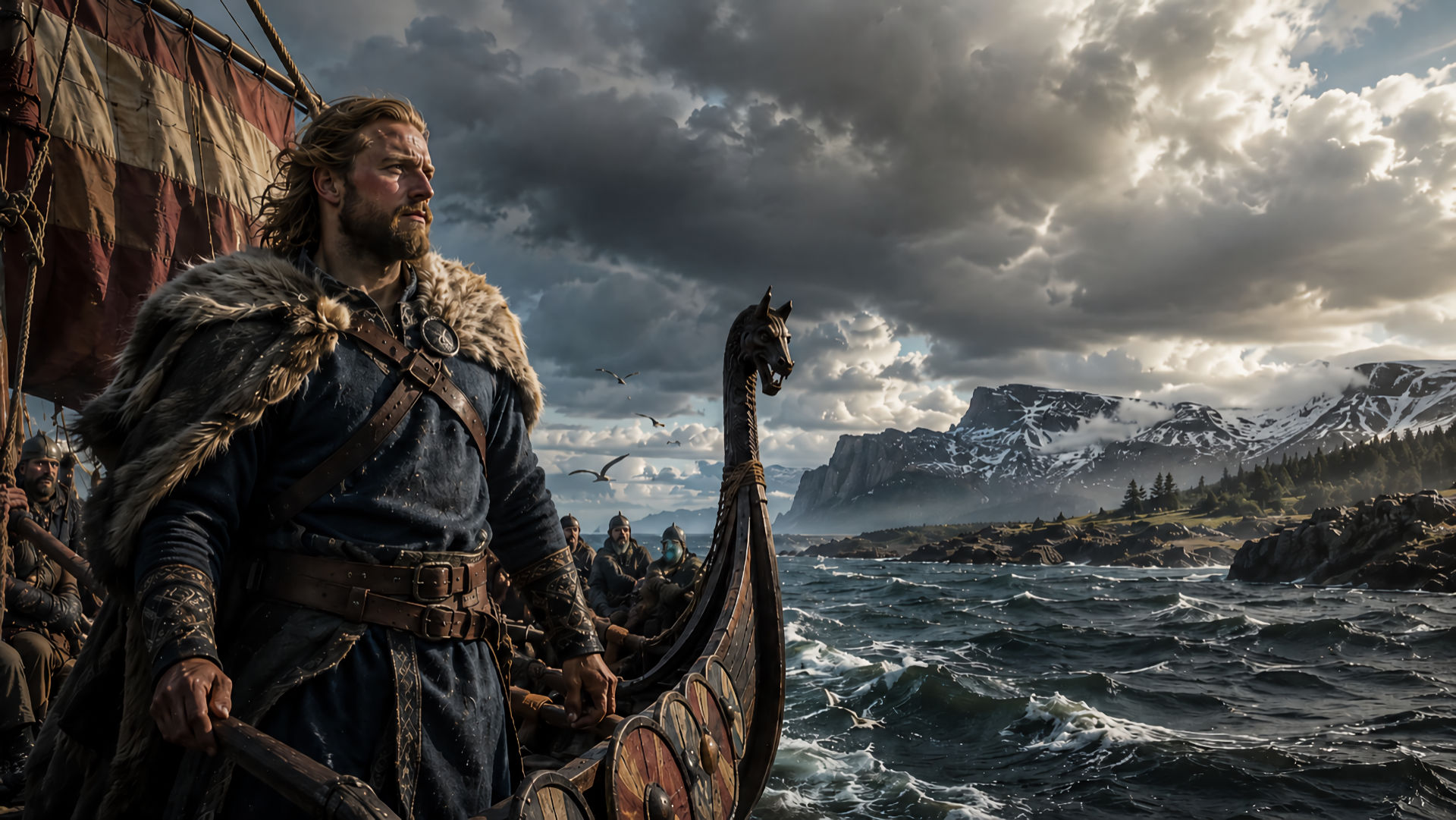
The key to this expansion was the longship and its broader relatives. Norse vessels were flexible, fast and well-suited to shallow coastal waters as well as open sea crossings. They were powered by sail and oar, built with overlapping planks, and strong enough to cross some of the harshest waters on Earth. These were not floating palaces, of course. A North Atlantic voyage in one was cold, cramped, wet and generally lacking in complimentary refreshments.
Yet the Norse crossed those waters again and again. They navigated by coastlines, currents, winds, stars, bird movements, cloud shapes and experience handed down through generations. Their journeys were not random acts of nautical optimism. They were part of a culture that understood movement as opportunity. If land was scarce, if enemies were too close, or if wealth lay elsewhere, a ship offered a way out.
Into this world came Leif Erikson, a man whose name would become attached to one of the most remarkable journeys in pre-modern exploration. Long before Christopher Columbus crossed the Atlantic in 1492, Norse sailors had already reached North America. Leif was not a lone genius staring nobly into the mist while dramatic music played. He was the product of a seafaring culture, a frontier family, and a restless Atlantic world.
His story begins not in Vinland, the mysterious western land with which he is most associated, but in a family already shaped by exile, violence, ambition and migration. To understand Leif Erikson, we first need to understand the man whose name he carried. That man was Erik the Red, and he was not exactly famous for keeping life simple.
Born into the House of Erik the Red
Leif Erikson was probably born in Iceland around the early 970s, though the exact date is not known. His father was Erik Thorvaldsson, better remembered as Erik the Red, a name that may have referred to his red hair, his fiery temper, or both. Erik was one of those historical figures who seemed to treat conflict less as a misfortune and more as a recurring hobby. According to the sagas, his family had already left Norway after his father was exiled for killings, and Erik later managed to get himself exiled from Iceland as well.
That exile would change the map of the Norse world. Around 982, Erik sailed west from Iceland and explored a large island that had been glimpsed before but not permanently settled by Europeans. After spending several years there, he returned to Iceland and promoted the land as Greenland. The name was not accidental. Erik apparently believed that people would be more likely to settle there if it sounded inviting, which is perhaps the earliest recorded example of real estate marketing.
Around 985, Erik led settlers back to Greenland and founded a Norse colony there. The main settlement grew in the south-west, in a relatively sheltered region where farming was just about possible. The family estate was at Brattahlid, in the Eastern Settlement, near modern Qassiarsuk. This was the frontier into which Leif grew up, a place of harsh winters, limited resources, scattered farms and constant dependence on the sea.
Leif’s mother was Thjodhild, also sometimes pronounced Thjodhildr, who appears in the sagas as an important figure in the Greenland settlement. Leif also had siblings, including Thorvald, Thorstein and Freydis, all of whom are connected in different ways to later stories of western voyages. This was not a quiet household tucked away from history. It was a family positioned at the very edge of the known Norse world, where rumour, ambition and survival were tightly woven together.
The sources for Leif’s life come mainly from two Icelandic sagas, the Saga of the Greenlanders and the Saga of Erik the Red. These were written down centuries after the events they describe, so they must be treated carefully. They preserve memory, legend, family pride and historical fragments all at once. In other words, they are invaluable, but they are not court transcripts.
Still, the broad picture is clear enough. Leif was born into a family of settlers, sailors and risk-takers. His father had opened Greenland to Norse settlement, but Greenland itself was not the end of the story. From its western edge, the ocean continued, and beyond it lay rumours of land.
From Greenland’s Edge to the Western Ocean
The story of Leif Erikson’s voyage west begins with another sailor, Bjarni Herjolfsson. According to the Saga of the Greenlanders, Bjarni was blown off course while sailing from Iceland to Greenland and sighted unknown lands to the west. He did not land there, which must have made him either unusually disciplined or deeply uninterested in becoming the first European tourist in North America. Instead, he continued until he found Greenland, where his report of wooded lands beyond the sea attracted attention.
For Greenland’s Norse settlers, the idea of land to the west was not just exciting. It was practical. Greenland had limited timber, and timber was essential for building, repairs, fuel and tools. Driftwood helped, but reliable access to forests would have been a major advantage. A land with trees was not merely a curiosity. It was a resource, and for a frontier community, resources could be the difference between survival and decline.
Leif appears to have taken Bjarni’s report seriously. The saga says he bought Bjarni’s ship and prepared an expedition to investigate the lands that had been sighted. This detail may or may not be exact, but it makes sense within the broader Norse world. Exploration was not usually a scientific project in the modern sense. It was tied to settlement, trade, reputation, family ambition and the search for usable land.
There is another important strand in Leif’s story, his connection to Norway and Christianity. In the Saga of Erik the Red, Leif travels to Norway and enters the service of King Olaf Tryggvason, who ruled from 995 to 1000 and worked aggressively to spread Christianity. Olaf is said to have sent Leif back to Greenland with a mission to bring the new faith to the settlers there. This places Leif at the crossroads of two forms of expansion, one across the Atlantic and one across the spiritual landscape of the Norse world.
Whether Leif’s voyage to Vinland happened before or after his time in Norway depends on which saga is followed. The two accounts do not fit together perfectly, which is a useful reminder that medieval sources often give us overlapping traditions rather than neat timelines. What matters is that Leif emerges as a man shaped by both sea travel and changing belief. He was not simply chasing a coastline. He belonged to a generation in which Norse society was being pulled westward by exploration and reshaped at home by Christianity.
From Greenland’s edge, the western ocean offered danger, timber, fame and uncertainty. Leif chose to cross it. The result was one of the earliest known European encounters with North America.
Vinland: The Land Beyond the Known Map
Leif’s expedition is said to have travelled west from Greenland and reached a series of lands. The first was Helluland, usually interpreted as a barren land of flat stones, possibly Baffin Island. The second was Markland, meaning forest land, often associated with Labrador. The third and most famous was Vinland, a more inviting region where the Norse found useful resources and established a temporary base.
The name Vinland has been debated for generations. It has often been translated as “wine land”, linked to descriptions of grapes or vines, which would suggest a more southerly location than Newfoundland. Another interpretation connects the name to pasture or meadowland. The sagas themselves are not precise enough to settle every detail, and the Norse may have used Vinland to describe a broader region rather than one exact spot. Geography can become complicated when sagas are involved.
What seems likely is that Leif’s expedition found a place that was noticeably richer in resources than Greenland. There were trees, milder conditions and possibly wild foods that seemed abundant to Norse visitors. The saga describes the party building shelters and spending time there before returning home. This was not a full colony in the later European sense. It was more like a seasonal or exploratory settlement, a foothold rather than a new kingdom.
The strongest archaeological evidence for Norse presence in North America comes from L’Anse aux Meadows, on the northern tip of Newfoundland. Excavations in the 1960s by Helge Ingstad and Anne Stine Ingstad revealed the remains of Norse-style turf buildings, ironworking activity and artefacts consistent with a Norse presence around the year 1000. The site does not prove every detail of the sagas, but it proves the essential point. Norse people reached North America about five centuries before Columbus.
Whether L’Anse aux Meadows was Leif’s own base, a later Norse camp, or part of the wider Vinland story remains debated. It may have functioned as a staging post for further exploration southward, where timber and other resources could be gathered. This would explain why the archaeology points to Newfoundland while saga descriptions sometimes seem to hint at lands beyond it. The Norse were mobile, practical and perfectly capable of exploring a coastline without leaving permanent stone monuments helpfully labelled for future historians.
Leif’s achievement was extraordinary, but it was also limited. His voyage did not lead to lasting Norse settlement in North America. The distances were too great, the Greenland colony too small, and contact with Indigenous peoples likely too difficult to manage over time.
Still, for a moment around the year 1000, Leif Erikson and his crew stood beyond the known Norse map. They had crossed from Greenland to a continent Europeans would not widely encounter again for centuries.
Faith, Family and the Return to Greenland
After his western voyage, Leif Erikson returned to Greenland with a reputation that grew into legend. One story says he rescued shipwrecked sailors on the way home, earning the nickname Leif the Lucky. It is a fine nickname, and certainly better than many Viking alternatives, which tended to involve weapons, injuries or deeply unflattering personal habits. Whether the rescue happened exactly as told or not, the name reflects how later tradition remembered him, as a fortunate and capable leader.
Leif’s return also connects to the Christianisation of Greenland. According to the sagas, he brought Christianity to the settlement under the influence of King Olaf Tryggvason of Norway. His mother, Thjodhild, accepted the new faith and had a church built at Brattahlid. Erik the Red, by contrast, is described as reluctant to abandon the old Norse gods. This domestic religious divide gives the story an almost modern texture.
The conversion of Greenland was part of a broader transformation across the Norse world. Iceland formally adopted Christianity around the year 1000, and Norway was moving in the same direction through royal pressure, missionary activity and political change. For Greenland, Christianity connected the remote settlement more closely to the wider European world. It also changed burial practices, community life and cultural identity over time.
Leif himself appears to have become an important figure in Greenland after his father’s death. He likely took over leadership at Brattahlid, one of the key farms in the colony. In a frontier society, leadership was not just about status. It involved managing resources, alliances, disputes, labour, trade and survival. A man who had crossed to Vinland and returned with stories, goods and prestige would have carried considerable authority.
The western voyages did not end with Leif. His brother Thorvald is said to have travelled to Vinland and died there after a conflict with Indigenous people. Another brother, Thorstein, attempted a voyage connected to the same lands but failed to reach them. Freydis, Leif’s sister or half-sister, appears in the sagas in darker and more violent Vinland traditions. These stories differ in tone and reliability, but together they show that Leif’s expedition was part of a wider family and community interest in the western lands.
The Norse encounters with Indigenous peoples, called Skraelings in the sagas, were crucial to the failure of permanent settlement. The term is a Norse label and tells us more about Norse perception than about the people themselves. The sagas describe trade, tension and violence, suggesting that the newcomers were operating in lands already inhabited and understood by others.
Leif returned from Vinland, but Vinland did not become a second Greenland. His life turned back towards faith, family and leadership. His legend, however, kept looking west.
Leif Erikson’s Legacy: Before Columbus, Beyond the Legend
Leif Erikson’s legacy rests on a simple but powerful fact. Norse sailors reached North America around the year 1000, roughly 500 years before Christopher Columbus’s first voyage across the Atlantic in 1492. That does not make Leif the “discoverer” of America in any complete sense, because Indigenous peoples had lived there for thousands of years. But it does make him central to the history of Atlantic exploration and to Europe’s earliest known contact with North America.
For centuries, Leif’s story survived mainly through Icelandic saga tradition. The Saga of the Greenlanders and the Saga of Erik the Red preserved accounts of voyages to western lands, but historians long debated how much truth lay behind them. Sagas are not simple history books. They blend memory, storytelling, politics, family identity and cultural pride. They can preserve genuine events while also reshaping them into drama. Medieval Iceland, it turns out, was not short of dramatic editors.
The discovery and excavation of L’Anse aux Meadows changed the debate. Archaeology confirmed that Norse people had indeed reached North America around Leif’s lifetime. The site included turf structures similar to those found in Greenland and Iceland, along with evidence of ironworking, which Indigenous peoples in that region were not practising in the same way at the time. This gave physical weight to traditions that had once seemed legendary or uncertain.
Even so, Leif’s achievement should be understood carefully. His voyage did not create a permanent bridge between Europe and North America. It did not lead to widespread European settlement, sustained trade networks or the world-changing consequences that followed Columbus’s voyages centuries later. The Norse presence was brief, fragile and limited. In historical terms, it was a remarkable spark rather than a spreading fire.
That may actually make the story more interesting. Leif Erikson stands at the edge of what was possible in his age. His people had the ships, courage and knowledge to cross the North Atlantic, but not the numbers or political structures to transform contact into colonisation. Greenland itself was already a difficult settlement to maintain. Vinland was even farther away, and the Norse were entering lands where they were strangers, not masters.
In modern times, Leif has become a symbol for exploration, especially among people of Scandinavian heritage. He has been celebrated in statues, holidays, books and popular history. Sometimes that celebration has simplified him into a heroic “first European in America” figure. The real Leif is more compelling than that. He was a frontier Norseman, a Christian convert or missionary figure, a Greenland leader, and the remembered captain of a voyage beyond the known map.
His story reminds us that history is not always a straight line from discovery to conquest. Sometimes it is a glimpse, a landing, a campfire, a repaired ship, and then a return across a dangerous sea. Leif Erikson did not change the world in the way later Atlantic voyages would. But he widened it, and that is no small thing.
Leif Erikson FAQ
Leif Erikson was a Norse explorer from Greenland, remembered for leading a voyage to North America around the year 1000. He was the son of Erik the Red, the founder of the Norse settlement in Greenland.
Leif Erikson reached North America roughly 500 years before Christopher Columbus’s first voyage in 1492. However, North America was already inhabited by Indigenous peoples, so it is more accurate to say he was among the first known Europeans to reach the continent.
Vinland was the name given in Norse saga tradition to a western land reached by Norse explorers. It is usually associated with parts of North America, and may have referred to a broader region rather than one exact location.
The strongest archaeological evidence is at L’Anse aux Meadows in Newfoundland, Canada. The site contains remains of Norse-style buildings and activity dating to around the year 1000.
Leif Erikson is important because his voyage shows that Norse sailors crossed the Atlantic and reached North America centuries before the better-known voyages of Columbus. His story expands our understanding of medieval exploration and the reach of the Viking world.