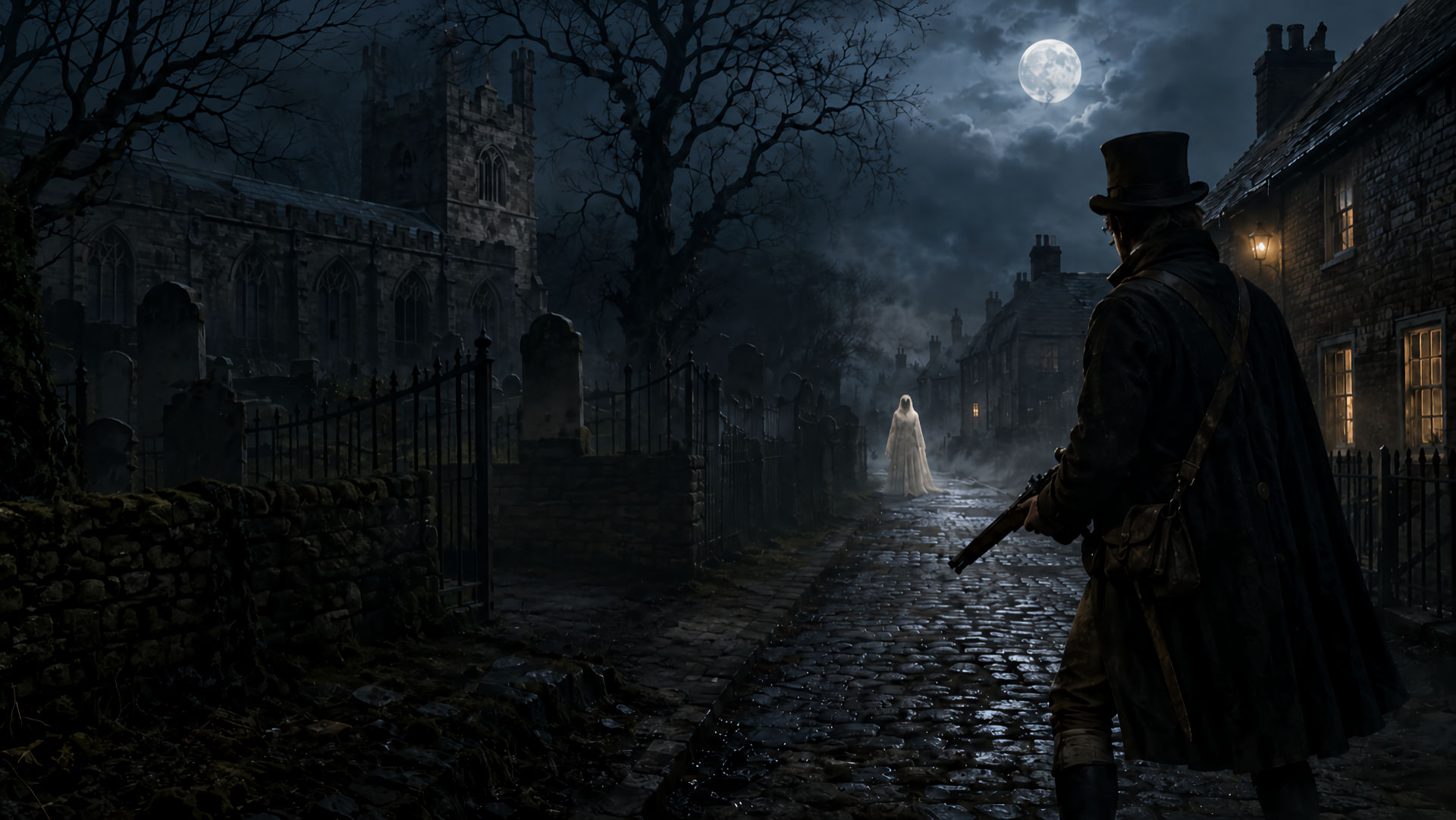
The Hammersmith Ghost Murder
In the winter of 1803, Hammersmith was not yet the busy part of west London it would later become. It was still semi-rural in feel, with lanes, fields, churchyard paths, dark corners, and enough poor lighting to make imagination do half the work before midnight had even cleared its throat. Into that uneasy setting came a rumour that would turn a neighbourhood fright into one of the strangest murder cases in English legal history.
The story began with reports of a ghost near Black Lion Lane and the churchyard of St Paul’s, Hammersmith. People claimed to have seen a tall white figure moving through the darkness, sometimes appearing from among the tombstones, sometimes confronting travellers, and sometimes doing more than simply appearing. The supposed apparition was widely believed to be the restless spirit of a man who had died by suicide and had been buried nearby, a detail that fitted neatly into older fears about improper burial and unquiet souls.
The reports grew in the usual way such stories do. One sighting became several, details became sharper, and each new account seemed to make the ghost taller, whiter, stranger, and more dangerous. Some said the figure wore a white shroud, while others gave it more theatrical features, because apparently even Georgian ghosts understood the importance of brand development.
Fear spread quickly because Hammersmith did not have a modern police force ready to calm things down, investigate properly, and issue a reassuring statement with the word “community” in it sixteen times. Instead, local men began organising themselves into patrols, some of them armed, determined to catch whoever, or whatever, was frightening the neighbourhood. In their minds, they were not merely indulging superstition; they were defending their homes.
That is what makes the case so unsettling. The ghost was not real in the supernatural sense, but the fear certainly was. People changed their routes, watched the shadows, repeated stories, and accepted the idea that something dangerous was loose in the lanes. By the time Francis Smith walked out with a loaded gun, the tragedy was already taking shape.
The Hammersmith Ghost Murder was not a murder born from long planning, hatred, or greed. It was born from rumour, panic, darkness, and the fatal confidence of a man who thought he understood what he was seeing. Before the law could ask whether his mistake mattered, a living man would be dead in the road.
The White Figure on Black Lion Lane
The figure at the centre of the fatal mistake was Thomas Millwood, a bricklayer whose ordinary working clothes became extraordinary under the wrong circumstances. Bricklayers and plasterers often wore pale or white clothing, partly because of the materials they worked with, and Millwood’s outfit on the night in question was especially unfortunate. He was dressed in white linen trousers, a white flannel waistcoat, a white apron, and pale shoes, which in daylight would have said “working man”, but in a frightening lane at night said, “spectral nuisance approaching”.
Millwood had already been warned about how he appeared in the dark. His family reportedly knew that he had been mistaken for the ghost before and had advised him to cover his white clothing with a coat when going out. That detail is painful because it shows how close the tragedy came to being avoided, not through law, courage, or clever detection, but through the simple practicality of putting on darker outerwear.
On 3 January 1804, Millwood had been visiting family in the Hammersmith area. He was not hunting ghosts, pretending to be one, or trying to frighten anyone. He was simply making his way through Black Lion Lane, dressed in the clothes of his trade, unaware that someone nearby was ready to interpret his appearance through the thick fog of local panic.
Francis Smith was an excise officer and one of the men who had taken it upon themselves to confront the supposed ghost. Armed with a gun, he went out into the streets during a period when local nerves were already badly stretched. He was not alone in believing that the ghost should be stopped, but he would be the one whose response turned superstition into homicide.
The encounter itself was brutally brief. Smith saw a white figure and believed he had found the ghost. According to later accounts, he challenged the figure, but the warning and the shot came so close together that Millwood had little or no chance to explain himself. A man who had set out to catch a phantom had instead shot a bricklayer.
The fatal wound struck Millwood in the head and neck area, killing him almost immediately. In that moment, the ghost story changed form completely. It was no longer a rumour travelling from mouth to mouth in frightened Hammersmith homes; it was a body in the lane, a gun in a man’s hands, and a question that would trouble the law for generations: what should happen when a person kills under an honest but terrible mistake?
A Watchman, a Gun, and a Fatal Mistake
Francis Smith’s actions after the shooting suggest that he understood almost immediately that something had gone horribly wrong. He did not vanish into the night, invent a complicated story, or pretend that the gun had fired itself, which would have been a bold defence but not a promising one. He admitted the shooting, but insisted that he believed he had fired at the Hammersmith ghost.
That distinction mattered deeply to Smith, and to many members of the public who later heard the case. To them, he was not a cold-blooded murderer in the ordinary sense. He was a foolish, frightened, armed man who had gone out believing he was protecting the community from a terrifying impostor. However, the law would soon prove far less sentimental about the difference.
The difficulty was that Millwood had done nothing to justify violence. Even if the figure had been the prankster responsible for the ghost scares, frightening people in a sheet would not have been a capital offence. It might have been cruel, reckless, and deeply stupid, but the proper punishment for local haunting cosplay was not being shot dead in the road.
That point became central to the case. Smith had armed himself in advance, gone looking for the supposed ghost, and fired at a figure who had not attacked him in a way that could justify lethal force. The law had to ask not only what Smith believed, but whether that belief could excuse the deliberate firing of a loaded weapon at another person.
The human tragedy is easy to lose beneath the legal oddity, but it should not be. Thomas Millwood was not a plot device in a ghost story; he was a working man with a family, habits, clothing, and a route home. His death left real grief behind, while the public fascination focused on the bizarre question of whether a man could be guilty of murder for killing someone he genuinely believed was not a man at all.
That is why the Hammersmith Ghost Murder sits uneasily between folklore and true crime. It has the furniture of a ghost tale, the shroud, the churchyard, the dark lane, the frightened villagers, but its ending belongs firmly to the world of criminal justice. When the smoke cleared, the ghost had not been killed, because there had never been a ghost to kill. Instead, an innocent man lay dead, and Francis Smith would have to answer for it before the Old Bailey.
The Trial of Francis Smith
Francis Smith was tried at the Old Bailey in January 1804 for the wilful murder of Thomas Millwood. The proceedings were not concerned with solving the identity of the shooter, because Smith had admitted that part. The real question was whether his mistaken belief, however sincere, could reduce the crime or excuse it altogether.
Witnesses described the panic that had taken hold in Hammersmith and the circumstances of the fatal night. The court heard that Millwood had been dressed in white and that he had previously been warned about being mistaken for the ghost. It also heard that Smith had gone out armed, had challenged the figure, and had fired with fatal consequences.
The jury appears to have struggled with the moral weight of the case. They initially returned a verdict of manslaughter, which suggests they believed Smith was blameworthy but did not fit comfortably into the usual image of a murderer. That instinct is understandable, because the case felt less like calculated wickedness and more like lethal stupidity, fear wearing boots, carrying a gun, and making a catastrophic decision.
The judges, however, refused to accept the manslaughter verdict. Their view was that the law left the jury with a sharper choice: convict Smith of murder or acquit him. Since Smith had intentionally fired the gun, and since Millwood had done nothing that could justify being killed, the court treated the shooting as murder rather than manslaughter.
Smith was therefore convicted and sentenced to death. At that time, a murder sentence could carry not only execution but also the grim additional punishment of anatomical dissection after death. It was a chilling outcome for a man whom many people saw as misguided rather than monstrous, and public sympathy for Smith became an important part of what happened next.
The sentence was soon commuted. Instead of being executed, Smith received royal mercy and was punished with a period of imprisonment or hard labour, commonly given as one year. The law had made its formal point, but the public response showed that many people felt the rigid legal answer did not quite satisfy the human complexity of the case.
Then came a final twist worthy of a penny dreadful, though sadly not one that could restore Thomas Millwood to life. A local shoemaker named John Graham reportedly admitted that he had been the real “ghost”, dressing up to frighten others after ghost stories had scared his children. If true, it meant the original prankster had survived, the wrong man had died, and the man who pulled the trigger had become the centre of a legal storm that outlived them all.
Ghosts, Guilt, and the Question of Intent
The moral puzzle of the Hammersmith Ghost Murder lies in the space between intention and outcome. Francis Smith intended to fire his gun, and he intended to hit the figure he believed was before him. What he did not intend, at least according to his defence and the wider public understanding, was to kill Thomas Millwood, an ordinary man walking home in white work clothes.
That distinction seems obvious to modern readers, but the law of the time did not treat it with the flexibility many might expect today. The court focused on the intentional use of deadly force against a figure who was not lawfully subject to such force. In simple terms, even if Smith honestly thought he was facing the ghost prankster, he had no right to turn that suspicion into a death sentence.
There is a grim logic to that position. If fear alone could excuse killing, then every nervous person with a weapon could become judge, jury, and executioner of whatever they imagined in the dark. The law had to draw a boundary, because the alternative would have allowed private terror to become public danger.
At the same time, the case exposes why strict legal categories can feel emotionally inadequate. Smith was not hunting Millwood personally, and he did not appear to have any motive against him. He was acting inside a community panic that many others had helped create, which does not absolve him, but does make the situation more complicated than a simple act of malice.
The Hammersmith Ghost Murder also warns against the contagious nature of certainty. By the night of the shooting, the “ghost” had become real enough in people’s minds to justify patrols, weapons, and confrontation. That is how rumours can become dangerous, not because everyone believes them completely, but because enough people act as though they might be true.
Millwood’s white clothes were not evidence of guilt, but in Smith’s mind, they became proof. A shape became a ghost, a ghost became a threat, and a threat became a target. The tragedy was not just that Smith misidentified a man, but that he acted violently before reality had a chance to correct him.
This is why the case remains more than a macabre curiosity. It asks how far the law should go in recognising honest mistakes, especially when those mistakes are unreasonable, reckless, or rooted in panic. It also asks how societies should respond when fear spreads faster than facts, a problem which, regrettably, did not remain in 1804, where it could have been safely contained in a powdered wig.
The Legal Legacy of the Hammersmith Ghost
The legal importance of the Hammersmith Ghost Murder lasted far beyond the death of Thomas Millwood and the punishment of Francis Smith. The case became a reference point in debates about mistaken belief, self-defence, and criminal responsibility. At its heart was a question that sounds simple until real life gets involved: should a person be judged by what was actually happening, or by what they honestly believed was happening?
For much of English legal history after the case, that question remained uncomfortable. Smith’s conviction suggested that a mistaken belief, even if sincere, could fail as a defence where deadly force had been used without lawful justification. The court’s approach was stern, perhaps understandably so, because accepting Smith’s mistake too easily might have weakened the protection owed to innocent people like Millwood.
Yet the case also lingered because it felt unfinished. Public sympathy for Smith showed that many people recognised a difference between deliberate murder and a fatal mistake born from fear. The law’s problem was how to recognise that difference without opening the door to every violent person claiming that panic made their actions reasonable.
The issue was not fully clarified until the modern era. In R v Williams, a 1980s Court of Appeal case concerning mistaken intervention in what was believed to be an assault, the court accepted that a defendant could rely on an honestly held mistaken belief when claiming self-defence, even if the mistake was unreasonable. However, the reasonableness of the mistake could still help a jury decide whether the belief was truly honest. The Library of Congress summary of the Hammersmith case notes that this later decision helped settle an issue that had haunted English law for nearly two centuries.
That development does not turn Francis Smith into a hero, nor does it make Thomas Millwood’s death any less unjust. It simply shows how one strange case helped expose a gap between legal doctrine and human reality. People do sometimes act on mistaken beliefs, and the law has to decide when those beliefs matter and when the consequences are too grave to excuse.
The Hammersmith Ghost Murder also belongs to the history of policing and public order. In a world without a modern police presence, local men took enforcement into their own hands, and one of them carried that role far beyond safety into lethal violence. The case is a reminder that community fear can be dangerous when it arms itself before it understands what it is facing. In the end, the Hammersmith ghost was not the most frightening figure in the story. The real danger was a rumour powerful enough to make an ordinary man seem supernatural, and a loaded gun held by someone too certain of what he saw. The haunting did not come from the churchyard. It came from the fatal moment when imagination, fear, and force met in Black Lion Lane.
The Hammersmith Ghost Murder FAQ
The Hammersmith Ghost Murder was an 1804 criminal case in London in which Francis Smith shot and killed Thomas Millwood after mistaking him for a supposed ghost that had been frightening local residents.
Thomas Millwood was a bricklayer who was walking through Hammersmith wearing pale work clothes. In the darkness, Francis Smith mistook him for the so-called Hammersmith ghost and fatally shot him.
Francis Smith was an excise officer who joined local efforts to confront the alleged ghost. After shooting Thomas Millwood, he was tried for murder at the Old Bailey.
There was no supernatural ghost. The panic appears to have been fuelled by rumours and sightings of a person dressed in white, with later accounts suggesting that a local shoemaker may have been responsible for some of the ghostly appearances.
The case became important because it raised difficult questions about mistaken belief, intent, and criminal responsibility. It remained relevant in later legal discussions about whether a person can rely on an honest mistake as part of a defence.