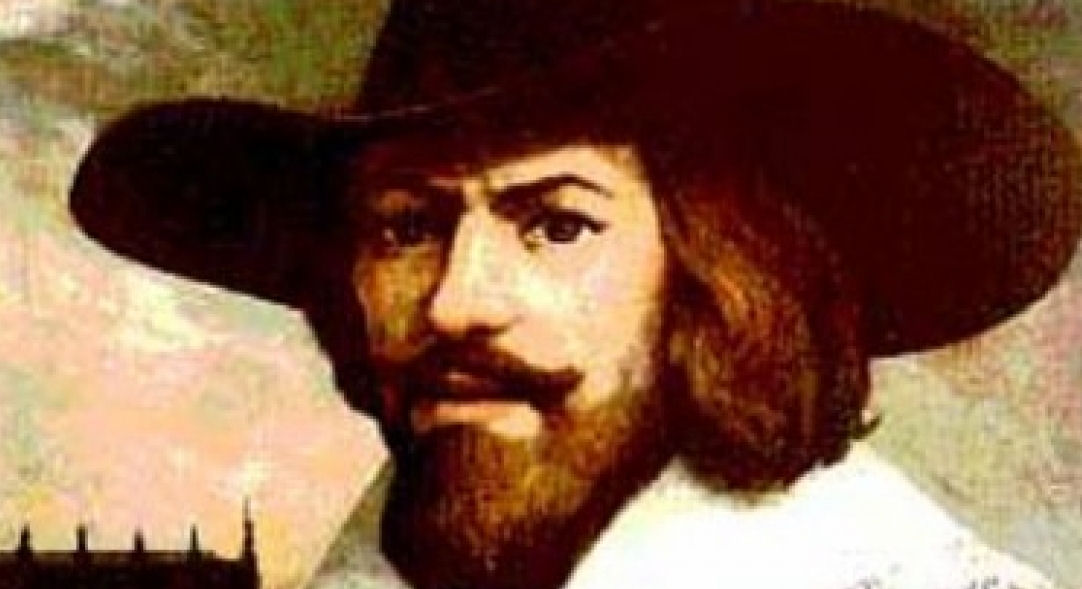
Guy Fawkes
Guy Fawkes Biography
Guy Fawkes was born on 13 April 1570 in York, in the North of England. His parents were a proctor called Edward Fawkes and Edith, a recusant Catholic. His great-grandfather on his father’s side of the family was the Lord Mayor of York in the 1530s.
He also had three siblings: a sister named Anne, who was born in 1568 but died only a few weeks later, and two younger sisters, both born after Guy. One of these sisters was also named Anne, born in 1572, and the other was Elizabeth, born in 1575.
The date given for his birth above is a rough estimate, as it is not actually known on which date he was born. However, there are baptism records from the church of St. Michael le Belfrey showing that he was baptised on 16 April. At the time, it was customary to wait three days from the birth of a child before the baptism was performed.
Edward, Guy’s father, died when he was only eight years old and several years later, his mother remarried to a Catholic called Dionis Baynbridge, who came from Scotton, near Harrogate. Guy attended St. Peter’s School in York, and both of these things seem to have cemented Guy’s Catholic faith, which at the time was a dangerous thing due to Elizabeth I, who was Queen of England between 1533 and 1603, continuing her father, King Henry VIII’s, legacy of turning England into a Protestant state. There were severe punishments for those who continued to practice Catholicism.
After leaving school, Guy Fawkes became a servant in the household of the 1st Viscount Montagu, Anthony Browne. The Viscount didn’t like Fawkes and eventually dismissed him, but upon the Viscount’s death, he was reemployed by his grandson, the eighteen-year-old 2nd Viscount Montagu, Anthony Maria. Some sources claim that Guy Fawkes married around this time and had a son, but this has not been verified.
Upon his father’s death, Guy Fawkes inherited an estate in Clifton, York, but in October 1591, he sold it and travelled to join the Catholic Spanish army to fight against the Dutch Republic in what became known as the Eighty Years’ War. He also fought in France between 1595 and 1598. By joining the Spanish, Guy was also effectively fighting against England, as the two countries were still at war. The Spanish Armada was a past event, but only by a few years, and tensions were still high. Fawkes became a junior officer under Sir William Stanley, who had once been highly regarded by Queen Elizabeth but had now switched sides to fight for Catholic Spain. By 1603, the year Elizabeth died, Fawkes had been recommended for captaincy and travelled to Spain to try and gain support for a Catholic rebellion in England. At the same time, he began using the Italian version of his first name, Guido. He denounced James I, who had taken over England’s throne from Elizabeth, as a heretic and also denounced Scotland and all of the King’s favourite noblemen. Philip III of Spain received Guido at court, but support for the rebellion was not forthcoming.
In 1604, a group of English Catholics led by a man called Robert Catesby had planned to assassinate King James I in order to replace him with his daughter, the Princess Elizabeth. Guy Fawkes joined the group, and their first meeting took place on Sunday, 20 May 1604, at an inn called the Duck & Drake in London. The group had already discussed the possibility of blowing up Parliament with gunpowder, and it was felt that the addition of Fawkes would be a welcome one due to his wartime experience, as well as the fact that he had been away from England for so long, making him relatively unknown.
One of the group’s members, Thomas Percy, had managed to secure a promotion from his employer, who happened to be the Keeper of the King’s Wardrobe, and gained access to a house in London. There, Guy Fawkes was appointed caretaker and servant to Percy, using the pseudonym John Johnson. The conspirators discovered that a local widow was clearing out an undercroft, and that the space, which the group arranged to purchase the lease for, would be perfect for their purposes as it was located directly beneath the House of Lords. Twenty barrels of gunpowder were brought in at first, and this was followed by sixteen more on 20 July, with the plan being to blow up parliament on opening day. However, the plan had to be delayed as the threat of the Plague in the city had delayed the opening of parliament until Tuesday, 5 November.
In August 1605, it was discovered that the gunpowder being stored in the undercroft had decayed, and so more was brought in. The group of plotters continued to meet, and it was determined that Guy Fawkes would play a crucial role in the plot, lighting the fuse, after which it was intended that he would escape across the River Thames.
Things started to unravel for the plotters when some of them became worried about the fate of a few Catholics who would be attending the opening of parliament. An anonymous letter was sent to Lord Monteagle on 26 October warning him to stay away from the ceremony. The plotters heard that the letter had been considered a hoax, and so they decided to continue with their plans, unaware that Lord Monteagle had taken the letter more seriously than they thought and had shown it to the King. The King ordered a search of the cellars to be conducted by Sir Thomas Knyvet, which was conducted in the early hours of 5 November. Guy Fawkes was discovered leaving the cellar and was arrested. The barrels of gunpowder were found hidden behind piles of firewood, and so the plot was foiled.
The following day, King James ordered that the defiant John Johnson, as Fawkes had identified himself as, be tortured in order to discover the identities of his co-conspirators, and so Fawkes was transferred to the Tower of London.
As the torture became progressively worse, Fawkes eventually gave up his true identity on 7 November and also revealed there to be five conspirators, the names of whom he started to reveal on 8 November, along with their intention to install Princess Elizabeth on the throne. By 9 November, the interrogators, led by Sir William Waad, Lieutenant of the Tower, had extracted a full and signed confession from Guy Fawkes.
The trial of the eight men accused of the Gunpowder Plot began on Monday, 27 January 1606, at Westminster Hall and was secretly observed by the King and his close family. All of the defendants were found guilty by the jury of high treason. Guy Fawkes, along with all of his co-conspirators, were hanged, drawn and quartered, with various body parts being distributed to the four corners of the Kingdom as a warning to other potential traitors.
Guy Fawkes FAQ
Guy Fawkes was a member of a group of English Catholics who plotted to assassinate King James I and blow up the House of Lords in the failed Gunpowder Plot of 1605.
The conspirators wanted to restore a Catholic monarch to the English throne by killing the Protestant king and government officials during the State Opening of Parliament.
An anonymous letter led authorities to search the cellars beneath the House of Lords, where Fawkes was found guarding barrels of gunpowder on the night of 4–5 November 1605.
Guy Fawkes Night, or Bonfire Night, is held annually on 5 November in the UK to commemorate the failure of the plot, with fireworks and effigies of Guy Fawkes burned on bonfires.
[this article originally appeared on 5MinuteBiographies.com on 1 November 2018]