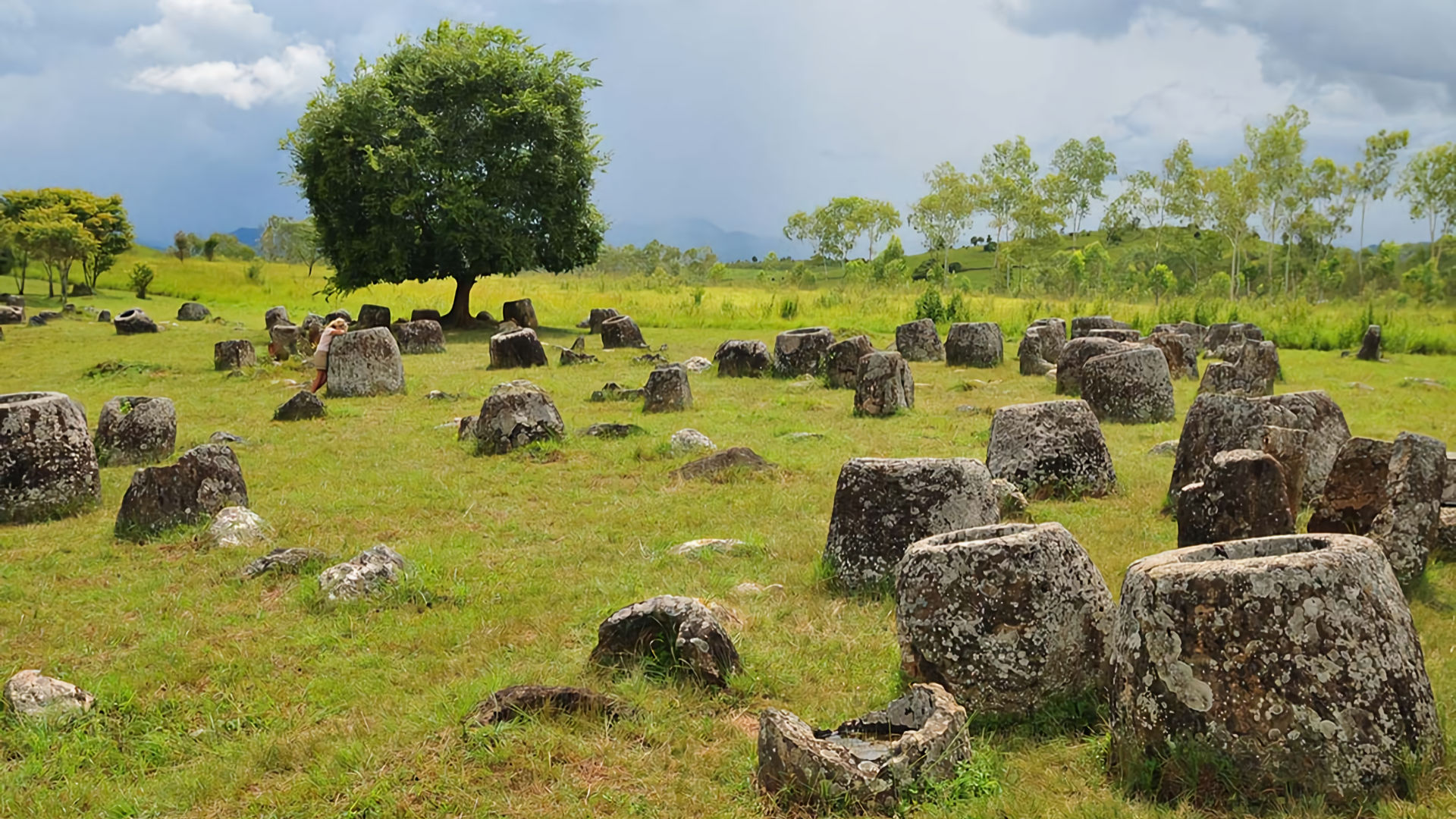
The Mystery of the Plain of Jars
Nestled in the rugged mountains of northern Laos lies a landscape unlike anywhere else on Earth. Spread across a series of windswept plateaus are thousands of enormous stone jars, some standing upright like forgotten giants’ cups, others toppled and broken from centuries of neglect and war. This is the Plain of Jars, one of Southeast Asia’s most baffling archaeological wonders. It is a place where history, myth and mystery intertwine, and where even the most seasoned researchers still scratch their heads and mutter, “Right, but how and why exactly?”
Although Laos itself is often overshadowed by more touristed neighbours like Thailand or Vietnam, the Plain of Jars has long captured imaginations and confounded experts. Who carved these colossal containers? What purpose did they serve? And how did an ancient civilisation manage to drag them kilometres across such harsh terrain without the help of Amazon Prime delivery drones?
To answer these questions, we need to look at both the deep past and more recent history. The Plain of Jars invites curiosity. It demands imagination. And crucially, it requires very sensible footwear.
A Landscape Marked by Stone
The term “Plain of Jars” is slightly misleading. It refers not to a single valley but to a region dotted with more than 90 jar sites across Xieng Khouang province. These locations sit at the crossroads of ancient trade routes, rolling hills and green rice paddies stretching across a dramatic plateau.
Here is the first remarkable thing. There are not a few dozen jars, nor a few hundred. Archaeologists estimate that there are more than 2,000. They range significantly in size. Some are as small as large garden pots, roughly a metre high. Others rise over three metres tall and weigh several tonnes. They are carved almost entirely from stone types such as sandstone, granite, or conglomerate. Each jar is roughly cylindrical, wider at the base, sometimes hollowed with impressive smoothness.
Around many jars lie stone discs, some believed to have served as lids. Others think these discs acted as grave markers. The jars themselves are often found in clusters, placed in close proximity to cliffs or hilltops with sweeping views. If ancient people wanted these jars to be noticed, they certainly achieved their goal.
Who Made Them?
Dating the jars proved tricky for years. The absence of inscriptions and the sheer weight and durability of stone make precise timelines contestable. However, research in the twenty-first century has provided clearer evidence. Charcoal, bone fragments, and burial goods found near the jars were dated to approximately 500 BCE to 500 CE.
This places the jars in Southeast Asia’s Iron Age, linked to a culture advanced enough to quarry, shape and transport multi-tonne stone objects. That alone is worth a round of applause. Consider the logistical nightmare of hauling something weighing as much as an elephant over uneven terrain without the wheel technology we take for granted today. There are no ancient instruction manuals or time capsule guides that read: “Step one: deploy lots of people. Step two: try not to drop the jar on anyone.”
The prevailing theory suggests these jars were created by a sophisticated society engaged in long-distance trade networks that included India and coastal Vietnam. The Xieng Khouang plateau may have been a busy corridor used for commerce, cultural exchange and funerary practices.
Yet the identity of the jar-makers remains unknown. They left no written history, no depiction of themselves and no identifiable lineage among current local populations. It is one of those historical vanishings that leave us chasing shadows. They arrived, changed the landscape and then disappeared, leaving enormous stone hints behind like ancient breadcrumbs.
The Purpose of the Jars
This is where archaeology meets speculation with a cheeky grin. What exactly were these jars for?
There are three leading theories, each with varying levels of plausibility:
- Funerary Urns
The strongest archaeological evidence suggests the jars were used in burial rites. Human remains, beads, ceramics, and bones found in and around several jars suggest a mortuary function. It appears bodies may have been placed inside the jars for a period of decomposition. Afterwards, the bones were removed and reburied nearby. Not the most glamorous, but death rarely is. - Storage for Water or Food
Some propose the jars stored rice wine, grains or rainwater. Their placement along potential ancient trade routes could mean they acted as roadside storage stops. Travellers would undoubtedly have appreciated a sip of something strong after lugging one of those jars uphill. - Mythic Megajugs
Local folklore offers far more colourful explanations. One story claims the jars were made by giants who needed enormous cups for drinking celebratory rice wine after a great battle. Another tale says they held human pickles. Yes. Pickled people. That is one way to deal with house guests who overstay their welcome.
Most scholars today lean firmly toward the first theory, yet the presence of so many sites suggests the jars’ use may have evolved over time. Rituals change. Beliefs shift. But stone endures.
Archaeology Meets Danger
You might assume that unlocking the secrets of the jars would be a priority for researchers for decades. However, the Plain of Jars had an unintentional second life as one of the most bombed regions on Earth. During the Vietnam War era, Laos became entangled in a conflict far larger than itself. More than two million tonnes of ordnance were dropped over the country, much of it in Xieng Khouang.
A significant portion of these explosives failed to detonate. This left the fields laced with unexploded ordnance that continues to threaten local communities and prevent safe access to many jar sites. Archaeologists could not simply turn up with notebooks and sun hats. They also required bomb disposal teams and a healthy respect for the phrase “Watch where you step”.
Over the past few decades, clearance operations have made enormous progress, allowing experts to resume careful study. The urgency is twofold. It protects lives today and will enable researchers to preserve the cultural legacy of a civilisation that came before the modern borders and battles.
Rediscovery and Recognition
Western exploration of the jars dates back to the 1930s, when French archaeologist Madeleine Colani began systematic study of the sites. She documented nearly 600 jars and theorised their funerary purpose, an idea now widely accepted.
More recently, UNESCO recognised the importance of the Plain of Jars. In 2019, the region was inscribed as a World Heritage Site, recognising both its cultural significance and the need for continued protection. It was a triumph not only for archaeology but for the people of Laos, who have long lived with the dangers of the past as well as its mysteries.
This recognition also opened the door for more sustainable tourism. Visitors now arrive not only to learn about ancient customs but to witness a place where humanity’s deep past stands stubbornly against time and turmoil.
A Mystery That Refuses to Be Solved
Even with advancing research, unanswered questions remain. Why are some jars smooth inside while others retain rough chisel marks? Why do designs vary across sites? Why did this culture choose stone at all, when bamboo would arguably have been a much easier DIY project?
There is a universal charm in things that refuse to explain themselves. The Plain of Jars is history’s equivalent of a mischievous smile. It invites theories while revealing very little. Even the jar lids remain debated. Some discs clearly look like grave markers, while others might have sealed the jars. The trouble is that not many of them fit neatly. Either ancient people were terrible at matching sizes, or the jars and discs did not always belong together in the first place.
Then again, perhaps perfection was not the goal. Ritual often values symbolism over precision. We may never fully understand the cultural nuances behind these practices, and maybe that is part of the fascination.
Cultural Heritage and the Future
Today, Laos embraces the Plain of Jars as a symbol of national heritage. Local communities play a central role in its stewardship. Tourism brings income and pride, but there is always a delicate balance between preservation and accessibility.
Archaeologists continue working alongside deminers to expand research zones safely. Techniques such as ground-penetrating radar, drone mapping and more precise radiocarbon dating promise deeper insight into the Iron Age society responsible for the jars.
The hope is that, eventually, more sites can be studied, more stories can be told, and more threats can be removed from this remarkable landscape. The jars have stood for over 2,000 years, surviving war, weather and wandering cattle. With proper care, they will continue to fascinate generations to come.
A Final Word
The Plain of Jars is a monument to human ingenuity and human mystery. It represents a civilisation that wielded remarkable stone-working skills, deeply cared about its rituals, and left behind a legacy strong enough to challenge modern armies. Yet for all the excavation and analysis, we still peer at those jars and wonder: what exactly were they thinking?
Perhaps that is why the Plain of Jars endures in global imagination. It is a reminder that not every question has a neat answer. That the past can surprise us with its scale and skill. And that sometimes, the most captivating footprints are the ones carved in stone, too heavy to ignore and too mysterious to explain away entirely.
Should you ever find yourself standing among those monolithic vessels on the Lao plateau, the wind brushing past like a whisper from the Iron Age, you might feel the same irresistible curiosity that has pulled archaeologists here for nearly a century. These jars are more than stone. They are a puzzle. A memorial. A message from a people lost to time.
And until someone invents a time machine, the Plain of Jars will continue to hover between history and legend, inviting us to look closer, think deeper and occasionally enjoy a good giant-wine-cup theory for fun.
The Plain of Jars FAQ
It is situated in the Xieng Khouang province in northern Laos.
Archaeological dating suggests they were created between 500 BCE and 500 CE during the Iron Age.
The leading theory is that they were part of burial rituals, although other theories include storage of food, water or ceremonial drinks.
Because the region was heavily bombed during the Vietnam War era and unexploded ordnance remains in the ground.
Yes. It was officially added to the list in 2019.