The Battle of Bosworth
The morning of 22 August 1485 was cool and grey over the fields south of Market Bosworth. Men woke stiff on damp ground, checked straps and buckles, and tried not to think about what would happen once the sun climbed. England had been living with nerves and rumours for years. Even so, this day felt different. Richard III, a hard fighter and a quick decision maker, stood with the crown. Henry Tudor, an exile with a thin legal claim but a simple, powerful promise to end the fighting, had come back to take his chance.
Richard had ruled for just over two years. He had put down a rising, kept the north quiet, and watched the royal accounts like a hawk. He was also shadowed by the story of his nephews, the Princes in the Tower. Friends said he was fair and effective. Enemies said he was ruthless and not to be trusted. That split in opinion mattered, because a king in a civil war rules as much by belief as by law. Henry brought a different kind of strength. He promised to marry Elizabeth of York, the eldest daughter of Edward IV. That offer to join York and Lancaster gave doubtful lords a way to back him without feeling they had betrayed their past. Add French money and a few veteran captains, loyal Welsh support, and quiet help from English figures who were tired of fear and fines, and Henry had enough to gamble with.
Henry came in through Wales, drawing men as he marched. Each night, he and his council weighed the same questions. Who would join him openly? Who was pretending to be friendly while sending word to Richard. Above all, what would the Stanley brothers do? Thomas, Lord Stanley, was married to Henry’s mother, Margaret Beaufort, which made him family. He had also served Yorkist kings for years. His brother, Sir William Stanley, was kept close by with his own well-drilled force. The Stanleys never rushed. To Richard, they said they needed time to muster. To Henry, they said they needed to see how the field shaped up. They were waiting for the moment when a single move could decide the day, and they wanted to make that move count.
Richard gathered his army and marched out from Leicester to find Henry before the challenger could grow any stronger. He set the Duke of Norfolk in command of one wing, the Earl of Northumberland on the other, and kept the royal household with him in the centre. He knew the Stanleys were near and did not like the uncertainty. To force Thomas Stanley’s hand, he held Thomas’s son, Lord Strange, as a hostage. That was harsh, but this was a harsh kind of war.
The ground near Fenn Lane Farm was mixed and awkward. There were small rises firm enough for guns. There were also wet patches and seams of soft earth that could trip men and animals. A stream cut across the area and would split any charge not handled with care. The older guidebooks put the battle higher up on Ambion Hill, but finds of round shot and other items in later digs point to the lower ground as the main scene. For a modern visitor, it looks like ordinary farmland. For soldiers on foot with polearms and for gunners with heavy carriages, it was the kind of place where footing, angle, and short distances decided everything.
Henry drew up his force close and compact. At the front, he placed a strong core of French-trained professionals under Philibert de Chandée. Behind them stood Welsh and English companies, steadied by captains who had seen real fighting. Around Henry himself was a tight guard. He had fewer men than Richard, so he aimed to keep order and protect the centre at all costs. The professionals in the van mattered. They had drilled with powder and pike. They could hold under fire. Their job was to keep the line straight when nerves frayed.
The Stanleys stood on higher ground, able to see both arrays. Thomas sent Henry a token body of men, a sign but not a commitment. William posted his troops where he could move fast if the time came. Neither brother nailed his colours to a mast. They were there to choose the winner in a way that made their choice the reason the winner won.
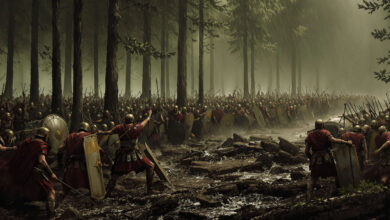
The guns began. Iron and stone balls thumped into the earth and smashed into ranks. There were not enough cannon to decide the battle alone, but the noise bit at the stomach and the splinters made men duck. When the lines moved to close, Norfolk’s wing pushed hardest, and Henry’s vanguard stepped forward to meet it. This was late medieval fighting at close range. No sweeping cavalry charge from a romance. Archers loosed where they could. Handgunners fired when they had a clear shot. But the heart of it was the press: bills hooking legs and shields, halberds striking at neck and hip, poleaxes driving in short, heavy blows. Men fought for a few yards at a time, shoulder to shoulder, and every gain cost blood and breath.
Richard watched the shape of the fight and tried to keep three plates spinning. He needed Norfolk to attack hard without overreaching. He needed Northumberland to hold in the right place and then hit at the right time. He needed the Stanleys either fixed in place or brought in on his side. That mix is difficult even with a loyal, drilled army. In a civil war, with uncertain allies, it becomes a test of nerve. Norfolk pushed forward and paid for it. He was killed near the royal standard, and the shock of his fall ran down the line. Richard had to feed weight from his centre to steady that flank, which took away some of his freedom to act elsewhere.
Northumberland’s part is still argued, now as then. Some say the ground held him. Some say he did not receive a clear order. Some say he waited too long by choice. What is certain is that the fresh push Richard wanted from that side did not land when needed. Henry’s line, tight around its core, held its shape. The Stanleys still waited.
Henry kept near the middle under close guard. He knew his life was both prize and target. Keep back too far and men begin to think you are hiding. Go too far forward, and a single stroke ends the whole bid for the crown. He settled on a simple rule. Stay close to the standard. Trust the professionals in front to hold. Do not let anyone open a wide lane to you.
Richard saw what he took as his chance. Henry’s standard was visible. The guard nearby looked thinner for a moment. Or perhaps Richard had simply had enough of waiting for other men to act. He called on his household knights, men he trusted, and led a straight charge at Henry. If he could cut the challenger down, the battle would end. It was a bold, clear decision. It fit the kind of commander Richard had always been.
The royal household smashed into Henry’s guard. The banner shook. The guard closed in. The fighting around Henry became a knot, iron on iron at arm’s length. The royal standard bearer went down, but the story goes that he held the pole even after losing both legs. Richard forced forward until the two groups were almost one, so close that later writers said he died within a lance’s length of Henry. When his bones were found in Leicester centuries later, the skull wounds matched the idea of a man cut down in a tight circle with no room to break away.
That was the moment William Stanley chose to move. He brought his men in at an angle that hit Richard’s thrust from the side. It was not a push straight into Henry’s guard; it was a blow on the Yorkist flank while the household knights were already fully engaged. That change broke the shape of the fight around the centre. Richard’s charge slowed and stuck; then the men with him began to fall. The household was too far ahead for the rest of the army to close up and save them. A large army never vanishes all at once, but it only takes one part to give way at the wrong time for the rest to feel the ground shift. Cracks became gaps. Gaps became lanes of flight.
Richard was killed in the crush, the last English king to die in battle. His body was stripped and slung over a horse to show the people of Leicester that there would be no tales of escape. It was a brutal sight, but it shut down rumour. In the short term, the effect on the field was simple. With the king dead and the centre broken, Yorkist resistance collapsed. Men ran or threw down their arms. A handful fought on until surrounded. Others tried to make their names good by helping to stop the killing.
Henry was crowned on the field with the circlet taken from the fallen standard. It was a symbol, not a legal ceremony, but symbols matter on the afternoon after a fight. He dated his reign from the day before Bosworth to turn his enemies into traitors in law. Then he set about making himself safe. He married Elizabeth of York, as he had promised, and so turned a political plan into a real family bond. He called a parliament that confirmed his title. He had it reverse the act that had declared Edward IV’s children illegitimate, which helped his wife and soothed Yorkist pride. He did not make his position rest only on the marriage. He said he was king by God’s judgement in battle, by parliament’s word, and by right of conquest. That mixture gave him room to handle trouble in different ways.
He punished some leading enemies with attainders. Others he brought back into service. He kept a close eye on money and men. He rewarded the Stanleys well; Thomas became Earl of Derby. At the same time, he started to reduce the chance that any single lord could do at the next battle what the Stanleys had done at this one. He built the treasury steadily. He managed patronage carefully. He kept the system watching itself with letters, audits, and small, regular pressures that did not make him popular but did make him secure.
So, why did Henry win? He kept his army close and disciplined. He protected himself without hiding. He used French professionals to steady his front and Welsh numbers to build depth. He waited for the Stanleys rather than trying to force them early. When William Stanley finally moved, Henry was still alive and still guarded; the help mattered at once.
So, why did Richard lose? He could not get Northumberland to strike at the right time; his left was weakened when Norfolk fell, and his own bold attack, which might have worked on a different day, ran into a fresh enemy wing while it was still fighting through Henry’s guard. Add to that the wider mood. Enough lords believed that Henry’s promise to end the quarrels was worth a chance. Belief is not a pike or a bill, but it changes how hard men push and how long they hold.
What kind of battle was this? Not a knightly tourney. Not yet the set-piece gun battle of the next century. It was a clash where cannon opened the show, archers and handgunners hurt men at the edges, and then bills, halberds and poleaxes did most of the killing at short range. Armour still helped against arrows and glancing blows, but the close work found weak spots. Cavalry still mattered, not for long sweeping charges across open downs, but for quick, hard hits at the right place and time. Above all, command depended on human judgement and short messages carried by voice, trumpet and banner. There was no staff map with coloured pins. There was a king on a horse looking for a gap, a challenger in a tight ring trying to stay alive, and two brothers waiting to tip the scales.
For years, the story of Bosworth was told the Tudor way. Writers praised the new king and darkened Richard’s character to fit the mood. Later, others tried to balance that view and show Richard as brave and capable, even if they thought his choices were wrong. Archaeology has helped. Finds of round shot and other pieces on the lower ground have shifted our picture of where the main action took place. The discovery and reburial of Richard’s remains in Leicester gave the public a human link to a figure who had primarily been an argument in books. The bones showed injuries that fit a last stand. The spine’s curve matched portraits. The facts were plain, not romantic: a man killed in a press, struck again after he fell, carried away to be shown, and then buried without much ceremony.
Bosworth did not bring instant peace. There were pretenders and plots. But it did change a habit. It made it harder to imagine that a fresh banner and a few bold lords could swap the crown back and forth every other year. Henry kept the promise of quiet well enough to build something stable. Richard died fighting, and that deserves respect, even from those who think he should never have been king. The field today is tidy and signed. If you walk it, the ground will look small for something that decided so much. That is common with battlefields. The choice that changed the country often happens over a few hundred yards, with tired men stepping into mud, a handful of riders taking a risk, and one or two well-placed interventions turning a hard contest into a result that everyone has to live with. So, in plain terms, a king tried to finish a war with his own sword. A rival stayed alive long enough for help to arrive. Two brothers chose the winning side at the winning moment. The outcome ended a dynasty and started another. From there came a marriage that joined old enemies, a slow tightening of royal control, and a country that, bit by bit, learned to breathe without waiting for the sound of drums in the next valley.
The Battle of Bosworth FAQ
The Battle of Bosworth was fought on 22 August 1485 in Leicestershire, England, between the forces of King Richard III and Henry Tudor. It ended the Wars of the Roses and marked the start of Tudor rule.
Bosworth is important because it ended Plantagenet rule, led to the death of Richard III, and brought Henry Tudor to the English throne as Henry VII, reshaping England’s political future.
King Richard III was killed during the battle, making him the last English king to die in combat. His death effectively ended Yorkist resistance.
Henry Tudor’s victory was aided by the defection of key nobles, most notably Thomas Stanley, whose intervention at a critical moment turned the battle against Richard III.
After the battle, Henry Tudor was crowned King Henry VII. He later married Elizabeth of York, uniting the rival houses and bringing the Wars of the Roses to an end.