The Battle of Naseby
By the summer of 1645, England had been at war with itself for nearly three years. The conflict between King Charles I and Parliament had begun in 1642, but its roots reached further back, into arguments over religion, taxation, royal authority, and who ultimately controlled the armed forces of the kingdom. Charles believed he ruled by divine right and that Parliament existed to advise and fund him, not to limit him. Many in Parliament believed the King had tried to govern without proper consent, especially during the eleven years from 1629 to 1640 when he ruled without calling Parliament at all.
Once war began, neither side achieved a quick victory. The first major battle, Edgehill in October 1642, was indecisive. Royalist forces then built a strong wartime base at Oxford, while Parliament held London, the navy, the South East, and many of the country’s financial and administrative advantages. The fighting spread through England and Wales, with sieges, raids, and pitched battles reshaping local loyalties as much as national politics. For ordinary people, the war meant taxation, requisitioning, disrupted trade, and soldiers billeted in towns and villages, whether people wanted them there or not.
In 1644, Parliament gained a major success at Marston Moor, which broke Royalist strength in the North. Yet that victory did not end the war. Charles still controlled important territory in Wales, the West Midlands, and the South West, and he still had experienced cavalry, battle-hardened infantry, and commanders who knew how to exploit Parliament’s divisions. Parliament, meanwhile, had money and manpower, but its armies had often been regional forces with different commanders, different priorities, and no single national strategy.
That weakness became impossible to ignore after the Second Battle of Newbury in October 1644. Parliament had outnumbered the Royalists, yet failed to destroy them. The result led to fierce criticism of the old command structure and helped push Parliament towards military reform. The answer was not just to raise more soldiers, but to create a new kind of army, one that could fight anywhere in the country, under a unified command, with promotion based more on ability than social status.
This mattered because the war had reached the point where one decisive campaign could change everything. Charles could not afford endless stalemate, but Parliament could not simply wait him out either. If the King kept enough field forces intact, he could prolong the conflict, exploit divisions among his enemies, and perhaps force a negotiated settlement on favourable terms. By early 1645, both sides understood that the next major confrontation might decide the future of the war. That confrontation would come only after Parliament built its most effective weapon yet, the New Model Army.
The New Model Army: Parliament Builds a Different Kind of Force
The New Model Army was Parliament’s attempt to solve a military problem that had dragged on since the beginning of the war. Earlier Parliamentarian forces had often been tied to particular counties or associations, meaning they could be reluctant, or legally restricted, when ordered to campaign far from home. That made it difficult to chase the King’s main army, relieve distant garrisons, and coordinate operations across England. The New Model Army was designed as a national force, not a collection of local contingents stitched together with hopeful string.
Its commander-in-chief was Sir Thomas Fairfax, a serious, capable Yorkshire soldier who had already proved himself in northern campaigns. Oliver Cromwell, who had risen through the war because of his effectiveness as a cavalry commander, became one of its most important figures, especially on the battlefield. The army was unusual not because every soldier was new, but because the structure was new. It brought together experienced men under more consistent leadership, pay, discipline, training, and purpose.
At Naseby, Parliament’s force numbered roughly twelve to fifteen thousand men, depending on the estimate used. It included infantry armed with pikes and muskets, cavalry organised into disciplined regiments, and dragoons, mounted troops who could ride quickly into position and fight with firearms on foot. The National Army Museum gives Fairfax overall command and notes that around half the army at Naseby was on horseback under Cromwell, while the Battlefields Trust gives Parliament around fifteen thousand men in total. Either way, Parliament had the larger army, but numbers alone did not explain what happened next.
The army’s real strength lay in control. Cavalry in this period could win a dramatic charge and still lose the battle if it galloped too far in pursuit. Infantry could hold ground for a time, but if its flanks were exposed, it could be overwhelmed. Artillery was useful, but slow and difficult to move once a fight began. The New Model Army was built to combine these elements more effectively, so cavalry, foot, and dragoons supported one another rather than fighting separate private wars across the field.
Discipline also mattered. Parliament wanted an army that could move fast, obey orders, and maintain cohesion under pressure. The soldiers were not saints, whatever later myth-making might suggest, but the New Model Army developed a reputation for professionalism and ideological commitment. Many of its officers and soldiers believed they were fighting not merely against a king’s army, but for a godly and lawful settlement of the kingdom.
This new army first moved west to relieve Taunton, a Parliamentarian stronghold under pressure in Somerset. Then Parliament changed the plan and ordered Fairfax towards Oxford, the Royalist wartime capital. That threatened Charles directly. To draw Fairfax away, the Royalists would make a bold move of their own, one that briefly restored their confidence and set both armies on the road to Naseby.
Royalist Confidence: Charles I Marches Through the Midlands
King Charles I still had reasons to believe the war could be saved. His cause had suffered blows, especially in the North, but it had not collapsed. Oxford remained his headquarters. Wales and parts of the Midlands still supplied men, horses, and resources. In the South West, Royalist strength remained formidable. Prince Rupert of the Rhine, the King’s nephew, was still one of the most feared cavalry commanders in Britain, known for aggressive charges and a willingness to seize the initiative before his enemies were ready.
The Royalist army, however, had serious weaknesses beneath its confidence. Parliament controlled London, major armouries such as the Tower, important ports, and much of the machinery needed to sustain war over the long term. The Royalists could still fight well, but replacing losses was becoming harder. Their commanders also disagreed about strategy. Some wanted to focus on the South West, others on the Midlands and the North, while Charles himself often sought to preserve political options as much as military ones.
In May 1645, Charles moved north from Oxford with his main field army. Parliament’s pressure on Oxford made this a risky moment. If Fairfax could threaten the Royalist capital while the King was elsewhere, Charles might be forced into a defensive campaign. The Royalist answer was to strike at Leicester, an important Parliamentarian town in the Midlands. On 31 May 1645, Royalist forces stormed Leicester. The attack shocked Parliament and forced Fairfax to abandon operations against Oxford.
The capture of Leicester gave the Royalists a burst of momentum. It showed that Charles could still act offensively and that the New Model Army could not simply choose its own campaign without reacting to events. Yet it also tempted the King towards battle at a dangerous moment. The Royalist army was smaller than Fairfax’s force, probably around ten to twelve thousand men. It included good cavalry and veteran infantry, but it could not easily replace them if they were lost. Prince Rupert, often remembered as reckless, was not blind to this danger. He understood that accepting battle against a larger and newly organised Parliamentarian army carried huge risks.
The days before Naseby were marked by uncertainty. Both armies moved across the Midlands, trying to locate one another and gain an advantage. Intelligence was imperfect. Scouts misread movements. Commanders argued over whether to fight, withdraw, or manoeuvre for better ground. Charles and his senior officers spent the night before the battle near Market Harborough and Daventry, with the Royalist army close to the Parliamentarian force but not entirely clear about its exact position.
By the morning of 14 June, the decision had effectively been made. Charles had come far enough that retreat would be difficult and dangerous if Fairfax pressed him. The King’s army moved towards the area north of Naseby in Northamptonshire, where open fields, ridges, hedges, and shallow valleys would turn a strategic gamble into a brutal test of command.
14 June 1645: How the Armies Met Near Naseby
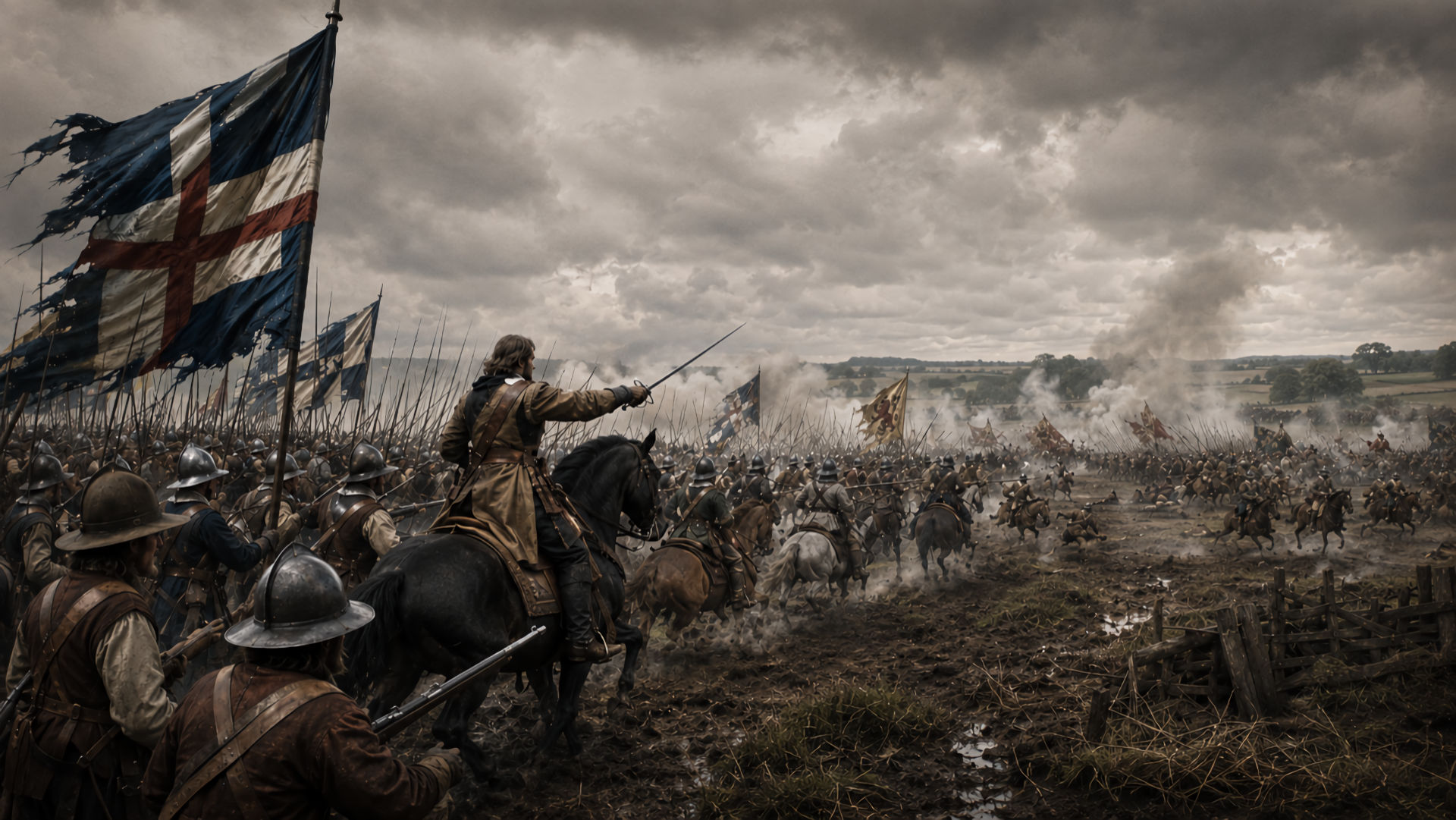
The Battle of Naseby was fought on the morning of 14 June 1645, north of the village of Naseby in Northamptonshire. The battlefield was not a grand arena, but a stretch of open countryside shaped by ridges, enclosed edges, hedges, and a shallow valley. In seventeenth-century warfare, that mattered enormously. A slope could slow cavalry. A hedge could shelter musketeers. A patch of broken ground could disrupt a charge. Armies did not simply collide like two blocks on a map; they moved through real terrain, and at Naseby the terrain helped shape the outcome.
The morning began with uncertainty and some fog. The two armies were close, but neither had a perfect view of the other. Fairfax initially held a strong position, but there was a danger that the Royalists might refuse battle if Parliament appeared too secure. According to later accounts, Parliament’s line was adjusted to encourage the Royalists to advance. It was a calculated risk. Fairfax wanted Charles to come forward, but if the Royalists attacked with enough force and coordination, they could still break part of the New Model Army before Cromwell and the reserves could decide the fight.
The two sides formed in a familiar pattern. Infantry stood in the centre, with cavalry on both wings. For Parliament, Fairfax commanded overall. Philip Skippon led the infantry in the centre, Henry Ireton commanded the left wing of horse, and Cromwell commanded the right. John Okey’s dragoons were placed near the hedges, where their firearms could harass the Royalist cavalry. On the Royalist side, Prince Rupert commanded the right wing, facing Ireton. Sir Marmaduke Langdale’s northern horse held the Royalist left, facing Cromwell. Lord Astley was among those associated with the Royalist infantry in the centre.
The opening arrangement carried a dangerous imbalance. Rupert’s cavalry on the Royalist right was capable of a powerful charge. If he smashed Parliament’s left and then turned back in good order, the Royalists might roll up the Parliamentarian line. But Cromwell’s cavalry on Parliament’s right had a similar opportunity against Langdale. The battle therefore depended not just on who won the first clashes, but on who could keep command after success. In cavalry warfare, victory could become a problem if horsemen abandoned the main fight to chase fugitives, plunder baggage, or pursue glory beyond the battlefield.
As the armies moved closer, the centre became a killing ground of muskets, pikes, swords, and clubbed weapons. Visibility was limited by smoke and motion. Orders became harder to transmit. Men were packed into formations where courage mattered, but so did the ability of officers to keep units together when the line bent. The Royalists had not come to be crushed quietly. Their first attacks were fierce, and for a time the issue remained in doubt. But the way each side handled success on the wings would decide whether that early Royalist pressure became victory or disaster.
Cromwell’s Cavalry and the Collapse of the Royalist Line
Prince Rupert struck hard on the Royalist right. His cavalry charged into Henry Ireton’s Parliamentarian horse and drove it back. Ireton himself was wounded and captured during the fighting. In the first phase of the battle, this looked like a serious Royalist success. Rupert had done what he had done many times before, using speed, shock, and aggressive leadership to break opposing cavalry. The problem was what happened after the breakthrough. Instead of quickly reforming and returning to support the Royalist centre, much of Rupert’s horse continued towards the Parliamentarian rear, where they became tangled with the baggage and artillery area.
In the centre, the Royalist infantry pressed Parliament hard. Philip Skippon, commanding the Parliamentarian foot, was wounded but stayed on the field, a decision that helped steady his men. The fighting here was close and vicious. Muskets could fire only slowly, so once formations closed, soldiers fought with pikes, swords, musket butts, and whatever violence the moment allowed. The Royalist infantry were experienced and determined. For a time, they pushed the New Model Army’s centre backwards and created the real possibility that Fairfax’s line might crack.
On Parliament’s right, however, Cromwell handled his cavalry differently from Rupert. Facing Marmaduke Langdale’s Royalist horse, Cromwell’s men eventually drove them back. Crucially, Cromwell did not allow his whole wing to disappear in pursuit. He kept reserves under control and turned cavalry back towards the centre of the battlefield. That difference was decisive. While Rupert’s successful horsemen were too far away to help the Royalist infantry, Cromwell’s cavalry could strike the Royalist centre in flank and rear.
Okey’s dragoons added to the pressure from the hedges, firing into vulnerable positions and helping disrupt Royalist movement. Fairfax’s infantry, though battered, held long enough for the Parliamentarian cavalry to make its advantage count. The Royalist foot found themselves attacked from more than one direction. What had begun as a hard-fought infantry struggle turned into encirclement and collapse. Some Royalist units fought stubbornly, but battlefield courage could not solve the tactical problem. Without cavalry support, with Parliament’s horse returning against them, and with Fairfax still holding the field, the Royalist infantry began to break.
Charles still had mounted men near him and appears to have considered an attempt to intervene, but the moment passed. Whether through caution, confusion, advice from those around him, or recognition that the centre was already lost, the King did not launch the counterattack that might have offered one last chance. When Rupert returned, it was too late. His cavalry had won its first fight, but Parliament had won the battle.
The Royalist losses were catastrophic. The Battlefields Trust estimates around one thousand Royalist dead and fewer than 150 Parliamentarian dead, while other evidence records thousands of Royalist prisoners. Civil War Petitions notes that 4,508 Royalist prisoners were marched from Market Harborough to Northampton the day after the battle, with many later moved south towards London. Parliament had not merely defeated Charles’s army; it had destroyed its ability to act as the King’s main field force.
After Naseby: The King’s Papers, Parliament’s Momentum, and the Road to Defeat
Charles I escaped from Naseby, but escape was not the same as recovery. The Royalist army he left behind had been shattered. Parliament captured guns, supplies, baggage, standards, and thousands of prisoners. The King still had supporters, fortresses, cavalry remnants, and hopes of raising new forces, but he no longer had the same quality of field army. In a war of manoeuvre, that was fatal. A king could not win simply by remaining uncaptured; he needed an army capable of changing the facts on the ground.
The immediate military consequences came quickly. Leicester, whose capture had helped bring Fairfax after the Royalists, was retaken by Parliament within days. In July, the New Model Army defeated the last significant Royalist field army in the West at Langport. After that, much of the war became a process of reducing Royalist garrisons, containing remaining forces, and closing down Charles’s options. The First English Civil War did not technically end at Naseby, but after Naseby the Royalist cause was fighting from weakness rather than possibility.
The political consequences were just as damaging. Among the captured baggage was the King’s cabinet, containing private correspondence. Parliament understood the propaganda value immediately. In 1645, the letters were published as The King’s Cabinet Opened, a pamphlet that presented Charles’s private papers as proof of his intentions. The publication helped Parliament argue that the King had sought foreign and Catholic support, a deeply damaging charge in a country already anxious about religion, popery, and outside interference. The Internet Archive record of the 1645 publication describes it as letters and papers written with the King’s own hand and taken in his cabinet at “Nasby-Field” on 14 June 1645.
For Charles, the loss of the papers was a disaster because it damaged trust. Even those who still believed in monarchy could question whether this particular monarch could be trusted in negotiation. Parliament did not need merely to defeat him militarily; it needed to persuade people that continuing the war was justified. The captured correspondence helped it do exactly that.
Within a year, Charles’s position had become untenable. In 1646, he surrendered to the Scots, hoping to exploit divisions between his enemies. That hope would lead to further conflict, but it did not undo Naseby. The battle had proved the effectiveness of the New Model Army and exposed the weakness of the Royalist war machine. It also shifted the political imagination of the country. Before the war, many English people could criticise a king, but still struggle to imagine a state without one. After Naseby, the question became more dangerous: if a king made war on his own people, lost, negotiated in bad faith, and tried again, what then?
The later trial and execution of Charles I in 1649 were not inevitable on the morning of 14 June 1645. History rarely works as neatly as that. But Naseby made them possible by breaking the King’s army, damaging his credibility, and giving Parliament’s soldiers the confidence that they were not merely rebels in arms, but the force that had decided England’s future. The battlefield near a Northamptonshire village became the place where Royalist victory ceased to be realistic, and where Parliament’s military revolution became impossible to ignore.
The Battle of Naseby FAQ
The Battle of Naseby was a major battle of the First English Civil War, fought on 14 June 1645 near Naseby in Northamptonshire. Parliament’s New Model Army defeated the main Royalist field army of King Charles I.
Naseby was important because it destroyed the King’s main field army and gave Parliament a decisive military advantage. The Battlefields Trust describes it as the destruction of the Royalist main field army, while the National Army Museum states that it won the First English Civil War for Parliament.
The Parliamentarian army was commanded by Sir Thomas Fairfax, with Oliver Cromwell commanding the right wing of cavalry. The Royalist army was led by King Charles I, with Prince Rupert of the Rhine commanding the Royalist right wing.
After Naseby, Charles I escaped, but his army was badly damaged. Parliament captured Royalist supplies, guns, prisoners, and the King’s private papers, which were later used politically against him. The Royalist cause continued, but it never fully recovered from the defeat.