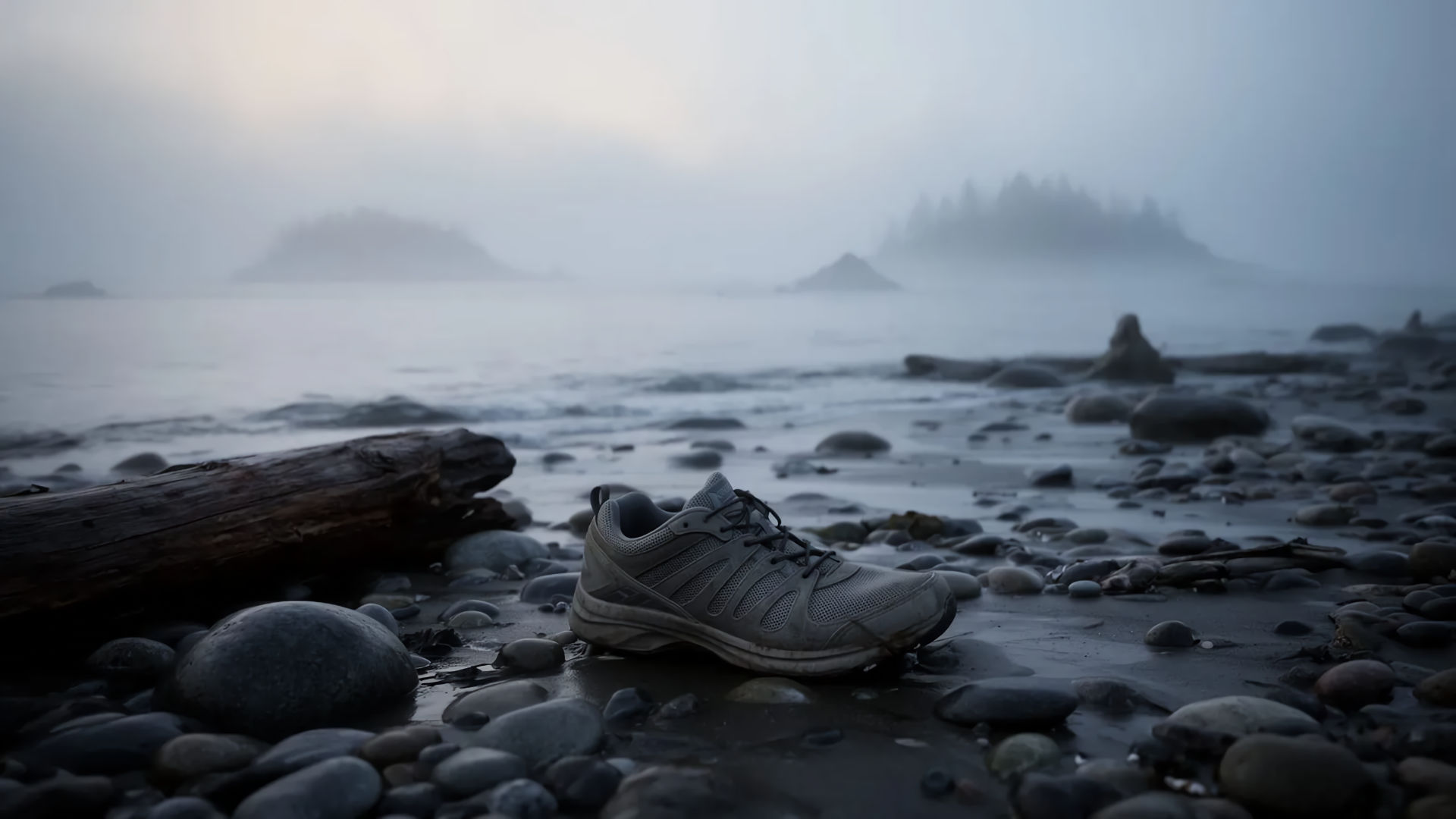
The Mystery of the Salish Sea Feet
It sounds like the premise of a maritime ghost story. A quiet coastline, a stray trainer washed ashore, and inside it a human foot. Then another appears. And another. Over a dozen in total. Since 2007, the picturesque shores around the Salish Sea, which stretches between southern British Columbia and the northwestern United States, have been the scene of one of the strangest ongoing mysteries of the modern era. Why feet? Why here? And, perhaps most unsettling of all, why does it keep happening?
In a region celebrated for its wildlife, scenic ferries, and orcas breaching under pink-gold sunsets, the discovery of disembodied feet feels jarringly out of place. Yet the story is true, persistent, and full of unanswered questions. This investigation explores what we know, what we still do not, and why this mystery refuses to wash away.
The First Foot and the Flood That Followed
On 20 August 2007, a young girl picked up a lone trainer on the beach at Jedediah Island, looked inside, and froze. It contained a human foot. Ok, so that’s quite alarming, but not yet mysterious. The ocean brings strange objects to land all the time. People assumed it was an accident, a tragic one, but an isolated event.
Only six days passed before that notion was shattered. On Gabriola Island, another foot appeared. Another trainer. Same region. No one could explain it. Reporters flocked to the coast. Local residents wondered if something sinister lurked beneath the sparkling waves. Police suddenly found themselves dealing with what seemed like the opening chapter of a horror film.
And then the feet kept coming. As the years rolled on, beaches around Vancouver, the Gulf Islands, and Washington State produced shoe after shoe, each containing a foot and a story that had ended somewhere at sea.
Patterns and Peculiarities
Once forensic scientists began examining the remains, something immediately stood out. These feet had not been cut off. There were no saw marks or slicing, no evidence of deliberate removal. Whatever separated the feet from the rest of the bodies was a natural process.
Even stranger, nearly every foot was found inside a shoe. DNA testing helped identify several of the individuals, linking them to missing persons who had vanished from bridges or gone overboard in accidents. That evidence pointed away from murder and toward a heartbreaking reality: the ocean had claimed them, and only a small part of them had returned.
But while science kept pointing toward rational explanations, the public mind was still drifting into darker waters.
The Salish Sea as a Stage for the Strange
The Salish Sea is big. It connects hundreds of kilometres of coastline, countless inlets, ferry routes, and busy ports. It is home to millions of people who live and work near the water every single day.
Nature here is dramatic. The currents are powerful, swirling like underwater highways. A body that enters the sea in one location might someday surface in another country entirely. And yet, even with all this unpredictable movement, something about this particular region seems especially suited to sending footwear onto its shores.
One could argue that with such a massive population near the sea, the number of accidents and tragedies naturally rises. But it is still difficult to hear about disembodied feet washing ashore so close to where families go about their daily business.
The Role of the Shoe
The real key to understanding this mystery is about what we put on our feet. Modern trainers, especially those made from the 1980s onwards, are designed to be buoyant. They have air-filled cushions, light foam, and a strong structure. All that innovation means the shoe survives far longer in the water than the body that it’s on.
Decomposition underwater is quite different from what happens on land. The connective tissues around the ankle naturally weaken first. When currents move a body, the foot can detach. The shoe then protects it from scavengers and decay. It becomes its own little vessel, floating until the tides finally deliver it to the beach.
Older shoes, heavier shoes, leather boots, they sink faster. They break apart more quickly. But the modern trainer? It keeps going, like a macabre message in a bottle.
That accidental design quirk might be the only reason this phenomenon is happening now rather than a hundred years ago.
Accidents, Suicide, and Strong Evidence Against Foul Play
The more investigators learned, the more one conclusion pressed its way to the forefront. Most of these feet likely belonged to individuals who died tragically in the water, not victims of serial murder.
For families of those identified, the discovery brought a bittersweet end to the limbo of not knowing. The returned foot was a fragment of closure, even if it raised painful questions about a loved one’s final moments.
Still, some people found that explanation too convenient and not at all satisfactory. After all, mysteries rarely thrive when logic steps in to spoil the drama. But logic kept returning like the tide: no matching pairs found, no shoes sliced open, no evidence of restraint, no cluster of disappearances to hint at a killer. Just stories about people lost at sea and found again in fragments.
Why Only Feet?
Of all the parts of the body, why do feet keep making this lonely pilgrimage back to land? The answer hangs on biomechanics. The ankles are one of the weakest connection points once decomposition takes hold. Legs have denser bones and heavier joints. Arms detach too, but without a shoe to keep them buoyant, they vanish beneath the surface.
The ocean does not preserve the dead. It breaks them down. Bones sink. Fragments scatter. Without the shoe acting as a miniature life raft, we would never see these remains again.
It is grim, but it is natural. And understanding that helps explain why this eerie pattern keeps repeating.
Cultural Impact and Public Fascination
Soon enough, the Salish Sea feet were no longer a cluster of related forensic cases. They became lore. Books were written. Documentaries aired. Podcasters and TV crews arrived, whispering ominously about serial killers or secret experiments. Headlines made the discoveries feel like clues in a treasure hunt no one wanted to win.
Yet there is a darker truth beneath the sensationalism. Every single shoe belonged to someone who lived, laughed, struggled, and suffered. Real human beings with families left searching for answers. The transformation of tragedy into spectacle doesn’t always sit well with local authorities, who see less intrigue and more heartbreak.
But there is no denying that humans are drawn to the strange and seemingly inexplicable. And a disembodied foot inside a well-travelled trainer is strange and puzzling enough to lodge itself permanently in the imagination.
Theories That Refuse to Sink
Even when evidence is strong, suspicion has a way of clinging on like seaweed. Over the years, people have floated ideas far more dramatic than decomposition and buoyancy. They imagine secretive killers, underwater morgues, or supernatural forces. There is something irresistible about assuming that a story this eerie must have an equally eerie explanation.
But those script-worthy theories start to lose their shine when DNA is matched, weather patterns are understood, footwear technology is explained, and the cold logic of the sea is described. Science is not as compelling as conspiracy theories, but it is a lot harder to argue with.
Still, the mystery continues, not because the answers are unknown, but because the story is so unsettling that many people simply struggle to accept how ordinary the truth might be.
A Mystery Still Ongoing
Even now, the mystery has not faded into folklore. From time to time, another shoe arrives. Another investigation begins. Another family gets a final chapter they never wanted.
Authorities remain alert, not because they expect a dramatic twist, but because each discovery offers a tiny piece of resolution to someone waiting on the shoreline of uncertainty. The sea keeps its secrets close, but occasionally, it lets one small piece go.
Final Word
The Mystery of the Salish Sea Feet lingers because it forces us to confront the ocean as a place of both beauty and brutality. The sea gives and takes without bias. It can be a source of joy or a final resting place.
What washes ashore is not a symbol of a crime spree or a horror legend. It is a reminder that the line between the living and the lost can be as thin as a wave’s edge. The explanation may be rational, even mundane in scientific terms, but the emotional weight of it is what stays with us.
Modern shoes, natural decomposition, and powerful tides. These are the mechanics behind the mystery. But each trainer that arrives on the sand carries the last surviving trace of a human life. It is the story of real people swept away by chance, by despair, or by the sea’s unforgiving nature. And as long as the tide keeps returning to the shore, the Salish Sea may never stop sending us reminders of those still out there, somewhere beneath the waves.
The Mystery of the Salish Sea Feet FAQ
It refers to numerous human feet found washed ashore around the Salish Sea since 2007, often still inside modern trainers.
Over a dozen discoveries have been formally documented, though the exact number varies with new findings.
Authorities say no, most of the feet belong to people who died by accident or suicide, and the separation of the feet from the body happens naturally in water.
Shoes protect and help feet float, while the rest of the body decomposes more quickly and sinks.
Science explains much of it, but new feet still occasionally appear, keeping the story unsettlingly alive.