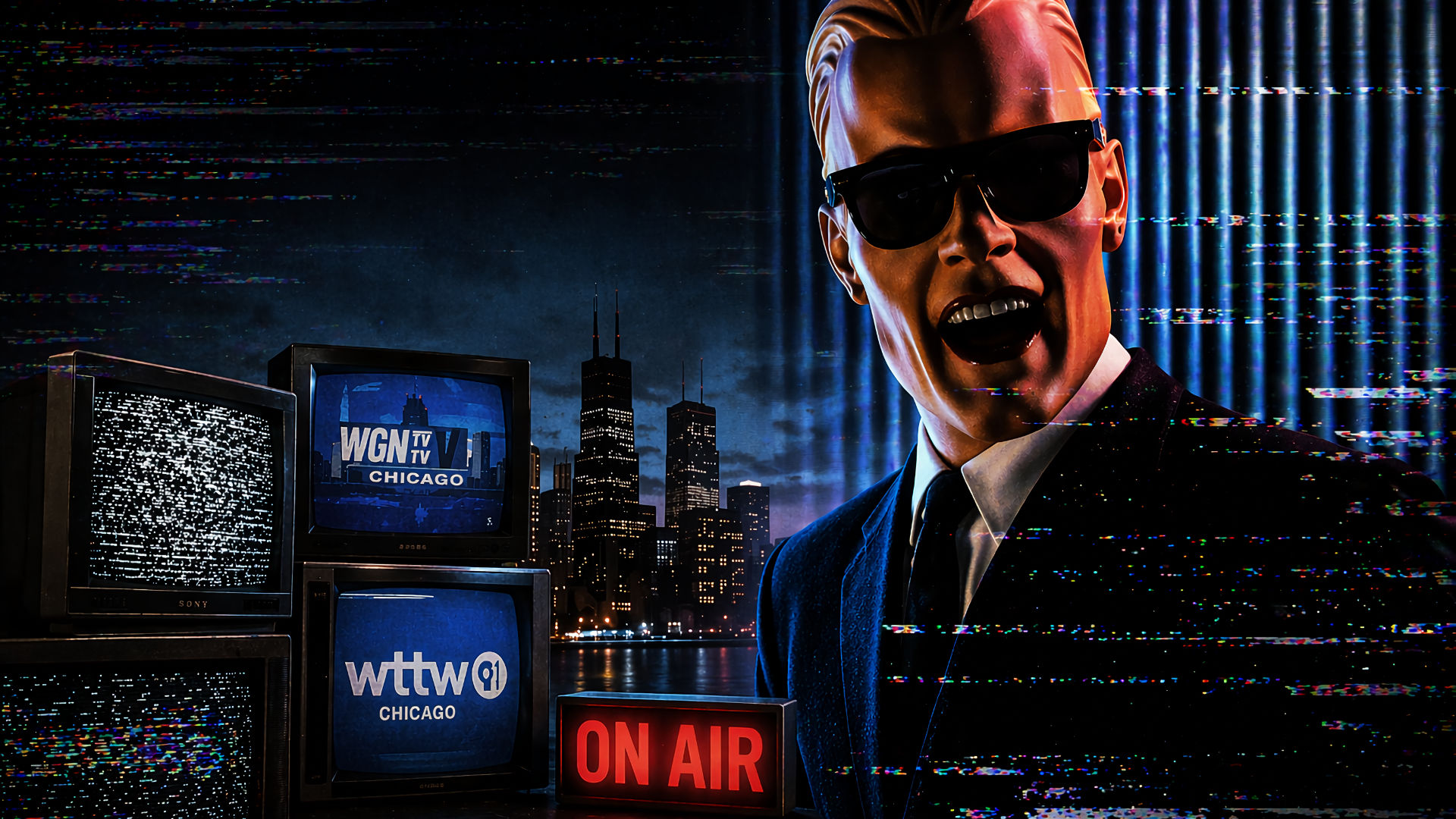
The Mystery of the Max Headroom Signal Hijack
On the night of 22 November 1987, viewers in Chicago settled in for what should have been an ordinary Sunday evening of television. At 9:14 p.m., WGN-TV’s nine o’clock news was rolling along normally, with sports anchor Dan Roan delivering highlights from that day’s Chicago Bears game. Then the picture broke. For roughly half a minute, viewers saw something that made no sense at all: a person in a Max Headroom mask and dark glasses, jerking awkwardly in front of a corrugated metallic background meant to imitate the geometric setting associated with the real character. The sound was little more than a harsh buzzing distortion. Then, just as suddenly, the station got control back. Roan returned to the screen and delivered the immortal line, “Well, if you’re wondering what happened, so am I.” It was funny in the moment, but it was also the first sign that somebody had just done something extraordinarily bold.
To understand why the intrusion landed with such force, it helps to remember what television still felt like in 1987. Broadcast TV was authoritative. It came from towers, studios, control rooms, and people in jackets who seemed permanently in charge of the universe. Home viewers were used to fuzzy pictures and occasional technical hiccups, but not to the idea that an outsider could muscle into the airwaves and replace the signal with a homemade act of electronic vandalism. This was not a prank pulled on a camcorder for a few mates. It was a direct strike against a major television station in one of America’s biggest cities. That alone made it unsettling. The absurdity of the masked figure only made it more memorable.
Then, two hours later, it happened again. At about 11:20 p.m., WTTW, Chicago’s PBS station, was airing Doctor Who, specifically the serial Horror of Fang Rock, when the picture once more gave way to the masked intruder. This second hijack lasted much longer, around ninety seconds, and it was far stranger than the first. This time, there was distorted speech, bizarre gestures, nonsense references, and a deliberately ugly, low-budget feel that suggested the hijacker was not just trying to break in, but to stage a performance. Staff in WTTW’s control room could do little but watch. They were not able to force the pirate signal off the air. It ended only when the intruder’s own transmission stopped.
By the time regular programming resumed, Chicago had been handed one of the strangest unsolved media mysteries in American history. What had begun as a brief technical shock at one station had now become a deliberate, repeated act. That changed everything. This was no random flicker or equipment failure. Someone had planned this, rehearsed it, and done it twice in one night. The obvious next question was how, exactly, they had managed it.
The Broadcast That Should Never Have Happened
The phrase most often used for the Max Headroom incident is “broadcast signal intrusion,” and that tidy bit of engineering language almost undersells how audacious the stunt really was. In simple terms, someone overpowered or replaced the microwave relay signal linking the stations’ studios and transmitters. In 1987, television stations commonly relied on studio-to-transmitter links, often using line-of-sight microwave systems. If an intruder had the right equipment, enough power, and a good position, they could potentially override the legitimate signal long enough to be seen by viewers at home. That was not easy then, and it certainly was not something an average prankster could improvise after a few pints and a trip to Radio Shack.
Engineers at WTTW later said the culprit almost certainly had serious technical know-how. Broadcast engineer Al Skierkiewicz suggested it would have taken the skills of a broadcast engineer, a satellite engineer, or an experienced ham radio operator, and likely more than one person working together. The practical requirements back that up. The hijackers needed a video source, audio, transmission equipment powerful enough to interfere with major stations, and a location with line of sight to the relevant towers. They also needed timing. The WGN intrusion was cut off after station staff changed the frequency of the studio link, which suggests the hijackers were adaptable enough to regroup and hit WTTW later that night, where they enjoyed a much longer run.
The second broadcast is the one that became infamous, partly because more of it survives and partly because it escalated from eerie to ridiculous to vaguely menacing. The masked figure appeared against that wobbling metal backdrop, muttering through garbled audio. The content seemed designed to confuse. There were fragments of pop-culture references, strange comments, and gestures that felt too specific to be random but too disjointed to form a clear message. Near the end, the intruder exposed his backside and was spanked with a fly swatter by a person dressed as a French maid. It was the kind of image that sounds invented by someone trying too hard, and yet there it was, broadcast into ordinary living rooms across Chicago.
That surreal quality is part of what has kept the case alive. The hijackers did not use their access to make political demands, threaten the public, or boast about their brilliance. They hijacked the airwaves and chose instead to perform what looked like an anti-broadcast, a pirate transmission that mocked television itself by being shabby, obnoxious, and impossible to decode. But before anyone could work out what the intruder might have meant, people had to ask a more basic question. Why Max Headroom? Why that face, that voice, and that particular symbol of 1980s media weirdness?
Who Was Max Headroom, and Why Use Him?
To a modern audience, Max Headroom can seem like an oddly obscure choice, but in the mid-1980s, he was recognisable enough to make an immediate impact. The character, played by Matt Frewer, was presented as a stuttering, computer-generated television personality from “twenty minutes into the future.” In reality, he was not computer-generated at all, but performed through makeup, prosthetics, costume, lighting, and stylised video effects. That blend of synthetic image and human performance was exactly what made Max Headroom memorable. He looked like television trying to impersonate the future while half-melting in the effort. He was satirical, artificial, and deeply tied to the look and mood of 1980s media culture.
The hijacker, therefore, did not simply wear a random mask. The choice of Max Headroom turned the intrusion into a warped parody of television itself. Here was a figure already associated with glitchy futurism, cynical media commentary, and the idea of synthetic broadcasting, suddenly materialising inside a real television signal that he had no right to occupy. The visual joke was clever. The execution was scruffy, but that almost improved it. The fake corrugated-metal background echoed the geometric look used in official Max Headroom appearances, but in a homemade way that felt both comic and unsettling. It was recognisable enough to land, but cheap enough to suggest mockery.
There may also have been a practical reason. Max Headroom’s exaggerated look helped hide the intruder’s identity. The mask, glasses, distorted audio, and erratic movement all made recognition difficult. If the hijacker had appeared as himself, the stunt might have been remembered only as a daring bit of signal piracy. By appearing as a damaged, counterfeit media icon, he turned himself into an image rather than a person. That transformed the event from a crime into a legend. People were no longer just asking who had done it. They were asking what, exactly, they had seen.
And that was probably the point. Whether the hijackers were motivated by satire, private in-jokes, anti-media impulses, or simple mischief, they understood that symbolism matters. A broadcast hijacking by an anonymous man in ordinary clothes would have been a technical curiosity. A hijacking by a twitching fake Max Headroom became folklore. The image lodged in the mind, weird enough to be unforgettable, familiar enough to be shared and discussed. Once the stations, engineers, and regulators began trying to find the people behind it, they were not chasing a normal suspect profile. They were chasing someone who had already turned himself into a myth.
Inside the Hunt for the Hijacker
After the shock wore off, the incident shifted from strange television moment to criminal investigation. WTTW staff were left not only embarrassed and alarmed, but deeply curious about the mechanics of what had just happened. Engineers examined the interruption and quickly concluded that it was no fluke. Whoever had done it understood transmission systems well enough to interfere with professional broadcast infrastructure. The Federal Communications Commission opened an investigation, and the matter also drew law-enforcement attention. This was not treated as a harmless comedy sketch. Interfering with licensed broadcast signals was, and is, a serious federal offence.
But serious investigations do not always produce satisfying endings. One of the difficulties was that the hijackers had chosen a method that was bold but fleeting. The intrusions were short, the people on screen were disguised, and the evidence trail was thin. In the late 1980s, there was no social media breadcrumb trail, no mobile phone location history, no tidy little cloud account full of incriminating drafts. Investigators had to think in terms of equipment, geography, access, and expertise. The hijacker likely needed a transmission point within line of sight of the stations’ relay paths or towers. That narrowed things somewhat, but not enough. Chicago is not exactly a village where everyone notices a suspicious van by teatime.
The WGN and WTTW interruptions also suggested planning and teamwork. The first intrusion proved the method could work, but it was cut off when WGN switched frequency. The second showed persistence and perhaps confidence, as if the pirates knew they still had a chance elsewhere. Engineers later theorised that more than one person was probably involved. Someone had to handle the on-screen performance, someone had to manage recording and transmission, and someone had to know enough about the stations’ signal paths to choose the moment and location effectively. It was not impossible that a single highly capable person could coordinate much of it, but the more likely picture was a small group with overlapping technical and creative skills.
Yet for all the attention, the case stalled. No public identification was ever announced. No one convincingly claimed responsibility. No prosecution followed. Over time, the official trail went cold, and the mystery passed into that peculiar category of unsolved cases where the absence of resolution becomes part of the appeal. The investigation had established what sort of feat this was: difficult, intentional, and technically sophisticated. What it could not establish was who had the nerve, the skill, and the very odd sense of humour to pull it off. That vacuum was soon filled by what always arrives when facts run out: theories.
Theories, Suspects, and Dead Ends
Because no culprit was publicly named, the Max Headroom case has attracted decades of speculation. One of the oldest ideas is that the hijackers were insiders, perhaps current or former station employees, or people who worked around television and knew exactly how local broadcast systems functioned. That theory has a certain practical appeal. An insider would understand studio-to-transmitter links, frequency changes, control-room procedures, and the vulnerabilities of local broadcasting. They might also possess the odd mixture of confidence and resentment that sometimes fuels elaborate pranks. But compelling as the theory sounds, no evidence strong enough to resolve the case ever emerged publicly.
Another line of thought points to Chicago’s technical hobbyist and underground media scene of the 1980s. WTTW’s engineer, Al Skierkiewicz, suggested the culprit could have been someone with a background in broadcast engineering, satellite work, or ham radio. That broadens the pool beyond television employees to technically adept enthusiasts who knew how to build, modify, or operate transmission equipment. Such people existed, and some were more than capable of experimental signal work. But capability is not identity. A person can know how to do something without ever wanting to don a plastic Max Headroom face and wave their backside at Doctor Who viewers.
Then there are the content-based theories, which try to decode the transmission itself. Some viewers have tried to interpret the garbled remarks and references as clues pointing to local media grudges, specific personalities, or private jokes aimed at a small circle in Chicago television. Others think the content was deliberately meaningless, designed only to be chaotic and memorable. That second possibility deserves respect. Not every bizarre act conceals a deep manifesto. Sometimes the point of nonsense is simply to seize attention and deny interpretation. The problem is that both readings fit the evidence. The broadcast is weird enough to invite decoding, but not clear enough to reward it.
What makes the dead ends so stubborn is that every plausible theory stops just short of proof. The event required skill, but many people possessed skill. It looked local, but local does not mean identifiable. It felt personal, but personal to whom? In the absence of confession or hard evidence, the case remains a magnet for amateur detectives, each convinced the answer is just one grainy tape analysis away. So far, none has produced the breakthrough that officials could not. And that is precisely why the mystery has endured. It is not only unsolved, it is unsolved in a way that leaves just enough shape for the imagination to keep dressing it up.
Why the Max Headroom Mystery Still Won’t Go Away
Many unsolved mysteries fade because, once the immediate excitement passes, there is little left to hold on to. The Max Headroom signal hijack is the opposite. It survives because the surviving footage is so vivid, so compact, and so baffling. In less than two minutes across two interruptions, it managed to combine technology, anonymity, performance art, trespass, and absurdity. It looked like science fiction colliding headfirst with public-access chaos. You do not need a long documentary to explain why it lingers. One glance at the tape and you understand why people still talk about it.
It also arrived at a cultural sweet spot. The late 1980s were full of anxieties and fascinations about media, computers, and the future. Max Headroom himself embodied that mood, part satire, part corporate mascot, part digital hallucination. The hijack exploited those associations brilliantly. It made television look vulnerable, ridiculous, and strangely haunted. What viewers saw was not just a crime but a symbolic breach, the sense that the screen, usually controlled from the top down, could suddenly be invaded by someone from outside the system. That is the sort of thing people remember, especially once the years turn it from alarming event into cultural artefact.
There is also the matter of rarity. Broadcast signal intrusions have happened in various forms, but this one became iconic because it was so brazen and so theatrically pointless. It did not sell anything, issue demands, or make a clear argument. It simply intruded, mocked, and vanished. In an age before digital television became standard in the United States, such an act was difficult but possible. After the switch to digital broadcasting in 2009, repeating the stunt in quite the same way became vastly more difficult. That gives the 1987 hijack a peculiar historical status. It belongs to a technological window that has closed. And perhaps that is why the case still feels alive. It is unresolved, but not inert. It remains a perfect mystery object, a tiny shard of surviving footage that hints at a whole hidden world behind it: engineers, rooftops, homemade sets, inside jokes, risk, timing, and nerve. Whether the hijackers intended to make history or merely to cause chaos for one surreal Sunday night, they succeeded beyond measure. Nearly four decades later, the mask still grins, the audio still crackles, and the question still hangs in the air. Who took over Chicago’s television signal that night, and how on earth did they get away with it?
The Max Headroom Signal Hijack FAQ
It was an unauthorised broadcast intrusion in Chicago on 22 November 1987, when two television stations had their signals interrupted by a person wearing a Max Headroom mask.
The hijack affected WGN-TV first, then WTTW later the same night during a broadcast of Doctor Who.
No. The FCC investigated the incident, but no one was publicly identified or charged.
It became famous because the broadcast was bizarre, technically daring, and unsolved, combining media disruption with one of the strangest visual pranks ever seen on live television. This is an inference based on the enduring reporting and continued cultural attention around the incident.
Nobody knows for certain. The disguise may have been chosen because Max Headroom was a recognisable 1980s media figure associated with artificial, glitchy television imagery. That interpretation is an inference rather than a confirmed fact.