The Mystery of the Shroud of Turin
The Shroud of Turin is, at first glance, an object of almost startling simplicity: a long piece of linen, pale with age, marked by the faint front-and-back image of a man. Yet few historical objects have carried such emotional, religious, and scientific weight. To believers, it may be the burial cloth of Jesus Christ, wrapped around his body after the crucifixion; to sceptics, it is a medieval creation whose power lies not in authenticity, but in human longing, devotion, and mystery.
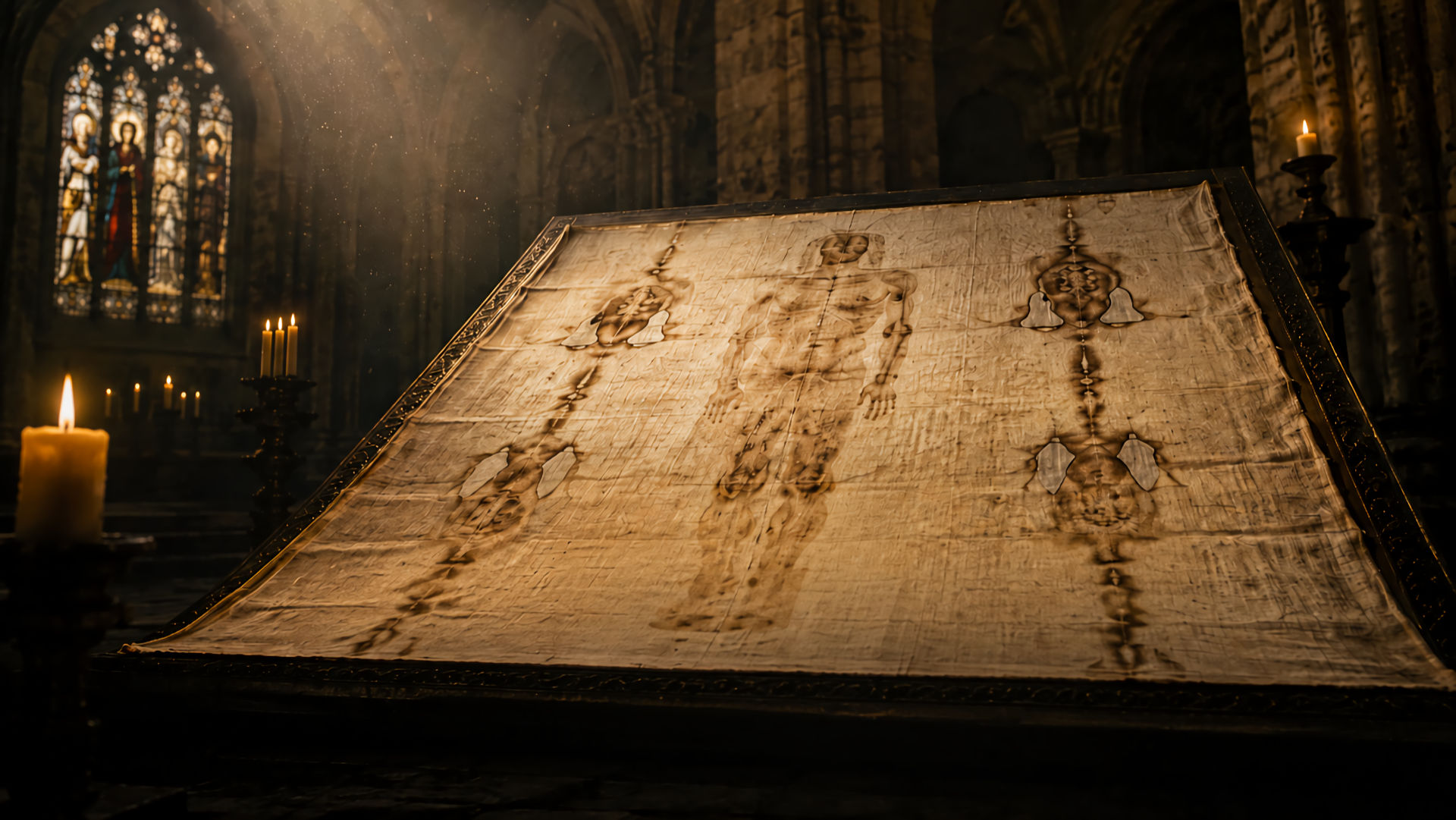
The cloth is usually described as showing the image of a gaunt, wounded man, with markings that many have connected to the wounds of crucifixion. There appear to be injuries around the head, wounds to the wrists or hands, marks across the body resembling scourging, and stains long interpreted as blood. Its basic visual claim is therefore not subtle: this is not merely a holy cloth, but one that seems to present the body of a man who suffered in a way strikingly similar to the Gospel accounts of Jesus’s death. The Shroud measures roughly 4.3 metres long and 1.1 metres wide, and the image appears as if a body had been laid on one half of the cloth before the other half was folded over the front of the body.
That is where the mystery begins, because the Shroud is not simply a relic quietly accepted by the faithful. It sits at the crossroads of faith, medieval history, forensic investigation, chemistry, photography, textile analysis, and, inevitably, public argument. For some, it is a sacred witness to the central event of Christianity; for others, it is one of the most successful religious images ever produced. For many more, it is something awkwardly in between: too compelling to dismiss casually, yet too historically uncertain to accept without hesitation.
The fascination is partly due to timing. The Shroud claims to connect the modern viewer directly with the first century, but its securely documented history begins much later. That gap has allowed centuries of speculation to settle around it like dust on old stone. In a mystery worthy of the name, the most important question is not only what the object is, but how much of the story around it can actually be proved.
The Shroud of Turin is a mystery where history, belief, science, and suspicion all keep interrupting one another. The cloth may be silent, but people have been arguing loudly around it for hundreds of years, which is usually a sign that something interesting is going on.
From Lirey to Turin: The Shroud Enters History
The first major problem for the Shroud is that its early history is not clear. If it truly belonged to the burial of Jesus, then the question becomes enormous: where was it during the first centuries of Christianity, and why does its documented trail become firm only in medieval Europe? There are theories linking it to older relic traditions, hidden images, and Byzantine treasures, but the strongest historical footing begins in fourteenth-century France, not first-century Jerusalem.
The Shroud appears in the historical record in Lirey, a village in France, associated with Geoffroi de Charny, a French knight. By the late 1300s, it was already controversial, and Pierre d’Arcis, Bishop of Troyes, denounced it as false when it was exhibited. Antipope Clement VII allowed it to be shown, but under the condition that it be presented as an image or representation rather than definitively as the true burial cloth. That distinction shows that doubts about the Shroud are not a modern invention cooked up in a laboratory by people allergic to incense. They were there near the beginning of its documented public life.
From Lirey, the Shroud eventually passed into the hands of the House of Savoy in the fifteenth century. It was kept at Chambéry, where it suffered serious damage in a fire in 1532. Molten material from its container caused burn marks and holes, and the damage later had to be repaired by Poor Clare nuns. These scorch marks and patches became part of the Shroud’s physical identity, reminding anyone who looked at it that relics, like people, rarely pass through history without picking up scars.
In 1578, the Shroud was moved to Turin, where it has remained ever since. Its new home gave it the name by which it is now known around the world. Since then, it has been displayed only occasionally, drawing huge interest whenever the public has been allowed to view it. The Roman Catholic Church has treated it with reverence and allowed devotion connected to it, but it has not issued a final declaration that the Shroud is unquestionably the authentic burial cloth of Jesus.
This careful position has helped the Shroud survive both devotion and doubt. It can be venerated without every historical and scientific question being settled. That may sound evasive, but it is also practical, because the Shroud attracts certainty the way a candle attracts moths. Every camp wants it to say something final, while the actual evidence remains stubbornly complicated.
The Image No One Could Easily Explain
The Shroud changed from a famous relic into a modern mystery in 1898, when an Italian photographer named Secondo Pia took the first photographs of it. When he developed the images, he noticed something astonishing: the photographic negative seemed to reveal a much clearer, more lifelike image than the cloth itself. This discovery electrified interest in the Shroud, because it suggested that the faint markings were not behaving like a normal painted image.
To understand why that mattered, it helps to remember how the Shroud looks in person. The image is faint, subdued, and difficult to read clearly at close range. It does not look like a dramatic medieval painting, full of colour and theatrical flourish. Instead, it appears ghostly and restrained, as though the cloth is withholding more than it reveals. That quality has been one of the reasons supporters argue that it was not created by ordinary artistic methods.
The image also presents details that have intrigued researchers. The man appears front and back, aligned as if the cloth covered the body lengthwise. The wounds have been compared with crucifixion injuries, including marks consistent with scourging and apparent blood flows. Some have argued that the image contains three-dimensional information, meaning variations in image intensity may correspond in some way to the distance between cloth and body. That claim remains debated, but it has added to the sense that the Shroud refuses to behave like a simple painting.
There are also awkward questions. A cloth wrapped around a three-dimensional human body would normally be expected to distort an image when laid flat, especially around the sides of the face and body. Critics argue that the relatively recognisable front image may suggest an artistic or contact-based process rather than a true burial wrapping. Others respond that the image may not have formed through ordinary contact at all, which moves the discussion from history into chemistry, physics, and sometimes very enthusiastic speculation.
This is where the Shroud becomes more than a question of whether people in the Middle Ages were capable of making impressive religious images. They absolutely were, and anyone who has seen medieval art knows they were not short of imagination. The harder question is whether known medieval techniques can fully explain this particular image. That question has produced a long-running contest between the apparently simple and the strangely elusive.
Faith, Forensics, and the Search for Evidence
By the twentieth century, the Shroud had become a scientific target as much as a devotional object. Researchers wanted to know whether the image was made by pigment, stain, scorching, chemical change, bodily contact, or some process not yet fully understood. The Shroud of Turin Research Project, commonly known as STURP, examined the cloth in 1978 and produced findings that were widely discussed, especially around whether the body image was painted. Britannica summarises the broader scientific picture by noting that tests from the late nineteenth century onwards have not conclusively settled whether the images were caused by paint, pigments, scorching, or another agent.
Supporters of authenticity often point to the absence of obvious brush strokes and the superficial nature of the image on the fibres. They argue that the image is not made in the way a conventional painting would be made, and that no one has produced an exact duplicate using medieval materials and methods. This is a fair point in a limited sense, because failure to reproduce something perfectly can keep a mystery alive. However, it does not automatically prove that the object is ancient, miraculous, or connected to Jesus.
Sceptics have countered with their own explanations. Some researchers, including the microscopist Walter McCrone, argued that the image could be explained through pigments and artistic technique. Others have suggested contact printing, bas-relief methods, chemical reactions, heat, or forms of medieval image-making. The problem is that proposed explanations often solve one part of the mystery while creating another. A technique may explain the body shape but not the fibre chemistry, or it may explain the image tone but not the apparent lack of obvious brushwork.
Blood evidence has also been central to the debate. If the stains are genuine blood, that supports at least the possibility that the cloth was in contact with a wounded body, though not necessarily the body of Jesus. If they are pigment, then the case for an artistic origin becomes stronger. As with almost everything about the Shroud, the evidence has been interpreted differently by different specialists, and the arguments often depend on which tests, samples, and assumptions are trusted.
This is why the Shroud can feel like a courtroom drama in which every expert witness is cross-examined for several decades. The more it is studied, the more each side believes the other has missed the obvious. Yet for some, that is exactly the appeal. The Shroud is not interesting because there is no evidence; it is interesting because there is too much evidence, too many interpretations, and not enough agreement.
Carbon Dating and the Medieval Problem
In 1988, the debate appeared to reach its decisive moment. Small samples from the Shroud were given to laboratories in Arizona, Oxford, and Zurich for radiocarbon dating, with the British Museum involved in coordination and statistical analysis. The published result placed the linen between 1260 and 1390 with at least 95 per cent confidence. That date range landed squarely in the medieval period, close to the Shroud’s first secure historical appearance, and far too late for the burial of Jesus.
For many sceptics, this was the end of the matter. The cloth was medieval, the historical trail began in the medieval period, and the simplest explanation was that the Shroud was a medieval religious image. The result was also difficult for supporters of authenticity because radiocarbon dating is not a vague impression or an aesthetic judgement. It is a scientific method designed precisely to answer questions about the age of organic materials.
Yet the dating did not end the argument. Critics of the 1988 test questioned whether the sample area was representative of the whole cloth. Some argued that later repairs, contamination, fire damage, handling, or environmental effects might have affected the result. Others objected to elements of the testing protocol or the way the samples were selected. The challenge for those objections is that they must explain not merely that something could have gone wrong, but that enough went wrong to shift a first-century cloth by more than a thousand years.
Later assessments have tended to regard the radiocarbon result as important and credible, while still acknowledging debate around methodology. A 1990 assessment in the journal Radiocarbon noted the 1260 to 1390 date range at 95 per cent confidence, described the three-laboratory testing, and concluded that the results were credible despite procedural differences from earlier recommendations. More recent studies have explored alternative approaches, including a 2022 study using wide-angle X-ray scattering that suggested structural features compatible with ancient linen. However, its researchers did not claim that it proved the Shroud’s authenticity.
This leaves the Shroud in a difficult position. The strongest single scientific result points to the Middle Ages. The strongest emotional and devotional tradition points to the Passion of Christ. Between those two stands a long list of theories, objections, studies, and counter-studies. It is the sort of debate where everyone reaches for certainty and comes back holding a footnote.
Relic, Artwork, or Unsolved Enigma?
So what is the Shroud of Turin? The most cautious answer is that it is a medievally documented linen cloth bearing an extraordinary image of a crucified man. That answer is not as dramatic as saying it is definitely the burial cloth of Jesus, nor as satisfying as calling it simply a fake and walking away. But caution is useful here, because the Shroud has spent centuries punishing overconfidence.
If it is a medieval artwork, then it is still remarkable. It would represent an unusually powerful religious object, created in a way that continues to provoke technical debate. Medieval Europe was full of relics, pilgrimages, devotional images, and sacred theatre, and the Shroud fits naturally into that world. It could have been designed to move viewers emotionally, encourage devotion, and bring the Passion of Christ into terrifying physical closeness. If so, it succeeded rather spectacularly, since people are still arguing about it centuries later.
If it is older than the carbon dating suggests, then the mystery deepens. Supporters of authenticity must explain the medieval documentation gap, the radiocarbon result, and the absence of an unbroken early provenance. Sceptics must explain why the image has remained so difficult to reduce to one universally accepted method of production. In that space between historical record and physical analysis, the Shroud continues to breathe as a mystery.
The Vatican’s careful position reflects that tension. The Church allows the Shroud to be treated as an object of devotion and contemplation, but it has not required believers to accept it as genuine. That approach leaves room for faith without pretending that every scientific question has been settled. It also allows the Shroud to function as an image of suffering, sacrifice, and hope, regardless of whether it is literally the cloth that wrapped Jesus.
Perhaps that is why the Shroud endures. It is not only a question of linen, fibres, stains, and dates. It is also a question of what people want from the past, especially when the past touches the sacred. Some want proof, some want disproof, and some simply stand before the image and feel the chill of history looking back.
The Mystery of the Shroud of Turin remains powerful because it refuses to belong entirely to one category. It is religious, but not only religious. It is scientific, but not only scientific. It is historical, but full of gaps. Whether relic, artwork, or unresolved enigma, it has become one of the most famous mysteries in the world, and like all great mysteries, it does not merely ask what happened. It asks why we are still so desperate to know.
The Mystery of the Shroud of Turin FAQ
The Shroud of Turin is a long linen cloth bearing the faint front-and-back image of a man who appears to have suffered wounds associated with crucifixion. Many people believe it may be the burial cloth of Jesus Christ, while others argue it is a medieval religious image or devotional artefact.
The Shroud is kept in Turin, Italy, in the Cathedral of Saint John the Baptist. It is not permanently on public display, but it has been shown on special occasions and continues to attract global interest.
The controversy comes from the clash between faith, history, and science. Some believe the Shroud is an authentic relic connected to Jesus, while others point to its medieval documented history and carbon dating results as evidence that it was created much later.
Radiocarbon dating carried out in 1988 dated the sampled linen to the medieval period, roughly between 1260 and 1390. This result strongly challenged the claim that the Shroud came from the first century, although some researchers and believers have disputed whether the tested sample represented the whole cloth.
Not entirely. The carbon dating result is a major piece of evidence for a medieval origin, but debate continues over the image formation, the nature of the stains, the Shroud’s historical gaps, and whether later contamination or repairs affected the results. For many, it remains an unresolved mystery.