
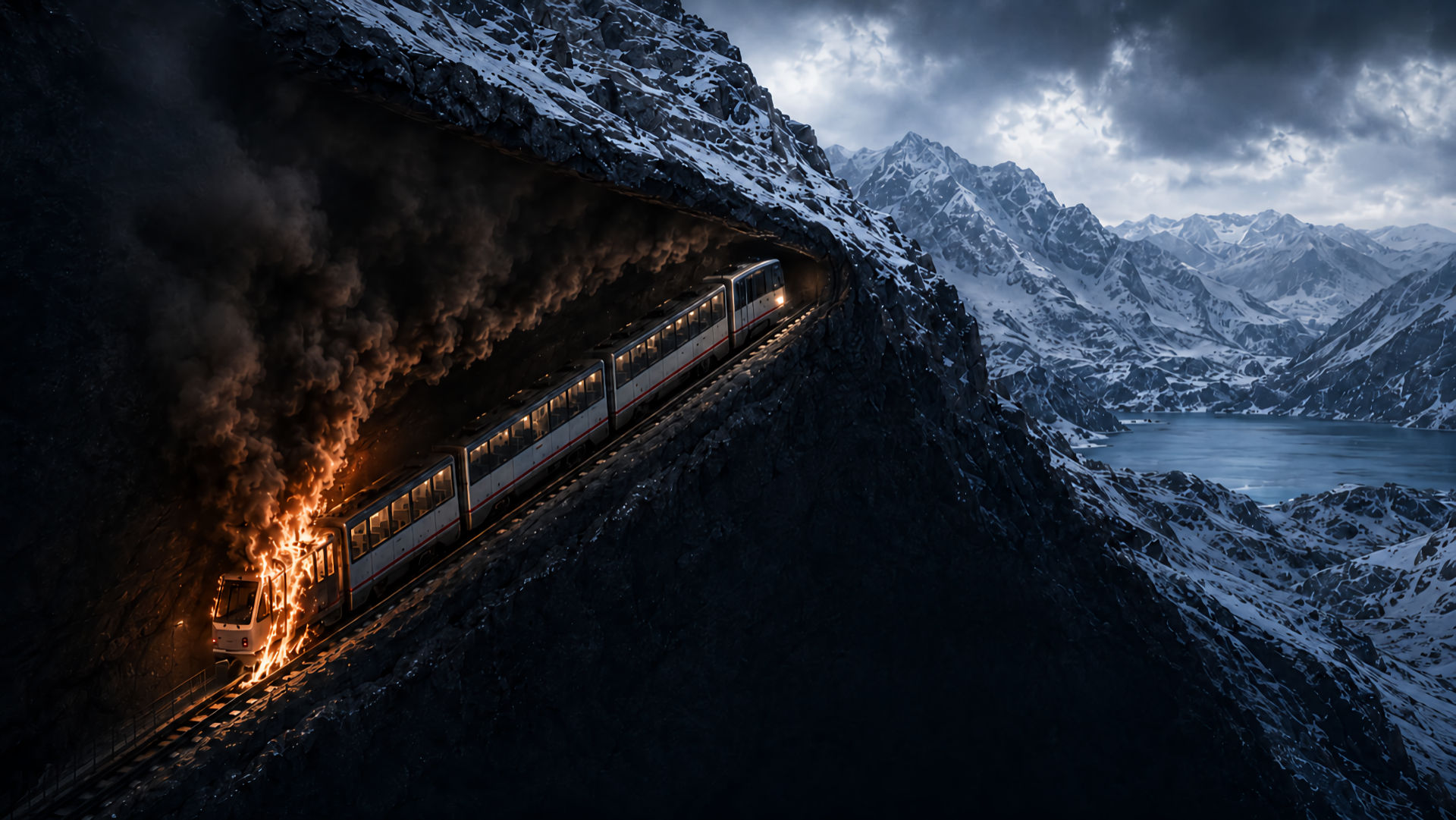
The Kaprun Funicular Fire
On the morning of 11 November 2000, Kaprun looked like a place built for confidence. The Austrian resort sat beneath the Kitzsteinhorn glacier, one of those Alpine landscapes that seems designed to reassure visitors before charging them handsomely for the privilege. Skiers and snowboarders arrived expecting fresh air, clean snow, and the familiar machinery of mountain tourism: tickets, boots, poles, goggles, queues, and trains that did what trains were supposed to do.
The Gletscherbahn Kaprun 2 funicular was part of that machinery. It carried passengers up towards the glacier through a long tunnel cut into the mountain, linking the valley below with the high-altitude skiing area above. For many visitors, it was not the most memorable part of the day. It was the practical bit before the fun began, the enclosed climb before the white slopes opened out. That very ordinariness is part of what makes the disaster so unsettling. Nobody boards a morning ski train expecting to be entering a trap.
The system had been operating for decades, and the train itself belonged to a world where engineering confidence often outran emergency imagination. Funicular railways were familiar in Alpine regions, and the danger most passengers would have associated with the mountains involved avalanches, falls, storms, or perhaps the regrettable decision to attempt a black run after too much confidence and not enough breakfast. Fire inside a sealed train in a steep tunnel was not the scenario at the front of anyone’s mind.
That absence of expectation mattered. Safety planning is often shaped not only by what can happen, but by what people believe is likely to happen. In Kaprun, the assumption that a serious fire was almost unthinkable helped create a system with very little margin once fire became real. The train was enclosed, the tunnel was steep, communication was limited, and escape options were painfully inadequate. The passengers did not know any of that as they settled in for the ride.
The train was carrying skiers and snowboarders on one of its early morning journeys when disaster began to unfold. Contemporary reporting described it as packed with 161 holidaymakers, with most of the victims later identified as visitors from Austria and Germany, along with people from several other countries. The ride should have lasted only minutes. Instead, shortly after setting off, the train entered the tunnel and carried its passengers into one of the deadliest ski resort disasters in history.
The Train Enters the Tunnel
Once the funicular entered the tunnel, the passengers were enclosed inside a narrow mountain passage with limited light, limited space, and no easy way to understand what was happening elsewhere on the train. The journey began like any other ascent, but within minutes, the rear section of the train was in trouble. Investigators later focused on a heater fitted in the attendant’s cabin, a small component with consequences wildly out of proportion to its size. Disasters, with their usual talent for dark irony, often begin with something that looks too ordinary to fear.
The train came to a halt inside the tunnel, and that stop changed everything. According to a forensic study of the disaster, the ascending cable car stopped 530 metres inside a tunnel with a 41 per cent incline. Twelve people managed to escape downhill and emerged from the lower portal. Everyone else inside the ascending train, along with three people at the upper station, died as the fire, smoke, and toxic gases turned the tunnel into a lethal space.
The passengers had to respond before they had a full picture of the danger. Some realised that smoke and flames were developing near the lower end of the train. The doors did not simply open and release everyone. Reports from the later trial noted that the automatic doors jammed shut as the fire took hold, trapping passengers who had expected transport, not imprisonment. Without ordinary escape tools, people tried to break windows using what they had with them, including ski poles and snowboards.
The train’s design made that desperate improvisation harder. The windows were not intended to be easily broken, and the tunnel environment left almost no room for calm decision-making. Heat and smoke were rising, visibility was worsening, and passengers had only seconds or minutes to decide whether to stay, force their way out, climb towards the upper station, or move downhill past the source of the fire. There was no neat emergency announcement, no reassuring line of illuminated exits, and no calm official telling everyone what to do.
The fire also attacked the systems that might have helped. Investigators later concluded that the blaze most likely began when a defect in the heater caused a heating element to come loose, with hydraulic brake oil in nearby pipes overheating and igniting. That meant the fire was not an isolated flame contained in one corner. It interacted with the train’s own systems, helped disable escape, and fed a rapidly worsening environment. A small heater had effectively punched a hole through the assumptions built into the entire railway.
Smoke, Heat, and the Deadly Choice of Direction
The most terrible decision inside the tunnel was also the most instinctive. When fire is below you, the natural reaction is to move away from it. In a building, that may mean climbing upwards to a clearer landing or heading towards a higher exit. In the Kaprun tunnel, that instinct became fatal. The tunnel’s steep incline turned it into a chimney, drawing air from below and sending smoke, heat, and toxic gases upwards towards the mountain station.
This was the central cruelty of the disaster. The passengers who moved uphill were not behaving foolishly. They were moving away from visible danger, which is what fear and common sense told them to do. But in a sloping tunnel, smoke does not politely wait for people to make informed decisions. It rises, gathers speed, and transforms the route that looks like escape into the route of greatest danger. The tunnel’s geometry made the disaster faster, hotter, and harder to survive.
Twelve people escaped because they went downhill, past the fire and towards the lower tunnel entrance. That choice was extraordinary because it required moving towards the area that appeared most frightening. Some accounts describe the escape group as being guided by a passenger with firefighting experience. Whether understood in the moment or only in hindsight, the key was that they moved below the smoke rather than into it. They broke out, descended, and survived with the kind of luck that survivors often struggle to call luck.
For those who moved uphill, the situation deteriorated with shocking speed. The Guardian reported during the later trial that the chimney effect quickly drove flames and toxic fumes upward, while those who tried to run away from the fire in that direction were engulfed. The same report described 12 people escaping by breaking windows and running down towards the lower entrance. That contrast, downhill survival and uphill death, became one of the defining lessons of Kaprun.
The final death toll was 155. Most were passengers on the ascending train, but the disaster did not stop at the carriage itself. Smoke reached the upper station, killing people who were not even inside the burning train. That detail matters because it shows how a tunnel fire can become a system-wide emergency. It was not simply a vehicle fire. It was a fire inside a connected environment where ventilation, gradient, materials, doors, cables, and human movement all combined into one deadly chain.
Rescue Efforts in an Impossible Space
For rescuers, Kaprun presented almost the worst possible environment: a burning train in a steep tunnel, filled with toxic smoke, with victims spread through a confined mountain passage. Emergency crews were not dealing with an open crash site where access, visibility, and movement were merely difficult. They faced a tunnel that channelled heat and smoke, restricted equipment, and made every approach dangerous. The geography of the railway protected the fire from easy intervention while exposing trapped passengers to its worst effects.
The first priority was survival, but very quickly the scale of loss became apparent. The people who had made it downhill were already out, and those still inside or above the fire were beyond ordinary rescue. That is one of the hardest truths in tunnel disasters. There is often a narrow window in which escape is possible, and once smoke inhalation takes hold, the event shifts from rescue to recovery with brutal speed. Kaprun’s emergency response was shaped by that awful transition.
The recovery operation was physically and emotionally punishing. Bodies had to be recovered from a tunnel and train environment that had been devastated by fire. Identification was especially difficult because there had been no complete passenger list, and many remains were badly burned. The forensic response became a major part of the aftermath, requiring careful coordination between investigators, medical examiners, police, families, hotels, and relatives across several countries.
A later forensic study recorded that all 155 victims were positively identified within 19 days, primarily through DNA analysis. It also found that the cause of death was carbon monoxide poisoning combined with suffocation due to smoke inhalation. Those findings underline a point sometimes lost in descriptions of fire disasters: many victims are overcome not by flames directly, but by the invisible chemistry of smoke. In a tunnel, that chemistry becomes a moving wall.
The human consequences extended far beyond the tunnel. Families had sent loved ones to ski on a Saturday morning, and were suddenly drawn into a cross-border disaster involving Austria, Germany, Japan, the United States, Slovenia, the Netherlands, Britain, and the Czech Republic. The victims included children, experienced skiers, holidaymakers, and athletes, each with a life that had been moving in an entirely different direction only minutes before the fire began. Disaster statistics may be necessary, but they are always brutally compressed biographies.
The Investigation and the Question of Blame
The investigation into Kaprun had to answer two linked questions. What physically caused the fire, and why had the system failed so completely once the fire began? The technical origin appeared small: a heater in the train. But the broader story involved installation decisions, materials, hydraulic systems, emergency planning, inspection, and the dangerous belief that a serious onboard fire was too unlikely to shape design. Kaprun was not a mystery in the sense of having no clues. It was a chain of clues leading through engineering, regulation, and assumption.
Prosecutors later argued that the heater should never have been installed and should not have been close to hydraulic pipes. Reporting from the 2004 verdict described investigators’ view that a heater defect likely caused a heating element to come loose, leading hydraulic brake oil in nearby pipes to overheat, drip, and ignite. Rubber and wood in the carriage helped the blaze spread. In other words, the fire was not just a single failed component. It became disastrous because that component sat inside a vulnerable arrangement.
The trial began in 2002 and became one of Austria’s most emotionally charged legal proceedings. Sixteen defendants appeared before a Salzburg court, including employees of the operating company, technicians, suppliers, and government safety inspectors. Prosecutors accused them of negligence. Families wanted accountability, not only because 155 people had died, but because the disaster seemed to reveal failures that should have been foreseeable. The courtroom had to translate grief, engineering, regulation, and causation into criminal responsibility, which is rarely neat work.
The operating company had admitted there was no contingency plan for a fire in the tunnel, and reports also noted the absence of basic passenger escape aids such as fire extinguishers or hammers. Those details became symbols of the wider safety failure. It was not simply that something had caught fire. It was that once it caught fire, passengers had almost nothing available to help them understand, communicate, escape, or fight for time.
On 19 February 2004, Judge Manfred Seiss acquitted all 16 defendants of criminal negligence, ruling that there was insufficient evidence to hold them personally responsible for the conditions that allowed the faulty heater to cause the blaze. For many relatives, the verdict was devastating. Legally, the court found that individual criminal responsibility had not been proved. Morally and emotionally, families were left confronting the much harder reality that a disaster can be caused by many decisions and still produce no simple criminal conviction.
Kaprun’s Legacy: Safety, Memory, and the Cost of Assumptions
Kaprun’s legacy begins with the simplest and most uncomfortable lesson: “unlikely” is not the same as “impossible.” The disaster exposed what happens when a transport system is designed around confidence rather than survivability. A serious fire may have seemed remote, but once it occurred, the tunnel, train, doors, windows, materials, hydraulic systems, and lack of escape equipment all worked against the passengers. Safety cannot depend on the hope that the worst scenario will politely refuse to happen.
The funicular itself never returned to service. The railway that had carried skiers towards the glacier became inseparable from the disaster, and the mountain’s access arrangements were replaced. That, too, is part of disaster legacy. Infrastructure can be removed, rebuilt, renamed, or bypassed, but the memory remains attached to the place. Kaprun could continue as a resort, but it could not return to being the place it had been before 11 November 2000.
The memorial at Kaprun gives that memory a physical form. A memorial near the lower station was created with 155 glass columns, one for each person who died. It is a fittingly quiet answer to a disaster that was caused by speed, heat, smoke, and failed assumptions. Glass is fragile but enduring, transparent but marked by light. It turns a number into individual points of remembrance, which is what memorials must do when public memory risks flattening lives into statistics.
Kaprun also remains a powerful case study in emergency design. Escape routes must account for how people actually behave under stress. Communication systems must work when ordinary power and visibility fail. Fire safety cannot be tucked away in staff-only spaces while passengers are sealed inside. Materials, maintenance, retrofits, and small devices must be judged not only by how they work in normal service, but by how they fail under pressure. The mountain did not create the disaster by itself. The system did. The story is especially haunting because the passengers were not taking an obvious risk. They were not deep-sea divers, war correspondents, or mountaineers on a knife-edge ridge. They were people on a ski trip using a normal piece of resort transport. That ordinariness is why Kaprun still matters. It reminds us that disaster often arrives not with a dramatic warning, but through a quiet accumulation of overlooked details. A heater, a pipe, a door, a tunnel, an assumption. Then, suddenly, no detail is small anymore.
The Kaprun Funicular Fire FAQ
The Kaprun Funicular Fire was a deadly transport disaster that occurred in Austria on 11 November 2000. A funicular train carrying skiers and snowboarders towards the Kitzsteinhorn glacier caught fire inside a mountain tunnel near Kaprun. The fire and smoke spread rapidly through the tunnel, killing 155 people.
Investigators linked the fire to an electric heater fitted inside the train. The fire was believed to have involved the heater and nearby hydraulic systems, which helped the flames spread. The disaster exposed serious concerns about design, materials, emergency escape options, and fire preparedness.
The tunnel was steep, enclosed, and difficult to escape from. When the fire broke out, smoke and toxic gases rose rapidly upwards through the tunnel, creating a chimney effect. Many passengers moved uphill, away from the visible fire, but that direction led them into the path of the smoke.
Only twelve people escaped from the burning train. They survived by moving downhill, past the fire, towards the lower tunnel entrance. Most of the other passengers were overcome by smoke and toxic gases inside the tunnel.
Sixteen people were tried in connection with the disaster, including employees, technicians, suppliers, and safety officials. In 2004, all were acquitted after the court ruled that criminal negligence had not been proven. The verdict was deeply painful for many victims’ families, who felt that accountability remained unresolved.