The Murder of Esther Soper
When Esther Soper was murdered on 1 January 1976, she was living alone at 9 Trematon Terrace, Mutley, Plymouth. She was 51years old, widowed, and described in later case summaries as a woman whose life had become increasingly narrow and private. Her husband, Norman Soper, had worked at Plymouth Dockyard, and after his death, Esther moved into a quieter, more self-contained existence in Mutley. That basic outline matters, because the police were not dealing with the murder of someone who lived a loud or chaotic public life. They were dealing with the killing of a woman whose days seemed to have been defined by routine, privacy, and religious discipline.
By the mid-1970s, Esther had become a member of the Exclusive Brethren, the strictest branch of the Plymouth Brethren movement. According to later reporting and case summaries, that faith shaped her social world in a very direct way. She did not mix freely outside the church, and her beliefs appear to have deepened her separation from people who might once have formed her natural support network. This was not simply a matter of being reserved. It meant Esther was living within a much tighter circle than many women of her age, and that isolation would become one of the most striking features of the case after her death.
The estrangement within her family makes that picture even starker. Sources linked to the case say Esther had not spoken to her father, Stanley Copeman, for around 15 years after his remarriage following her mother’s death. She was also said to be estranged from a daughter who lived nearby. That does not solve the murder, of course, but it tells us something important about Esther’s world in the years before it happened. She was not a woman surrounded by close relatives dropping in and out of the house. She was a woman living alone, with limited contact beyond her religious community, in a home that would soon become the scene of one of Plymouth’s most enduring unsolved crimes.
That is the real starting point for this story. Before the investigation, before the mystery over false names and house viewings, there was Esther herself: a widow in Plymouth, living quietly, holding tightly to her faith, and moving through a life that appears to have become smaller with time. The tragedy of the case is sharpened by that contrast. Nothing about the known facts suggests celebrity, notoriety, or scandal. Esther Soper seems to have been exactly the kind of person who should have passed through history unnoticed. Instead, she became the victim of what is still described as the oldest unsolved murder in the south-west of England.
The Sale of 9 Trematon Terrace
In the final days of 1975, one detail in Esther Soper’s life became central to everything that followed: she was trying to sell her house at 9 Trematon Terrace. On its face, that was an ordinary enough step. Esther was a widow living alone, and moving house would not in itself have seemed remarkable. But in this case, the sale meant something important. It meant strangers had a legitimate reason to approach her, speak to her, and enter her home. In a murder inquiry with no obvious suspect and a victim who lived a notably private life, that changed the shape of the investigation almost immediately.
Police established that Esther had arranged a number of viewings at the property. That fact mattered because it created a short list of people who may have had recent access to the house, or at least knew she would be there alone. One prospective buyer in particular stood out: a man who gave the name Clifford Sparks. According to the case summaries, he had already viewed the house a few days before Esther’s murder and was expected back again on New Year’s Day 1976. That made him one of the most important leads in the entire case.
Yet the most frustrating part of this line of inquiry is how quickly it dissolved into uncertainty. Detectives tried hard to trace Clifford Sparks, interviewing nine men with that name across Britain, but none could be tied to the murder. In time, police came to suspect that the name itself may have been false. Some later accounts have added that in the 1970s, estate agents were sometimes said to use invented names for potential viewers, which only deepened the confusion rather than resolving it.
So the sale of 9 Trematon Terrace did more than provide background. It created the most plausible opening through which Esther Soper’s killer may have entered the picture, and it left investigators with one of the case’s most enduring and maddening loose ends.
Death on New Year’s Day
On Thursday, 1 January 1976, Esther Soper spent her final known day at her home, making sure it was ready for a viewing. At some point that day, something went catastrophically wrong inside the property.
What makes the timing so striking is how ordinary the day may initially have appeared. It was New Year’s Day, after the noise and disruption of New Year’s Eve, and in a place like Mutley, that meant people would have been coming and going, social plans were likely to be different from normal, and routines were already unsettled. Esther herself was known for her regular church attendance, so when she failed to appear at a meeting of the Plymouth Brethren later that day, it was not brushed aside as a small change of plan. Her absence was serious enough for concern to build quickly.
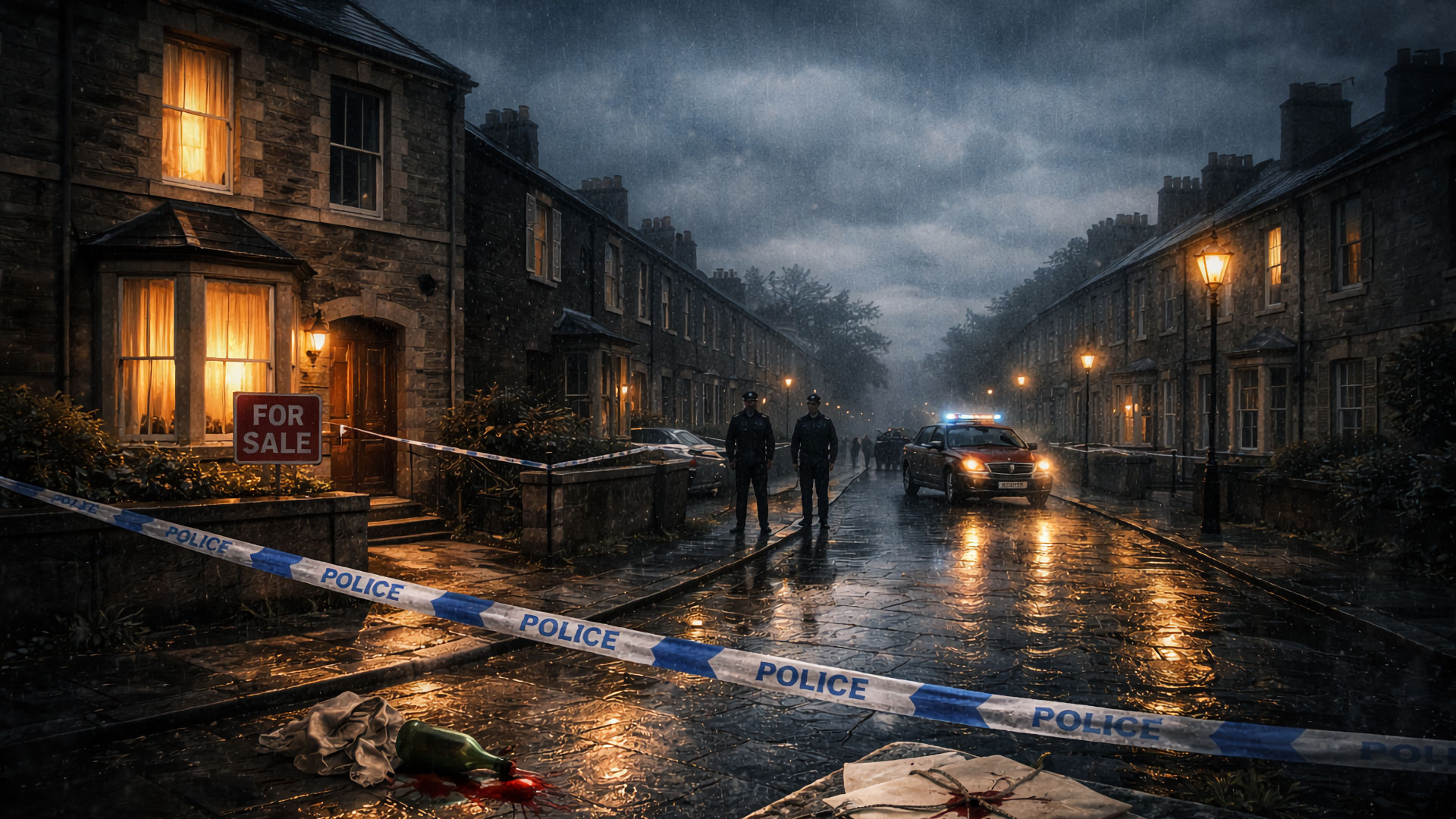
That concern led directly to the discovery of the crime. At around 9 pm, two members of the Brethren went to Esther’s house to check on her after she had missed the meeting. Inside, they found her body. She had been killed in the hallway of her own home, bludgeoned with a cider bottle, strangled with her own stockings, and then wrapped in a curtain. It is one of the bleakest details in the whole case: Esther was not discovered by police during some dramatic forced entry or emergency call-out, but by people from her own religious community who had gone to see why she had not turned up. In that moment, a missed church meeting led to a murder scene.
The condition of the house immediately deepened the mystery. Police found that the home appeared to have been ransacked, suggesting at first glance that this might have been a burglary or theft that had turned violent. But the attack itself was so savage that it also raised the possibility of something more personal, or at least more deliberate, than simple opportunistic theft. Investigators were left with a scene that seemed to point in more than one direction at once.
A Murder Scene Full of Questions
When police began working through 9 Trematon Terrace on the night of 1 January, the level of violence involved raised significant questions. Was this really a panicked attack during a break-in, or had someone entered that house with a more deliberate purpose?
That uncertainty shaped the investigation from the start. Detectives had to treat the disorder in the house as potential evidence, but they also had to consider the possibility that the scene had been disturbed to create a false impression. In other words, the ransacking may have reflected a genuine search for money or valuables, or it may have been a way of disguising a more targeted crime. Esther’s life did not immediately offer an obvious explanation. She was a 51-year-old widow, living alone, closely tied to the Exclusive Brethren, and by later accounts largely cut off from much of her family. That made the brutality of the attack harder to place within any clear domestic or criminal pattern.
The fact that Esther was in the process of trying to sell her house meant the investigation could not focus only on neighbours, relatives, and people from her church. Detectives also had to examine everyone who might have had a recent reason to visit the property. This was where the name Clifford Sparks entered the case so forcefully. He was said to have viewed the house a few days earlier and was expected back on the day of the murder. If that name was real, he was an obvious person to trace. If it was false, then the investigation had been handed a lead that looked solid but dissolved as soon as police tried to grip it.
The Search for a Killer
Police put enormous effort into tracing Clifford Sparks. According to later summaries of the case, investigators interviewed nine men with that name across the United Kingdom, but none could be connected to Esther’s murder. That failure pushed detectives towards an even more frustrating possibility: that “Clifford Sparks” was not a real identity at all. If that was true, then one of the most promising leads in the case had been false from the beginning, either because the viewer deliberately lied or because the name had been recorded inaccurately. The result was the same either way. The man the police most needed to find could not be found.
The inquiry itself was huge. By August 1976, around 33,000 people worldwide had been interviewed in connection with the murder, and more than 80 detectives were working on the case. Those numbers tell their own story. Esther Soper’s death was not treated as a minor local crime that faded after a few days. It became a major investigation, one that consumed time, manpower, and resources on a very large scale. Yet even that level of effort did not produce a charge, and the original investigation was closed after about seven months.
At the same time, detectives had to weigh up competing explanations for the murder. The house had been found ransacked, which supported the theory that it might have been a burglary or theft that had turned violent. But Esther’s personal circumstances also encouraged wider speculation. She lived a highly restricted life within the Exclusive Brethren, and her estrangement from parts of her family gave the case an aura of secrecy that invited theory after theory. Police, however, said they found no evidence linking the murder directly to the Brethren. That is an important distinction, because in unsolved cases, suspicion often grows far faster than proof.
Cold Case, Lasting Shadow
No one was charged with Esther Soper’s murder, no clear suspect was identified, and the questions left behind in Plymouth on 1 January 1976 remained unanswered. That is what turned the murder from a local tragedy into a cold case with a much longer life. Esther Soper’s name did not disappear with the closing of the inquiry. Instead, her case stayed on the list of Britain’s unresolved killings, and over time it came to be described as the oldest unsolved murder in the south-west of England.
There were later attempts to break the deadlock. In 1997, police revisited the case in the hope that modern forensic science could do what the original investigation could not. Items of Esther’s clothing were sent for testing so investigators could try to recover DNA from her killer and compare it against the national database. But the result was a bitter disappointment. The tests found only Esther Soper’s own DNA, which meant there was no usable forensic breakthrough waiting quietly in storage, no hidden profile ready to drag the case into a new era.
A further review followed in 2006, when Devon and Cornwall Police set up a Criminal Cases Review Unit to re-examine unsolved cases from the previous thirty years. Once again, there was renewed hope that advances in forensic methods might identify Esther’s killer or at least narrow the field in a meaningful way. But the review did not produce the breakthrough that detectives and surviving relatives would have wanted. The case remained unsolved, still suspended between a known crime and an unknown offender.
That lingering uncertainty is why Esther Soper’s murder still has force all these years later. The facts are stark enough on their own. A 51-year-old widow was killed in the hallway of her home, after a violent attack on a day when she should have been safe in familiar surroundings. The house sale, the mysterious viewer calling himself Clifford Sparks, the scale of the investigation, and the later forensic reviews all gave the case moments when resolution seemed possible. None of them delivered it.
And that is where Esther Soper’s story has to end, at least for now, not with a conviction, not with a confession, but with a file that stayed open in people’s memories long after it was closed on paper. Esther Soper lived a quiet life and met a violent death. No conclusions were reached, and only silence followed. Fifty years later, that silence remains the most haunting part of all.
The Murder of Esther Soper FAQ
Esther Soper was a 51-year-old widow living in Mutley, Plymouth, at the time of her murder on 1 January 1976.
She was murdered on New Year’s Day, 1 January 1976.
The killing took place at Esther Soper’s home at 9 Trematon Terrace in Mutley, Plymouth, Devon.
No. Despite a major police investigation and later forensic reviews, no one was ever charged with her murder.
Clifford Sparks was the name used by a man connected to a viewing of Esther Soper’s house before her death. Detectives were never able to trace a suspect under that identity.